

Use this when
- One recurring meeting tries to call the number, create pipeline, and coach deals, and all three feel thin.
- The quarter is a surprise in week 12 because nobody owned next-quarter coverage until then.
- Managers spend the one-to-one reviewing predictions, with little time to understand a deal or coach a specific skill.
- You inherited a calendar of “alignment” meetings with no written purpose.
Do not use this when
- There are no stages and no credit rule. Stay in forecasting and sales compensation.
- The founder still sells three logos. A 13-week factory is costume. Stay in first ten.
- You need a 90-day leader plan. That is sales-leadership ramp. This page is the rhythm that leader installs—or refuses.
A few useful terms
Keep this in mind
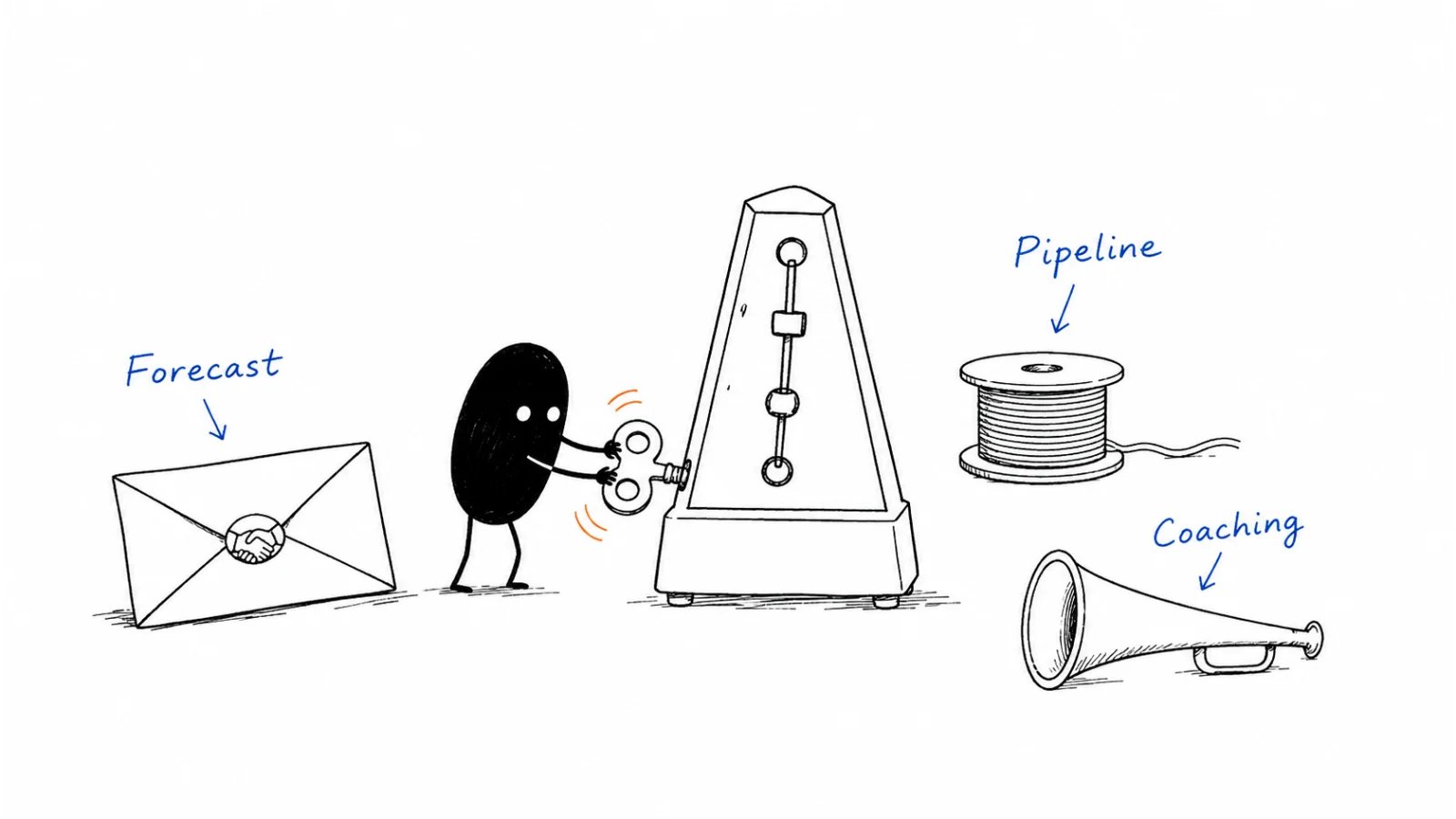
One meeting, one question. If the agenda cannot finish that sentence, split the meeting or delete it. Mixing the three jobs is how pipe gen becomes a footnote, coaching becomes pep talk, and the forecast becomes the only ritual anyone still attends.How to do it
Step 1: Separate forecasting, pipeline, and coaching
Before you touch calendars, write:- What will be in the pipeline (this quarter and the next)?
- How much will close in this period, and why?
- Which few deals need a manager in the work, not in the spreadsheet?
Step 2: Give each a suitable frequency
A pattern that survives small teams:- Forecast is frequent and short. It inspects the call. It does not invent pipeline.
- Pipe-gen looks forward (often next quarter as well as this one). Coverage, created vs converted, the gap, the named create plan. That is not a second forecast roll-up.
- Deal coaching is few deals, deep. A methodology checklist can live here as questions on the record, not as a 20-minute lecture. The account plan and the pitch are the work; the meeting is the inspection.
Step 3: Map the quarter’s meetings
Treat the quarter as a clock you can print:- Every week: the jobs in Step 2, collapsed to the time you actually have. Hygiene before the forecast, or the call is fiction—see forecasting.
- Once a month: a strategic check that is not a forecast. Capacity, motion, enablement, what to stop. If this meeting re-litigates commit, you failed Step 1.
- Once a quarter: a QBR that looks back and sets the next 13 weeks. A QBR that is a longer forecast call is overtime, not strategy.
Step 4: Remove meetings that do not help
Cadence fails in two directions: too few forums (everything lumped) and too many (nobody tells the truth). Delete the duplicate forecast standup. Name an owner for each remaining meeting. Time-box. Capture actions with an owner and a date; a notes doc without completion is a diary. Small teams collapse floors. One manager can run pipe-gen and forecast on different days, not in the same 45 minutes. Do not skip the job because headcount is four.Step 5: Keep coaching focused on improvement
The moment the forecast is light, coaching gets skipped. Write the coaching slot as a standing inspect of two or three deals, pre-read from the CRM, not a tour of every open opportunity. If conversation intelligence exists, it is a pre-read—see MarTech governance—not a reason to add a fourth weekly all-hands.Worked example (illustrative)
Eight AEs, one manager, ~45-day cycle. Not a headcount model.Copy: cadence one-pager (fill)
- Pipe-gen: who, when, duration, the question on the invite, the artifact they walk in with:
- Forecast: who, when, duration, what “the call” means this period:
- Deal coaching: who, when, how many deals, pre-read rule:
- 1:1: length, what is not allowed to eat it:
- Monthly strategic check (and what it must not become):
- QBR week and output:
- Meetings we will delete this month:
- Action log owner (and where it lives):
Before you start
- Each recurring sales meeting finishes one of the three questions, written on the invite.
- Forecast and pipe-gen are not the same hour.
- Coaching is a few deals with a pre-read, not a roll-call.
- Next-quarter coverage has a home before week 11.
- Duplicate forecast forums are deleted, not “optional.”
- Actions have owners and dates; last week’s list is inspected.
- A team of five collapsed floors without skipping a job.
Metrics
Do not count meetings held, or a decorated 13-week poster, as an operating system.
Common mistakes
- One “revenue meeting” that is forecast + pipe-gen + coaching.
- A QBR that is a long forecast.
- Coaching that tours the entire book.
- Pipe-gen with no named create plan (coverage as a screenshot).
- Adding a fourth weekly because a vendor sold “rituals.”
- Copying another company’s week-by-week grid, including a public Doc with a qualification brand, as if it were your motion.
- Treating a leader’s personal turnaround story (EBITDA, retention, span of control) as your proof.
What to read next
The quarterly company clock—launch offset from close—is company cadence. The call itself is still forecasting. Pay and credit stay in sales compensation. Whether next year is possible is GTM planning. A new leader’s first 90 days are sales-leadership ramp. Creating the pipeline you inspect is channel strategy and outbound.Sources and evidence boundary
This is an owner-maintained operating synthesis. It is not a meeting product, not a qualification methodology, and not a claim about anyone’s EBITDA. The split of purpose (pipe-gen vs forecast vs deal coaching), the instruction not to lump them, the 13-week quarter as a printable clock, and monthly strategy vs QBR as different altitudes are distilled from a public operator essay on a 13-week sales operating cadence (Giri Fox, Medium, 2025-12-08). That essay is a method prompt, not a source to copy. Personal results, company names, and team sizes in the essay are the author’s illustrations, not this library’s outcomes. The essay points at a Google Doc (agendas, checklists). That Doc is not reproduced here. Third-party qualification materials are outside the scope of this guide.Copyright © 2026 Ivan Xu. All rights reserved. See the copyright and reuse terms. Canonical source: github.com/weilun88313/B2B-Playbook