

Use this when
- A named account is large enough that a single email sequence is not the system.
- An opportunity is stuck and the team cannot point to the next stage-based action.
- Marketing and sales disagree about “what is going on” in an account they both claim.
- You are about to spend coordinated time on a named account and the file is a logo list.
Do not use this when
- You cannot name the ICP. Complete ICP first.
- You still need the first ten by hand. A plan for accounts you have never spoken to is fiction.
- You want a SWOT/PEST workshop to postpone asking for a meeting.
- Legal or a customer contract forbids the research you would put on the page. Stop; this is not a license to scrape.
Keep this in mind
The attack plan must come from the sales stages you actually run. “Build a relationship” is not an action. “Get the economic buyer on a mutual close plan by Friday” is. If an action cannot be mapped to a stage, a date, and an owner, it does not belong on the plan.How to do it
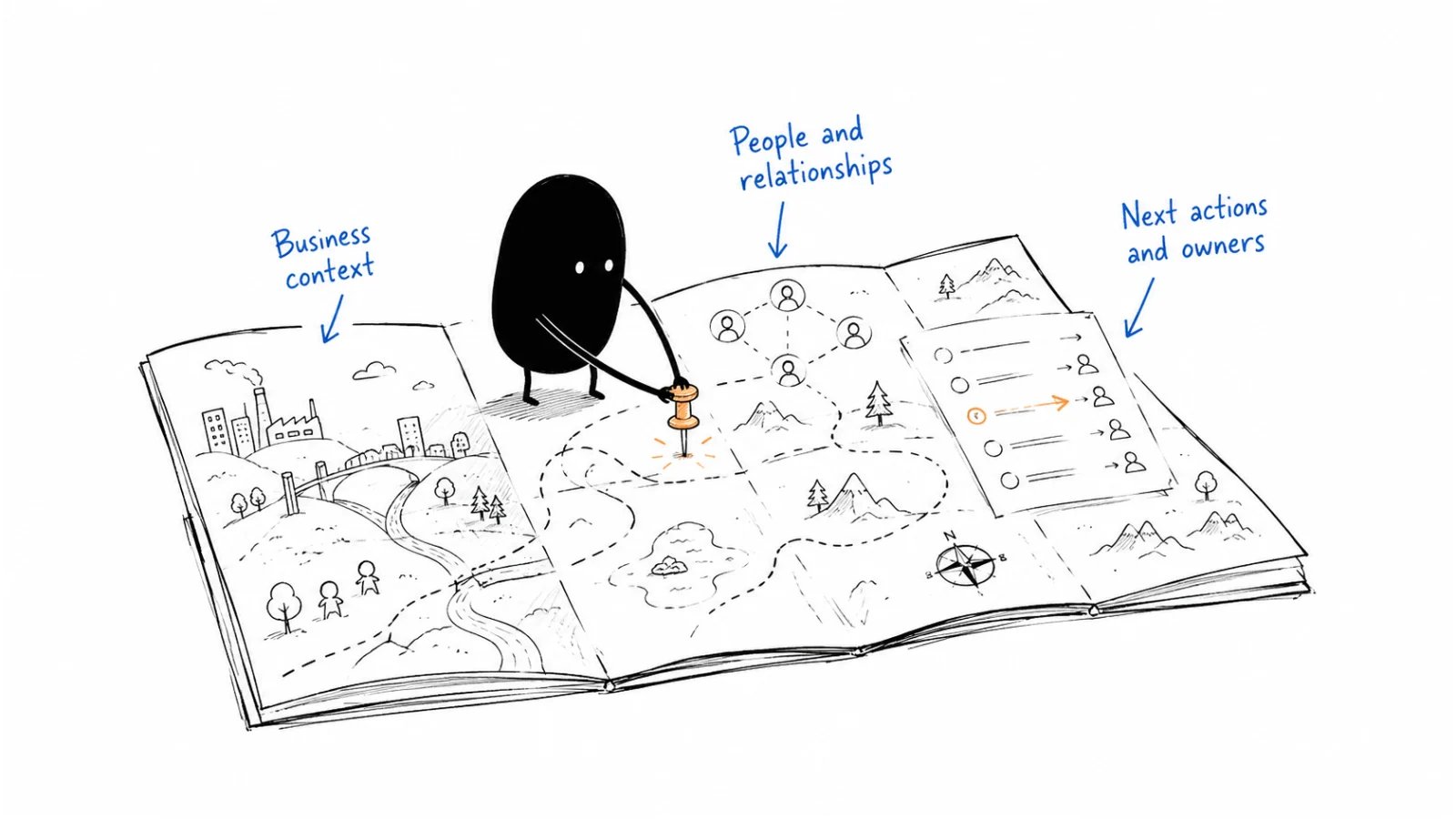
Step 1: Start with a one-page overview
Write the header so a stranger on the account could brief in two minutes:- Account name, site, owner (rep), specialist if any
- Age of the opportunity (or of the relationship, if this is expansion)
- Stage, expected close date, expected amount—or “no live opp; land-and-expand”
- Last update date. A plan without a date is a grave.
- Account. Where they operate, what they sell, current customer-of-ours or not, competitive threats, partners already in the building.
- Opportunity (or expansion thesis). The business outcome they named, the strategy they are using, the personal drivers of the people who care. Not your product pitch.
- Attack plan. The specific moves that close the largest honest next contract. All of them from the stage the deal is in.
- Timed work. Objectives, desired outcomes, activities, dates, names. This is the 30/60/90 (and 180 if the cycle is that long). Include a last-90 lookback so you do not relaunch the same failed move.
- Key contacts. Programme owner, economic buyer, champion, operators. Business agenda and personal agenda. Existing relationship yes/no. Next action per person.
Step 2: Answer the key planning questions
Before you add frameworks, answer these in sentences the customer would recognize:
Impact questions belong here: what happens if they do nothing; what happens if they pick the wrong path. If you cannot ask them live, write the ones you still owe.
Step 3: Map people and alternatives
A deeper strategic file is useful for a few accounts. It is malpractice as a default. Useful, in order:- Landscape. Company, product/service, size, properties, stack—enough to not sound lost.
- History of the account. What you already sold or failed to sell; services you could sell next; a vision in three SMART goals, not twelve.
- Intake on a new engagement. Overlaps landscape; designed for day one of a paid relationship, not a hunting fantasy.
- Relationship map. Name, position, influence, public profile if they have one, comments, next action. Six named humans beat a pretty org-chart graphic with nobody on it.
- Resources that build the relationship. Which paper, exec, or proof this person would forward—not a content dump.
Step 4: Set a time limit for planning
A 30-day plan that lists “nurture” is a slogan. Write:- 30 days: conversations and proofs you can actually book.
- 60 days: committee seats you still lack; a mutual next step.
- 90 days: a commercial event (pilot, paper, no-decision) you are willing to call.
- 180 days: only if the cycle is honestly that long.
- Last 90: what you said you would do, and whether you did.
Step 5: Keep the plan current
On a living account, revisit:- Who is the strongest ally, and can you speak candidly?
- Would they be a reference? Have you asked?
- Tone of the last month of conversations.
- How you might be more worth their time.
- How often you actually check in versus how often you think you do.
Worked example (illustrative)
Mid-market analytics buyer. One live opportunity. AE owns the file. Marketing has one ABM motion this quarter.Copy: one-page plan (fill)
- Account / owner / last update:
- Stage · amount · close date (or “no live opp”):
- Account landscape (one short paragraph):
- Opportunity or expansion thesis:
- Attack plan (stage-based actions only):
- 30 / 60 / 90 / last-90:
- Contacts (name · seat · personal agenda · next action):
- Open risks (level · owner):
- Health: ally · candor · reference asked? · last-month tone:
Copy: five questions (fill)
- What they are trying to solve:
- Why solve with us (alternative named):
- How they solve today:
- Who the characters are:
- When they must solve (date + reason):
Before you start
- The header has a date and an owner.
- Attack-plan lines map to a real stage, a date, and a name.
- The five questions are answered in customer language.
- Committee seats are on the contact block, including unknowns.
- 30/60/90 is work, not nurture slogans; last-90 is honest.
- Optional assessments were run only to unblock a decision.
- Health and risks have owners.
Metrics
Do not count pages in a template, SWOT workshops completed, or “strategic” tags in the CRM as success.
Common mistakes
- A beautiful landscape with no next meeting.
- Actions that cannot sit on a stage.
- Titles without personal agendas.
- Rerunning last quarter’s 30-day plan with new dates.
- PEST/SWOT as delay.
- Treating the plan as a sales-only secret so marketing runs a parallel story.
- Opportunity amount copied from a wish, not from what the champion can defend.
What to read next
Which logos deserve this file is ABM strategy. Seats still live in the buying committee. Outreach inside the plan is account research and, if you hired the role, SDR onboarding. Events for this account are event marketing. After they buy, the file should not die—customer success and customer onboarding. Whether the quarter’s number is real is forecasting.Sources and evidence boundary
This is an owner-maintained operating synthesis. It is not a licensed account-planning product and not a substitute for customer permission or employment of a sales methodology. The one-page header (account, opportunity, stage-based attack, timed work, key contacts), the five thinking questions plus a timed 30/60/90/180 and last-90 lookback, and the deeper landscape / relationship-map / health-check sequence are distilled from operator templates: a Pavilion summary account-planning sheet; a 2019 Catalyst Sale account-planning worksheet (their “sales is a thinking process” frame); and a strategic account-planning template circulated from Unstrategic / GAL-style agency practice (landscape, intake, optional SWOT/PEST, relationship map, risks, health questions). Those files are method prompts, not sources to copy, and not verified use cases here. Agency examples (CMS jokes, sample spend tables) are not imported. Named books and sites pointed from those materials are not abridged in this repository.Copyright © 2026 Ivan Xu. All rights reserved. See the copyright and reuse terms. Canonical source: github.com/weilun88313/B2B-Playbook