

Use this when
- ACV and cycle justify a night for eight to twelve people who share a job.
- You can name the seat and the question before you book the room.
- The alternative is a large reception “to maximize pipeline.”
- A peer community intro needs a table, not a Slack thread.
Do not use this when
- The ICP cannot name who should sit down. Stay in ICP.
- Nobody is available to handle the promised follow-up. Arrange ownership before inviting people.
- You need a booth. That is trade shows.
- The goal is “brand” with no dated next action.
A few useful terms
Keep this in mind
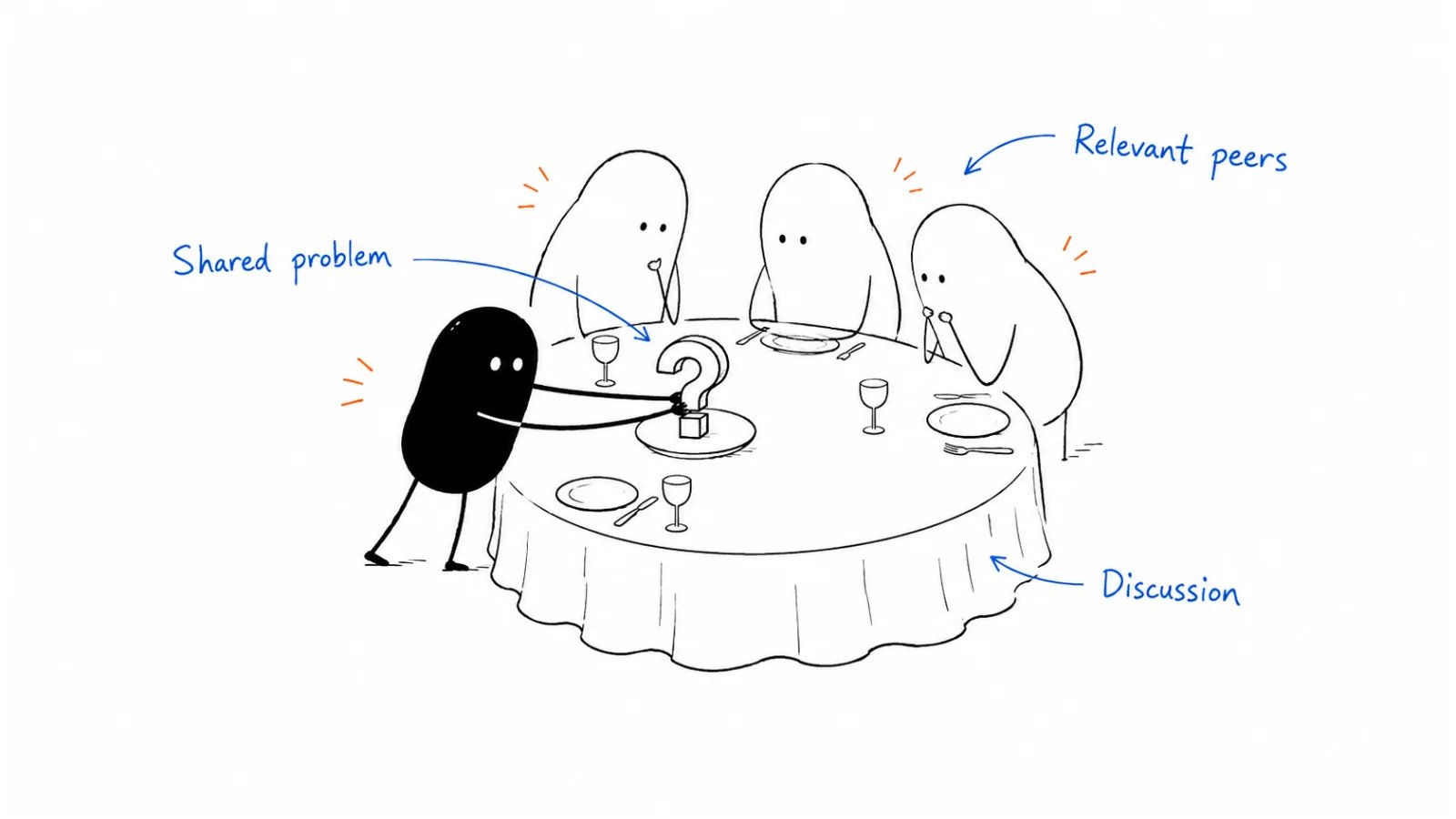
Same role, small table, one question. If you add seats so more titles can “get value,” you will get polite conversation and no pipeline. Operator rooms keep repeating that the smaller, role-consistent night beats the large generic one. Treat that as a method prompt, not a community’s ROI table.How to do it
Step 1: Choose the guest profile and discussion
Write: [seat] will sit for [question] because it is already costing them _____. If the question needs a slide, it is a pitch. If the seat is “CMOs and their agencies and a few founders,” it is a mixer.Step 2: Research the guest list
Every name has a reason, a account note if they are named, and a why-them. Invite fewer than you want. A no from the right seat is better than a yes from a tourist. Customers and peers can outnumber you at the table; that is the point.Step 3: Make room for peer conversation
Room, not stage. No booth kit. A short frame from the host, then the table. You may offer a working file or a data cut—see peer community—but the product demo stays home unless someone asks.Step 4: Capture relevant context with care
For each guest who is in-ICP: trigger, alternative, missing seat, what they asked, agreed next step, owner, date. A photo of the table is not capture. Consent and notes stay inside the rules you already use for events.Step 5: Follow up individually
One note per person from the conversation. Complete the action you promised before you ask for a demo. A shared recap is optional and never the CRM update.Worked example (illustrative)
Twelve heads of customer ops, one city, one question: “when does the questionnaire pack stop being a spreadsheet?” No AEs pitching. Two customers at the table. Three T1 next steps booked before dessert; the rest get a working-file link and no sequence.Copy: table card (fill)
- Date / city / host:
- Seat lock (one):
- Question (one interrogative):
- Guest list (name / account / why them)—target 8–12:
- Customers or peers at the table:
- What we will not do (demo, mixer titles, recap blast):
- Capture fields we will actually fill:
- Next-morning owner:
Before you start
- Event score still says host or attend.
- One seat, one question, ≤12 guests.
- Every name has a why-them.
- Host reputation is real; we are not renting a celebrity for a pitch.
- Capture and next-morning owner exist before the reservation.
- Demo and badge logic are off the table unless asked.
- We will not add titles to “fill the room.”
Metrics
Do not count RSVPs, photos, or “everyone had a good time.”
Common mistakes
- Growing the table so the venue looks full.
- Three personas “for energy.”
- A fifteen-minute product slot “because we paid.”
- One recap to the whole list.
- Skipping event marketing and hosting because dinners are fashionable.
- Calling a 40-person reception a roundtable.
What to read next
Whether the night should exist is event marketing. A booth week is trade shows. The room you did not host is peer community. Named accounts at the table need account planning. The story in follow-up is sales enablement.Sources and evidence boundary
This is an owner-maintained operating synthesis. It is not a catering guide. Role lock, small table, and “mixer ≠ pipeline” are judgments in this library. Practitioner communities often prefer smaller, same-role nights to large generic events; that pattern is a method prompt, not a source to copy and not a requirement to join any paid room.Copyright © 2026 Ivan Xu. All rights reserved. See the copyright and reuse terms. Canonical source: github.com/weilun88313/B2B-Playbook