

Use this when
- Owned channels are producing volume without qualified conversation.
- The team is too small to manufacture trust at the same rate it ships product.
- Buyers already learn from a known set of operators, agencies, associations, or tools.
- A second product, integration, or community already sits next to the buyer’s workflow.
Do not use this when
- The ICP and current alternative are still empty. Complete ICP and positioning first.
- The request is “find us influencers” with no win for the partner or the prospect.
- Leadership will not involve product (integrations, referral mechanics, partner-only features, or community presence).
- The team intends to launch every partner type in the same quarter.
How to do it
Step 1: Connect partner work to the business
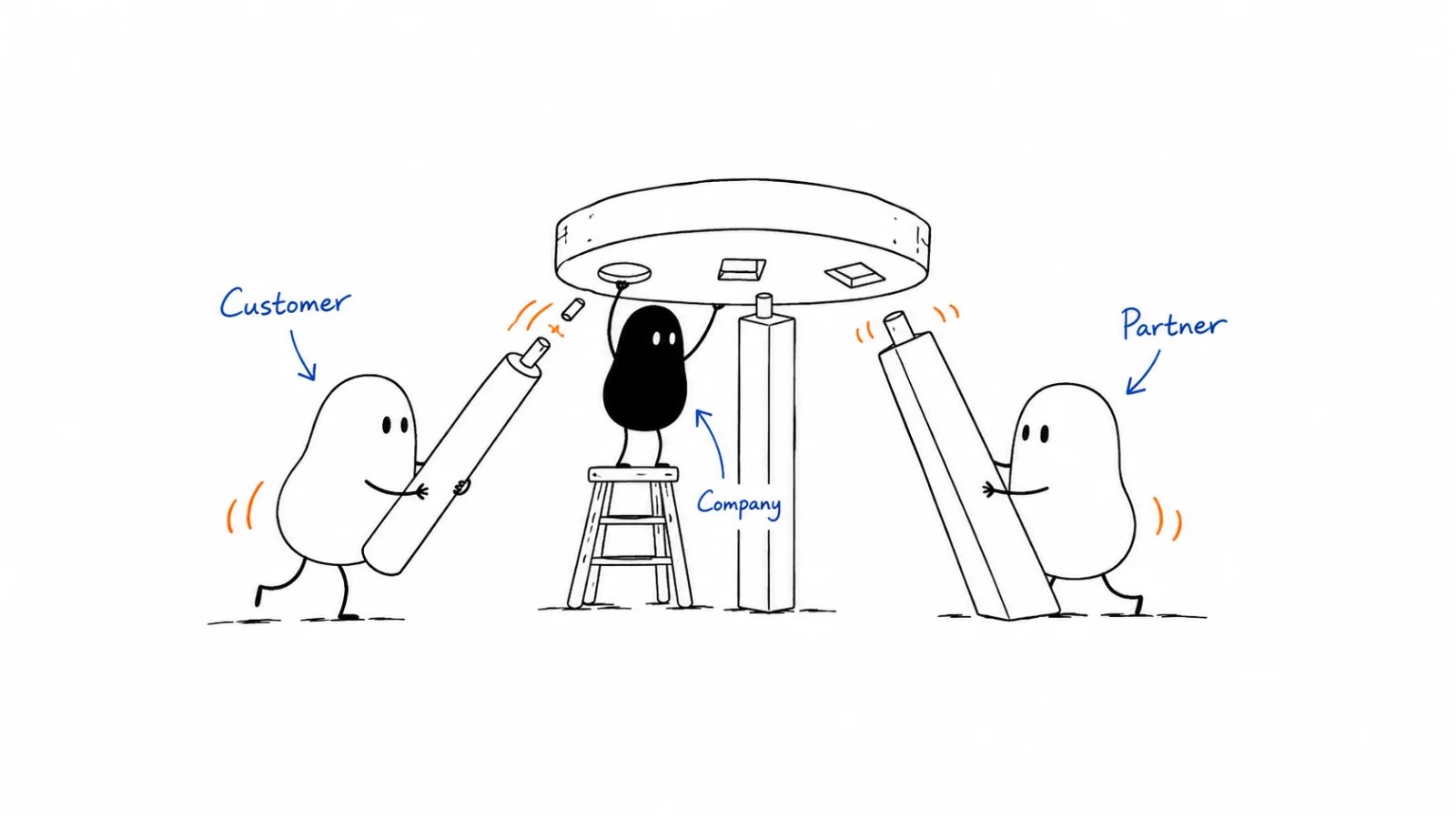
Name an executive owner. Product, marketing, and a seller who works live deals must all have a job in the motion. Typical product work: integrations, referral or “built with” mechanics, features agencies or channel partners need, and people who can show up as experts inside communities. A single contractor posting from a partner list is distribution help. It is not an ecosystem.Step 2: Map complementary products and services
List every person or company that already has reach and credibility with the ICP. Look past the obvious integration logo. Common partner types (one partner can sit in more than one cell):
Relationship-driven partners usually produce more resonant creative than purely transactional placements. Place each name on two filters before you spend:
High coverage and high composition is rare and worth a deep program. High coverage with low composition needs a tight offer so you are not paying to reach the wrong people. High composition with low coverage is often a narrow, high-trust wedge—useful to start, not the whole TAM.
Step 3: Check that all three parties benefit
Every live partnership must be worth it for you, the partner, and the prospect. Two out of three is a tax. Value is not only cash and impressions: data, event cost-share, early product access, status, and audience for the partner all count. Write the three wins in one sentence before a contract, gift, or integration queue:We get ___. They get ___. The buyer gets ___.If the third blank is “more of our content,” it is not a win for the prospect.
Step 4: Start with one joint activity
Pick the partner type that already sits on the buyer’s path. Prove the flywheel on that program before adding a second type. When it works, go deeper with the same partners before widening the roster. Scale that kills the human relationship kills the reason the motion worked. A useful pattern: become the best option inside one ecosystem the buyer already chose, then expand. Positioning add-ons the same way—best for accounts that already own the lead product—is in the positioning playbook. Named illustrations in Emily Kramer’s 2025 write-up (her claims on her date, not this repository’s benchmarks):- Supabase / Vercel-shaped: grow as the default complement inside a platform or community the developer already chose, not as a lonely brand blog.
- HubSpot-shaped: agencies and channel partners who already sit with the buying seats—coverage × composition, not a logo wall.
- Gamma / creator-shaped: practitioners who already teach the buyer; the company amplifies rather than manufacturing trust from zero. Treat “half of growth” style figures as that author’s dated claim.
- Clay / integration-shaped: the product sits in the workflow the buyer already runs; the partner is the pipe, not a rented list.
- Vanta / Tracksuit / Arrows: named in that piece as ecosystem examples; copy the motion, not the screenshot metrics.
Step 5: Build on channels already in use
Ecosystem is not a sixth silo. Attach it to work that already exists:
The loop to protect: partner creates → you amplify and repurpose → new customers and partners arrive → the next partner has a better reason to say yes.
Step 6: Measure useful introductions and results
A signed logo, a Discord member, or a creator post is activity. The motion is working when a named ICP account takes a next step that sales would recognize without the partner in the room.Copyable templates
How a filled ecosystem map reads
Illustrative example: one implementation agency that already serves your ICP (HubSpot-shaped channel partner), not ten logos.
Win-win-win: we get qualified conversations; they get a deliverable their client will thank them for; the buyer gets a comparison they can forward. If the third sentence is “they post our PDF,” it is not a program.
Copy: one row this quarter, not a spreadsheet of maybe-partners.
Ecosystem map (copy)
- Partner / type / coverage / composition / access / our ask / their win / buyer win / owner / status:
Win-win-win brief (one partner)
- Partner:
- ICP overlap (who, not follower count):
- Motion (one primary: content, referral, integration, community, event, course):
- We get:
- They get:
- The prospect gets:
- Product work required:
- Amplification plan (which owned channels, who posts, what we will not fake):
- Stop rule (when we pause):
- Leading indicator (this month):
- Lagging indicator (qualified conversation or expansion):
One-program 90-day test
- Hypothesis: [partner type] already has trust with [ICP seat] because [evidence].
- Design: one motion, one owner, one amplification path.
- Proof of life: [number] partner-originated pieces or intros that a champion could forward.
- Business test: qualified conversations or expansions within 14 days of the partner touch.
- Decision: deepen / change the offer / stop. Do not add a second partner type on a failed first test.
Before you start
- An executive owner is named; product has a defined job if the motion needs one.
- Complements are mapped, not only competitors.
- Coverage and composition are written; vanity reach is not the selection reason.
- Each live partner has a three-sided win in one sentence.
- The first program is one type, not a marketplace of every tactic.
- Amplification is scheduled on channels the team already runs.
- Sales can finish: “I use this partner when _____.”
- No invented customer, download, or revenue claims in partner creative.
- Referral, data, and endorsement rules are written before launch.
Metrics
Do not count partner logos, Discord members, creator posts, or “mentions” as the outcome. Those are inputs to the flywheel.
Named growth figures in public write-ups (developer counts, “half of growth,” ARR with a small team) are that author’s claims on that date. Copy them into your board deck only after you can point to a primary source and a date. They are not this repository’s benchmarks.
Common mistakes
- Hiring a partner marketer so leadership can ignore the motion.
- Equating a co-branded webinar calendar with an ecosystem.
- Paying for reach with no composition filter.
- Launching creators, integrations, community, and affiliates in the same month.
- Keeping partner content on their channel and never amplifying it.
- Using the partner’s audience as a rented list while giving them nothing they can show their buyers.
- Measuring the program as a media buy (impressions) instead of qualified access.
- Dropping the relationship once the first campaign “worked,” which resets you to zero.
What to read next
Ecosystem is usually a secondary motion. Name the primary first in channel strategy. One existing room is peer community. One named voice is creator partnership. Partners still need pages they can send: content strategy. If you do not yet have customers who would introduce you, that is still product-market fit.Sources and evidence boundary
This is an owner-maintained operating synthesis. Partner, referral, endorsement, and data-sharing rules vary by jurisdiction and contract; this page is not legal advice. The flywheel, complement map, coverage/composition filters, win-win-win bar, and “start narrow then expand” sequence draw on Emily Kramer’s ecosystem growth guidance (Lenny’s Newsletter, 2025-11-11). Company illustrations in that source (among others: Supabase, Clay, Lovable, Gamma, Vercel, ElevenLabs, HubSpot, Vanta, Tracksuit, Arrows) are named examples with the author’s attribution. They are not independently audited case studies in this repository. LinkedIn’s employee-versus-brand performance claim should be checked against LinkedIn’s current documentation before you treat the multiple as a planning constant.Copyright © 2026 Ivan Xu. All rights reserved. See the copyright and reuse terms. Canonical source: github.com/weilun88313/B2B-Playbook