

Use this when
- The team is adding channels because “that is what B2B does.”
- Founders want product-led growth as a way to avoid hiring sales.
- Content, ads, and partner logos are busy, but nobody can name the motion that actually creates customers.
- Leadership is arguing about time-to-$1M without a first-customer date or a primary channel.
Do not use this when
- The ICP and alternative are empty. Complete ICP and positioning first.
- Nobody loves the product enough to keep using it. Climb the PMF ladder before scaling a motion.
- You do not yet have ~10 ICP-matching companies. Walk first ten customers first—those tactics are handmade on purpose.
- There is no working product a buyer can try or buy. Channel mix will not create pull.
- The request is a seven-channel GTM deck for a board meeting.
How to do it
Step 1: Start with how customers already arrive
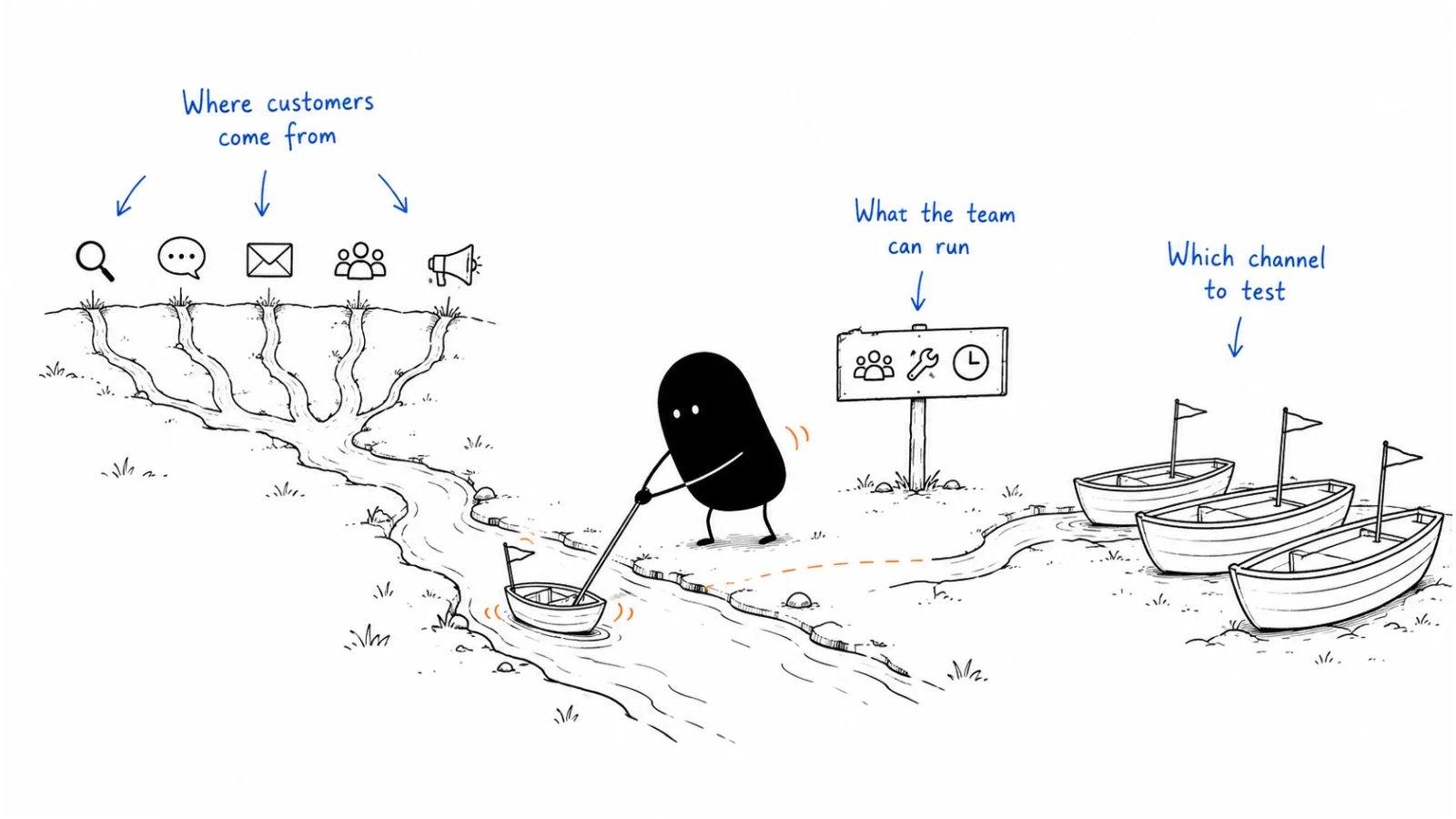
Pick one primary. Use what is already happening, not the motion that sounds modern.
If organic inbound is absent, do not paper over it with ads.
Name the motion from the last ten to twenty wins, not from a slide titled “we are PLG.” A CRM default of “inbound” that was actually a founder intro is not evidence.
Named illustrations from that 2023 interview set (how they arrived, not a menu to copy):
- Self-serve inbound is a product fact: a new user can reach value without a human. Figma is the usual shorthand for “open it and work.” If your buyer cannot do that, you do not have this motion yet.
- Sales-assist inbound: demand shows up; a seller still walks evaluation. Databricks tried a more zero-touch console path and watched revenue flatten until sales was back in the motion.
- Outbound: the team creates the conversation because the buyer will not raise a hand. Do not borrow another company’s later mix until your last 20 wins name your primary.
Step 2: Check whether self-service fits your product
Self-serve is a product and activation fact, not a values statement. If a new user cannot swipe a card and get value quickly, turning off sales to “be PLG” can stall revenue. The Databricks episode above is that failure mode. Enterprise deals that need a champion, security review, and a committee are sales-assist or outbound until proven otherwise. Expect to build a sales team eventually. The question is when, not whether.Step 3: Identify the team’s existing advantages
A secondary channel is how you accelerate something that is already true, not a menu item you add because a famous company used it. Write one to three advantages you actually have. Typical shapes: product (virality, a free plan that unlocks value, a wedge you will reuse), ecosystem (integrations, channel partners, a regulation or trend that creates urgency), brand-story (a founder who already has the room, a category you can own, an underserved community). If you cannot name one, do not invent a partner program or a category-creation campaign to look strategic. Do not treat the list as a checklist. One real advantage beats nine borrowed ones.Step 4: Keep one main channel and test one more
After the primary motion is named, treat everything else as a growth-engine menu, not a department org chart. The six engines are inbound, outbound, product virality, events, ecosystem, and lifecycle. Lifecycle is owned by lifecycle; do not stand it up here as a seventh “channel.” Product virality is a product fact—if you do not have it, you do not have that engine. Pick one secondary this quarter that accelerates a named advantage. Give it a status so the metric matches the job:
Treat the remaining tactics as a menu, not a checklist:
A useful rule: you are probably already living in one of the three primaries. Ask which one remaining engine is a real opportunity—then give it an owner, a status, a 90-day test, and a stop rule. Content that cannot scale beyond heroic founder posts is a turbo boost, not an engine.
Step 5: Match the website to the buying process
- Self-serve: signup, activation, and a credit-card or equivalent path. The scan still starts on the homepage.
- Sales-assist: a decision-specific demo or conversation request, with the assisted process explained clearly to the visitor.
- Outbound: the site still has to pass the homepage 10-second test; it is not the acquisition engine.
Step 6: Account for the time it takes to earn revenue
In one interview set of later-successful B2B companies, median time from founding to about $1M ARR was roughly two years, and about 1.5 years after the first customer. Some were faster; some delayed monetization on purpose (for example to become a default tool inside companies). Large ACV and small ACV did not produce a clean split in that sample. Use the 1.5-year-after-first-customer line as a worry trigger if you want to compare yourself to that survivor set. It is not a promise, a fundraise requirement, or your OKR. Validate against your own first-customer date and ACV. Pricing timing is in pricing and packaging.Copyable templates
How a filled motion one-pager reads
Illustrative example: last 20 wins were demos booked from inbound and referrals; nobody activated alone. Primary = sales-assist inbound. Advantage = founder already has the ops-lead room (brand-story), not a partner motion we wish we had. Secondary this quarter = one content comparison page (inbound engine, testing), not ads. Site door = request a scoped conversation. Stop rule for content: if sales has not pasted the URL into an evaluation thread in 90 days, pause publishing. Copy:Motion one-pager
- Primary motion (exactly one): self-serve inbound / sales-assist inbound / outbound
- Evidence from the last 20 wins (how they actually arrived):
- Can a new user activate without a human? yes / no / unknown (test: ____)
- Marketing advantages we will accelerate (1–3):
- Secondary channel we will explore this quarter (exactly one or none):
- Engine it belongs to (inbound / outbound / virality / events / ecosystem):
- Status (up next / testing / scaling / core / big bet):
- Why not the other secondaries:
- Owner of the primary:
- Owner of the secondary test:
- Stop rule for the secondary:
- Site door that matches the primary:
90-day secondary-channel test
- Hypothesis: [channel] will create [qualified conversations / self-serve starts] for [ICP] because [evidence].
- Budget and hours we will not steal from the primary:
- Leading indicator (week 4):
- Business test (day 90):
- Decision: keep as engine / keep as turbo / stop.
Before you start
- Exactly one primary motion is written.
- The last 10–20 customers’ true source is listed (not the CRM default).
- Self-serve is claimed only if activation without a human has been watched, not hoped.
- Sales is not being removed to make a PLG story true.
- One to three marketing advantages are named; secondaries that do not accelerate one are deferred.
- At most one new secondary channel has an owner, a status, and a stop rule.
- Content, ads, and partners are not substituting for a missing primary.
- The website CTA matches the motion.
- Time-to-$1M talk uses your first-customer date; borrowed medians are labeled survivor observations.
Metrics
Do not count channel count, campaign volume, or “we are now PLG” as outcomes. Do not import another company’s years-to-$1M as your target.
Common mistakes
- Running all six channels because a famous company used each of them at some point.
- Declaring PLG while every activation still needs a demo.
- Turning off sales because a cloud-console story sounded efficient.
- Treating word of mouth as a budget line instead of a fit diagnosis.
- Starting paid ads before the primary motion and offer are named.
- Picking a secondary before naming an advantage it would accelerate.
- Judging a testing channel on core efficiency.
- Launching partnerships as a time sink with no win-win-win.
- Publishing a content calendar instead of a decision-page map.
What to read next
If market, product, channel, and model do not describe the same company, stop here and write four fits. If you still need the first ten names, that work is first ten customers, not a channel mix. If the primary is outbound, start with account research. If you are hiring people to run that motion, SDR onboarding is the curriculum, not a sequence export. If it is sales-assist inbound, you need pages a champion can forward—content strategy—and a pitch. How those pages (and citations) get found is SEO and AEO. If strangers already trust someone else, that is ecosystem or a peer room, added as one secondary, not as a seventh channel. At high ACV, contribute in the room or co-create before you buy syndication or ads. Product Hunt is a one-day amplifier, not a motion. If the motion is a few named accounts, write ABM strategy (capacity and tiers) and then account planning before a campaign calendar. The first audience-plus-use-case the engine should serve is wedge. Pricing and packaging still decide whether the motion can collect money: pricing. If the primary needs quota-carrying sellers, they need a plan they can explain: sales compensation. Whether the quarter’s number is real is forecasting.Sources and evidence boundary
This is an owner-maintained operating synthesis. Channel mix is not a forecast. The three-primary-motion frame, the six-channel menu, the “optimize the primary / add one” rule, the expectation that B2B firms eventually hire sales, the caution against forced product-led growth, and the ~2 year / ~1.5-year-after-first-customer pacing notes draw on Lenny Rachitsky’s interviews with later-successful B2B companies (Lenny’s Newsletter, 2023-10-24). That set is a survivor sample. Named companies in the source illustrate motions; they are not audited case studies here. Revenue expansion was out of scope in that piece. Marketing advantages (name 1–3 real ones in product / ecosystem / brand-story before you pick a channel) draw on Emily Kramer (MKT1, 2023-02-27). The six-engine menu (inbound, outbound, product virality, events, ecosystem, lifecycle) and the test / scale / core / big-bet / not-working statuses draw on Kramer’s channel guidance (MKT1, 2023-11-16). Those essays are method prompts. The paid tactic charts, generator apps, and template packs behind the paywall are not reproduced here. Do not treat another company’s advantage list as yours.Copyright © 2026 Ivan Xu. All rights reserved. See the copyright and reuse terms. Canonical source: github.com/weilun88313/B2B-Playbook