

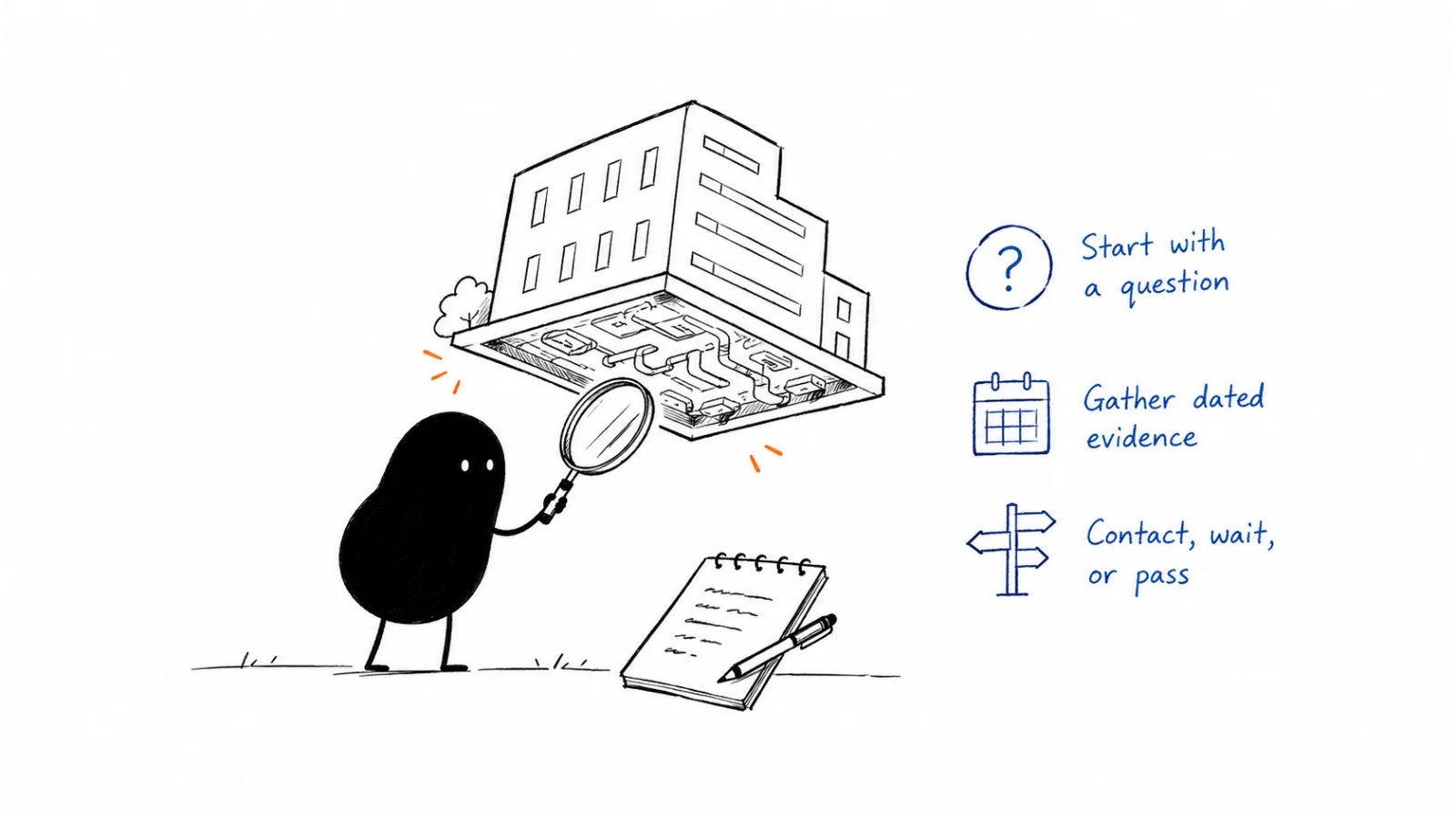
Use this when
You have an account worth an initial look, but you need to understand whether the business actually does the work your product supports. An initial filter is a starting point, not a completed qualification. You want a first message to be relevant without filling it with personal trivia. You need a credible connection between the company’s situation and something useful you can offer. A buyer has requested a conversation and you want to prepare intelligently. Research should help you ask better questions, not delay a promised response until every field is complete. Several teammates are touching the same account and their notes disagree. One person says there is an active project; another has only an old job advertisement. You are deciding where to spend scarce research or selling time. You want a defensible reason to prioritize one account, keep another in view, and stop work on a third. You are also trying to improve your understanding of the market. Repeated corrections from accounts can reveal that an assumed problem, role, or segment was wrong.Do not use this when
The activity is collecting private or irrelevant personal detail to make a stranger feel familiar. A professional conversation does not require family information, health details, home addresses, or inferences about a person’s vulnerabilities. You are trying to manufacture evidence for a conclusion already chosen. If a material requirement cannot be met, a new funding announcement should not erase it. The account already gave you a clear next step and the research is becoming a way to avoid taking it. Preparing for a call is useful; spending another day collecting facts instead of answering the buyer’s question may not be. You need a full strategic account plan, a technical security assessment, or legal due diligence. Those are different scopes. This brief can identify when specialist work is needed, but it does not replace it. The only output is a richer database row. Enrichment can support operations, but it is not automatically evidence of fit, a buying project, or permission to contact someone. An account does not need a visible trigger to be worth understanding. You also do not need ten customers before doing careful research. The evidence required depends on the decision, the offer, and the cost of being wrong.Research order
Begin with the account and the work, then move toward timing and people. The order is a useful default, not a requirement to ignore information a buyer has already supplied. First, establish which company, business unit, or team you are actually researching. A parent brand, regional subsidiary, and product division may have different workflows and purchasing arrangements. Next, ask whether the work your offer supports appears to exist in that part of the business. Industry and employee count are clues, not the job itself. Then examine timing, the current approach, and the roles involved. These help decide whether there is a useful conversation to have and with whom. Research individual professional context only to the extent it helps that decision. The best-known executive is not always the person who understands the workflow. Keep five questions distinct:- Fit: could this team benefit from the offer, given its actual work and constraints?
- Timing: is there evidence of a reason to consider change now?
- Current approach: how might the work be handled today, and what remains unknown?
- Ownership: who does the work, cares about the outcome, evaluates risk, or approves a change?
- Next action: what is the smallest appropriate step that would reduce the important uncertainty?
How to do it
Choose the decision before choosing the sources. A list-selection decision may need only enough evidence to avoid obvious mismatches. A meeting with an engaged account may justify a deeper review of its operating model and the questions already raised. A technical evaluation can require specialist input that public research cannot supply. The sensible next action may be to ask the buyer for an approved document or a joint discussion, not search harder for a hidden answer. Keep the brief short enough for someone else to use. Put the supporting evidence behind the decision rather than making the reader reconstruct your reasoning from a pile of links.Step 1: write the hypothesis before searching
Start with a possible connection between the account’s work and your offer. For example: “This company serves customers through a support team. Our review workspace may be relevant if people need to inspect AI-drafted replies before sending them. We do not yet know whether they use drafts, how approvals work, or whether this creates a problem.” That is a useful research hypothesis because it identifies the missing connection. It does not assume that every company with customer support needs another review tool. A weaker version would say: “They are growing fast and probably struggle with manual processes.” Almost any account could fit that sentence, and it gives the researcher no reliable way to disagree. Write what would weaken the hypothesis as well as what would support it. The team might already have a sufficient workflow, require a deployment model you cannot provide, or handle a different task from the one your product serves.How a filled hypothesis reads
The following is fictional. It describes a seller of a workspace for human review of AI-drafted support replies, not an actual Lensmor prospect.Account A may be worth investigating because its public support material describes approval for certain exception requests, and a current operations vacancy mentions evaluating AI assistance. Those observations suggest a review-related question. They do not establish that AI drafts are in production, that approvals are failing, or that a new tool is budgeted. The next useful unknown is how exception replies are prepared and approved today.Notice what the paragraph does not contain: an invented employee count, a made-up technology stack, an assumed budget owner, or a claim that the vacancy proves urgency. You can work with incomplete information without making the brief sound evasive. State the observation clearly, explain why it matters, and name the question it leaves open. The following conversation is fictional. Seller: The company has several operations openings. They must be struggling to keep up with support. Researcher: The openings show roles being advertised. They do not tell us whether support is overloaded or whether these are replacement hires. Seller: Then what can we reasonably investigate? Researcher: Whether the roles involve the review workflow we support. If they do, we can ask about the current process without claiming it is broken. That change in language is small. The change in the quality of the premise is substantial.
Set a research depth that matches the decision
Do not give every company the same research treatment. For an initial screen, you might check identity, the relevant business activity, a material constraint, and existing relationship history. If one decisive mismatch appears, stop that screen. For a promising but unfamiliar account, investigate the workflow and a plausible owner. For a scheduled meeting, use what the buyer has already said to prepare specific questions and relevant evidence. A named strategic account may justify a shared, evolving plan. Keep that in Account planning rather than turning every first-touch note into a strategy document. Timeboxes can help, but they are operating choices, not scientific thresholds. A short review may be enough for a familiar segment; a complicated parent-subsidiary structure may take longer to resolve. At the end of the timebox, ask what another block of research would change. “We might find something interesting” is weaker than “we need to establish which entity operates the service before approaching anyone.” If the answer is only available from the account, stop trying to infer it from public material. Decide whether an appropriate conversation is warranted.Check relationship history before external browsing
Use the information your team is authorized to access before paying to rediscover it. Is the account already a customer? Is there an open opportunity, a prior request, a partner relationship, or an agreed follow-up date? Has someone objected to contact? Is another teammate responsible for the relationship? A public event does not turn an existing customer into a new prospect. A new contact record should not erase the history attached to the company. Read internal notes critically too. “No budget” may mean no budget for the proposal discussed last year, not a permanent fact about the organization. “Not interested” may describe one person’s response to one offer. Record the scope and date of those statements. If the history is unclear, ask the relationship owner before starting a parallel approach. Keep internal notes private. They can inform your decision without appearing in an unsolicited message or being uploaded to an unapproved external research tool.Step 2: collect evidence with source and date
Look for sources that can answer the specific question you wrote. A product page can help establish what the company sells. A help article may reveal a customer-facing workflow. A job description may show responsibilities the company is recruiting for. A filing may explain a business unit or a strategic risk. Each source has a scope. A job requirement is not a complete description of the current team. A public customer case on a vendor’s website may establish a relationship at the time described, not a current contract or exclusive deployment. Search results are useful for discovery. Open the underlying material before using a material claim, and check that the result belongs to the right company and period. If the full source is unavailable, record that limitation. Do not turn a search snippet into a detailed account of a document you have not read.Resolve the company before interpreting the facts
Start with the official domain and the part of the business relevant to the offer. Check whether a product brand belongs to a parent, whether a similarly named company is a different entity, and whether an acquisition changed the identity of the operating team. A database match on a short name can attach the wrong funding round or employee count. Separate company-wide scale from the size of the relevant operation. A group with thousands of employees may have a small team doing the particular task you support. A small corporate entity may operate a large distributed service network. Where a legal entity matters, use the appropriate registry and verify the context. Do not treat registration data as a description of the company’s buying workflow. Companies House explained in its February 2024 account of expanded querying powers that incorrect information could still be accepted and published. This is a historical statement about register limitations, not a claim that the agency lacks current verification powers. The practical lesson is to corroborate material identity questions rather than treating a registry entry as infallible. Companies House on register accuracy If the entity remains ambiguous, pause the person search. Finding a polished profile for an executive at the wrong organization will not fix the underlying match.Choose sources for the question they can answer
A source is useful because it reduces uncertainty about the decision, not because it sounds prestigious.
A company’s own material is often the closest source for what it announces or offers. It can still be selective, promotional, outdated, or silent about an important limitation.
A commercial data provider may be useful for finding candidates. Keep the field’s source, definition, and update date where available, especially if a decision depends on it.
Do not confuse three copies of the same announcement with three independent confirmations. Follow the claim back to its origin.
Read filings with a business question
For a relevant public company, a filing can be more useful than a broad web summary. The SEC’s guide to reading a 10-K identifies the Business section as a place to understand products and markets, Risk Factors as a discussion of significant risks, and management discussion as the company’s perspective on operating results. These sections answer different questions. SEC guide to a 10-K If your question concerns an operating segment, start there. If it concerns implementation constraints, a generic financial summary may be less useful than product or technical material. A stated risk is not proof that the feared event occurred. An efficiency priority is not evidence that your product has a funded project. A company-wide cost goal does not tell you which team can spend on a solution. Keep the reporting period and publication date visible. A recent filing can describe the previous financial year; a management statement can concern an expected future change. This is account context, not an investment recommendation or a substitute for specialist financial analysis.Keep event dates separate from observation dates
Every material claim needs a time context, but not every page has a publication date. Record when the source was published if known, when the event occurred if different, and when you checked it. If a page is undated, say so rather than assigning today’s date to the underlying fact. An old announcement resurfacing in a search result is not a new trigger. A role still visible today may be a long-running vacancy or a repost. A technology detected at one point may have been removed. The freshness required depends on the claim. A headquarters location may be stable enough for one decision; a person’s current role or a scheduled evaluation may need a fresh check. Set a revisit condition for facts that drive action. Do not make every field expire after the same arbitrary number of days.Use professional context without building a personal dossier
Collect the minimum information needed to understand the business relationship and choose an appropriate route. A person’s role, published professional remit, or relevant public explanation can help you prepare. Their private life is not a shortcut to relevance. Public availability does not resolve how information may be collected, stored, shared, or used for marketing. The ICO’s B2B guidance says UK data-protection requirements can apply to identifiable business contacts, including information from public sources, and electronic marketing has additional rules. Do not treat this as global permission or a complete legal assessment. ICO B2B marketing guidance Platform access rules matter separately. LinkedIn’s help page prohibits software that scrapes or automates activity on its site. An extension being available does not establish that its use is permitted. LinkedIn prohibited software guidance Use authorized sources and approved workflows. Do not bypass access controls, buy leaked records, or use someone else’s account to reach restricted information. Before purchasing data or setting up automation, check the provider’s rights, intended uses, retention, security, and handling of objections with the responsible owners. A research brief is not legal clearance for a contact campaign.Step 3: classify each item
Separate the source statement from your interpretation. A useful record might say: “The careers page advertises an operations role responsible for evaluating AI assistance; checked September 9.” The interpretation might be: “There may be an evaluation underway.” The unknown might be: “Whether the role is filled and whether the evaluation includes support replies.” Those are three different statements. Keep them separate even when the final brief is short. Use labels that your team can understand: observed statement, account-reported fact, hypothesis, contradiction, and unknown. You do not need a complicated ontology. A label is not a guarantee. Something a buyer told you may be incomplete or limited to their team. Something on an official site may accurately describe a policy without proving it is followed in every instance.Build a small evidence ledger
The following entries are fictional and belong to the teaching account introduced earlier.
The ledger should make it easy to challenge a claim without discarding every useful observation about the account.
Keep short excerpts only where needed and allowed. A source link, precise paraphrase, and location in the source often make a more usable record than copying an entire page.
For restricted internal material, use the appropriate access-controlled reference. Do not turn a public research brief into a container for confidential meeting notes.
Look for a plausible alternative explanation
Ask what else could explain the observation. A new role may replace someone who left. A funding round may extend runway rather than create a new budget. A migration project may be nearly complete, leaving little reason to evaluate another vendor. A help article describing manual review may indicate a deliberate control, not inefficient work to eliminate. Your product could support that control, but an automation pitch might miss the point. You do not need to enumerate every possibility. Find the alternative most likely to change the action. The useful question is not “Can I imagine why they need us?” It is “What evidence would make this a reasonable conversation, and what would make it inappropriate?” That habit helps prevent personalization built on a flattering story the researcher told themselves.Resolve contradictions rather than averaging them
Suppose the official site says one region is supported, a database lists three, and an old press release mentions an expansion plan. Do not write “global operations” as a compromise. Identify what each source describes: a live service, a provider estimate, and an announced intention. Prefer the most relevant, direct, and current evidence for the particular claim. Recency alone is not enough if the new source is merely repeating an old statement. If the conflict is material and unresolved, say so. “Service coverage outside the published region is unconfirmed” is more useful than a confident but unsupported expansion narrative. Record when a claim is corrected so another teammate does not reimport the stale field. A CRM update without a reason can be overwritten by the next enrichment run.Use AI to organize evidence, not invent the account
AI can help extract candidate claims from authorized sources, compare descriptions, identify gaps, and turn notes into a concise draft. It can also produce a persuasive account of a company that the sources do not support. A fluent sentence and a citation-shaped link are not evidence that the source contains the claim. NIST’s Generative AI Profile describes confabulation as confidently presented false or erroneous output, including output that diverges from the supplied input. This is a known risk to manage, not a claim that every generated summary is wrong. NIST Generative AI Profile Give the system a narrow task. Ask it to extract what the provided materials state, separate inference, preserve dates, and report missing information. Then open the cited source for each claim that will affect an external statement or an important decision. Check entity, time, scope, and whether the source actually says the thing attributed to it. Do not ask the model to fill every field. A blank budget field is better than a fabricated estimate that gets copied into a forecast.Check the chain between extraction and action
A good extraction can still become a bad message. The source says “evaluating AI assistance.” The structured field becomes “AI adoption.” The lead score turns that into “high intent.” The email then says, “As you roll out AI support, you must be struggling with quality.” No single step looks dramatic, but the final sentence contains several unsupported claims. Keep the original evidence available at the point where a person approves the action. Show the model’s interpretation beside the source statement, not only a polished company summary. The following conversation is fictional. Researcher: The AI brief says they have deployed automated replies and need a quality-control layer. Manager: Which source establishes deployment? Researcher: The vacancy only says the new hire will evaluate AI options. The model also inferred their current stack from an older vendor story. Manager: Then remove the deployment claim and mark the stack as unconfirmed. We can investigate the workflow without pretending we have seen it. A corrected brief is a successful quality check, not a reason to hide uncertainty from the next person. Use automation to preserve corrections too. If a buyer later says the project concerns internal search rather than support, that correction should prevent the old hypothesis from being regenerated next week.The AI report has sources, but the claims are still wrong
The AI report has sources, but the claims are still wrong
Check the relationship between each claim and the cited passage. A real link can point to a source that is too old, about a different subsidiary, or unrelated to the statement.Reduce the task to extraction from a small set of approved materials. Ask for exact source locations and separate inferences, then inspect the decision-critical claims yourself.If a source cannot be accessed, mark it unavailable. Do not let the system describe the missing page as if it had read it.Keep an error note that identifies the failure mode, such as wrong entity, changed date, inferred budget, or mistaken product capability. Use that note to improve the workflow rather than simply asking for a more confident rewrite.
Step 4: decide whether the trigger is real
A trigger is useful when a change plausibly affects the work, priority, or timing relevant to your offer. The change alone is not enough. A funding round matters differently to a team investing in expansion, one reducing costs, and one completing an unrelated acquisition. Write the connection in ordinary language. “The announced service expansion may add approval work across time zones” is a hypothesis you can investigate. “They raised money, so they need our platform” skips the business mechanism. Look at the event’s status. Announced, planned, piloting, implemented, and completed are different stages. A planned change can create an evaluation window; a completed change may remove it. Also ask whether your offer fits the direction of the change. A company consolidating tools may be less interested in adding another interface unless you can explain a credible replacement or integration.You can have fit without a trigger
A stable company may still have recurring work that your product supports. It may be reasonable to make an appropriate, low-pressure introduction without claiming urgency. Say why the offer could be relevant to the role or workflow. Do not invent a current initiative to make the opening sound timely. An explicit evaluation request is a stronger reason to respond than a missing public signal is a reason to delay. Use research to prepare for the requested conversation, not to reclassify the request as cold outreach. Conversely, a strong headline does not make an unsupported use case suitable. If your product cannot meet a material requirement, separate that limitation from excitement about the account. Research can also challenge an outdated internal exclusion. If your product’s capabilities changed or the earlier disqualification was based on a mistaken fact, revisit it explicitly. Do not preserve old labels merely because they are already in the CRM.Avoid turning correlation into a deadline
A new executive, job advertisement, or category-page visit can suggest a question. It does not give you the person’s calendar, mandate, budget, or willingness to talk. Do not assume every leader spends the first ninety days buying software. Do not treat a website visit as a confirmed procurement project. When timing is unclear, record what would make it clearer: a stated evaluation, a relevant deadline, a direct explanation from the team, or a change in a material requirement. Set a sensible review point if there is something real to revisit. “Check after the announced service launch” is more useful than “follow up forever until they reply.” The separate Buying signals guide covers signal-led work. Treat fixed windows or scores as operating hypotheses to validate, not evidence of a specific account’s readiness.Step 5: map the likely buying seat
Start with responsibilities, then look for names. Who performs the task? Who is accountable for the outcome? Who needs to evaluate technical, security, or operational risk? Who can authorize a change or spend? One person may hold several responsibilities. A self-serve product may not require a committee at all. An enterprise workflow may involve a central platform team and a business-unit owner. Use the Buying committee guide when the decision becomes more complex. Do not invent six stakeholders to make a simple purchase look enterprise-ready. Keep “likely relevant role” separate from “confirmed owner.” A title can help identify a plausible route, but it does not establish authority.Choose the person closest to the question
If the important unknown is how a workflow runs, an operator or administrator may be more useful than a distant executive. If the question concerns a cross-team priority, an operational leader may have the broader view. If an account has already named a technical reviewer, use that context rather than starting a new search. A public talk can help you understand a person’s professional perspective. It does not imply a personal relationship or permission to attribute an unstated problem to them. Avoid praising an unrelated post just to demonstrate that you found it. Mention a professional observation only when it helps explain why the conversation might be useful. Before approaching someone, check that the role is current and that the route is appropriate. Finding a probable email pattern is not the same as verifying contact data or deciding whether outreach is permitted.Find the current alternative without guessing the whole stack
The alternative may be another product, an internal process, a spreadsheet, a service provider, or deciding not to change anything. A visible technology tag rarely describes the whole workflow. A website script can identify something used on the public site without telling you how internal support approvals work. A vendor customer story can suggest a relationship to verify. It should not become “you use Vendor X and want to replace it” unless you have evidence for both parts. If the current approach is unknown, ask a question that lets the buyer explain it. “How are exception replies reviewed today?” is more useful than a claim that the team must be struggling with spreadsheets. You may discover that the existing process works well. That is a meaningful result, not a failed opportunity to personalize.Turn the research into a question, not a diagnosis
A first approach should not read like an audit of a company you have never worked with. Compare these fictional openings:Your new AI initiative is creating quality problems, and your operations team is wasting hours on manual approvals.That sentence asserts a deployment, a problem, and a cost that the evidence does not establish. A more grounded opening could be:
Your support guidance mentions approval for exception refunds. We work on the handoff between a drafted reply and the person who approves it. Is that part of your team’s workflow, or handled elsewhere?This is an illustrative relevance question, not a send-ready compliance template. The appropriate channel, contact permissions, and any required disclosures still need review. The recipient can correct it easily. They do not have to dispute a dramatic claim about their performance before explaining what actually happens. You do not need to mention every fact you found. Research often improves a message by helping you leave irrelevant details out.
Step 6: stop research with a decision
End with a next action that another person can understand. “Research complete” is not enough. Say whether the account appears worth a conversation, which important uncertainty remains, and what would change the decision. The next step might be a narrow additional source check, a question to the relationship owner, an appropriate first approach, preparation for an already-requested meeting, or a pause. Distinguish unknown from unsuitable. Not finding a budget is not evidence of no budget. Not finding public documentation is not proof that the workflow does not exist. Also distinguish unsuitable for this offer from unsuitable forever. A deployment constraint can rule out the current product while leaving a different service or future version relevant. Use the degree of commitment to set the evidence bar. A tentative research question needs less evidence than a tailored implementation proposal, a forecast, or a public claim about the account.Write a decision brief a teammate can use
The top of the brief should explain the job, evidence, uncertainty, and next action in a few sentences. Put links and supporting detail below that. A salesperson should not need to open twelve tabs to discover that the most important fact remains unconfirmed. If you use priority tiers, record the meaning and evidence. “T1” without a reason hides judgment. A numeric score can help organize work, but it is not a probability unless you have actually calibrated it. Keep ownership and a review date attached to the action. A pause without a reason or revisit condition easily becomes forgotten work. For a meeting, prepare questions in an order that respects the buyer’s time. Confirm the premise, understand the current approach, then explore fit. Do not make the buyer sit through every field in your research template.Let the account correct the model
When someone replies, update the brief before planning the next message. A correction can change the workflow, owner, timing, or entire premise. Preserve it in the shared record so the next teammate does not repeat the old assumption. The following conversation is fictional. Operations lead: The AI role is for internal knowledge search. Support replies are still written by people, and the helpdesk handles our approval step. Seller: That changes our assumption. Is the approval handoff something you are looking to improve, or is the current setup sufficient? Operations lead: It is sufficient for now. We are focused on the internal search project. Seller: Understood. We will not treat this as a support-review evaluation. The seller has learned something useful without forcing the account back into the original story. No reply is different. Silence does not confirm or refute the research premise. It may reflect timing, message quality, contact accuracy, workload, or lack of interest. Record what you actually learned, then decide whether another appropriate action is justified. Do not turn a lack of response into a made-up account diagnosis.The account looks promising, but public information is sparse
The account looks promising, but public information is sparse
A small or private company may not publish the detail your template asks for. Sparse information is a research limitation, not automatically a fit problem.Check the basic identity and the work you can reasonably observe. Separate the unknowns that matter from fields that are merely nice to have.If a respectful, appropriate question can resolve the key uncertainty, a conversation may be more useful than another hour of browsing. If the uncertainty concerns a material legal, security, or service constraint, get the right evidence before making a commitment.You can also pause. Record what you could not establish and why more research was not justified. Do not fill the missing fields with estimates just to make the account look ready.
Worked example: illustrative
The seller, three accounts, documents, conversations, times, and outcomes below are fictional. They demonstrate research decisions, not actual prospect data or Lensmor results. The seller offers the same review workspace described earlier: a person checks an AI-drafted support reply, sees the relevant policy context, and records approval. The product is a hosted service and does not offer customer-managed deployment. The team wants to decide which of three candidate accounts deserves a first conversation. None is an existing customer or open opportunity in the fictional internal check. It does not set a target to make all three qualify. A useful result can be a narrower hypothesis, a pause, or a documented mismatch.Begin with three different questions
Account A publishes support guidance describing approval for certain exceptions. An operations vacancy mentions evaluating AI assistance. The question is whether those two observations relate to the same workflow. Account B serves a business segment that could plausibly use the product, but its published vendor requirements explicitly require customer-managed deployment for this type of system. The question is whether the seller can meet that requirement; in this example, it cannot. Account C recently announced funding. The public material describes a professional-services model, but the researcher cannot establish a recurring support-reply workflow. The question is whether the apparent category match is real.
The funding announcement does not make C the highest priority. B’s apparent market fit does not cancel the deployment mismatch. A’s two observations do not prove an active opportunity.
Inspect Account A without connecting unsupported dots
The researcher records the support policy as an undated page checked on the research date. The vacancy has a visible posting date. An older vendor story names a helpdesk product. The brief says what each source supports. It does not claim that the older helpdesk remains in place, that the vacancy is filled, or that the company is replacing anything. The first draft from an AI assistant connects the observations into a confident story about a support-AI rollout. The reviewer removes that story because the sources do not connect the AI role to support. The revised hypothesis is narrower: there may be a relevant review workflow, and the appropriate owner could clarify it. That is enough to consider an appropriate question, not enough to propose an implementation.Stop Account B for the reason that matters
The researcher initially spends time reading B’s product pages and sees a plausible operating context. The deployment requirement then becomes decisive. Because the seller’s current product cannot meet it, further searches for executive biographies and hiring news would not improve the current decision. The brief records the requirement, source, date, and product limitation. It does not mark the company as a bad customer or imply that it has rejected the seller. The team can revisit if its deployment capability changes or the account provides credible evidence that the requirement does not apply. Until then, the proposed hosted offer should not proceed. There is no need to manufacture a compelling opening for an offer the team already knows it cannot deliver.Give Account C a bounded check
The funding news is real within the fictional scenario, but the connection to the supported job is weak. The researcher checks the service description and one relevant operational source. Neither establishes the recurring reply-review process. The team pauses with “workflow not established” rather than “no need” or “no budget.” Those stronger conclusions would exceed the evidence. It does not build a list of employees to ask the same question repeatedly. If a relevant inbound conversation later appears, the account can be reconsidered with better context. This is an example of stopping because the next research cost is not justified, not because public silence proves the absence of a business problem.Turn Account A’s reply into a correction
Assume the team has an appropriate contact route and sends a short workflow question, not the earlier AI-generated diagnosis. The operations lead explains that AI evaluation concerns internal knowledge search. Support replies are written by people, and the existing helpdesk handles approvals adequately. The seller asks whether the approval process is being reconsidered. The answer is no for the current period. The team updates three things: the AI initiative’s scope, the current approval approach as reported by this participant, and the absence of a current support-review evaluation. It does not claim that every team in the company has no need. It records the scope of the answer and stops this line of pursuit rather than sending a sequence built on the invalidated premise. The conversation produced no opportunity. It still prevented repeated irrelevant outreach and corrected a pattern the team might otherwise have applied to other accounts.Account for the research effort
The initial research takes twenty minutes for A, ten for B, and fifteen for C: forty-five minutes in total. At an illustrative internal rate of $60 per hour, that is $45 of valued time. Reviewing A’s reply and correcting the shared record takes another ten minutes, or $10. The total is fifty-five minutes and $55 of assumed internal effort. No data subscription, external cash spend, or opportunity value is included. The point is not that an account should take fifteen minutes on average. These are fictional allocations that make the cost visible. B was stopped for an evidenced constraint, C was paused with an unresolved fit question, and A’s premise was corrected through a conversation. None became a customer, so there is no observed customer acquisition cost. You also cannot claim a precise saving from the outreach that did not happen. The team can record that it stopped an unsuitable approach without inventing a counterfactual revenue or efficiency number.Improve the next batch
The review reveals a recurring risk: treating any mention of AI as evidence of the seller’s particular use case. The team changes its research instructions to require the source to connect AI assistance to the relevant support workflow, or leave that connection explicitly unconfirmed. It also moves deployment constraints earlier in the screen when they are material to the offer. That change could reduce wasted work, but the team will observe later batches rather than claim an improvement before measuring it. The research process has produced better questions and better stop rules. Its value is not measured only by how many accounts were marked ready for outreach.Copyable research brief
This is the handoff document, not a requirement to complete every field before a conversation. Keep unsupported answers marked unknown.Copy: evidence extraction with AI
Use this only with material you are authorized to access and process. It is an extraction task, not permission for autonomous browsing or outreach.Copy: research review
Use this after a small batch or a meaningful correction. Do not evaluate the researcher solely on how many accounts moved into outreach.Before you start
Confirm that you have the right company and business unit. Check internal relationship history before treating the account as new. Name the business job and the decision the research should support. If the only question is “what can we personalize,” start again with relevance. Review the material constraints of the offer. Put decisive limitations early enough to prevent unnecessary person-level research. Make the evidence easy to inspect. Keep dates, direct statements, inferences, contradictions, and unknowns distinguishable. Check the route for collecting and using data. Public access, a paid subscription, and an existing customer relationship each leave other questions unresolved. Decide what would stop the research. It may be a clear mismatch, sufficient evidence for a modest next step, or an important unknown that only an appropriate conversation can answer. Before an external message, reread the sentence against the source. Does it say more than you know?Metrics
Evidence quality
Audit a sample of decision-critical claims, not only random fields that are easy to check. Look for wrong entities, stale dates, unsupported causal stories, role changes, and estimates presented as measured facts. Record the denominator: five errors in twenty checked claims is different from five errors in an unknown volume. Keep source quality separate from interpretation quality. A reliable source can be misread, and a low-confidence source can be accurately labeled as uncertain. Do not hide corrected errors. A visible correction that stops a bad message is healthier than a perfect-looking database with no audit trail.Learning from the account
Track which premises were tested in actual replies or conversations and which were confirmed, narrowed, or corrected. Use only tested premises as the denominator for a confirmation rate. Nonresponses do not establish that the hypothesis was right or wrong. Distinguish a correction about one team from a conclusion about the whole company. Record the participant’s scope and the date. A high correction rate may reveal weak assumptions, unclear segment definitions, or research sources that do not answer the real question. It is a reason to improve the method, not suppress inconvenient replies.Time and decision usefulness
Measure research time together with verification, corrections, and rework. A fast AI draft can still be expensive if a person must repair every important claim. Compare similar decisions. Screening a known segment is different from preparing for a technical meeting at a complex account. Review whether the research produced an appropriate next step. A well-supported stop can be valuable even though it creates no meeting. Do not maximize disqualifications either. A team that rejects every uncertain account can look efficient while missing reasonable opportunities to learn.Commercial outcomes and attribution
Research is one part of the selling process. Replies, meetings, opportunities, and customers also depend on the offer, message, route, timing, and follow-through. Track later outcomes if useful, but avoid attributing every difference to the research tool or the number of fields collected. If you test two research approaches, consider whether the accounts, offers, and selling conditions were comparable. A richer brief assigned only to your strongest accounts is not a clean test of its effect. For a small batch, report what happened and what remains uncertain. A few promising conversations do not establish a repeatable lift in revenue.Common mistakes
Collecting company trivia instead of answering a business question. Start with the work and the decision. Treating a headline as proof of pain. Explain the possible mechanism and what still needs validation. Requiring a trigger for every suitable account. Stable work can be relevant without invented urgency. Confusing a provider estimate with a verified fact. Preserve source, scope, and uncertainty. Researching the person before resolving the account. An accurate biography at the wrong entity is still the wrong research. Using a title as proof of buying authority. Map responsibility and confirm ownership when it matters. Letting AI fill every blank. Inspect the source behind each decision-critical claim and preserve unknowns. Continuing after a decisive mismatch. More personalization will not make an unsupported offer deliverable. Ignoring the buyer’s correction. Update shared records and stop downstream actions built on the old premise. Calling silence validation. No reply is an untested premise, not confirmation.What to read next
Use ICP to improve account-fit criteria and Buying committee to map a real decision as it develops. Buying signals focuses on changes that may affect timing. Message-market fit and Cold email cover the offer and first approach; research supplies evidence, not an automatic reason to send. Contact data addresses the contact route. Account planning is the deeper shared record for a named account program. If you are still learning which companies can benefit, use First ten customers alongside this guide. It is a learning path, not a prerequisite customer count for doing research. Research also supports inbound conversations, partnerships, and customer work. Use Channel strategy to choose the broader route rather than treating research as proof that outbound must be your primary channel.Sources and evidence boundary
Five primary sources were checked on September 9, 2026: the SEC’s 10-K reading guide, Companies House’s February 2024 register-accuracy explanation, ICO B2B marketing guidance, LinkedIn’s prohibited-software help, and NIST’s Generative AI Profile. The SEC source supports distinctions between filing sections, not a sales-intent model. The Companies House source is explicitly historical and does not describe every subsequent verification reform. ICO guidance is UK-specific. It does not establish lawful collection or outreach for a particular account, channel, or jurisdiction. LinkedIn’s platform rules are a separate constraint from privacy law. NIST identifies generative-AI risks; it does not validate the extraction prompt, guarantee accuracy, or certify a research vendor. The workflow and quality checks here are original operating recommendations. All account evidence, conversations, messages, costs, and outcomes in the worked example are fictional. No real prospect list, contact details, CRM data, restricted account information, or private customer notes were accessed for the example. No outreach was sent and no external customer record was changed while writing this guide.Copyright © 2026 Ivan Xu. All rights reserved. See the copyright and reuse terms. Canonical source: github.com/weilun88313/B2B-Playbook