

Use this when
You can describe the product’s features, but buyers struggle to say what it would help them do. Different people at the company introduce the same offer in different ways, and sales conversations begin by correcting expectations set by marketing. A campaign gets clicks, replies, or meetings, but those interactions rarely involve the work your product serves. You have learned something important about a segment and want to test a sharper explanation without rewriting the entire website. Someone wants to add automation or increase outreach volume before the team understands why the current message succeeds or fails. You also want to distinguish a communication problem from a product, audience, price, timing, or distribution problem. A copy rewrite is useful only when it addresses the thing that is actually getting in the way.Do not use this when
The request is simply to choose a prettier phrase. Style matters, but this guide is about whether a truthful offer connects with a relevant audience. You already know the product cannot meet a requirement and want language that hides the gap. That is a product or commercial decision, not a messaging exercise. You are trying to prove broad product-market fit from a few positive replies. A useful message does not establish adoption, retention, delivery quality, or a sustainable business. You need the full positioning strategy, an individual account brief, or the mechanics of a channel. Use positioning, account research, and cold email for those tasks. You are also not required to postpone all tools until someone has personally written fifty emails. Software can help organize learning from the beginning. The problem is expanding an unexamined promise, not using a tool.A few useful terms
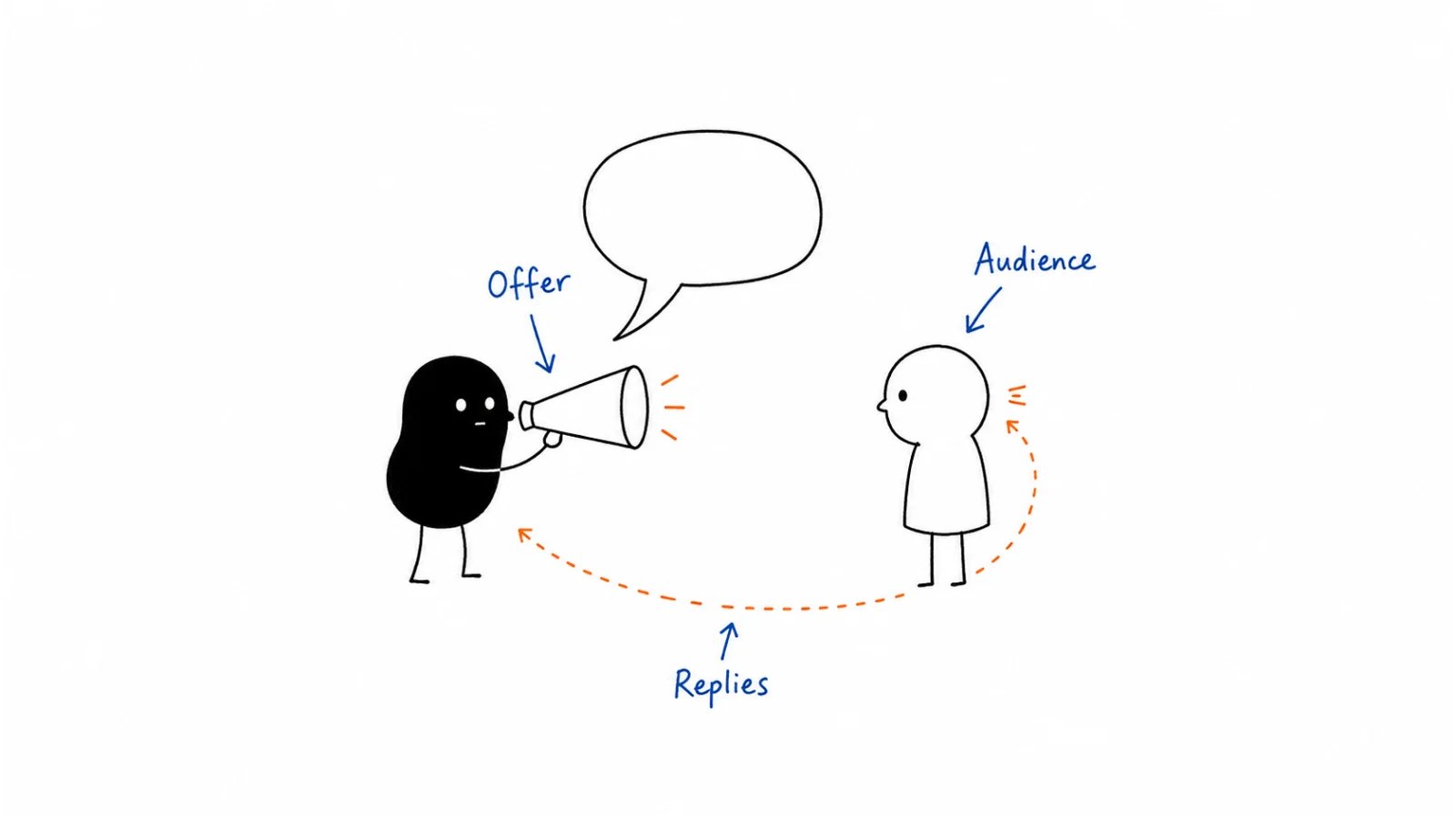
The audience is the group whose circumstances you are trying to understand. A useful definition includes relevant work and constraints, not only industry and employee count. The offer is what you propose to help them do, under what conditions, and through what next step. It might be a product, service, evaluation, or a narrowly scoped piece of help. The message is how you communicate that offer. It includes the promise, the explanation, the evidence, and the request—not just a headline or subject line. The frame is the angle you use to help the audience understand the value. The same product might be described in terms of avoiding missed handoffs or making ownership visible. Different frames should not quietly imply different capabilities. A hypothesis is a belief you can examine: “Regional operations managers will recognize temporary approval cover as a current problem, and this explanation will make the relevant capability clear.” Message-market fit is not a certification with a universal passing score. Here, it means you have useful evidence that an accurate message connects with a defined audience and context strongly enough to support a next decision.
Treat these as different kinds of evidence, not a compulsory five-stage journey. A buyer may arrive already evaluating alternatives and skip the educational conversation entirely.
An account can also understand you perfectly and decide the product is not right for it. That is a useful result if your communication helps the wrong buyer avoid wasting time.
Keep this in mind
The aim is an accurate expectation that the product can fulfill. If a headline wins attention by implying automatic decisions when your product only assists a human reviewer, the test has exposed a misleading promise—not a reason to publish the headline everywhere. If the clearer version produces fewer replies but more relevant conversations, it may be doing a better job of selecting who should engage. Keep the message attached to its context. A line that works in a conversation with an existing customer may not work in a cold introduction. A founder’s explanation may benefit from authority or a personal relationship that a new seller does not share. Likewise, a recurring objection is evidence to interpret, not evidence of fit by itself. “We never do that work” can be a reliable reason to change the audience. It is not a positive result for the offer.How to do it
Begin with the uncertainty you need to reduce. If people think your software is a consulting service, test comprehension. If they understand it but cannot connect it to their work, examine the audience and problem. If they see the relevance but distrust the promise, inspect the evidence and scope. If they want it but cannot implement it, rewriting the subject line may not help. A small amount of well-chosen feedback can expose a clear misunderstanding. Measuring a modest conversion improvement is a different task and may require substantially more data. Do not force those two tasks into the same experiment. Use conversations to understand what might be wrong, then use appropriately designed behavioral tests when you need to compare outcomes.Step 1: Choose one audience and offer
Describe a situation in which the offer could matter. “Operations leaders at B2B companies” is a place to start, but it includes people doing very different work. “Operations managers responsible for employee-onboarding approvals across several company-run sites” gives you something more concrete to investigate. Now state the relevant variation within that group. Some teams may have reliable backup owners already. Others may handle absence through ad hoc messages. Some may outsource onboarding altogether and not need the product. Write down what makes an account unsuitable as well as what makes it promising. This keeps you from interpreting every response as encouragement. You do not need a recent funding round or two public facts to test whether people understand an offer. You need appropriate participants or accounts and enough context to avoid testing on people whose work is unrelated. A company headline can help with timing; it does not replace the audience definition. Read buying signals when the question is whether a change creates a useful reason to act now.Name the current alternative fairly
The alternative is what the buyer would do without your offer. That might be another product, an internal process, a spreadsheet, a service provider, or simply continuing as they are. Do not assume “doing nothing” means no work is happening. A spreadsheet might be easy to maintain, familiar, and sufficient. A human reviewer might be required because the consequences of a mistake are significant. An incumbent system might already be embedded in several teams. When you describe the alternative, include why someone would sensibly choose it. Otherwise, your message will argue against a simplified version of the buyer’s life. For example, “Replace messy spreadsheets with our intelligent platform” assumes both that the spreadsheet is a problem and that another platform is welcome. A more useful hypothesis might be: “Teams with changing approval owners need a way to keep temporary cover visible without asking a central administrator to edit the process every time.” That gives you a specific question to test. You may discover the current spreadsheet already handles it well. You may also discover that the real problem is not visibility but the authority to approve. Do not skip that discovery because the first version sounds easier to sell.Separate the outcome, mechanism, and limits
Write three things before trying to make the message elegant. First, the outcome: what becomes easier, safer, faster, or more reliable for the buyer? Second, the mechanism: what does your offer actually do that could produce that outcome? Third, the limits: what must the buyer still do, what conditions apply, and what you cannot promise? For a fictional approval tool, the outcome might be fewer interruptions when a local approver is absent. The mechanism might be named backup owners and a visible delegation history. The limits might include setup work, supported systems, and the need for the customer to define who has authority. Those pieces are related. “Never delay an employee’s first day again” would reach far beyond the mechanism. The product cannot control every cause of delay. You do not need to recite all limits in the first sentence. But no part of the message should contradict them, and material qualifications should be available before the buyer takes a step that depends on them. A good short explanation is supported by a more complete, consistent one. It is not a slogan that becomes false as soon as someone asks how it works.Decide what the next step is worth
An offer to review a configuration, an invitation to a product demonstration, and a downloadable checklist ask for different levels of effort. Choose the next step because it helps answer a real buyer question. Do not default to a meeting because meetings are easy to count. If the key uncertainty is whether a capability supports their setup, a short example may be enough. If the workflow is complex, a joint review might be useful. If the product is easy to try safely, a trial could be appropriate. A free asset can attract people interested in the asset rather than the product. That does not make the asset bad. It changes what its uptake can tell you. Keep the commercial purpose clear. Do not pretend to be an independent researcher or neutral peer to obtain replies and reveal the sales pitch later. If you are researching a problem for a product you sell, say so. Also avoid making the next step artificially easy by hiding its cost. A “quick check” that requires a full data export, integration access, and three colleagues is not quick from the buyer’s perspective.Step 2: Write the first messages yourself
The useful part of writing an early version yourself is that it forces you to decide what you mean. It is not a requirement to reject an editor, an AI draft, or help from someone who understands the market. Put a responsible person in charge of the claims. They should be able to explain why each sentence is true, which audience it is for, and what response would challenge the hypothesis. Start plainly: who the offer helps, what work it addresses, how it helps, and what you are asking the reader to do. Then remove words that do not help the buyer make that decision. You may use the product name. Removing a name can expose an empty description, but a useful offer does not become invalid because the name is necessary to explain a familiar integration or category. You also do not need to force every message into “two facts → consequence → ask.” A direct request deserves a direct answer; an introduction at an event may need a different shape from a cold email. The discipline is accuracy and relevance, not obedience to one sentence formula.Write alternatives that test an actual difference
If all your variants say “save time” with different adjectives, you may be testing style without learning much about the value. Create alternatives that make a meaningful question visible. One might emphasize avoiding an interrupted handoff. Another might emphasize knowing who can act when an owner is absent. Keep the underlying capability and next step consistent if the purpose is to compare the frame. If you change the promise, price, and request at the same time, you are testing different offers rather than different wording. Here is a fictional example. Assume the product really supports named backup approvers and a delegation history. Vague version“An AI-native workspace that unlocks operational efficiency for distributed teams.”A reader could reasonably imagine reporting, task management, staffing, or consulting. The sentence does not help them tell which one you mean. Outcome-led version
“Keep employee-onboarding approvals moving when a local owner is away. Set a named backup and keep the handoff visible.”The work and mechanism are clearer. The team must still check whether “keep moving” implies more automation than the product provides. Visibility-led version
“See who can approve employee onboarding at each site, including temporary cover. One place for owners, backups, and handoff history.”This makes a different benefit prominent while describing the same assumed capability. Neither alternative is a proven winner. Both are candidates for learning. The right response is to check what relevant people understand, not declare the one you personally prefer to be market fit.
Make proof as specific as the claim
Evidence should address the doubt the message creates. A demonstration can show that a feature exists. A worked configuration can show how a particular setup would function. A named customer’s account can illustrate an experience, with permission and limits. None automatically proves the same result will occur for every buyer. If you do not have outcome data, do not invent a percentage or disguise an internal estimate as a customer result. Explain the capability and show it accurately. Separate measured results from expectations. If a number came from a small pilot, state the population, period, and conditions needed to interpret it. If you cannot substantiate it, remove it from the test rather than hoping a winning headline will justify it later. Social proof needs the same care. A logo on a page may indicate a relationship without demonstrating use of the exact capability being discussed. A buyer who asks “Does this work with our approval rules?” needs an answer about the rules. Ten unrelated logos may do little to resolve that uncertainty. Proof is not decoration added at the end of a paragraph. It is part of making the promise believable without making it larger than the evidence.Check what people understand before asking what they like
Show one version in a realistic context and ask the participant what they think it offers. For a landing-page introduction, allow them to read the material without a live sales explanation. For a spoken introduction, use the actual brief explanation you expect someone to hear. Useful questions include: “What do you think this would help a team do?” “Who would use it?” “What would you expect to happen next?” Ask what led to their interpretation. Avoid beginning with “Does this clearly explain our approval automation?” The question supplies the answer and may introduce a capability the material did not establish. Give the participant room to be confused. If you explain the message immediately, you learn whether your rescue explanation worked rather than whether the original message did. GOV.UK’s interview guidance recommends open, neutral questions and concrete stories rather than general accounts of how things should work. That is useful discipline here, though its service-research guidance is not a validated B2B messaging test. Using in-depth interviews. Record the participant’s interpretation separately from your explanation. “Thought this replaced our HR system” is a clearer observation than “Needed more education.” If several relevant people misunderstand the same important point, you have a specific revision to make. You do not need to wait for a large conversion experiment to correct a misleading description.Ask about relevance without teaching the answer
Once you know how someone interprets the offer, ask where it might connect with their actual work. A recent example is more informative than a general statement of interest. “Tell me about the last time an approver was unavailable” leaves room for the participant to say it caused no problem. If there was a difficulty, ask what happened, who dealt with it, and what they did. If there was not, ask how the current arrangement works. Do not keep reformulating the question until they describe the pain you hoped to hear. Distinguish words the participant uses spontaneously from words they repeat after seeing your message. Both can be useful, but repeated language is not necessarily independent confirmation of the problem. Ask about the current alternative without disparaging it. A participant may prefer an existing process for reasons that your team has overlooked: local flexibility, low setup effort, familiarity, or clear accountability. There is also a difference between recognizing a problem and wanting to change it. A team can tolerate occasional inconvenience because replacing the process would cost more than the inconvenience itself. Do not treat that calculation as an objection to overcome automatically. It may be a sensible reason the offer is not compelling in that context.Choose participants who can teach you something relevant
A friendly customer, a colleague, an industry expert, and an unfamiliar prospective buyer can provide different kinds of feedback. Colleagues can catch unclear language and unsupported claims. Existing customers can explain real workflows and buying memories. Prospective buyers can reveal what an unfamiliar reader understands without your company’s background knowledge. Keep those groups distinguishable in the notes. Ten positive comments from people who already know the product are not the same evidence as ten unfamiliar readers understanding it without help. Within the relevant audience, include meaningful variation: different current processes, different levels of responsibility, and people whose needs may not be a fit. Do not recruit only enthusiastic users and then generalize their reactions to the whole segment. Tell participants the purpose of the session and handle recording or note sharing appropriately. If you offer compensation for research time, make it clear that useful criticism is welcome and payment does not depend on a positive response. Compensated research participation is not a commercial conversion. Nor should a research invitation become an unexpected sales meeting. The aim is to reduce uncertainty honestly, not assemble a panel that makes the next internal presentation easier.Everyone likes the message. Is that enough?
Everyone likes the message. Is that enough?
Ask what “likes” means in the notes.Someone may like the tone, appreciate the design, agree that the category is important, or want to encourage the person running the session. Those reactions are not interchangeable with understanding or relevance.Return to the interpretation before the compliment: what did they think the offer did? Could they connect it to a real situation? What did they expect the next step to involve?You can learn from preferences, especially when a participant explains a confusing word or an unwanted implication. But do not ask a preference question and report the answer as willingness to buy.If you showed two versions side by side, record that setup too. Comparing copy is different from encountering one message naturally while deciding whether to continue.A useful conclusion might be “Participants prefer the simpler phrasing, but we have not yet tested whether it earns a relevant next step.” That gives the team a sensible next task without overstating the result.
Step 3: Run a small test with a review date
Decide whether you are exploring an idea or trying to estimate a difference between versions. An exploratory test can reveal misunderstandings, unsuitable accounts, and questions worth investigating. You may adapt it as you learn, provided you record the changes and do not present it as a controlled comparison. A comparative test asks a narrower question: under reasonably comparable conditions, does one version lead to a different outcome? That needs more discipline about assignment, timing, exposure, and measurement. A list of twenty-five or fifty accounts is not automatically enough for either conclusion. The useful size depends on the expected outcome frequency, the difference you need to detect, the variation in the audience, and the consequences of the decision. For a small team, it may be more sensible to run an exploratory round than an underpowered experiment dressed up as an A/B test. You can still make progress without a claim of statistical certainty. Define a review date and an outcome window that fit the task. The review date is when the team examines the evidence. It does not prove that every buyer’s decision cycle has finished.Write the test plan before seeing the result
A short plan should explain who is eligible, what they will see, how the next step works, and what you will count. Choose an outcome close enough to observe and meaningful enough to inform the decision. For an early cold approach, an account confirming a relevant workflow and agreeing to discuss it may be more useful than an email open. Define that outcome before reading the replies. Otherwise, a team can unconsciously change “qualified conversation” to include whatever happened. Record guardrails as well: misleading expectations, unsuitable meetings, complaints, opt-outs, and unexpected delivery problems. A version that gets more attention by creating confusion should not win on attention alone. For an actual controlled experiment, Microsoft Research emphasizes a clear hypothesis, appropriate metrics, adequate statistical power, and a suitable randomization unit. Those principles help frame the design; the article does not establish an outbound batch size or a sales conversion threshold. Pre-experiment trustworthiness patterns. If your test is exploratory, label it that way. A useful internal note does not need to borrow the authority of an experiment it did not run.Keep the groups comparable
If one message goes to existing relationships and another to unfamiliar prospects, their results cannot isolate wording. The same problem appears when one version goes to founders and another to department managers, or one is delivered by a known expert while the other comes from an unfamiliar sender. Where a comparison is appropriate, assign eligible accounts to variants using an agreed method and keep meaningful conditions consistent. If several people from one account may share the message, consider assigning the account as a group rather than treating every contact as independent. Do not remove inconvenient accounts from one variant after seeing the results. If an account was included incorrectly, report the issue and how exclusions are handled. Avoid counting multiple follow-ups or several contacts at one company as independent evidence that a message works across the market. Preserve both account-level and contact-level counts when needed. Equal group sizes alone do not make a comparison fair. A random assignment method can help with balance, but a small sample may still contain important differences by chance. In a limited pilot, inspect those differences and state the limitation. The right response to uncertainty is often another focused round, not a confident percentage claim.Make the experience consistent after the first line
A test can be undermined by what happens after the message. If one version offers a relevant configuration example and the other leads to a generic booking page, you are comparing more than wording. That can be a valid whole-experience test, but name it accurately. Check that links work, the destination explains the same offer, and the person handling replies knows what was promised. A buyer should not have to repeat the context because the testing spreadsheet is separate from the inbox. Keep the response process reasonably consistent. An unanswered question in one group and an immediate helpful reply in another can change the outcome independently of the first message. If the test involves outreach, use the team’s approved contact and suppression process. A research label is not permission to bypass prior instructions or send more messages than the situation warrants. This article does not authorize contacting anyone, enrolling accounts in a sequence, or changing an existing customer’s communication preferences. It describes how to evaluate a workflow you have appropriately chosen to run.Keep a record you can read without a dashboard
For each account or participant, preserve the message version, context, observation, and next action. A useful response record includes the actual meaning of the reply, not just a sentiment label. “Interested” can hide very different situations: wants the free checklist, asks a product question, seeks a partnership, or agrees to a conversation about an active task. When retaining exact wording is appropriate, keep enough surrounding context to avoid misinterpretation. Restrict access and remove unnecessary personal detail from shared summaries. Record non-response separately from explicit rejection. A quiet inbox does not tell you whether the message was seen, understood, relevant, timely, or trusted. Likewise, a delivery status is not proof of attention. HubSpot documents suspected bot activity and privacy-related effects in email metrics, which is one reason opens and clicks should not stand in for human understanding. That documentation does not tell you which individual non-responders read your message. HubSpot’s bot-filtering guidance. You can automate recordkeeping, but make it possible to inspect and correct the classification. A neat dashboard is only as useful as the observations behind it.Read responses in more than one dimension
A reply can contain a useful question and a product mismatch at the same time. For example, “This would help us, but we need an on-premises deployment” suggests comprehension and possible relevance while revealing a constraint. Labeling it simply positive loses the reason it may not progress. Use a primary disposition for counting, then separate notes for understanding, relevance, trust, and constraints. That avoids forcing every nuance into a single mutually exclusive sentiment category.
These are prompts for interpretation, not automatic diagnoses. A short reply may not contain enough information to distinguish several explanations.
If asking a follow-up is appropriate, keep it proportionate. Someone declining your offer does not owe you an interview about why.
Step 4: Change one variable at a time
Changing one important element is useful when you want to understand its effect. It is not a rule that forbids correcting several obvious errors. If the audience is wrong and the promise is misleading, fix both before contacting more people. Record that the next round is a revised offer or audience, not a clean test of one phrase. When the underlying offer is sound but the mechanism is unclear, hold the audience and request steady while changing the explanation. When people understand the product but describe a different owner, test the role hypothesis rather than adding adjectives. When the request feels too costly, inspect what participation requires. A smaller next step may be appropriate, but it changes the offer being tested. Do not report the resulting increase as a wording improvement alone. A practical revision note has four parts: what you observed, what you think explains it, what you will change, and what result would challenge that explanation. For example: “Three participants expected automatic approval. We think ‘keep approvals moving’ caused that interpretation. We will name the human backup owner in the first sentence. We will check whether new readers still expect automatic decisions.” That note is much more useful than “Make it clearer and more benefit-led.”Know when not to edit the message
Sometimes the message does its job by revealing a problem elsewhere. If suitable buyers understand the product and ask for an integration you do not support, the decision is whether to build it, narrow the audience, or explain the limit. A different headline cannot supply the integration. If the economics do not work at the price required to deliver the service, do not keep replacing the price with “let’s talk” to make response metrics look better. If the person is not responsible for the work, changing the opening may not help. If the company has no reason to change its current process, a stronger urgency claim may simply be false. Conversely, repeated misunderstanding is not automatically a product failure. If buyers think the product replaces a system it actually complements, clearer category and mechanism language may be enough to make a useful conversation possible. The task is diagnosis before revision. You want the smallest honest change that addresses the evidence, not the largest rewrite the team can produce.A test got no replies. What can we conclude?
A test got no replies. What can we conclude?
You can conclude that no replies were observed within the stated group and window. The cause remains uncertain.Check whether the messages were sent as intended, whether the contacts and account fit were reasonable, whether the destination worked, and whether your observation period was appropriate. Do not assume a green delivery status proves that a human read the message.Then inspect the offer with relevant people through a different, transparent research route if one is available. Ask what they understand and whether the work is familiar, without pretending they were part of the original test.A small zero-result batch can justify pausing and investigating. It does not establish that the market has no demand, and it does not justify unlimited follow-ups to the same people.Avoid changing every variable and then announcing that the new headline fixed the problem. If several changes are necessary, make them and describe the result as a new exploratory round.Sometimes the honest next decision is to stop the channel test while learning more about the audience or offer.
Step 5: Check demand before adding automation
Ask what you are ready to repeat. You may have enough evidence to repeat a clearer explanation in another small group. You may not yet have enough to expand into a new segment, increase spending substantially, or delegate the whole conversation to an agent. Separate those decisions. “Use this wording in the next round” is a smaller commitment than “This message is now the company-wide positioning.” Before expanding, make sure the message is accurate, the relevant audience can be identified, the next step is deliverable, and someone can handle the expected responses. Keep product gaps and untested assumptions visible. Try the explanation with another person delivering it when that is relevant. A founder may compensate for weak wording through deep product knowledge or an existing reputation. The aim is not to remove all human skill, but to learn which parts of the result depend on that particular person. Look for repeatability across an additional group without silently changing the definition of success. Preserve negative feedback and unsuitable responses as well as the best conversation. Scale in a way that still allows inspection. If the next increase would produce more conversations than the team can review or support, capacity becomes part of the decision.Give automation a bounded job
A useful automated workflow can select from approved message components, preserve account context, track versions, and route replies for review. It should not invent customer results, expand a capability claim, pretend to have a relationship, or infer that an ambiguous reply means a purchase is likely. For AI-assisted writing, provide the approved audience, capability, evidence, limits, and request. Ask for variations within those boundaries rather than a completely new promise for every account. For AI-assisted analysis, ask the model to distinguish observation from interpretation and attach each classification to the relevant response. Review ambiguous items rather than forcing the model to choose a confident category. Do not count simulated buyer reactions as market evidence. An AI-generated objection can be useful preparation for an interview, but it is not a reply from the audience. Keep one consistent message version available for comparison. If every output varies in audience, promise, proof, and ask, it becomes difficult to learn what people responded to. The point is not to prohibit variation. It is to make variation intentional enough that you can review the claims and interpret the outcome.Carry the message into the rest of the journey
A promising first approach should lead to a consistent page, example, demonstration, and sales conversation. If the message promises named backup owners, the first demonstration should show that task. Do not start with an unrelated dashboard tour and hope the buyer remembers why they agreed to attend. The next material can add detail without changing the promise. A technical reader may need configuration limits; an operations owner may need the handoff process; a financial approver may need costs and expected effort. That does not mean every stakeholder receives an identical paragraph. Keep the core capability and evidence consistent while adapting the explanation to the decision each person needs to make. Give sales and support a short note about the current wording and common misunderstandings. A message is not truly operational if only the person who wrote it knows what it means. When replies reveal a new interpretation, update the relevant material deliberately. Avoid changing the homepage, every sequence, and the sales deck simultaneously based on one anecdote.Know when to revisit the fit
Message-market fit can weaken as the product, audience, alternatives, and channels change. A capability that once needed explanation may become familiar. An integration you added may open a new use case. A product change may make an old promise incomplete or inaccurate. Keep a dated record of the audience, version, evidence, and boundaries behind an important message decision. That gives future editors something more useful than “this headline won.” Watch for changes in the quality of conversations, not just the volume. If buyers increasingly arrive expecting a different product, review the message and the sources sending those buyers to it. A decrease in response does not automatically mean the wording has worn out. Audience saturation, contact quality, timing, sender reputation, competing offers, and changes in your own handling can all matter. Return to the relevant uncertainty instead of rewriting everything on a calendar.Three conversations that reveal different problems
The exchanges below are invented teaching examples. They are not customer transcripts or tested sales scripts.Conversation: the reader understands a different product
Researcher: “After reading this introduction, what do you think the product does?” Participant: “It approves the onboarding tasks automatically when the usual manager is away.” Researcher: “What in the introduction led you to expect automatic approval?” Participant: “The line about keeping approvals moving. I assumed the software makes the decision.” The participant has identified a material misunderstanding. The next revision should clarify who makes the decision; adding more claims about speed could make the problem worse. Record the interpretation before explaining the actual capability. Otherwise, later notes may incorrectly say the person understood the original message.Conversation: the message is clear, but the work is not theirs
Seller: “We help teams assign temporary cover for site-level onboarding approvals. Is that something your team manages?” Buyer: “I understand, but our sites do not approve onboarding. HR handles it centrally.” Seller: “Thanks—that means I used the wrong ownership assumption for this approach. I will correct it.” Buyer: “Yes. There is no site-level process to change.” This is not evidence that “temporary cover” needs a more exciting phrase. It is evidence about the audience or account-selection rule. The reply also does not authorize an introduction request or a new approach to HR. Those would require their own appropriate context.Conversation: relevant interest meets a real product limit
Buyer: “The backup-owner approach fits our problem. Can the backup be restricted to one region and expire automatically?” Seller: “Regional scope is supported in this example product, but automatic expiry is not. Cover needs to be removed manually.” Buyer: “Automatic expiry is required by our process, so we cannot use it as it stands.” Seller: “Understood. I will record that as a capability gap, not a wording objection, and avoid promising a workaround we have not validated.” The fictional product capability is stated only for the example. For a real conversation, check the actual behavior before answering. This is useful demand evidence with a delivery constraint. It is not a qualified opportunity ready to forecast, and it is not a reason to hide the limit from the next buyer.Worked example: illustrative
All accounts, responses, costs, and outcomes in this example are invented. This is not a reported company case or evidence of Lensmor performance. A small software team sells a workspace for employee-onboarding approval ownership. The product can record a named backup and a handoff history. It does not make approval decisions automatically and does not support on-premises deployment. The team has a plausible audience: operations managers involved in approval handoffs across several company-run sites. It wants to learn which explanation and next step deserve another round of testing. The current alternative is a mix of existing process documentation and messages to find someone who can cover. The team does not assume that every company using that arrangement has a problem worth solving.First, check the explanation
The team speaks with six relevant people in transparent research sessions. Some know the category; none are counted as part of the subsequent cold-outreach pilot. Each sees the current short description without a demonstration. Two interpret it as automatic approval, three understand that people still approve, and one thinks it is primarily a reporting product. Those counts describe these six sessions. They are not an estimate of how the entire market understands the page. The feedback points to two specific issues: the wording does not clearly identify the human decision-maker, and the category description is too broad. The team revises the explanation to mention named backup owners. It also prepares a concrete configuration example that shows what a user would do. The next live pilot is still exploratory. The team has not established a conversion improvement from the research sessions.Two different approaches, not a pure copy test
The team selects sixty eligible accounts, checks existing relationships and contact instructions, and assigns thirty accounts to each approach using its planned random assignment procedure. It contacts one relevant person at each account. The assignment helps avoid deliberate cherry-picking, but the small pilot is not powered to establish a modest performance difference. The team checks obvious audience imbalances and records them rather than treating equal group sizes as proof of equivalence. Approach A introduces the broad benefit of keeping onboarding approvals moving and offers a free delegation checklist. Approach B explains named backup owners and offers a short configuration example showing the handoff. Both descriptions must remain truthful. Neither promises automatic approval. Nevertheless, the team wants to learn whether readers still make that inference. Because the frame and the next step both differ, the pilot compares two approach packages. It cannot isolate the effect of a headline or a particular phrase. For both groups, the same seller handles replies, uses the same approved follow-up policy, and keeps the follow-up window consistent. No account receives both approaches during the pilot. Before launch, the team defines its most useful early outcome: an account describes a relevant approval-cover situation and agrees to a conversation or review specifically about that situation. A checklist request alone does not meet that definition. Nor does a product question that immediately reveals a known blocking requirement.The two-week snapshot
All sixty planned first messages are sent. There are no recorded bounces in this invented dataset, but that is not proof that every intended recipient saw the message. At the review date, the team records the following:
The six reply categories under the total are mutually exclusive primary dispositions in this example. In real notes, an account can still carry additional observations about comprehension, trust, or constraints.
For A, three plus two plus one equals six replies. For B, two plus one plus one equals four. Adding no replies brings each group to thirty accounts.
The human reply rates are 6/30 = 20% for A and 4/30 ≈ 13.3% for B.
The predefined relevant-next-step rates are 0/30 = 0% for A and 2/30 ≈ 6.7% for B.
If the team reported only reply rate, A would look stronger. That would miss the fact that its replies did not meet the outcome the test was intended to explore.
What the replies actually mean
The three asset-only replies in A are fulfilled as promised. They are not relabeled as sales interest. A checklist can still be useful content; its demand is simply different from demand for the product. The two automatic-approval interpretations tell the team the broad framing remains risky. The team should revise or retire it before expanding, regardless of whether those misunderstandings helped generate replies. The wrong-workflow response corrects the account-selection hypothesis. The team checks whether that error is isolated or reflects a broader problem in its role assumptions. In B, two accounts describe a relevant cover problem and agree to a focused next step. One other account recognizes the work but has no current reason to revisit its process. The remaining reply requires on-premises deployment, which the product does not support. That last reply is not a failure of comprehension. It is useful relevance evidence with a blocking constraint. It stays outside the predefined next-step count. At a later checkpoint, one of B’s two agreed conversations has taken place and the other has been postponed. The team reports those outcomes separately rather than continuing to describe both as completed meetings. No purchase has been reported. No account is counted as won merely because it requested an example or accepted a calendar invitation.The decision is another bounded round
The team has reason to prefer B as the next working hypothesis: its explanation produced fewer observed misunderstandings and two relevant next steps in this pilot. It does not have evidence that B will produce a stable 6.7% rate, that the audience is commercially viable, or that naming backup owners alone caused the difference. The next round keeps the truthful mechanism explicit and tests a narrower uncertainty. For example, the team could keep the configuration-example offer fixed while comparing an ownership-visibility frame with a continuity frame. It can also use what it learned to improve selection: check whether the relevant approval process is local, central, or outsourced before treating the account as eligible. Do not retroactively remove the wrong-workflow account from A to make its result cleaner. Record the error, preserve the original pilot report, and apply the improved rule prospectively. The product team separately records the on-premises requirement. One request is not a roadmap mandate, but it should not disappear into “messaging objection” either.The cost view
Suppose the pilot uses eight hours of incremental research, preparation, and response review. At an assumed internal cost of $60 per hour, that is $480. Add an assumed $120 allocation for data and sending tools. The assigned pilot cost is $600. Dividing that by two accounts with relevant work and an agreed next step gives $300 per such account in this pilot. This allocation includes costs from both approaches and excludes other company costs. It is not customer-acquisition cost, cost per completed meeting, or a profitable return. There are no customers acquired in the reported result, and only one conversation has taken place at the later checkpoint. The team can use the figure to judge whether another limited round is affordable. It cannot use it to forecast revenue without evidence about later evaluation, delivery, purchasing, and retention.Copyable message hypothesis
Use one card for a defined audience and context. Keep the promise accurate even when you are testing different ways to explain it.Copyable test plan
This plan works for a small exploratory round as well as a more controlled comparison, provided you state which one you are running.Copyable feedback and revision note
Use this after a research session or response review. One clear observation is more useful than a large collection of adjectives about the copy.Before you start
Check that the audience, truthful promise, next step, and learning question fit in a short brief. Before a research round or live test:- The people involved are relevant to the work you are investigating.
- The product can support the claims, including any examples or numbers.
- You have separated comprehension, relevance, and commercial behavior.
- The next step is clear about effort, purpose, and what will happen.
- The test is labeled exploratory or comparative honestly.
- Outcomes, denominators, observation windows, and guardrails are defined.
- Contacts, existing relationships, and stop instructions are handled appropriately.
- A person owns response handling and ambiguous classifications.
- Important changes will be recorded rather than mixed into one result.
- There is a review decision smaller than “scale everything” if the evidence is promising but limited.
Metrics
Choose measures that match the uncertainty. For comprehension, record the interpretations people give without help and the misunderstandings that affect the buying expectation. Do not report a convenience sample’s result as a population estimate. For relevance, record concrete situations the offer connects with, the roles involved, and cases where the work does not exist or is already handled adequately. For live behavior, count actual requests, agreed next steps, completed conversations, evaluations, and purchases separately. Preserve dates so an early snapshot does not pretend to include later outcomes. For response quality, distinguish asset interest, product questions, relevant needs, wrong-fit accounts, and stop requests. A total reply rate is useful context, not a complete decision. For efficiency, record the work required to produce and handle those outcomes. Include the cost of unsuitable meetings and corrections where relevant, rather than measuring only message production speed. For truthfulness, look for repeated expectations the product cannot fulfill. A high-converting misunderstanding is a problem to fix, not a successful variant with an inconvenient footnote.Make denominators visible
“Four conversations” means little without knowing whether the team approached twenty accounts or two thousand, whether the conversations were agreed or completed, and whether existing customers were mixed with unfamiliar prospects. Choose the unit that matches the decision and show it. Multiple messages to one account are not multiple accounts exposed to independent tests. If you use delivered-message counts, state what the delivery status means and what it does not establish. If you exclude records, explain the rule and the impact rather than quietly improving the denominator. When comparing periods, account for changes in audience, source, sender, follow-up, and offer. A new result after several changes may be operationally useful without isolating the cause.Do not stop the test because one number looks good
A scheduled review can reveal a strong qualitative issue that should be corrected immediately. A false claim, broken link, or ignored stop instruction is not something to leave running for cleaner data. A performance claim is different. Repeatedly checking a small sample and declaring a winner at the most flattering moment can make the apparent result unreliable. If you need a formal statistical comparison, plan the analysis and stopping approach with the right expertise. If you are running an exploratory pilot, report counts and uncertainty without a significance claim. The discipline is to stop promptly for harm or clear error, while avoiding premature certainty about performance.Common mistakes
The team votes and calls it market feedback. Internal review can improve a draft, but it does not show how the intended audience interprets it. A preference test becomes a demand claim. Someone choosing headline B has not agreed to evaluate the product. A free resource stands in for the paid offer. Fulfill the resource request, then report it for what it is. A clear rejection is called message-market fit. Repeated “not our work” responses may support an audience correction, not the current offer. A capability gap becomes a copy assignment. Better wording cannot provide a missing integration, deployment option, or approval rule. Every version changes everything. You may learn which whole approach is more promising, but not which individual wording change caused the result. The founder’s result is assumed to transfer unchanged. Test whether another person can set the same accurate expectation and handle the resulting questions. AI-generated reactions are counted as buyers. They can help brainstorm uncertainties, not establish market demand. Only positive replies survive the summary. Keep misunderstandings, constraints, and stop instructions alongside the encouraging cases. A small pilot becomes a benchmark. Report its audience, counts, period, and limitations. Keep the next decision proportionate to what you observed.What to read next
Use positioning when the question is how the product should be understood against alternatives. Return to ICP if feedback challenges who the offer is for. For a specific account and its timing, read account research and buying signals. Once the audience and message hypothesis are clear, continue with cold email or cold call. Those guides cover the channel execution that this page deliberately keeps separate from offer validation. For coordinated follow-up, use multichannel sequence. When another seller takes over, SDR onboarding helps turn what you learned into a repeatable working practice. For the wider relationship between market, product, channel, and business model, read four fits. If you introduce automation, keep the claim boundaries and human review explicit in the AI workflow.Sources and evidence boundary
This is an owner-maintained operating guide, not a validated fit score, a statistical test specification, or an endorsement of an outreach vendor. The examples, dialogue, counts, and cost assumptions are invented teaching material. Sources checked on September 9, 2026:- GOV.UK: using in-depth interviews supports neutral questions and concrete accounts of actual work. It does not establish a required number of interviews or a B2B demand threshold.
- Microsoft Research: pre-experiment trustworthiness patterns supports hypothesis, metric, power, and randomization considerations. Applying those principles to account-based outreach requires a design suited to that context.
- HubSpot: bot filtering in marketing email analytics supports the limits of opens and clicks as human-attention evidence. It does not prove why a particular account did not respond.
- Clay: validating cold outbound offers and finding message-market fit is retained as provenance for the earlier edition’s outbound-validation framing. Its vendor methodology and response benchmarks are not universal thresholds. This guide does not adopt disguised non-sales personas or treat information-gathering replies as purchase intent.
Copyright © 2026 Ivan Xu. All rights reserved. See the copyright and reuse terms. Canonical source: github.com/weilun88313/B2B-Playbook