

Use this when
- You are designing a repeatable agent, orchestrator, or internal AI path (pre-call brief, inbound draft, content derivatives).
- Last quarter’s “workflow” was a vibe prompt that looked right and skipped the work.
- You want an outbound agent and have not written what it may do when it is unsure.
Do not use this when
- The problem is still a shopping list. Return to AI use-case selection.
- You only need a one-off chat. Do not industrialize it.
- You need the company to show up in answers. That is SEO and AEO and content strategy.
- Legal, privacy, or employment review is the request. Qualified owners; this is not that advice.
A few useful terms
Keep this in mind
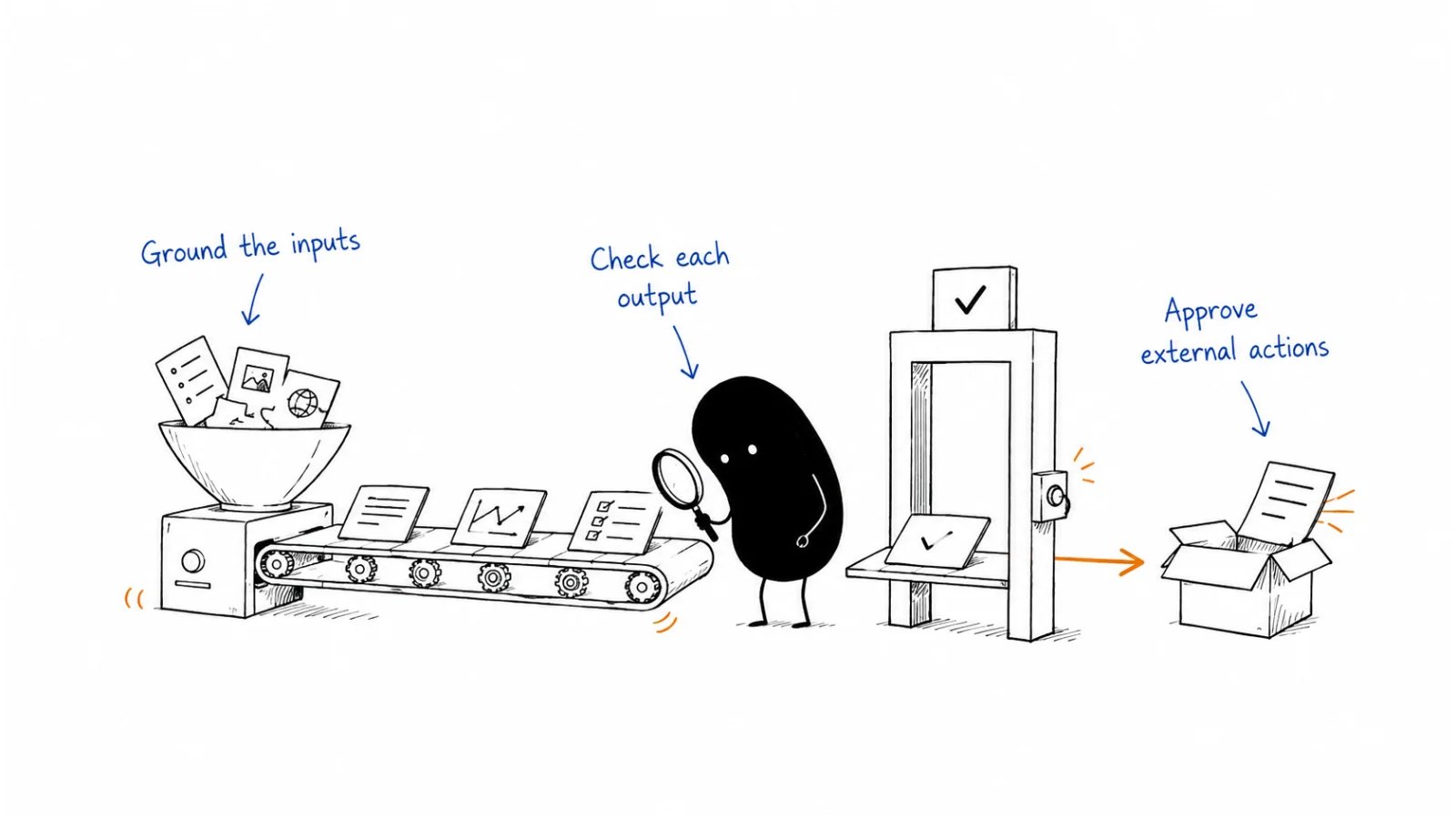
Do not ask “what are the steps?” Ask: what artifact must exist before the next move is allowed? If a stage has no artifact, no gate, and no collapse, it is ceremony. If an external message has no human approval, it is an incident waiting for a cron job.How to do it
Step 1: Define the finished output
What does the workflow produce? Why is a good one good? What must not be lost when you reproduce it? One-off, personal repeatable, or a module other people will run—pick one. If the output is still “help with sales,” stop. Write what the example (if you have one) actually depends on: process moves you will keep, tone you will keep, anti-patterns you will ban.Step 2: Set the human and AI responsibilities
Exact use case. Final deliverable. Human role. AI role. Success condition. Unacceptable failure. At least one hard constraint. Inputs you are guaranteed versus ones you will pretend to have. Tools and sources that are allowed. Assumptions that are forbidden. Stop if another operator could not run this from the card.Step 3: Identify likely failure modes
Likely shortcuts. Fake-success (the brief looks complete and the ICP was guessed). Stage-mixing. Laundering a guess as evidence. The highest-cost wrong answer (email the wrong account; invent a security claim). If you have not named the expensive failure, you are decorating.Step 4: Break the workflow into reviewable steps
For each stage: objective, allowed evidence, prohibited moves, required artifact, advancement gate, collapse condition, recovery move. Repeat until the final package. Then try to break it: can the model jump to the end, fake a stage, or look right without obeying the gates? Kill stages that exist for elegance. If the job is lighter than the architecture, simplify.Step 5: Define approval rules for external actions
- Assignment — what it is trying to finish.
- Permitted action space — read, draft, classify—not send, not discount, not invent policy.
- Escalation — existing customer, legal words, weak fit, missing inputs.
- Output format — fields, not a vibe paragraph.
/resources/ tree or their sprint price list.
Worked example (illustrative)
Sales-assist ops tool. Six discovery calls a week.Copy: workflow card (fill)
- Final artifact and why a good one is good:
- Human role / AI role:
- Success / unacceptable failure:
- Hard constraint:
- Guaranteed inputs / forbidden assumptions:
- Stages (artifact · gate · collapse · recovery):
- How we tried to break it:
- Assignment · action space · escalation · output format:
- Human gate before send (yes/no):
Before you start
- The artifact is concrete enough to reject a bad draft.
- Every stage has an artifact, a gate, and a collapse.
- The expensive failure is written.
- External send requires a human.
- Action space does not include “be helpful.”
- We did not paste a public worksheet as the live SOP.
- We did not deploy because a cookbook said it was week 60.
Metrics
Do not count workflows drawn, or resemblance to a paid architect worksheet, as reliability.
Common mistakes
- Vibes prompt → production.
- Stages with no artifact.
- Automating judgment.
- A second browser for the team to live in.
- Building complex agent-to-agent arrangements before one workflow works reliably with human review.
- Copying a fractional-consultant 90-day price ladder as your plan.
- Building the workflow before AI use-case selection names the problem.
What to read next
The bet this workflow serves is AI use-case selection. The ladder the company is on is GTM AI maturity. The test row is experimentation. The record it may write is CRM data model. Findability of the facts it reads is SEO and AEO. Then write the teammate: ai-teammate-brief.md.Sources and evidence boundary
This is an owner-maintained operating synthesis. It is not a Sacred Loop product, not a Sun Business Group engagement, and not an Agent Commerce Protocol implementation. Artifact-first stages (gates, collapse, recovery, attack-the-design) are distilled from a public operator worksheet (Jason Hubbard / Sacred Loop, AI Workflow Architect Worksheet). Assignment, permitted action space, escalation, and output format before outbound agents—and the reminder that agents parse structured meaning—are distilled from a public GTM prep note (Sun Business Group, Agentic Prep Cookbook, linked from their resources directory). Both are method prompts, not sources to copy. Gated manuals,/resources/ file recipes, ACP checklists, sprint prices, course pitches, and phone numbers are not this library’s program.
Copyright © 2026 Ivan Xu. All rights reserved. See the copyright and reuse terms. Canonical source: github.com/weilun88313/B2B-Playbook