

Use this when
- The first marketing hire is “a growth person” because pipeline is the only story the board hears.
- The Head of Marketing has never executed at this stage, motion, or company size—too many firsts at once.
- Fuel, engine, and PMM sit in silos; content never reaches a channel; paid has nothing worth clicking.
- You are past a handful of marketers and still have no one whose job is to connect campaigns across the three.
Do not use this when
- There is no ICP and no motion. Stay in first ten and channel strategy.
- You need next year’s demand vs capacity math. That is GTM planning. Headcount dollars are budget and planning.
- You need the weekly sales clock. That is sales operating cadence.
- The request is a JD, a hiring scorecard, or a copy of someone else’s org chart.
A few useful terms
Keep this in mind
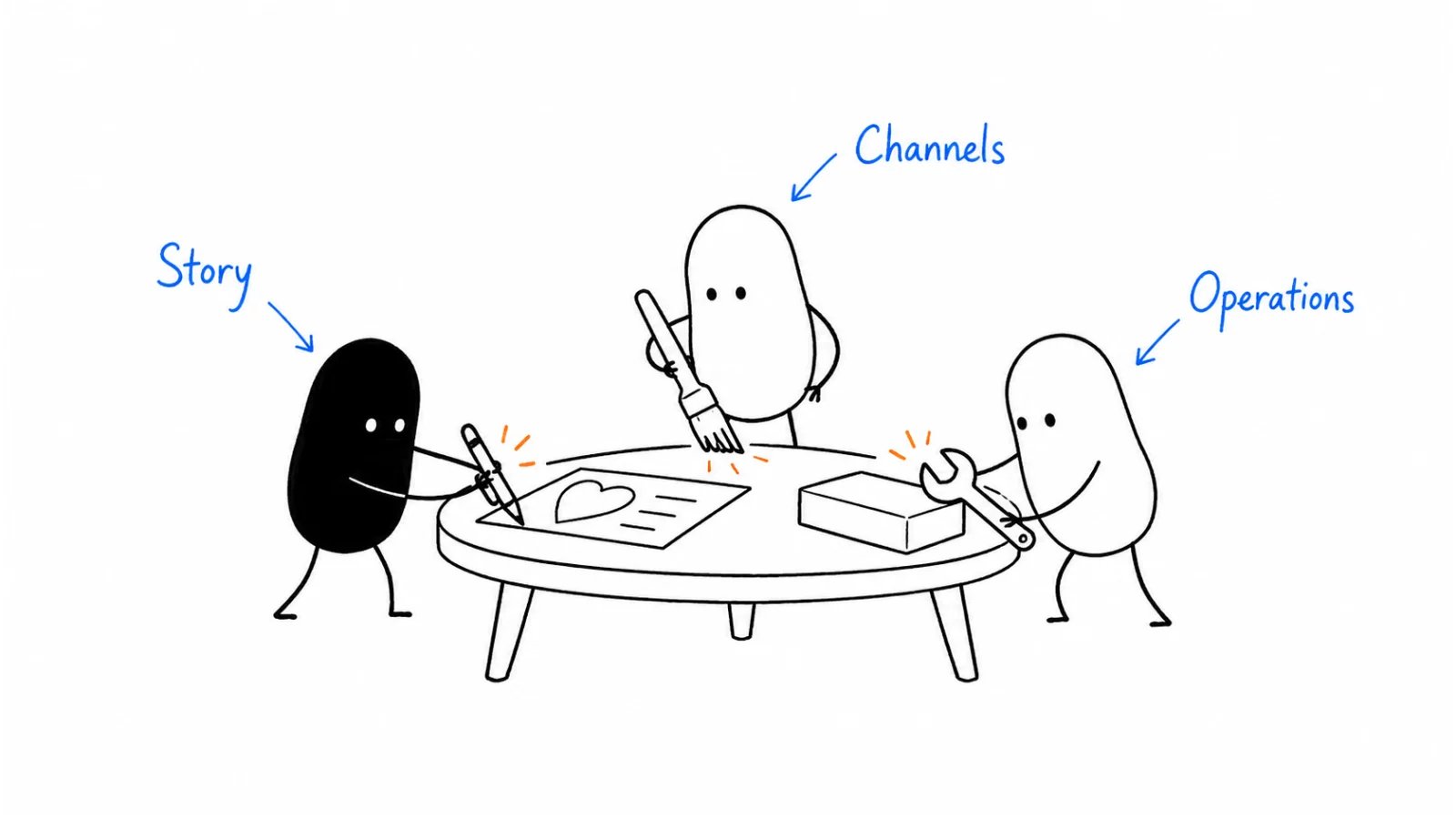
Hire generalists who cover two of the three, then fill gaps; do not staff only the engine. A Head of Marketing remains an IC until the team is large. If fuel and engine are misaligned, add a producer who reports to the Head—not another demand-gen seat that never talks to content.How to do it
Step 1: Match early hires to the work
The first marketer should be on their first or second of these—not five: scrappy execution; owning strategy; early-stage company; your buying motion (self-serve vs sales-assist vs outbound); managing people; the sub-function you need most. Default first hire is often PMM + growth. Sometimes content + PMM. Content + growth as the first hire is rare. Match channel strategy: a self-serve motion that hires only enterprise PMM, or an outbound motion that hires only brand, is a firsts problem wearing a title.Step 2: Cover content, distribution, and operations
Until you have specialists, people wear two hats. As you add seats:
Do not hire three growth people and a contractor for “some blogs.” Do not hire a very senior Head who only sets strategy. Alternate fuel and engine as you scale; keep enough PMM to aim both. Contractors without an internal owner who knows the business are decoration.
Step 3: Keep leadership close to execution
The Head of Marketing still produces until the team is well past a small squad (Kramer’s 2024 guide: still an IC until the team is well over ~20). Around a handful of people, a producer—campaigns, program management, mileage, feedback into the three crafts—reports to the Head, not into one silo. That is how fuel and engine stay married. Company cadence and content strategy still set the calendar; producers run it. Past ~15, put leads on sub-functions so the Head is not twenty directs. Past ~20, process and handoffs matter more than another specialist; re-org if events, ecosystem, or lifecycle no longer fit the original three boxes. Do not copy a 25-person chart at headcount four.Step 4: Explain marketing priorities to the rest of the company
Share strategy and priorities, not a research dump. Teach fuel vs engine so sales and product stop asking marketing to be a pipeline vending machine. Random acts of marketing from other teams die when the strategy inputs and a short KPO list are visible. This is not a brand campaign about the marketing team.Worked example (illustrative)
Sales-assist. Two marketers today. Primary engine: outbound + one event motion.Copy: org card (fill)
- Primary motion (channel strategy):
- Firsts we will not stack on the next hire:
- π-shape we need (depth / proficient):
- Fuel coverage today / gap:
- Engine coverage today / gap:
- Foundation (PMM) coverage today / gap:
- Head still ICs? until headcount ~:
- Producer: not yet / reports to Head / buried in a silo (fix):
- Next two hires (alternate fuel and engine):
- What we will tell the rest of the company this month (priorities, not a recap):
Before you start
- Motion is written; the hire matches it.
- Next hire is not stacked with too many firsts.
- π-shape names depth and a second proficiency.
- We are not hiring only engine.
- Head still has IC work, or the team is actually large enough.
- If fuel and engine already miss each other, a producer reports to the Head.
- Contractors have an internal owner.
- Internal update shares priorities, not a folder of research.
Metrics
Do not count org-chart revisions, open reqs, or agency retainers as an operating system.
Common mistakes
- Too many firsts on the first marketer.
- Hiring only growth / demand gen.
- Senior Head who will not execute.
- Specialists before generalists.
- Contractors with no internal strategy owner.
- Fuel, engine, and PMM as three companies.
- Glue buried inside one sub-function.
- Treating marketing as this quarter’s pipeline desk.
What to read next
What they will spend is budget and planning. Whether the year is possible is GTM planning. What they will ship is content strategy and channel strategy. Launches they must own are product launch. The quarterly calendar is company cadence.Sources and evidence boundary
This is an owner-maintained operating synthesis. It is not a compensation band, not a visa or labor-law guide, and not a copy of any company’s chart. “Too many firsts,” evaluating stage / motion / sub-function fit, and π-shape (depth in one of PMM, content, or growth plus proficiency in another; first hire often PMM+growth) draw on Emily Kramer and Kathleen Estreich (MKT1, 2021-01-28), restated in the MKT1 Method (2023-12-13) and hiring episode (2025-03-26). Three sub-functions as fuel / engine / foundation, generalists first, do not hire only engine, Head still ICs until a large team, producers as glue reporting to the Head, and the 1→10 / 10→20 / 20+ failure modes draw on Kramer (MKT1, 2024-08-19). Fuel and engine as the teaching metaphor: 2021-11-17. Teaching the rest of the company with strategy rather than a research dump: 2024-02-21. Headcount bands and dates in those essays are her scale sketches for VC-backed B2B teams on those dates—not this library’s SLA. Paid FigJam org charts, JD packs, and interview scorecards are not reproduced here.Copyright © 2026 Ivan Xu. All rights reserved. See the copyright and reuse terms. Canonical source: github.com/weilun88313/B2B-Playbook