

Use this when
- Last-click ROAS is how brand, podcast, and founder posts get defunded.
- Marketing and sales each have a “source” field and they disagree on every deal.
- Leadership wants “full-funnel attribution” before anyone asked buyers how they heard.
- Capture campaigns look like heroes and creation looks like waste.
Do not use this when
- Lifecycle words are undefined. You will measure noise. Define shared lifecycle stages first or at least the lead-scoring actions.
- You need a test design. That is experimentation.
- You need next year’s capacity math. That is GTM planning.
- The request is to implement a vendor’s multi-touch model as the source of truth.
A few useful terms
Keep this in mind
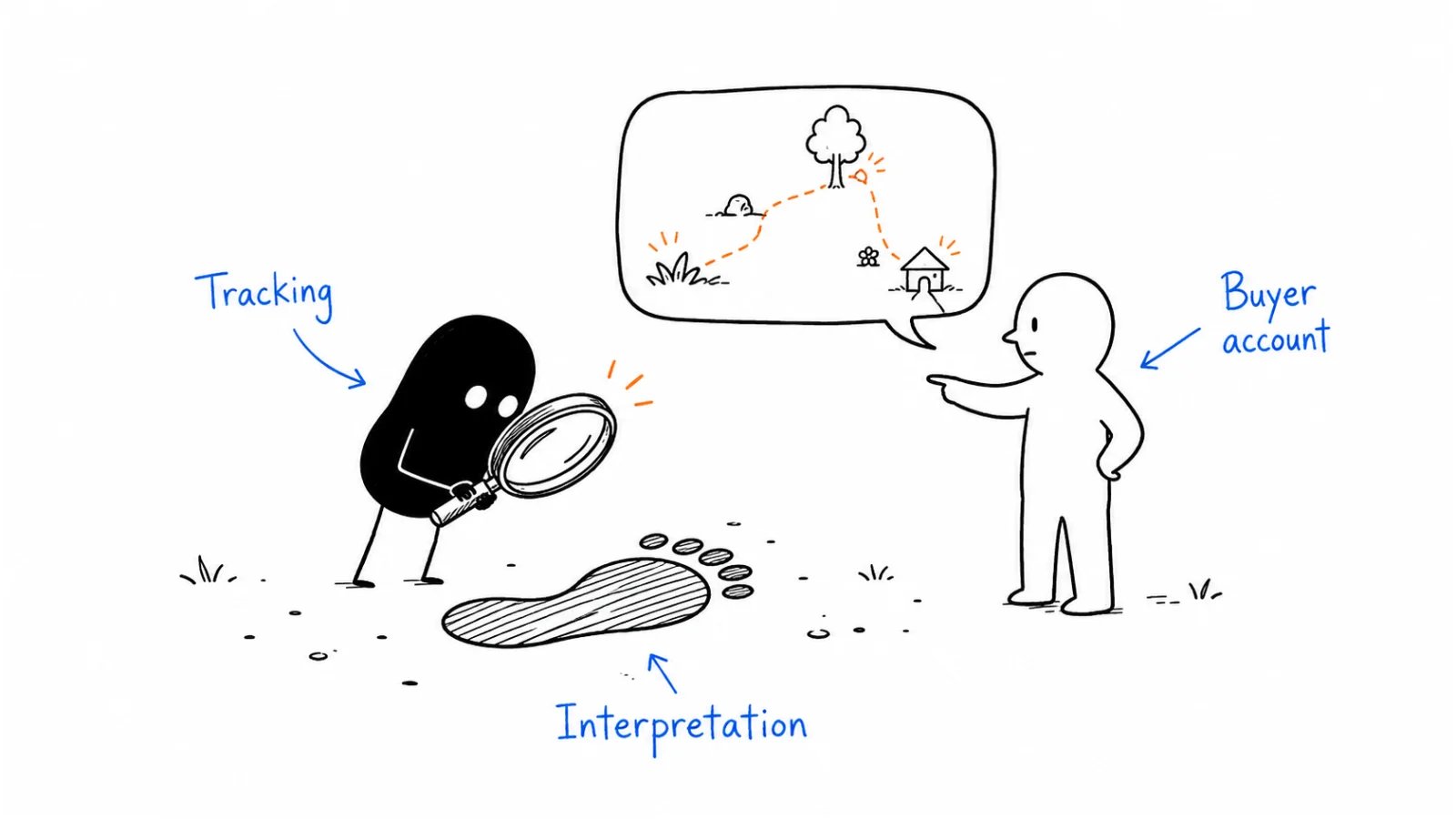
Software measures capture paths; humans measure creation paths; neither alone is the budget. If you only have UTMs, you will over-fund search and retargeting. If you only have stories, you will fund vibes. Ask on the high-intent form, keep the UTM, and refuse to pick a winner with one column.How to do it
Step 1: Keep channel tracking and buyer feedback separate
Write which weekly review reads capture (qualified conversations, accept rate, capture CAC you actually believe) and which quarterly review reads creation (category reach/evenness if you pay for it, HDYHAU mix, branded search, sales “I have been seeing you”). The CMO Scorecard is the public version of “creative and media inputs, long-horizon outcomes.” You do not need their product to refuse a 14-day CPL on a memory campaign. Kellblog-style board metrics (pipeline coverage, CAC payback, NRR) stay company numbers. Do not let a channel dashboard impersonate them.Step 2: Ask buyers how they found you
On demo request and other hand-raises: mandatory free text, no dropdown, no “Google / LinkedIn / Event” hints. Categorize after—string-match or a human pass. Prompting the list biases the study. Do not put HDYHAU on every content gate. You will train “idk” and you will think you measured demand.Step 3: Be clear about what software records
UTMs: first meaningful marketing touch and the session that converted—both stored, neither holy. Source = the offer or destination when that is more predictive than the referring hostname (a Refine Labs ops note, not a law). Sales may overwrite with a human source only through a written rule; silent edits are how two truths appear. Last-touch and first-touch are diagnostics. They are not the budget.Step 4: Investigate differences between the two views
Hybrid means: software says X, buyers say Y, here is what we will fund anyway. Refine Labs’ public study (620 declared-intent conversions, twelve months, software vs SRA) reported a large gap on dark social—podcast was a majority of their self-reported revenue and ~0% of their software credit. That is their tape. Your mix will differ. The method is the mismatch review, not their 90%.Step 5: Use experiments for causal questions
“Does this channel work?” on a small, new buy is experimentation: hypothesis, kill date, decision. Multi-touch models will not save a campaign that never defined the job. Incrementality tests and holdouts beat another attribution schema when the spend is large enough to justify them.Worked example (illustrative)
Sales-assist. Founder posts. Light search capture. No podcast yet.Copy: measurement card (fill)
- Capture metrics, owner, cadence:
- Creation metrics, owner, cadence:
- HDYHAU: which forms, open text (yes/no), who categorizes:
- Software fields we will trust—and only for what:
- Board metrics we will not let a channel dashboard impersonate:
- Disagreement rule (what we fund when SRA and software fight):
- What we will test instead of attributing:
Before you start
- Two scoreboards are written; one weekly meeting does not mix them without a label.
- HDYHAU is open text on declared intent.
- UTM/source rules are written; sales edits are governed.
- Creation campaigns are excluded from 14-day CPL kill decisions.
- A mismatch review exists (even a spreadsheet).
- Privacy/consent owner knows what you store. This page is not that review.
- No vendor model is the single source of truth.
Metrics
The model is a metric policy. Use this table as the refuse list:Common mistakes
- Buying HockeyStack / Dreamdata / a CDP to postpone asking buyers.
- Dropdown HDYHAU.
- One source field to rule them all.
- Firing the podcast because Salesforce said Organic.
- Treating Refine Labs’ 90% as your KPI.
- Asking attribution to answer a strategy question.
What to read next
The form that collects SRA is demo request. The buys that need two scoreboards are paid media and LinkedIn organic. Tests that can change the plan are experimentation. Whether next year’s number is possible is GTM planning. Person-level routing stays lead scoring. Use funnel model and pipeline model for progression, cohorts, and commercial planning.Sources and evidence boundary
This is an owner-maintained operating synthesis.- Two clocks: capture the 5, create among the 95; creative and media as inputs. LinkedIn B2B Institute 95-5 and CMO Scorecard.
- Open-text HDYHAU on declared-intent forms; software = capture, SRA = creation; read both. Refine Labs Attribution Mirage and Hybrid Attribution Framework. Sample sizes, $21.5MM, and the 90% figure are their study. Method only.
- Board-level SaaS metrics: Kellblog as a company scoreboard voice—not as channel attribution.
- Multi-touch SaaS products are tools. They are not this method. Attribution explains model math while retaining the distinction between tracked paths, buyer reports, and causal evidence.
Copyright © 2026 Ivan Xu. All rights reserved. See the copyright and reuse terms. Canonical source: github.com/weilun88313/B2B-Playbook