

Use this when
- Inbound volume is large enough that “work everything” is how good leads die.
- Sales says marketing sends junk; marketing says sales never follows up; nobody wrote the threshold.
- Every page view adds a point and employees keep becoming “hot.”
- You are about to turn scoring on retroactively in a MAP without a change-control note.
Do not use this when
- You do not yet have an ICP or a disqualifier. Agree on who fits before assigning scores.
- Volume is a handful of inbound names a week. A human queue beats a model.
- You need account-level orchestration. Person scores are not an account program. Use account scoring to combine account-level evidence and define the next action.
- Legal or consent rules forbid the events you want to count. This page is not privacy advice.
A few useful terms
Keep this in mind
Do not pay out points for every small action. Opens, social clicks, and uncritical page views will manufacture MQLs. Use intervals (every n events) and high-value URLs (pricing, demo) instead of “+1 per breath.” Use negative scoring for people you must not chase.How to do it
Step 1: Define the action a score should trigger
Complete this sentence: at score ≥ ____ (or rule ____), ____ is notified, must ____, within ____. If SQL is a Salesforce checkbox a human ticks, say so. Connecting lifecycle stage to a MAP score without a human is a choice—write it. Changing a live model re-scores the whole database. Small tweaks only; radical rewrites need a migration note.Step 2: Keep fit separate from intent
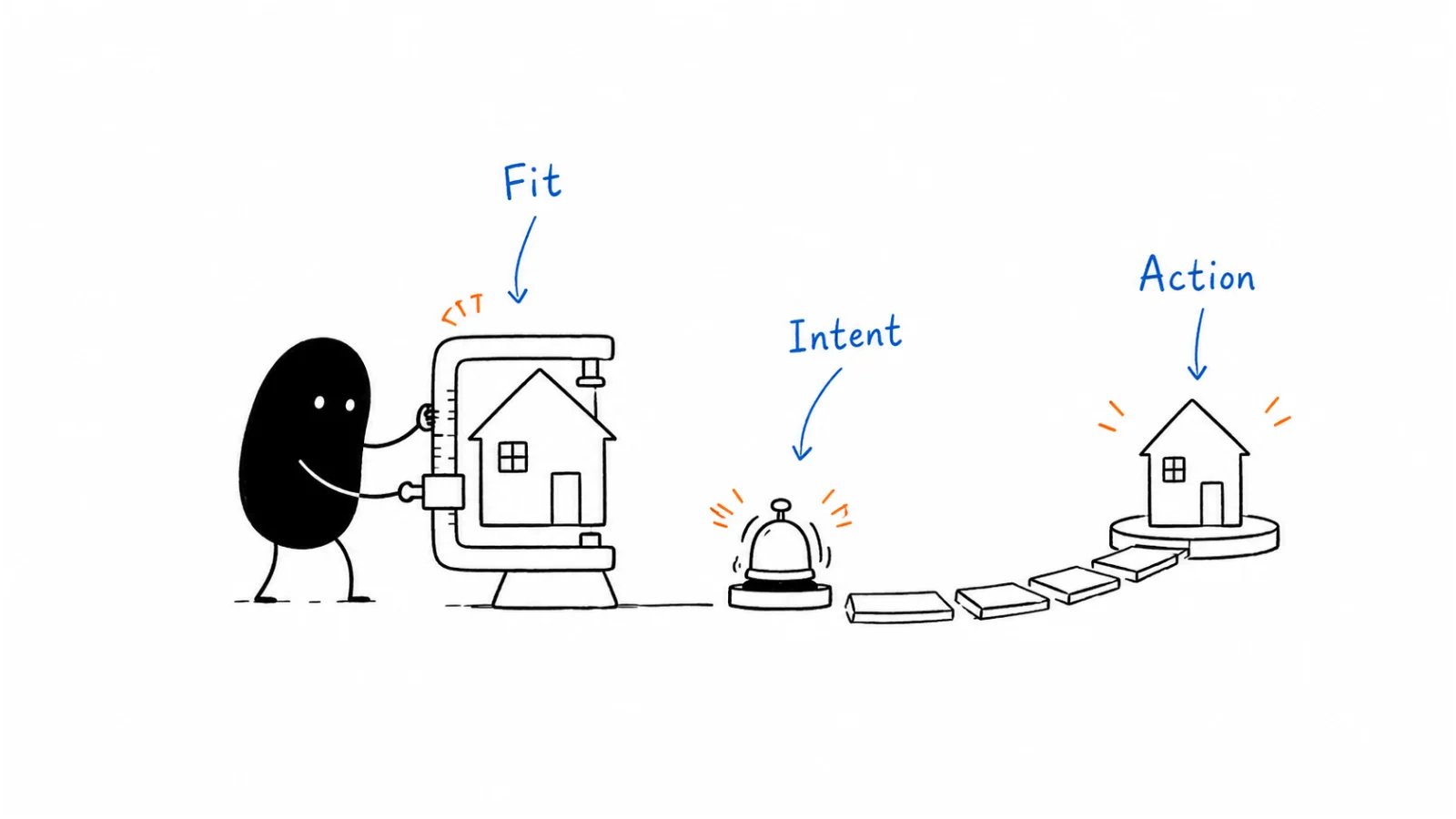
Fit without intent is a good logo browsing. Intent without fit is a student on the pricing page. Score both, or you will route the wrong people. Hand-raisers (demo, pricing, contact) should skip the leisurely ladder and notify whoever owns speed-to-lead. That is a workflow, not a polite +3.Step 3: Relate engagement to the buying situation
Awareness forms should be short enough that a stranger will complete them. Consideration can ask role and size. Decision can ask the questions that make the meeting useful. Progressive profiling: if you already have the field, ask the next one—not the same form twice. Reuse forms; segment with lists off page + form, not a new form per PDF. Do not copy another company’s industry dropdown or “50 employees or we disqualify” as your ICP. That is their wedge.Step 4: Include negative signals and exceptions
Employees, job seekers, known customers, agencies you do not sell, competitors: either large negatives or a persona that routes elsewhere (HR, CS, partnerships). Existing customers usually need help from their account or customer success team. Define a separate route so their activity does not put them into new-customer prospecting by mistake.Step 5: Test the rules against real outcomes
Seed points from your past leads, not a vendor blog. After go-live, review MQLs that sales rejected and SQLs that never closed. Adjust intervals before you adjust philosophy. The ledger is the artifact; the MAP is the implementation.Worked example (illustrative)
B2B workflow product. Sales-assist inbound. HubSpot is the MAP; SQL is accepted in the CRM by an SDR.Copy: scoring ledger (fill)
- Action at threshold (who, what, SLA):
- Fit attributes and disqualifiers:
- Intent events (high-value URLs and forms vs interval behaviors):
- Negatives and customer/employee handling:
- MQL definition vs SQL definition:
- Form fields by awareness / consideration / decision:
- Progressive-profiling rule:
- Review cadence and what would trigger a migration:
Before you start
- ICP and disqualifiers exist in writing.
- Threshold changes a task, not a dashboard color.
- Fit and intent are both represented.
- Hand-raisers bypass the slow ladder.
- Negatives exist; careers are not “engaged.”
- SQL ownership is named (human vs automatic).
- Forms match stage; progressive profiling is on.
- A change log exists before go-live.
Metrics
Do not count “model turned on” or resemblance to a HubSpot sample guide as success.
Common mistakes
- Points for every open, visit, and like.
- MQL = SQL = more points.
- Radical rescoring with no note, then wondering where the pipeline went.
- Copying another company’s form fields and employee-count floor.
- Scoring customers into the new-customer prospecting queue.
- Launching without an SLA.
What to read next
Who may be touched at all is ICP. A dated change that is not yet a form fill is buying signals. What the first meeting must teach is the pitch. If humans work the queue, they need SDR onboarding. Whether marketing can create the volume behind the scores is GTM planning. Use routing and SLA to define ownership, response clocks, and exceptions. The fields the score writes into are CRM data model.Sources and evidence boundary
This is an owner-maintained operating synthesis. It is not a HubSpot implementation guide, not GDPR advice, and not a benchmark point table. The split of fit vs behavior, negative scoring, high-value pages, interval scoring for cheap actions, explicit MQL vs SQL, caution against live radical changes, stage-based forms, progressive profiling, lists off reused forms, and workflow-at-threshold are distilled from an operator sample lead-scoring guide (Google Doc; HubSpot-shaped; company placeholders). That file is a method prompt, not a source to copy. Its example point values, industry lists, employee-count floors, and product-specific form fields are not this library’s facts.Copyright © 2026 Ivan Xu. All rights reserved. See the copyright and reuse terms. Canonical source: github.com/weilun88313/B2B-Playbook