

Use this when
- Sales wants a cadence tool, CS wants conversation intelligence, finance wants a forecast UI—and everyone thinks it is “one platform.”
- The last purchase cannot two-way sync with the CRM and nobody wrote that as a requirement.
- Implementation is “the vendor will configure it” with no owner and no exit test.
- You found a vendor grid with scores out of 10 and are about to paste it into a board deck.
Do not use this when
- There is no motion and no CRM map. Stay in channel strategy and CRM data model.
- You need software names for a job. Start in TOOLS.md, then come back here to evaluate.
- Procurement, security, or privacy review must be done by qualified owners. This page will not sign a DPA.
A few useful terms
Keep this in mind
Split the jobs before you split the vendors. Cadence / engagement, conversation intelligence / coaching, and pipeline / forecast are often sold as one suite and fail as one suite. If two-way CRM sync is not in the contract of requirements, you will re-key forever.How to do it
Step 1: Define the jobs the tool must do
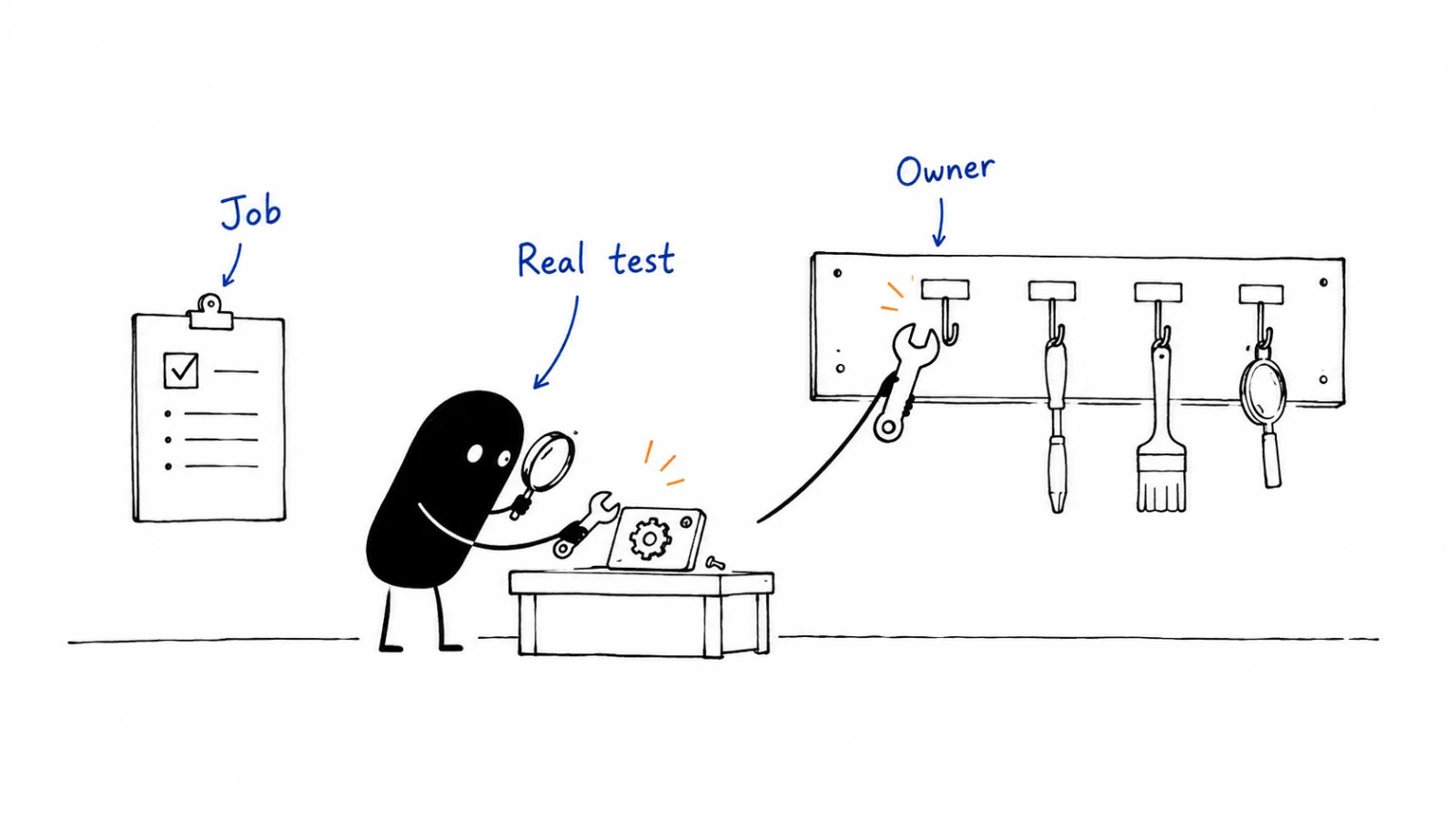
Complete: we are buying a tool so that ____ can ____ every ____, writing ____ into the CRM. If you cannot finish that sentence, you are shopping. Outbound needs a sequence home. Forecasting needs a source of truth—often the CRM, sometimes an overlay. Conversation intelligence is coaching and inspection, not a second forecast.Step 2: Talk to relevant customers
A published grid of “overall satisfaction” is their interviews, their year, their segments. Use it only as a prompt for questions, never as your score. Ask: win reasons, what is still weak, who they also evaluated, pricing shape, implementation calendar, CRM (and whether sync is two-way). Write your answers in the working file.Step 3: Record limitations alongside strengths
Recurring failure modes in this category of tools (from buyer-shaped grids, not as our benchmarks): CRM sync that is one-way or brittle; conversation intelligence that does not match the category leader the buyer compared; support that collapses across time zones or during implementation; forecast that cannot hold large, slow deals; pricing that only looks cheap per seat. Treat these as test cases, not as a ranking of named vendors.Step 4: Understand the full cost
Pricing model, discount logic (seats vs term), implementation as a line item, and a range for time-to-live-in-the-tool. Do not copy a community PDF’s median ACV into your model. Quote your seats and your legal. AI and usage pricing change the bill; treat software as a portfolio with a kill date, not a growing stack of seats. A vendor-spend benchmark landing page is a prompt for those questions—not your budget (Stackpack 2026 spend report is gated; we did not import its tables).Step 5: Assign an owner and review date
One owner. Fields it may write (from the CRM map). A date you will review usage and sync errors. If the bake-off winner cannot do two-way sync on required fields, that is a no—not a “phase two.”Worked example (illustrative)
Outbound-assist, ~12 sellers. CRM is the forecast source of truth. Not a vendor ranking.Copy: evaluation one-pager (fill)
- Jobs in scope this buy (and jobs we will not bundle):
- Required CRM writes (objects/fields, two-way yes/no):
- Recent-buyer questions we will actually ask:
- Win reasons we will test:
- Opportunity areas we will test:
- Pricing model we will quote:
- Time-to-live-in-tool we will believe:
- Alternatives we must see in the same bake-off:
- Owner, review date, kill criteria:
Before you start
- Jobs are split; a suite is a choice, not a default.
- CRM map exists for every field the tool will touch.
- Two-way sync is a requirement or an explicit out-of-scope.
- Community scores were not pasted as our scores.
- Implementation has an owner and an exit test.
- Pricing model is written; a borrowed median ACV is not.
- Kill / review date exists.
Metrics
Do not count vendor demos attended, or a 9.2/10 in a partner PDF, as governance.
Common mistakes
- One SKU for cadence, CI, and forecast because the logo is famous.
- Skipping two-way CRM sync until after contract.
- Treating implementation time as the vendor’s optimistic week.
- Importing another researcher’s satisfaction scores as facts.
- No owner after the invoice.
- Expanding TOOLS.md with a Slack list of AI apps instead of a job.
What to read next
The record the tools must obey is CRM data model. Sequences live in multichannel sequence. The call still lives in forecasting. Product names for a defined job start in TOOLS.md—start with the job table there, then the row. A community logo sheet or a marketplace-first skill pack is not the stack—pick the problem in AI use-case selection and the rung in GTM AI maturity first.Sources and evidence boundary
This is an owner-maintained operating synthesis. It is not a ranking, not a price guide, and not an endorsement of any vendor. The evaluation shape (overall buyer sentiment as a prompt not a score, win reasons vs opportunity areas, products/use cases, pricing model, typical alternatives, time to implement, headquarters as context only) is distilled from a two-page vendor scorecard on sales engagement and revenue intelligence produced with a GTM community (buyer-interview grid). That file is a method prompt, not a source to copy. Its satisfaction scores, median ACVs, discount anecdotes, implementation ranges, and named vendor columns are not this library’s facts or a ranking. Vendor marks remain theirs.Copyright © 2026 Ivan Xu. All rights reserved. See the copyright and reuse terms. Canonical source: github.com/weilun88313/B2B-Playbook