

Use this when
- You are hiring the first account executive, customer-success person on a number, or overlay, and “we will figure out variable later” is the current plan.
- People already carry quota and cannot say, without a manager in the room, what pays and what does not.
- Finance, sales, and the founder each have a different definition of “booked.”
- You are about to change the plan for a new year and the only process is a December Slack thread.
Do not use this when
- The founder still sells the first few logos by hand. Stay in first ten customers. A plan for a team of one is a salary conversation, not a compensation architecture.
- There is no ICP and no primary motion. You will pay people to hunt the wrong accounts.
- You need a full incentive-compensation product shortlist. That is software selection, not this method. The test on this page is: can you credit, calculate, and pay on time? If the answer is no, simplify the plan before you buy a system.
- Legal, works council, or a union must set pay. This page will not override that.
A few useful terms
Read this once. The rest of the page assumes these meanings.
Hunter means “paid to create new committed revenue.” Farmer means “paid to keep and grow a book.” The labels matter only if the components match the job. A “hunter” paid mostly on renewals is a farmer with a misleading title.
One rule that survives every spreadsheet
Pay people for the outcome they can own. If they do not control professional services scoping, do not put 30% of variable on services. If two people both “influenced” the deal, write a split rule before the deal closes—not in the dispute. Operators call this compensation solution neutrality: the plan should not bribe someone to sell the wrong packaging because it pays better. A pattern that keeps showing up in operator rooms: more of the paycheck at risk tends to travel with higher average attainment—if territories are fair. That is not a reason to starve base or to copy an enterprise mix onto four people. It is a reason not to pay full variable for doing 60% of the job. Check the book before you check the person.How to do it
Do these in order. Skipping to a cute accelerator while crediting is undefined is how January becomes a war.Step 1: Define the role and main responsibility
Write one sentence: this person is paid to ______ in ______ accounts, measured as ______. Examples of sentences that work:- New-logo AE: land committed subscription from accounts they do not already own.
- Expansion AE / farmer: grow net committed revenue in a named book.
- CSM on a number: retain and expand the book they run; they are not a hunter.
- Overlay (SE, partner): a defined slice or a multiplier on someone else’s close—never a second full quota on the same dollar unless you intend to double-pay.
Step 2: Define what revenue earns credit
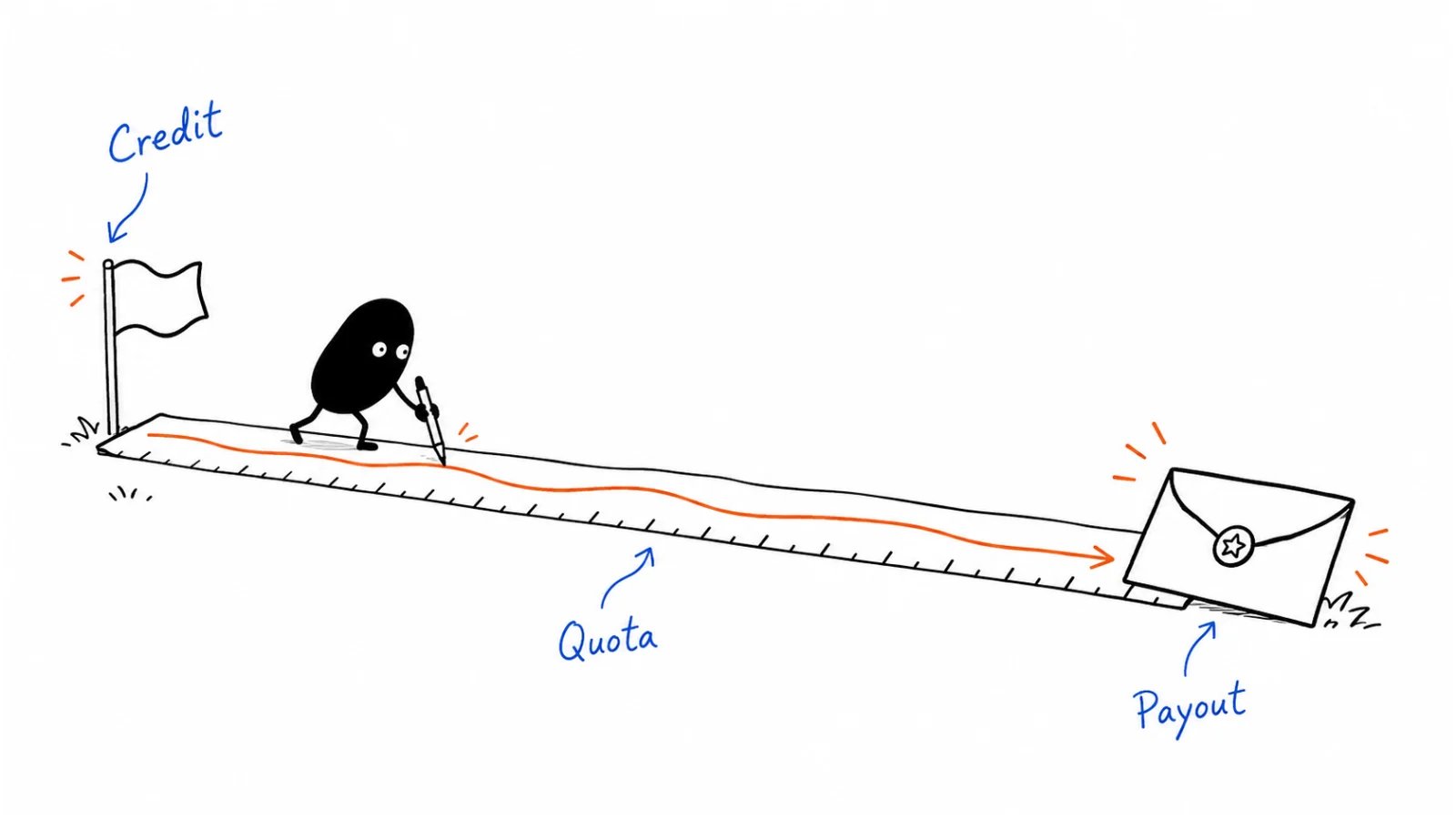
The credit metric is the unit that hits quota. Choose the one that matches how you actually sell, not the one that makes a dashboard pretty.- Pure subscription, little one-time junk: credit committed recurring—the monthly or annual amount the contract promises (often called CMRR or the ARR equivalent). A professional-services blob in month one should not look like a hero year.
- License, hardware, and services in one motion: total contract value (TCV) or bookings is usually the honest number. Forcing CMRR onto a perpetual-license shop just invents arguments.
- The test: would two equally good years look the same under this metric, or does the metric reward a packaging trick (prepaid multi-year dumped into one period, services stuffed into “bookings,” a side letter that finance will unwind)?
Step 3: Set target pay, pay mix, and quota
Work backwards from a job people will take, not forwards from a revenue wish.- OTE. What does a competent person in this role, in this city, actually require to join and stay? If you cannot hire at that OTE, the plan is fiction.
- Pay mix. More variable means more leverage and more fear. A starting place for teaching, not a law: many new-logo AEs sit near 50/50 or 60/40 (base/variable). Farmers and CSMs usually carry more base. Overlay roles often carry less variable than a core AE. Do not copy a 70% variable enterprise hunter plan because it looked aggressive in a slide.
- Quota. Quota = the amount of the credit metric that equals 100% attainment. Set it from territory capacity (how much a competent person can land in this book), not from “we need $X so divide by headcount.” If a fair book cannot support the quota, you did not design a plan. You designed a pay cut.
Step 4: Model the payout curve
The curve is how attainment turns into dollars of variable.- Below 100%: pay less than a straight line, or start paying only after a threshold. Full variable for 70% attainment trains the team that the number was optional. The money you do not pay here is what funds people who overperform.
- At 100%: 100% of target variable for that component.
- Above 100%: the rate should get steeper (an accelerator). If the slope stays flat, crushing quota is a hobby. If everyone is at 120%, the quota was a gift—fix the quota, do not celebrate the culture.
- Caps. A cap is a policy choice. Early teams often skip a cap so a once-in-a-decade year can pay. If you cap, write why (cost, windfall risk, a known one-time event). Silent caps destroy trust.
Step 5: Keep the variable components understandable
Each component is a mini-plan: its own weight, its own quota or pool, its own curve if you must. Two to four components. More than that, nobody knows what to do on Tuesday. Weights should match this year’s strategy, not last year’s org chart. If the company needs new logos, do not put 50% of AE variable on renewal. If the company is drowning in churn, a hunter-only plan is malpractice. Teaching shape (invented numbers, not a benchmark):
Kill a component that exists because a stakeholder wanted “visibility.” Visibility is a dashboard. Pay is a job.
Step 6: Test realistic rep outcomes
A new formula that has not been replayed against last year’s book is a speech. For each person (or a sample of books): what would they have been paid under the new plan? Who jumps, who drops, and is that the set you intend to keep? If the model says your best hunter takes a cut because you reweighted to renewal, that is a retention conversation before January 1. You do not need a full model every year. Model when the metric, mix, curve, or component weights change. A cost-of-living bump on base is not a redesign. While you model, look at territory balance. If three people have a book that can never hit 80% and two people inherit a river of inbound, the plan will look “unfair” no matter how pretty the accelerator is. Fix the books, or admit you are paying for assignment luck.Step 7: Check affordability and administration
A plan you cannot administer is not a plan. It is a lawsuit in slow motion. Write, in one page:- Credit splits (AE/SE, AE/AE, partner).
- Overlay rules.
- When credit is earned and when it is reversed.
- Draws and ramps for new hires (how many months, at what percent of variable, and whether it is recoverable)—detail on incentive timing.
- Who arbitrates a dispute, and in how many days.
Step 8: Explain the plan before it takes effect
The plan fails in the first manager meeting, not in the PDF. A sequence that holds:- Steering agrees the communication plan—dates, who speaks, what is frozen, what is still a FAQ.
- Build the training, including worked examples (“this deal credits here; this one does not”).
- Train managers first. They are the trainers. A skip-level dump onto reps guarantees ten versions of the plan.
- Schedule manager → rep sessions. Attendance is the job, not optional.
- Publish FAQ and a named inbox. First-week questions are the real spec. Update the FAQ; do not improvise in Slack.
- The written plan is the plan. People acknowledge it (sign, click-through, whatever your counsel accepts). A slide deck is not an acknowledgment.
- Managers walk their team through their own book under the new formula. Abstract training without their numbers does not stick.
Step 9: Plan changes before the next period
When the year will change the plan, use lanes. Modeling is not required every cycle—only when the design moves.
Mid-year change is an exception with a named reason (acquisition, a broken metric, a legal requirement). “We missed Q2” is not a reason to rewrite variable in July. You will teach the team that the plan is optional.
Worked example (illustrative)
Eight new-logo AEs. Subscription software. No hardware. Founder still closes a few named accounts outside the team.
At 100% of the new-ARR quota this person earns the $72,000 (80% of $90,000) tied to that component, plus whatever the expansion slice pays. At 50% they earn none of the new-ARR variable—by design. At 125% they are on the accelerator; the under-performers in the model are where that money comes from.
Copy the empty fields below. Do not copy the dollars as a market benchmark.
Copy: one-role plan (fill)
- Role and one-sentence job:
- Credit metric (and why not the alternative):
- When a deal counts / when it reverses:
- OTE:
- Base / variable (pay mix):
- Quota for the period:
- How quota was set (territory capacity, not a wish):
- Components and weights (max four):
- Curve: threshold · at-plan · accelerator · cap or no cap:
- Ramp / draw (if any):
- Credit splits and overlays:
- Who calculates payout, in what system, by what date:
- Who owns disputes:
- Steering approval date:
- Manager training date → rep session dates:
- Written plan + acknowledgment date:
Copy: year-end change (fill)
- Request window (open / close):
- Gaps named by sales / the business:
- Design changes (metric, mix, curve, weights)—or “rates only, no model”:
- Model result (who gains / loses, territory flags):
- Approvals (sales · GTM · People/HR):
- Ops verdict (implement as designed / simplify / manual with owner):
- Test deals used:
- Distribute + acknowledge by:
Before you start
- The buyer-facing price is a separate decision; this plan does not “make up” discounting.
- Each quota-carrying role has a one-sentence job and a credit metric that matches it.
- OTE can hire the role in the real market; mix is a choice, not a vibe.
- Quota comes from territory capacity; books were checked for balance.
- The curve pays less than linear below plan and steeper above plan, or a written reason explains why not.
- Variable has two to four components; each has a 100% definition.
- New design was modeled on last year’s book, or the change is too small to need a model.
- Crediting, timing, clawbacks, ramps, and dispute owner fit on one page.
- Someone can calculate a paycheck on time without heroics.
- Managers are trained before reps; the written plan is acknowledged.
- Counsel has seen the document if employment or wage rules apply.
Metrics
Do not count a finished kickoff deck, the number of SPIFs, or resemblance to a famous company’s mix as success.
Common mistakes
- Paying for activity (dials, meetings, unverified opportunity creation) instead of credited outcomes.
- Eight components and a curve nobody can draw from memory.
- Setting quota from a company wish divided by heads.
- Ignoring territory luck, then calling the plan “meritocratic.”
- A flat slope above 100%, so extra performance is a favor.
- Paying full variable for weak attainment, then wondering why accelerators have no budget.
- Changing the plan in Slack in July because the quarter missed.
- Launching by PDF on day one with no manager training and no acknowledgment.
- Crediting “influence” after the fact.
- Buying an ICM tool to rescue a plan you cannot explain on a whiteboard.
- Copying another company’s pay mix, including one from a membership template, without their books, roles, or admin stack.
- Letting customer discounts and seller pay fight each other with no rule (who owns the discount, and does it hit quota at list or at net?).
What to read next
What the market pays is still pricing. How the first meeting sounds is sales enablement. Whether this role should exist is channel strategy. If the hire is an SDR/BDR, the number is useless until they can do the job: SDR onboarding. Whether leadership can trust the path to the number is forecasting. When pay is reversed or advanced, that is incentive timing. Ops leaders are not a second AE quota: RevOps compensation. If you do not yet have the first handful of customers, do not start here—first ten. Write the credit event in the plan itself so marketing and sales are not using two definitions of “won.”Sources and evidence boundary
This is an owner-maintained operating synthesis. It is not a licensed compensation product, not a salary survey, and not legal advice. The sequence (role → metric → OTE/mix/quota → curve → few components → model → administer → train managers first → acknowledge → year-end lanes), the CMRR-versus-TCV choice by motion, solution neutrality, the idea that variable-at-risk and attainment often move together when books are fair, and the instruction to make above-plan pay steeper so under-plan pay can fund it, are distilled from operator practice in a Pavilion-circulated sales-compensation procedural template (undated PDF; internal screenshots in that file are circa 2016–2017). That file is a method prompt, not a source to copy, and not a verified use case in this repository. It includes third-party consulting artifacts and real-company tables; none of those names, employees, or numbers are imported here. Jason Jordan and Michelle Vazzana, Cracking the Sales Management Code, appears in that operator material as a named book pointer for managing the sales system, not as a page this repository abridges. Pavilion as a paid community is listed in RESOURCES.md. This repository does not require a membership, and it does not reproduce members-only templates.Copyright © 2026 Ivan Xu. All rights reserved. See the copyright and reuse terms. Canonical source: github.com/weilun88313/B2B-Playbook