

Use this when
- Finance handed a top-down revenue number and marketing has not yet said whether the funnel can produce it.
- The budget annualizes every req as if they started January 1.
- CAC, payback, and LTV:CAC are used as slogans with no shared formula.
- Paid, events, and tools were locked before anyone counted marketers by month.
Do not use this when
- Strategy inputs are empty. Fill marketing-strategy-inputs.md and GTM planning first.
- You need who to hire for fuel vs engine. That is marketing org.
- You need the weekly forecast call. That is forecasting.
- This is securities guidance or an investor model. Get qualified owners.
A few useful terms
Keep this in mind
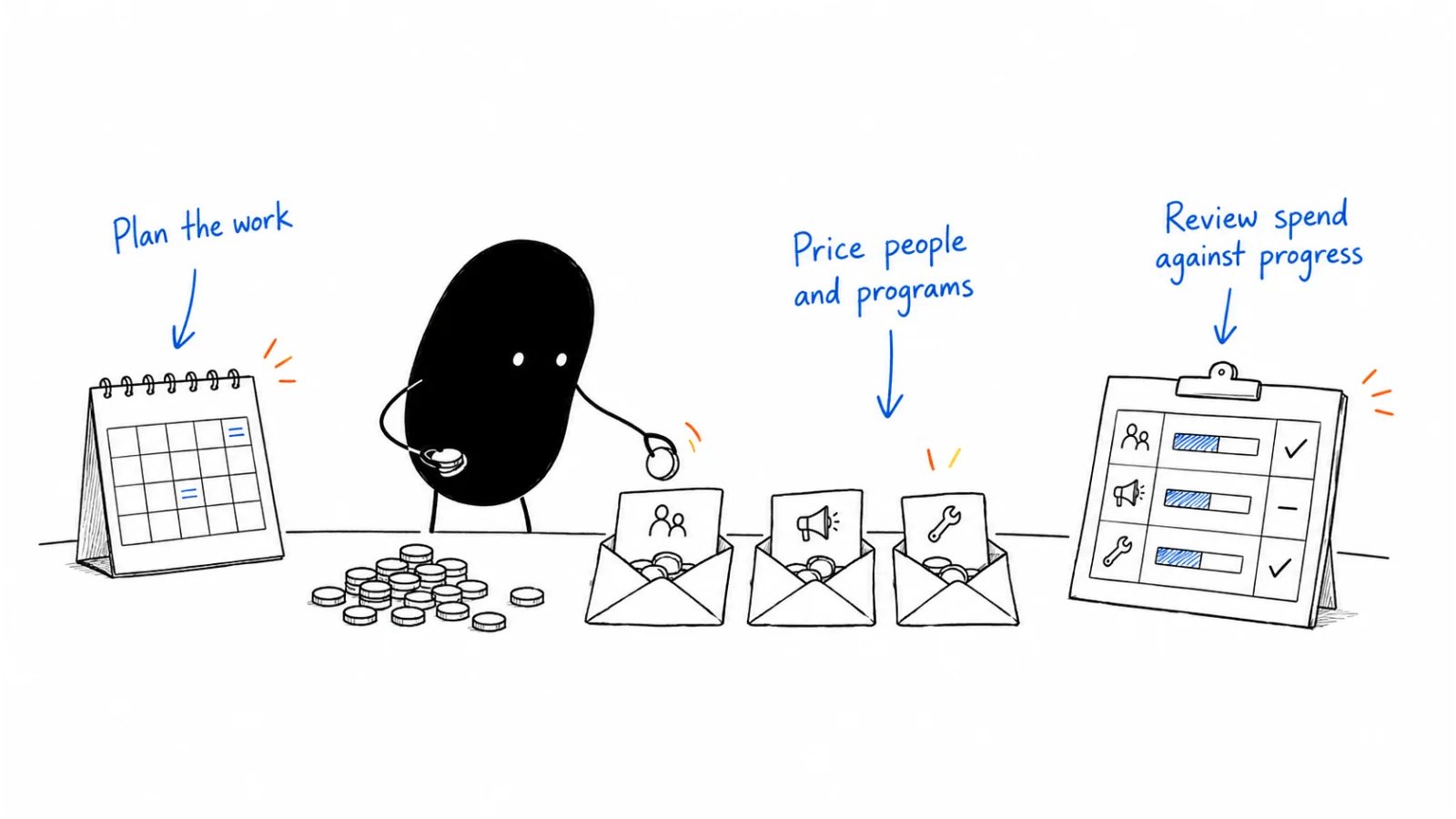
Budget and forecast iterate together; headcount is monthly. If the bottom-up cannot hit the top-down without typing over conversion cells, you change the target, the spend mix, or efficiency—not the formula. Sample CAC ratios and payback bands from any essay, including sources cited below, are not your SLA.How to do it
Step 1: Compare targets with a bottom-up plan
Top-down without bottom-up is a number nobody can create. Bottom-up without top-down is a hobby. Put both on the table with GTM planning. If finance needs $X and the demand sheet says $Y, that is a conversation—not a cell you overwrite. You cannot finish budget without a forecast, or forecast without a budget. Iterate. Paid, programs, and events change what is possible; what is possible changes what you can spend on people; people change what you can run.Step 2: Choose appropriate cost measures
Agree inside the company what CAC, payback, and LTV mean (new ARR vs bookings, gross margin, logo vs revenue churn). Then use them as a range-finder for a first budget—not as a law. Always split total CAC into sales vs marketing. If you have no history, write an explicit split and a date to replace it. Do not import a public “40% marketing” as a command. Kramer’s 2024-12-11 ranges for early-to-growth venture-backed B2B SaaS (CAC ratio, 12–18 month payback, ~3:1 LTV:CAC) are her sample on that date—method prompts. Bootstrapped, usage-priced, or services-heavy businesses will not share those bands. Payback longer than customer lifetime is a red flag in any model. A budget as a percent of revenue is a weaker prompt; if leadership insists on one, write it as an extra check, not the engine.Step 3: Plan headcount and programs by month
Fully loaded cost per marketer from finance—not salary. Count who is in seat each month, including people who start in April or November. Subtract that from the working budget. What remains is programs, paid, events, tools, agencies. Then reconcile: if leftover cannot fund the engines in the demand plan, cut scope, slip a hire, or change the revenue target. Do not keep the hire plan and the paid plan as if both were free. Marketing org decides which seats; this step decides when they hit the P&L.Step 4: Review spending against the plan
Break the year into months. Put the summary next to the GTM planning one-pager: revenue target, efficiency diagnostic you are steering to, headcount by month, remaining mix, constraint. Revisit when conversion or start dates slip—same rule as the demand sheet: only change inputs.Worked example (illustrative)
Not your rates. Not a benchmark.Copy: budget card (fill)
- Top-down number and owner:
- Bottom-up number (GTM planning reconcile):
- Gap and the decision (target / mix / efficiency / capacity):
- Shared definitions: CAC, payback, LTV, new ARR:
- Marketing vs sales share of total CAC (and when we will replace the guess):
- Fully loaded cost per marketer:
- Headcount by month (names or seats, start dates):
- Remaining mix (paid / programs / events / tools / agencies):
- Efficiency diagnostic we will steer to (our number, not a pasted band):
- Monthly review owner:
Before you start
- Strategy inputs and demand vs capacity exist; this page does not invent a motion.
- Top-down and bottom-up are both on the table.
- CAC includes sales and marketing; the split is written.
- Formulas are the company’s, dated; no pasted “industry” cells.
- Headcount is monthly, fully loaded, with start dates.
- Remaining mix can actually fund the engines in the demand plan.
- Sample calculator outputs from any template were cleared.
- We did not treat a VC-SaaS newsletter band as our SLA.
Metrics
Do not count a finished spreadsheet tab, or a CAC ratio copied from a 2024 essay, as a budget.
Common mistakes
- Agreeing to a finance number before the bottom-up exists.
- Annualizing headcount you will not have until Q4.
- Treating total CAC as the ads budget.
- Pasting public payback or LTV:CAC bands into the board deck as “the target.”
- Locking paid and events before people.
- Changing conversion cells so the budget “fits.”
- Hiring plan from marketing org with no monthly cost.
What to read next
Whether the funnel and the sales floor can meet is GTM planning. Who sits in the seats is marketing org. Calling the quarter is forecasting. Two scoreboards for what you buy or publish: measurement model. The calendar that keeps a launch off the close: company cadence.Sources and evidence boundary
This is an owner-maintained operating synthesis. It is not a financial model for fundraising, not tax advice, and not a benchmark. Iterate budget with top-down and bottom-up forecasts, start with a range from efficiency diagnostics, split total CAC into marketing vs sales, model headcount by month at fully loaded cost, then allocate the remainder and reconcile to the demand plan draw on Emily Kramer (MKT1, 2024-12-11), as a companion to the annual-planning series already cited on GTM planning (2024-09-23). CAC-ratio, payback, and LTV:CAC bands in that 2024-12-11 essay, and the 35–45% marketing-share-of-CAC sketch, are her prompts for early-to-growth venture-backed B2B SaaS on that date—not this library’s SLA, not a command to copy her calculator, and not a fit for every business model. The paid budget template, efficiency calculator, and AI prompts behind that paywall are not reproduced here.Copyright © 2026 Ivan Xu. All rights reserved. See the copyright and reuse terms. Canonical source: github.com/weilun88313/B2B-Playbook