

Use this when
- Marketing and sales both “own” the same logos and neither can say the tier or the weekly move.
- Leadership wants ABM because ACV is high, and the plan is ads + a landing page per industry.
- The T1 list is fifty accounts and nobody has a plan file.
- You are about to buy an ABM platform to create the strategy.
Do not use this when
- ICP is empty. Stay in ICP.
- You do not yet have ~10 matching customers. Handmade rings are first ten.
- You need the 30/60/90 for one logo. That is account planning.
- The motion is unnamed. Channel strategy first.
- You want papering and procurement. Outside this taxonomy.
- You want 1:1 creative on the entire GTM TAM. That is not ABM; map and signal the universe, then cut to capacity.
A few useful terms
Keep this in mind
Tier first, then tactics. Start by deciding how many priority accounts your team can realistically support this quarter. That gives you a practical limit for the program. Use one-to-one ABM and one-to-few ABM for the corresponding execution plans.How to do it
Step 0: List the addressable accounts in the CRM
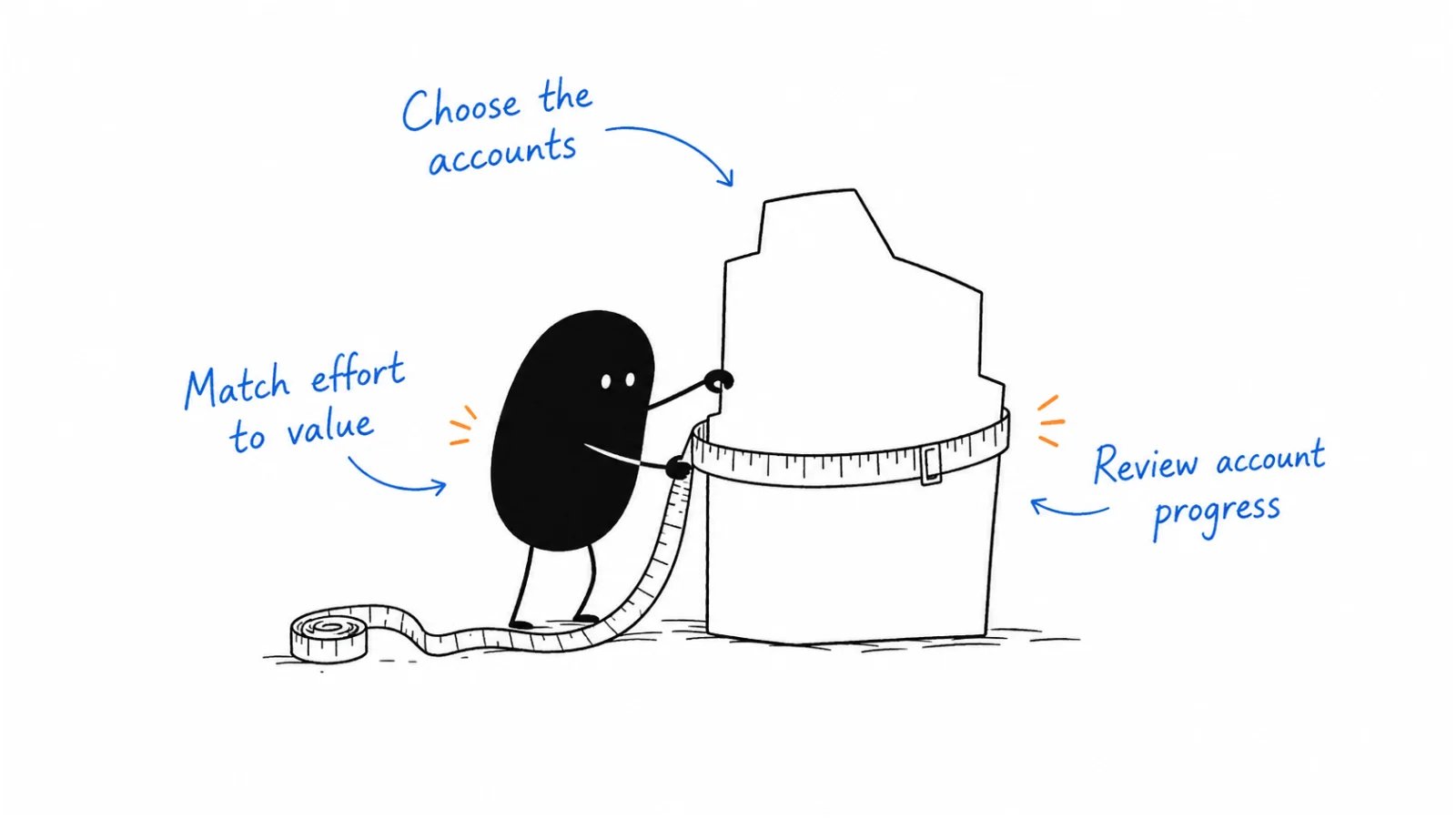
ICP and wedge define who belongs in the universe. Load those accounts (then contacts) into the CRM or warehouse. Write who is not TAM this year. Pitch-deck TAM for investors is not the operating list. Then choose a few signals you will actually act on (fit change, intent, engagement, a buying signal)—not fifty campaign ideas. Inbound form-fills are one signal among others. Stages belong on the account and the person; a lead-only funnel is how you forget the company. CRM data model is the record; this step is the GTM choice. This is not “ABM everyone we could ever sell.” T3 stays 1:many. T1 stays scarce.Step 1: Match the account list to team capacity
Complete: this quarter we can honestly run ____ T1 plans and ____ T2 clusters. T1 is measured in plans that get a weekly owner, not in TAM rows. If sales headcount cannot cover the T1 list, cut the list. Do not hire a platform to hide the math. Fit still comes from ICP. Intent and relationship can upgrade a name; they do not create a tier you cannot staff.Step 2: Set the service level for each tier
Do not invent T4. Do not put T3 on a personalized microsite.
Step 3: Use approaches the team can already run
ABM does not invent channels. It concentrates them:- Outbound sentences still need message-market fit.
- Proof is a case study or comparison URL, not a new brand.
- Field is a dinner or show aimed at named seats.
- Partners sit in ecosystem.
Step 4: Review progress at account level
Scoreboard: T1/T2 accounts that progressed (new relevant seat, scoped meeting, stage move you would defend in forecasting). Measurement model still forbids one UTM to own the account. Report form submissions separately from progress in the selected accounts. Record whether each account was part of the program before interpreting its activity.Step 5: Revisit the list regularly
Monthly: which T1 plan is stale, which T2 cluster never met, which T3 name is being treated like T1. Promote/demote in writing. ABM lists that only grow are a grave.Worked example (illustrative)
Sales-assist. Six AEs. High ACV.Copy: ABM system card (fill)
- GTM TAM in CRM (account + contact) / still a spreadsheet:
- Signals we will act on this quarter (few):
- T1 capacity this quarter (number + why that is staffable):
- T2 clusters (problem, account count, one shared play):
- What T3 is allowed to be (and what we will not call it):
- Entry / exit rules for a tier:
- Progression we will count:
- Platform we refuse until ______:
Before you start
- ICP and primary motion are written.
- GTM TAM is in the CRM as accounts (and contacts), not only a TAM slide.
- A short signal list exists; inbound is not the only front door.
- T1 count ≤ plans we will actually keep alive.
- Every T1 has or will get an account plan.
- T2 shares a problem, not only a vertical.
- T3 is not branded as ABM.
- Scoreboard is account progression, not MQLs.
- Review date for promote/demote is on the calendar.
Metrics
Do not treat ABM-influenced pipeline, ad engagement on account lists, or “accounts reached” as the program.
Common mistakes
- Calling the whole TAM “ABM.”
- Killing inbound and brand because the CRM now has accounts.
- Calling ICP outbound ABM.
- A T1 list larger than weekly coaching can see.
- Buying orchestration to postpone the plan file.
- Personalized assets nobody sends.
- Measuring MQLs from a tier-3 form.
- Skipping account planning and running “plays” into a void.
What to read next
The file for one T1 logo is account planning. A small table is executive dinners. Partners already in the building are ecosystem. Person-level work inside the program is outbound. After they buy, the book is customer success; expansion is expansion marketing. Continue with one-to-one or one-to-few execution according to the account tier and available capacity.Sources and evidence boundary
This is an owner-maintained operating synthesis.- Treat selected accounts as the market; coordinate marketing and sales; measure the account. Public ITSMA / Bev Burgess account-based marketing definition, stated as a method, not as a membership or a book you must buy. Vendor orchestration guides (including Demandbase, already cited on the master index) are not this page’s operating system.
- Capacity-before-list and “T3 is not ABM” are this library’s judgments, paired with account planning and channel strategy.
- Account-driven GTM as the foundation (TAM and ICP in the CRM, account + contact, signals, inbound as one signal not the only door; not “ABM the whole TAM”; not a substitute for brand) draws on Emily Kramer (MKT1, 2025-02-12 and 2025-02-27). The paid 50+ tool list and 50+ campaign-idea sheet are not reproduced here. GTM TAM vs pitch TAM is the same split as wedge.
- This page is not a license to scrape account data or to ignore consent.
Copyright © 2026 Ivan Xu. All rights reserved. See the copyright and reuse terms. Canonical source: github.com/weilun88313/B2B-Playbook