

Use this when
- New-logo quota is covering a leaking book and nobody will say so.
- CS and sales both “own expansion” and the customer hears two stories.
- Every QBR ends with a SKU, including accounts that never launched.
- Packaging created a second product and marketing wants a campaign to the whole base.
Do not use this when
- There are no customers. Stay in first ten.
- You need who owns the book. That is customer success.
- You need the renewal clock. That is renewal marketing.
- Gross churn is the fire. Fix onboarding and ICP before you sell more surface area.
A few useful terms
Keep this in mind
Do not expand an account that has not realized the first purchase. If launch is still open, or they cannot name the result, another SKU is how you create contraction. CS workspace must show realization before marketing writes a campaign.How to do it
Step 1: Agree on who owns the conversation
Write the sentence customer success already demands: renewals live with ____; expansion lives with ____; they are paid on ____. If both are paid on the same dollar, say so. If they conflict, stop the campaign until sales compensation is honest.Step 2: Look for a customer need
Allowed triggers (need two that a stranger could check):- They hit a usage or seat wall they already understood on the pricing page
- A new seat or team asked for the same job
- A dated constraint (security, region, product line) the first SKU does not cover
- They asked
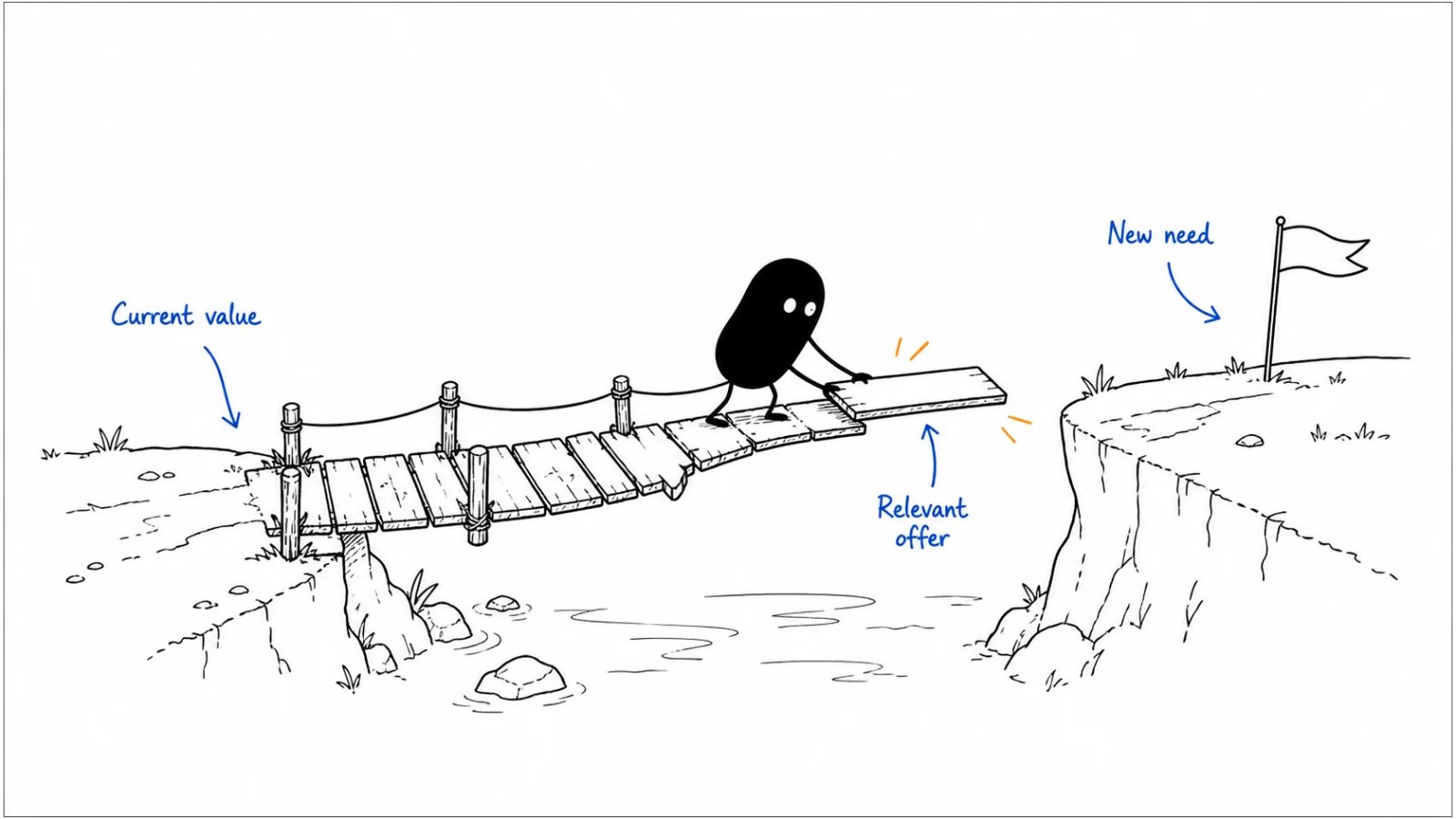
Step 3: Offer the next useful use case
One additional job, one owner in their committee, one next step (scoped conversation or a case study from a similar expand). Positioning already says add-ons are for accounts that own the lead product—not a second standalone category story.Step 4: Review losses as well as expansion
If expansion is the only reason net looks healthy, say that in GTM planning. Review upgrade revenue alongside departing customers so growth in healthy accounts does not hide problems elsewhere.Step 5: Keep the outreach relevant to each account
Do not email the whole customer list a new SKU. Segment on realization + trigger. A base-wide “what’s new” is lifecycle later—and even then it is education, not a close.Worked example (illustrative)
Ops queue product. Second SKU = audit log / enterprise admin.Copy: expansion card (fill)
- Who is paid for expansion / who is paid for renewal:
- Realization rule (what must be true):
- Triggers we will honor (checkable):
- Triggers we refuse:
- Next job we are allowed to introduce this quarter (one):
- Segment (not the whole base):
- Gross vs net sentence we will not hide:
Before you start
- Commercial owner is written and does not secretly fight CS pay.
- Realization is visible in CS workspace.
- Triggers are dated and checkable.
- One next job, not a catalog.
- At-risk and unlaunched accounts are excluded.
- Gross is reported next to any expansion celebration.
Metrics
Do not treat “expansion pipeline from a product-launch email” as health.
Common mistakes
- Expanding before launch.
- Two owners, two stories.
- Base-wide SKU blast.
- Using expansion to paper over gross churn.
- A second category story for an add-on.
What to read next
The clock that must not be a surprise is renewal marketing. The leak expansion must not hide is revenue churn. Who runs the book is customer success. How the second product is positioned is position the way you sell. Named-account expansion still uses account planning.Sources and evidence boundary
This is an owner-maintained operating synthesis. Realization-before-ask and “do not let expansion hide gross” are this library’s judgments, already implied by customer success, CS workspace, and revenue churn (Kellblog-shaped gross vs net). ITSMA/ABM “land and expand” slogans are not a method. This page is not a packaging or revenue-recognition opinion.Copyright © 2026 Ivan Xu. All rights reserved. See the copyright and reuse terms. Canonical source: github.com/weilun88313/B2B-Playbook