

Use this when
- You hired (or became) the first CS executive who will own retention, expansion policy, and the post-sale journey—not only a queue.
- The board wants CS “strategic” and the team only closes tickets.
- Health scores, NPS, and NRR cannot be explained by the people who live in them.
- Sales thinks CS is delivery; CS thinks Sales sold fiction.
Do not use this when
- There are no customers. Stay in first ten.
- You need the CS operating system for ICs. Write customer success first; this ramp uses it.
- You need implementation clocks. That is customer onboarding.
- You need seller 90 days. That is sales-leadership ramp.
Keep this in mind
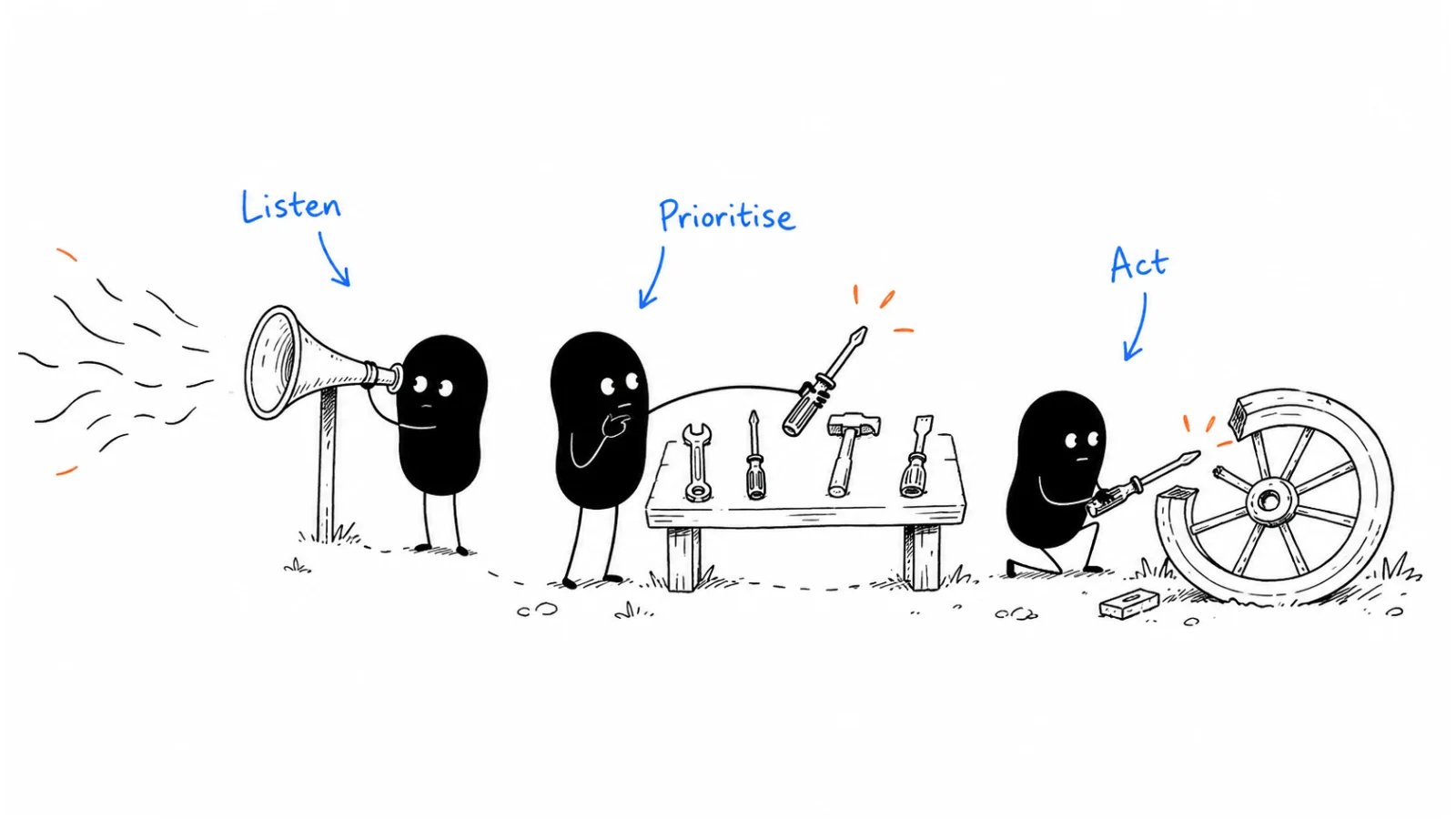
Days 1–30 you are the auditor of the book, not the keynote. Days 31–60 you name what CS is accountable for—and what it is not—with Sales, Product, and Finance in the room. Days 61–90 you prove it with a few visible standards (QBR, onboarding milestones, a health view Sales can see), not a reorg slide.How to do it
Step 1: Days 1–30: understand customers and the team
By segment: what “health” claims, and whether NPS/CSAT/health scores match reality. Which accounts are at risk and why. What share of the book had a strategic conversation in the last 90 days—not a ticket. As a system: drop-offs between Sales and CS; onboarding by segment (self-serve vs assisted); whether success plans exist and are visible; who owns expansion versus the CRO. Inward: who is doing success versus support versus admin. Whether CSMs can talk commercially or only “relationship.” Pattern recognition. Map the flywheel you will have to build. Do not announce the flywheel yet.Step 2: Days 31–60: agree on priorities and coverage
Write the charter: outcomes CS owns; where CS partners vs leads; non-negotiable engagement standards. Reset with Sales, Marketing, Product, RevOps: segmentation; renewal and upsell homes (same fight as customer success and sales compensation); QBR depth and frequency; CS → Product feedback loop that Product will actually read. With Finance and RevOps: GRR/NRR definitions; churn and expansion language; whether the health score is a model or a mood. If the formulas disagree, that is the work—not a dashboard color. Culture: if the team is only reactive, you may rebalance portfolios or move from one-size coverage to segments. Ratios are GTM planning math, not a LinkedIn benchmark. You are setting the foundation for scale, not performing scale.Step 3: Days 61–90: put the plan into daily work
Visible, dated wins: a QBR shape run on top accounts; onboarding relaunch with milestones the customer already has in onboarding communication; health (or a simpler at-risk flag) visible to Sales; books reassigned only from the segment insight, not from preference. Then the cross-functional job: Sales on expansion forecast and shared renewals; Marketing on advocacy only where value is real; Product on a short list of escalations, not a suggestion box. By day 90 the team should know the charter, customers should have a next date, and the CEO should see CS as a number with a process—not a gap.Step 4: Avoid making large changes before learning
Support lead in a CCO title. Tickets are a path; they are not the mandate. Agency-in-week-two as strategy. Partners can add capacity later; they do not replace seeing the book. Your network is not a substitute for customer success written down.Worked example (illustrative)
First VP CS. Forty logos, one CSM, AE still expands. Health score is a vibe.Copy: 90-day one-pager (fill)
- Days 1–30: health-by-segment findings · at-risk why · engagement % · handoff gaps · success vs support time:
- Days 31–60: charter (own / partner / not) · renewal & upsell homes · GRR/NRR language · coverage change:
- Days 61–90: QBR / onboarding / visibility wins · Sales · Marketing · Product asks:
- What we will not do in 90 days (reorg, tool rip-and-replace, agency as strategy):
Before you start
- 30-day work is the book and the journey, not a vision offsite.
- Charter names what CS does not own.
- Finance agrees how GRR/NRR/churn are calculated.
- 90-day wins are in CRM or customer-facing artifacts, not only a narrative.
- Hiring follows capacity, not a template bullet.
- Seller ramp and CS ramp are not the same document.
Metrics
Do not count CCO-school enrollment, or a “growth engine” slide in week two, as ramp.
Common mistakes
- Repositioning CS in a town hall before listing at-risk.
- Owning expansion in the charter while AE pay still owns it, with no written split.
- Trusting a health score nobody can calculate.
- Reorg in month one.
- Copying a Pavilion CCO 30-60-90—including “bring partners immediately”—as the plan.
- Treating this page as IC CSM ramp.
What to read next
The book those 90 days inspect is customer success. First value is customer onboarding and onboarding communication. The record CS lives in is CS workspace. Seller-side 90 days remain sales-leadership ramp. Pay still sits in sales compensation.Sources and evidence boundary
This is an owner-maintained operating synthesis. It is not a job description, not a Pavilion course, and not a recommendation to hire agencies. The 30 / 60 / 90 CS-executive verbs (audit the book and journey → charter, metrics, coverage → visible QBR/onboarding/health wins and cross-functional role) are distilled from a public CCO first-90-days mini-guide (Kickstand / Pavilion University template). That file is a method prompt, not a source to copy. Quotes about CCO visibility, CCO School, partner-as-week-two strategy, and named executives in the PDF are not imported as requirements. Pavilion is listed in RESOURCES.md.Copyright © 2026 Ivan Xu. All rights reserved. See the copyright and reuse terms. Canonical source: github.com/weilun88313/B2B-Playbook