

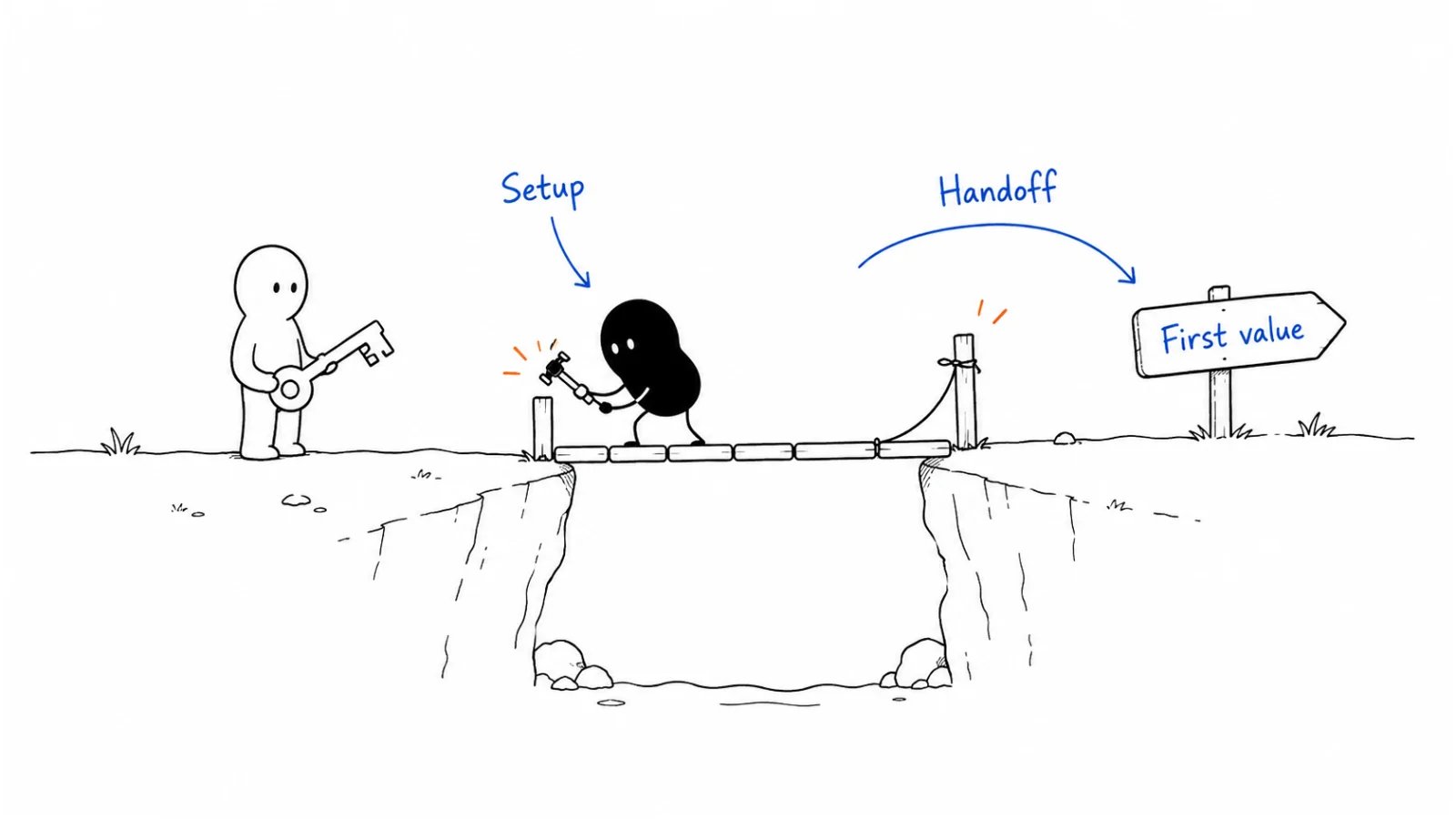
Use this when
- Deals close and customers stall in “we’ll get to the technical bit.”
- CSMs are running implementations they are not good at.
- Sales promised a date nobody scoped.
- You cannot say whether you are measuring time-to-launch or time-to-value.
Do not use this when
- There is no signed customer. Stay in first ten.
- The product is truly self-serve and the only job is an email series. Use lifecycle email for that communication—do not invent a professional-services factory.
- You need the ongoing CS operating system. That is customer success.
Keep this in mind
It is not a methodology if it is not written down. Repeatability → standardization → quality. Workshop it with the people who run the work. Identify milestones and a playbook for when a milestone is missed. A named methodology is also a sales tool: it is what you can point to when the buyer asks “what happens after we sign?”How to do it
Step 1: Separate learning from technical setup
From the customer’s side, not yours: acquire → handoff → kickoff → design → build → test → launch → adopt → expand → renew. Mark which steps are human, which can be product, and where you go blind. Onboarding (how it solves their pain, training, trainer-the-trainer, in-app teaching) is not the same row as implementation (data in, config, UAT, go-live). If the motion is PLG, most of this map collapses. If the motion is sales-assist enterprise, almost none of it does. Channel strategy decides which map you are on.Step 2: Prepare the sales-to-CS handoff
Always try for a live conversation. The CRM must already hold what the AE knew. The agenda focuses on what the CRM does not hold:- Who is an advocate? Who is a detractor?
- What did they hear as the promise?
- What business problem are we solving, and which outcomes will we track?
- How will we know they will want to renew?
Step 3: Agree on the project at kickoff
Kickoffs are critical:- Agenda; goal; success metrics confirmed
- Walk the order form—every line. That is also the first honest expansion conversation.
- Introduce the whole team and what you need from the customer. Introduce support at the beginning, not at go-live.
- After implementation, survey with CSAT (was this project good), not NPS (would you recommend the company). If they were unhappy in implementation, the account is red now.
Step 4: Prepare for common delays
A large share of implementation failure is process, not destiny. Write the save path before you need it:- Weekly status (a written report can beat a meeting)
- Buyer on the distribution list, not only the project manager
- Bilateral escalation path named in the kickoff
- Jump early; remediation plan with weekly updates
Step 5: Measure setup and first value separately
What gets measured gets staffed. If you only measure TTL, you will ship empty.
Step 6: Match the workload to team capacity
How you assign: round-robin, segment, territory, or tech-touch. How long implementation/onboarding should take: start from the journey, use your data, break tasks in the written methodology. Revisit the capacity plan when you add segments; update as TTL moves. Early-stage orgs often park implementation next to CS and support under one lead. Later they split CS, implementation, enablement, support. Do not copy a late-stage org chart onto four people.Step 7: Decide how onboarding is priced
Free implementation trains sales to give away the project and trains customers to treat your time as infinite. Paid implementation (especially packaged, not bespoke) can recoup cost-to-serve and force a real scope. Sales will complain unless they are incented to sell it—see sales compensation. Steer to packaged offerings. Customization is where fixed-fee projects die. Premium support and managed services are different SKUs; do not mix them into “onboarding” so NRR becomes mush. Where the cost sits (CAC vs COGS / above vs below the line) is a finance call. Write it once with finance; do not let every deal invent it.Worked example (illustrative)
Sales-assist B2B. Implementation is a two-person specialist lane. CSMs take the account at “first value,” not at contract signature.Copy: onboarding design (fill)
- Education vs implementation: who owns which journey steps:
- Handoff required fields + live agenda:
- Kickoff: order-form review · team intro · support intro · CSAT date:
- Standard vs custom · self-serve vs assisted:
- TTL vs TTV definitions:
- Milestone-missed playbook:
- Assignment model and capacity math:
- Paid vs free implementation (and how sales is paid on it):
- Where the cost sits (finance owner):
Before you start
- Education and integration are not the same workstream with the same owner by accident.
- Handoff is live plus CRM, with a success metric.
- Kickoff walks the order form and introduces support.
- Post-implementation CSAT exists; unhappy ⇒ account red.
- TTL and TTV are both defined.
- Methodology is written; missed-milestone play exists.
- Capacity is a number, not “we’ll stretch.”
Metrics
Do not count LMS enrollments, kickoff decks, or a named methodology with no document as success.
Common mistakes
- Calling a login “onboarded.”
- CSMs as default implementers.
- Support appearing at go-live.
- Measuring only time-to-launch.
- Unwritten “methodology.”
- Giving implementation away, then wondering why scope exploded.
- Copying a 12-step platinum package onto a PLG product.
What to read next
The ongoing book is customer success. What they receive in writing is onboarding communication. The promise they bought is positioning and pricing. Whether implementation revenue is in the number is forecasting. Named-account context is account planning.Sources and evidence boundary
This is an owner-maintained operating synthesis. It is not professional-services pricing advice, not PMI certification, and not legal advice. The education-versus-implementation split, journey-map breakpoints, handoff conversation contents, kickoff discipline (order form, support early, CSAT not NPS after the project), controllable-failure save path, TTL vs TTV, written methodology, capacity planning, and “charge vs free” packaging logic are distilled from an operator class deck on deep-dive onboarding (undated presentation; class labeled #3). That deck cites public and book pointers (including a Baton article on implementation vs customer onboarding, Donna Webber’s Onboarding Matters, Jeff Kushmerek / Infinite Renewals, Alli Temple Tiscornia). Those are named pointers, not pages this repository abridges. Statistics quoted in the class (avoidable-churn dollar figures, PMI failure mixes, survey “willing to pay for experience” claims) are not adopted as this library’s facts. Sample package prices in that deck are teaching examples, not recommended prices.Copyright © 2026 Ivan Xu. All rights reserved. See the copyright and reuse terms. Canonical source: github.com/weilun88313/B2B-Playbook