> ## Documentation Index
> Fetch the complete documentation index at: https://b2-b-playbook.mintlify.site/llms.txt
> Use this file to discover all available pages before exploring further.
# Lead scoring
**Last reviewed:** 2026-08-29 · **Reading edit:** 2026-09-12
Lead scoring should help the team choose a next action. Keep account fit separate from buying intent, decide what each score triggers, and test the rules against real outcomes. A high score is not a substitute for knowing why someone needs help.
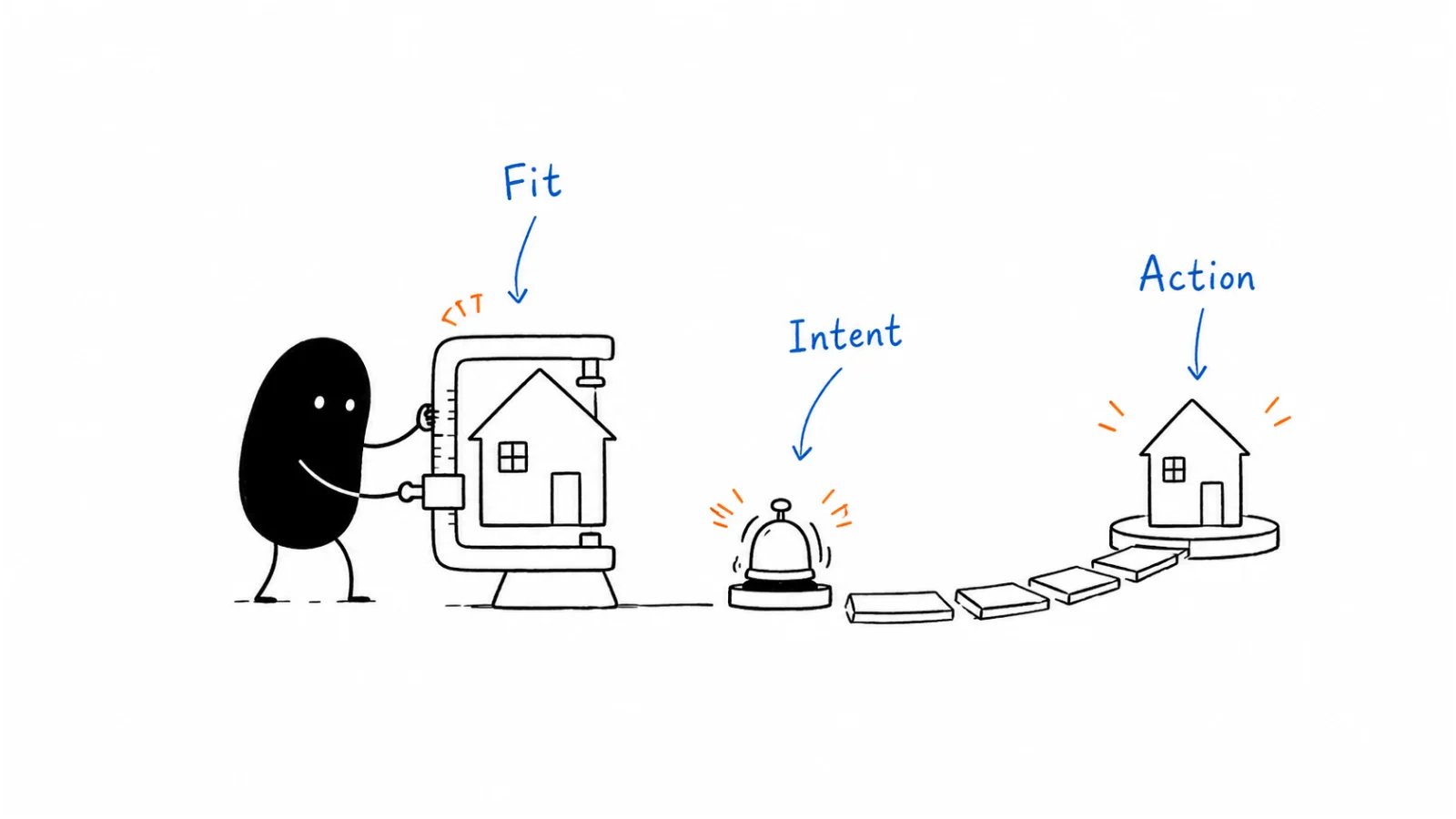 *Reading guide: does the account fit? · is there buying intent? · what should happen next?.*
## Use this when
* Inbound volume is large enough that “work everything” is how good leads die.
* Sales says marketing sends junk; marketing says sales never follows up; nobody wrote the threshold.
* Every page view adds a point and employees keep becoming “hot.”
* You are about to turn scoring on retroactively in a MAP without a change-control note.
## Do not use this when
* You do not yet have an ICP or a disqualifier. Agree on who fits before assigning scores.
* Volume is a handful of inbound names a week. A human queue beats a model.
* You need account-level orchestration. Person scores are not an account program. Use [account scoring](https://b2-b-playbook.mintlify.app/playbooks/09-operations-pipeline-and-measurement/account-scoring) to combine account-level evidence and define the next action.
* Legal or consent rules forbid the events you want to count. This page is not privacy advice.
## A few useful terms
| Word | Meaning here |
| ------------- | ----------------------------------------------------------------------------------------------- |
| **Fit** | Firmographic / role evidence they belong in the ICP |
| **Intent** | Behavior that suggests they are in a buying job *now* |
| **Negative** | Evidence they are not a buyer (jobs, students, customers already, competitors) |
| **Threshold** | The score (or rule) that changes **action**, not a feeling |
| **MQL** | Marketing believes this person deserves sales time—only if the action is written |
| **SQL** | Sales has accepted the person as worth a working motion. Often a **human** set, not more points |
## Keep this in mind
**Do not pay out points for every small action.** Opens, social clicks, and uncritical page views will manufacture MQLs. Use **intervals** (every *n* events) and **high-value URLs** (pricing, demo) instead of “+1 per breath.” Use **negative scoring** for people you must not chase.
## How to do it
### Step 1: Define the action a score should trigger
Complete this sentence: *at score ≥ \_\_\_\_ (or rule \_\_\_\_), \_\_\_\_ is notified, must \_\_\_\_, within \_\_\_\_.* If SQL is a Salesforce checkbox a human ticks, say so. Connecting lifecycle stage to a MAP score without a human is a choice—write it. Changing a live model **re-scores the whole database**. Small tweaks only; radical rewrites need a migration note.
### Step 2: Keep fit separate from intent
Fit without intent is a good logo browsing. Intent without fit is a student on the pricing page. Score both, or you will route the wrong people. Hand-raisers (demo, pricing, contact) should **skip the leisurely ladder** and notify whoever owns speed-to-lead. That is a workflow, not a polite +3.
### Step 3: Relate engagement to the buying situation
Awareness forms should be short enough that a stranger will complete them. Consideration can ask role and size. Decision can ask the questions that make the **meeting** useful. Progressive profiling: if you already have the field, ask the next one—not the same form twice. Reuse forms; segment with **lists** off page + form, not a new form per PDF.
Do not copy another company’s industry dropdown or “50 employees or we disqualify” as your ICP. That is their wedge.
### Step 4: Include negative signals and exceptions
Employees, job seekers, known customers, agencies you do not sell, competitors: either large negatives or a persona that routes elsewhere (HR, CS, partnerships). Existing customers usually need help from their account or customer success team. Define a separate route so their activity does not put them into new-customer prospecting by mistake.
### Step 5: Test the rules against real outcomes
Seed points from **your** past leads, not a vendor blog. After go-live, review MQLs that sales rejected and SQLs that never closed. Adjust intervals before you adjust philosophy. The ledger is the artifact; the MAP is the implementation.
## Worked example (illustrative)
B2B workflow product. Sales-assist inbound. HubSpot is the MAP; SQL is accepted in the CRM by an SDR.
| Field | Fill |
| -------------- | -------------------------------------------------------------------------------------------------------------------------------- |
| Action | Score ≥ 40 + fit = ICP → SDR task, 4 business hours. Demo form → same task immediately, ignore the leisurely threshold. |
| Fit | Target industries, 50–2,000 employees, role in ops or IT. Below 50 employees: nurture, not SDR. |
| Intent | Demo / pricing highest. Decision content next. Blog in intervals (every 3 posts). No points per email open; clicks in intervals. |
| Negative | Careers, student emails, own employees. Customers: blocked from new-customer prospecting queue; CS owns them. |
| SQL | Human accept in CRM. Not a second point gate. |
| Change control | Point changes logged; no silent rewrite after week two. |
## Copy: scoring ledger (fill)
* Action at threshold (who, what, SLA):
* Fit attributes and disqualifiers:
* Intent events (high-value URLs and forms vs interval behaviors):
* Negatives and customer/employee handling:
* MQL definition vs SQL definition:
* Form fields by awareness / consideration / decision:
* Progressive-profiling rule:
* Review cadence and what would trigger a migration:
Working file: [lead-scoring-ledger.xlsx](../../templates/lead-scoring-ledger.xlsx).
## Before you start
* [ ] ICP and disqualifiers exist in writing.
* [ ] Threshold changes a **task**, not a dashboard color.
* [ ] Fit and intent are both represented.
* [ ] Hand-raisers bypass the slow ladder.
* [ ] Negatives exist; careers are not “engaged.”
* [ ] SQL ownership is named (human vs automatic).
* [ ] Forms match stage; progressive profiling is on.
* [ ] A change log exists before go-live.
## Metrics
| Metric | Diagnostic use |
| ------------------------------------- | ----------------------------------------------- |
| SDR accept rate of scored MQLs | Whether the threshold is a hypothesis or a leak |
| Time to respond to explicit inquiries | Whether the skip-ahead workflow is real |
| % of MQLs that are employees/jobs | Negative scoring failure |
| Score distribution vs closed-won | Whether points predict anything |
Do not count “model turned on” or resemblance to a HubSpot sample guide as success.
## Common mistakes
* Points for every open, visit, and like.
* MQL = SQL = more points.
* Radical rescoring with no note, then wondering where the pipeline went.
* Copying another company’s form fields and employee-count floor.
* Scoring customers into the new-customer prospecting queue.
* Launching without an SLA.
## What to read next
Who may be touched at all is [ICP](https://b2-b-playbook.mintlify.app/playbooks/01-strategy-and-buyers/icp). A dated change that is not yet a form fill is [buying signals](https://b2-b-playbook.mintlify.app/playbooks/05-outbound-and-prospecting/buying-signals). What the first meeting must teach is the [pitch](https://b2-b-playbook.mintlify.app/playbooks/02-product-marketing/sales-enablement). If humans work the queue, they need [SDR onboarding](https://b2-b-playbook.mintlify.app/playbooks/05-outbound-and-prospecting/sdr-onboarding). Whether marketing can **create** the volume behind the scores is [GTM planning](https://b2-b-playbook.mintlify.app/playbooks/09-operations-pipeline-and-measurement/gtm-planning). Use [routing and SLA](https://b2-b-playbook.mintlify.app/playbooks/09-operations-pipeline-and-measurement/routing-and-sla) to define ownership, response clocks, and exceptions. The fields the score writes into are [CRM data model](https://b2-b-playbook.mintlify.app/playbooks/09-operations-pipeline-and-measurement/crm-data-model).
## Sources and evidence boundary
This is an owner-maintained operating synthesis. It is not a HubSpot implementation guide, not GDPR advice, and not a benchmark point table.
The split of fit vs behavior, negative scoring, high-value pages, interval scoring for cheap actions, explicit MQL vs SQL, caution against live radical changes, stage-based forms, progressive profiling, lists off reused forms, and workflow-at-threshold are distilled from an operator sample lead-scoring guide (Google Doc; HubSpot-shaped; company placeholders). That file is a **method prompt**, not a source to copy. Its example point values, industry lists, employee-count floors, and product-specific form fields are not this library’s facts.
***
Copyright © 2026 Ivan Xu. All rights reserved. See the [copyright and reuse terms](https://github.com/weilun88313/B2B-Playbook/blob/main/LICENSE).
Canonical source: [github.com/weilun88313/B2B-Playbook](https://github.com/weilun88313/B2B-Playbook)
*Reading guide: does the account fit? · is there buying intent? · what should happen next?.*
## Use this when
* Inbound volume is large enough that “work everything” is how good leads die.
* Sales says marketing sends junk; marketing says sales never follows up; nobody wrote the threshold.
* Every page view adds a point and employees keep becoming “hot.”
* You are about to turn scoring on retroactively in a MAP without a change-control note.
## Do not use this when
* You do not yet have an ICP or a disqualifier. Agree on who fits before assigning scores.
* Volume is a handful of inbound names a week. A human queue beats a model.
* You need account-level orchestration. Person scores are not an account program. Use [account scoring](https://b2-b-playbook.mintlify.app/playbooks/09-operations-pipeline-and-measurement/account-scoring) to combine account-level evidence and define the next action.
* Legal or consent rules forbid the events you want to count. This page is not privacy advice.
## A few useful terms
| Word | Meaning here |
| ------------- | ----------------------------------------------------------------------------------------------- |
| **Fit** | Firmographic / role evidence they belong in the ICP |
| **Intent** | Behavior that suggests they are in a buying job *now* |
| **Negative** | Evidence they are not a buyer (jobs, students, customers already, competitors) |
| **Threshold** | The score (or rule) that changes **action**, not a feeling |
| **MQL** | Marketing believes this person deserves sales time—only if the action is written |
| **SQL** | Sales has accepted the person as worth a working motion. Often a **human** set, not more points |
## Keep this in mind
**Do not pay out points for every small action.** Opens, social clicks, and uncritical page views will manufacture MQLs. Use **intervals** (every *n* events) and **high-value URLs** (pricing, demo) instead of “+1 per breath.” Use **negative scoring** for people you must not chase.
## How to do it
### Step 1: Define the action a score should trigger
Complete this sentence: *at score ≥ \_\_\_\_ (or rule \_\_\_\_), \_\_\_\_ is notified, must \_\_\_\_, within \_\_\_\_.* If SQL is a Salesforce checkbox a human ticks, say so. Connecting lifecycle stage to a MAP score without a human is a choice—write it. Changing a live model **re-scores the whole database**. Small tweaks only; radical rewrites need a migration note.
### Step 2: Keep fit separate from intent
Fit without intent is a good logo browsing. Intent without fit is a student on the pricing page. Score both, or you will route the wrong people. Hand-raisers (demo, pricing, contact) should **skip the leisurely ladder** and notify whoever owns speed-to-lead. That is a workflow, not a polite +3.
### Step 3: Relate engagement to the buying situation
Awareness forms should be short enough that a stranger will complete them. Consideration can ask role and size. Decision can ask the questions that make the **meeting** useful. Progressive profiling: if you already have the field, ask the next one—not the same form twice. Reuse forms; segment with **lists** off page + form, not a new form per PDF.
Do not copy another company’s industry dropdown or “50 employees or we disqualify” as your ICP. That is their wedge.
### Step 4: Include negative signals and exceptions
Employees, job seekers, known customers, agencies you do not sell, competitors: either large negatives or a persona that routes elsewhere (HR, CS, partnerships). Existing customers usually need help from their account or customer success team. Define a separate route so their activity does not put them into new-customer prospecting by mistake.
### Step 5: Test the rules against real outcomes
Seed points from **your** past leads, not a vendor blog. After go-live, review MQLs that sales rejected and SQLs that never closed. Adjust intervals before you adjust philosophy. The ledger is the artifact; the MAP is the implementation.
## Worked example (illustrative)
B2B workflow product. Sales-assist inbound. HubSpot is the MAP; SQL is accepted in the CRM by an SDR.
| Field | Fill |
| -------------- | -------------------------------------------------------------------------------------------------------------------------------- |
| Action | Score ≥ 40 + fit = ICP → SDR task, 4 business hours. Demo form → same task immediately, ignore the leisurely threshold. |
| Fit | Target industries, 50–2,000 employees, role in ops or IT. Below 50 employees: nurture, not SDR. |
| Intent | Demo / pricing highest. Decision content next. Blog in intervals (every 3 posts). No points per email open; clicks in intervals. |
| Negative | Careers, student emails, own employees. Customers: blocked from new-customer prospecting queue; CS owns them. |
| SQL | Human accept in CRM. Not a second point gate. |
| Change control | Point changes logged; no silent rewrite after week two. |
## Copy: scoring ledger (fill)
* Action at threshold (who, what, SLA):
* Fit attributes and disqualifiers:
* Intent events (high-value URLs and forms vs interval behaviors):
* Negatives and customer/employee handling:
* MQL definition vs SQL definition:
* Form fields by awareness / consideration / decision:
* Progressive-profiling rule:
* Review cadence and what would trigger a migration:
Working file: [lead-scoring-ledger.xlsx](../../templates/lead-scoring-ledger.xlsx).
## Before you start
* [ ] ICP and disqualifiers exist in writing.
* [ ] Threshold changes a **task**, not a dashboard color.
* [ ] Fit and intent are both represented.
* [ ] Hand-raisers bypass the slow ladder.
* [ ] Negatives exist; careers are not “engaged.”
* [ ] SQL ownership is named (human vs automatic).
* [ ] Forms match stage; progressive profiling is on.
* [ ] A change log exists before go-live.
## Metrics
| Metric | Diagnostic use |
| ------------------------------------- | ----------------------------------------------- |
| SDR accept rate of scored MQLs | Whether the threshold is a hypothesis or a leak |
| Time to respond to explicit inquiries | Whether the skip-ahead workflow is real |
| % of MQLs that are employees/jobs | Negative scoring failure |
| Score distribution vs closed-won | Whether points predict anything |
Do not count “model turned on” or resemblance to a HubSpot sample guide as success.
## Common mistakes
* Points for every open, visit, and like.
* MQL = SQL = more points.
* Radical rescoring with no note, then wondering where the pipeline went.
* Copying another company’s form fields and employee-count floor.
* Scoring customers into the new-customer prospecting queue.
* Launching without an SLA.
## What to read next
Who may be touched at all is [ICP](https://b2-b-playbook.mintlify.app/playbooks/01-strategy-and-buyers/icp). A dated change that is not yet a form fill is [buying signals](https://b2-b-playbook.mintlify.app/playbooks/05-outbound-and-prospecting/buying-signals). What the first meeting must teach is the [pitch](https://b2-b-playbook.mintlify.app/playbooks/02-product-marketing/sales-enablement). If humans work the queue, they need [SDR onboarding](https://b2-b-playbook.mintlify.app/playbooks/05-outbound-and-prospecting/sdr-onboarding). Whether marketing can **create** the volume behind the scores is [GTM planning](https://b2-b-playbook.mintlify.app/playbooks/09-operations-pipeline-and-measurement/gtm-planning). Use [routing and SLA](https://b2-b-playbook.mintlify.app/playbooks/09-operations-pipeline-and-measurement/routing-and-sla) to define ownership, response clocks, and exceptions. The fields the score writes into are [CRM data model](https://b2-b-playbook.mintlify.app/playbooks/09-operations-pipeline-and-measurement/crm-data-model).
## Sources and evidence boundary
This is an owner-maintained operating synthesis. It is not a HubSpot implementation guide, not GDPR advice, and not a benchmark point table.
The split of fit vs behavior, negative scoring, high-value pages, interval scoring for cheap actions, explicit MQL vs SQL, caution against live radical changes, stage-based forms, progressive profiling, lists off reused forms, and workflow-at-threshold are distilled from an operator sample lead-scoring guide (Google Doc; HubSpot-shaped; company placeholders). That file is a **method prompt**, not a source to copy. Its example point values, industry lists, employee-count floors, and product-specific form fields are not this library’s facts.
***
Copyright © 2026 Ivan Xu. All rights reserved. See the [copyright and reuse terms](https://github.com/weilun88313/B2B-Playbook/blob/main/LICENSE).
Canonical source: [github.com/weilun88313/B2B-Playbook](https://github.com/weilun88313/B2B-Playbook)