> ## Documentation Index
> Fetch the complete documentation index at: https://b2-b-playbook.mintlify.site/llms.txt
> Use this file to discover all available pages before exploring further.
# GTM AI maturity
**Last reviewed:** 2026-08-30 · **Reading edit:** 2026-09-12
Using AI in a few tasks is different from connecting it to a reliable team workflow. Assess each sales or marketing process separately: what context it has, what it can do, and how people check it. Improve one useful workflow before trying to automate the whole department.
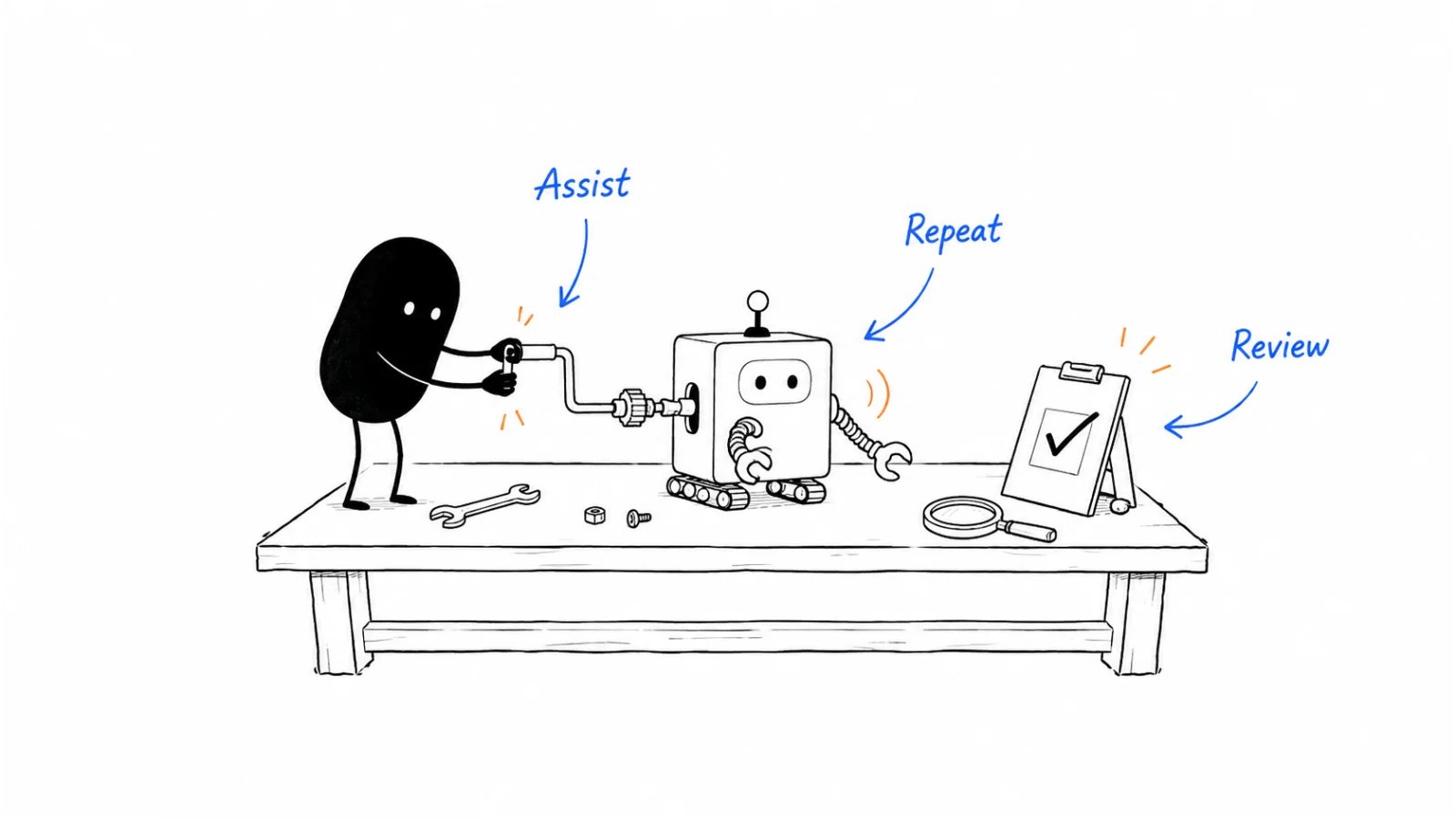 *Reading guide: individual assistance → repeatable team workflows → connected, reviewed work.*
## Use this when
* Leadership says “we are AI-native” and the evidence is browser tabs.
* Every function bought a different assistant, and nothing shares context.
* You are about to automate outbound, content, and events in the same quarter.
* A founder wants a command center before the CRM is updated.
## Do not use this when
* There is no primary motion. Stay in [channel strategy](../04-channels-and-distribution/channel-strategy.md).
* You still need to pick *which problem* AI should touch. That is [AI use-case selection](https://b2-b-playbook.mintlify.app/playbooks/09-operations-pipeline-and-measurement/ai-use-case-selection).
* You need the architecture of one workflow. That is [AI workflow](https://b2-b-playbook.mintlify.app/playbooks/09-operations-pipeline-and-measurement/ai-workflow).
* You need product names. Start in [TOOLS.md](../../TOOLS.md). A community spreadsheet of logos is not this page.
## A few useful terms
| Rung | Meaning here |
| ------------------ | ---------------------------------------------------------------------------------------------- |
| **0 · Random** | Channels by vibe. Thin CRM. No shared pattern. No AI, or AI as a toy. |
| **1 · Assisted** | A human still owns the path; a tool speeds one step (research, draft, notes). |
| **2 · Workflowed** | One to three *working* channels have an end-to-end assist; pieces do not share a brain. |
| **3 · Owned** | Each stage of the funnel has a named human or agent, and a **shared context** they can read. |
| **4 · Looped** | Outputs feed other motions (call → objection library → next content). Most of the stack talks. |
| **5 · Autopilot** | A world-model that experiments across every channel. **Not an operating target on this page.** |
## Keep this in mind
**Score the motion you have, then climb one rung on a channel that already works.** Do not automate what you have not made work by hand. Do not skip to a dashboard because a video called it a GTM engine.
## How to do it
### Step 1: Assess each process separately
Write one line per motion you actually run: outbound, owned content, events, inbound capture, first meeting / demo, expansion. For each: which rung, what evidence, what would make the next rung true.
Most teams are **1–3**. “We use AI” that means Perplexity on research and ChatGPT on DMs is rung 1. It can help. It is not an OS. Over-automating a weak DM motion at rung 1 is how buyers learn to ignore you.
### Step 2: Choose processes that already produce useful results
AI scales what exists. If LinkedIn content already books conversations, that is a candidate. If events are a monthly hope, do not build an invite agent first.
Refuse a stack that “covers the whole funnel” while no channel has a written win.
### Step 3: Write down the context the AI needs
Rung 2 hits a wall when every tool starts from zero. The fix is not a new SKU named “context.” It is a **small, current file** the workflows may read: ICP, offer, objections, banned claims, what “good” looks like. [Content strategy](../03-brand-story-and-content/content-strategy.md) and [positioning](../02-product-marketing/positioning.md) already own those facts. If they are empty, agents will invent them.
### Step 4: Connect one reviewed workflow
A loop is one output that becomes another motion’s input—transcript objections into the next page, closed-won traits into the next list—with a human still allowed to stop a send. Sheets and a CRM can be the first command center. Choose a shared view someone will keep current before building a custom dashboard.
Rung 4 is “enough of the stack is connected that the system can learn.” It is not “we posted that we run on autopilot.”
### Step 5: Treat future capabilities as uncertain
A system that senses Slack, Discord, and the roadmap and reallocates every channel without a human steer is a research story. You may watch it. You may not staff or budget as if you are already there. The human still reviews external messages—see [AI workflow](https://b2-b-playbook.mintlify.app/playbooks/09-operations-pipeline-and-measurement/ai-workflow).
## Worked example (illustrative)
Sales-assist ops tool. Founder-led. Not a survey.
| Motion | Rung | Evidence | Next rung would require |
| ----------------- | ---- | ------------------------------------------------------------------------- | -------------------------------------------------------- |
| Outbound LinkedIn | 2 | Research + draft + CRM note in one sequence; founder still edits every DM | Shared ICP file the sequence reads; reply handling owned |
| Founder content | 1 | ChatGPT drafts; calendar is still a vibe | One feature → post workflow with a review gate |
| Events | 0 | Monthly mixer, no list hygiene | Stop. Do not automate invites. |
| Demo | 1 | Recorder + notes; no write-back to objections | Objections become a page, not a folder of transcripts |
## Copy: maturity one-pager (fill)
* Motions we actually run (not the org chart):
* Rung and evidence per motion:
* Two channels already producing a sales-usable step:
* Context file the tools may read (and who updates it):
* One loop we will connect this quarter:
* What we refuse to automate:
* Rung-5 language we will not put in a board slide:
Working file: [gtm-ai-maturity.xlsx](../../templates/gtm-ai-maturity.xlsx).
## Before you start
* [ ] Each motion has a rung *and* a sentence of evidence.
* [ ] We named channels that already work; AI will not “create” a motion.
* [ ] Shared context exists as a file people will maintain—or we admitted it does not.
* [ ] One loop is written before a command-center SOW.
* [ ] External sends still have a human gate.
* [ ] No community AI-logo sheet substituted for this score.
* [ ] We did not buy a product because it claimed autopilot.
## Metrics
| Metric | Diagnostic use |
| ------------------------------------------------------------- | ------------------------- |
| Motions with evidence, not slogans | Whether the score is real |
| Working channels receiving AI vs broken channels receiving AI | Scale vs slop |
| Context file age | Shared brain vs folklore |
| Loops that changed a next action | Engine vs tools |
Do not count AI seats, or resemblance to a six-step YouTube ladder, as maturity.
## Common mistakes
* Calling browser AI a GTM OS.
* Automating a channel that has not worked manually.
* Buying a “context graph” with empty ICP.
* A dashboard of agents nobody owns.
* Skipping to rung 4 on slides while the CRM is fiction.
* Treating rung 5 as a 12-month OKR.
* Importing a Pavilion/community vendor list as the stack.
## What to read next
Which problem deserves a bet is [AI use-case selection](https://b2-b-playbook.mintlify.app/playbooks/09-operations-pipeline-and-measurement/ai-use-case-selection). How one workflow is staged and gated is [AI workflow](https://b2-b-playbook.mintlify.app/playbooks/09-operations-pipeline-and-measurement/ai-workflow). How a test dies or scales is [experimentation](https://b2-b-playbook.mintlify.app/playbooks/09-operations-pipeline-and-measurement/experimentation). Which tool may write into the record is [MarTech governance](https://b2-b-playbook.mintlify.app/playbooks/09-operations-pipeline-and-measurement/martech-governance). How answers get found is [SEO and AEO](../04-channels-and-distribution/seo-and-aeo.md).
## Sources and evidence boundary
This is an owner-maintained operating synthesis. It is not a licensed maturity product, not a consulting diagnostic, and not a forecast that full autonomy is near.
The six-rung shape (random → assisted steps → end-to-end on working channels → owned stages plus shared context → connected loops → refuse autopilot as the operating target) is distilled from a public explainer ([Roman J. Georgio, *how ai-native is your gtm team?! (6-step ladder)*](https://www.youtube.com/watch?v=WT7f1njMXYg\&ref=b2b-playbook)). That video is a **method prompt**, not a source to copy. Its founder vignette, tool shout-outs, “possible within a year,” newsletter raffle, and booking offer are not this library’s facts or a service to buy.
A circulated community spreadsheet of GTM AI products (company / site / use-case tags) is a **logo list**, not a maturity score. It is not imported into [TOOLS.md](../../TOOLS.md).
A global survey that more companies “use AI” while attributed EBIT stays flat is also not your rung ([McKinsey QuantumBlack, *The State of AI*](https://www.mckinsey.com/capabilities/quantumblack/our-insights/the-state-of-ai?ref=b2b-playbook), 2026 edition as reported). That series is a **method prompt** (adoption ≠ profit; high performers talk about redesigned work). Its percentages, “high performer” cuts, and consulting narrative are **not** this library’s facts.
***
Copyright © 2026 Ivan Xu. All rights reserved. See the [copyright and reuse terms](https://github.com/weilun88313/B2B-Playbook/blob/main/LICENSE).
Canonical source: [github.com/weilun88313/B2B-Playbook](https://github.com/weilun88313/B2B-Playbook)
*Reading guide: individual assistance → repeatable team workflows → connected, reviewed work.*
## Use this when
* Leadership says “we are AI-native” and the evidence is browser tabs.
* Every function bought a different assistant, and nothing shares context.
* You are about to automate outbound, content, and events in the same quarter.
* A founder wants a command center before the CRM is updated.
## Do not use this when
* There is no primary motion. Stay in [channel strategy](../04-channels-and-distribution/channel-strategy.md).
* You still need to pick *which problem* AI should touch. That is [AI use-case selection](https://b2-b-playbook.mintlify.app/playbooks/09-operations-pipeline-and-measurement/ai-use-case-selection).
* You need the architecture of one workflow. That is [AI workflow](https://b2-b-playbook.mintlify.app/playbooks/09-operations-pipeline-and-measurement/ai-workflow).
* You need product names. Start in [TOOLS.md](../../TOOLS.md). A community spreadsheet of logos is not this page.
## A few useful terms
| Rung | Meaning here |
| ------------------ | ---------------------------------------------------------------------------------------------- |
| **0 · Random** | Channels by vibe. Thin CRM. No shared pattern. No AI, or AI as a toy. |
| **1 · Assisted** | A human still owns the path; a tool speeds one step (research, draft, notes). |
| **2 · Workflowed** | One to three *working* channels have an end-to-end assist; pieces do not share a brain. |
| **3 · Owned** | Each stage of the funnel has a named human or agent, and a **shared context** they can read. |
| **4 · Looped** | Outputs feed other motions (call → objection library → next content). Most of the stack talks. |
| **5 · Autopilot** | A world-model that experiments across every channel. **Not an operating target on this page.** |
## Keep this in mind
**Score the motion you have, then climb one rung on a channel that already works.** Do not automate what you have not made work by hand. Do not skip to a dashboard because a video called it a GTM engine.
## How to do it
### Step 1: Assess each process separately
Write one line per motion you actually run: outbound, owned content, events, inbound capture, first meeting / demo, expansion. For each: which rung, what evidence, what would make the next rung true.
Most teams are **1–3**. “We use AI” that means Perplexity on research and ChatGPT on DMs is rung 1. It can help. It is not an OS. Over-automating a weak DM motion at rung 1 is how buyers learn to ignore you.
### Step 2: Choose processes that already produce useful results
AI scales what exists. If LinkedIn content already books conversations, that is a candidate. If events are a monthly hope, do not build an invite agent first.
Refuse a stack that “covers the whole funnel” while no channel has a written win.
### Step 3: Write down the context the AI needs
Rung 2 hits a wall when every tool starts from zero. The fix is not a new SKU named “context.” It is a **small, current file** the workflows may read: ICP, offer, objections, banned claims, what “good” looks like. [Content strategy](../03-brand-story-and-content/content-strategy.md) and [positioning](../02-product-marketing/positioning.md) already own those facts. If they are empty, agents will invent them.
### Step 4: Connect one reviewed workflow
A loop is one output that becomes another motion’s input—transcript objections into the next page, closed-won traits into the next list—with a human still allowed to stop a send. Sheets and a CRM can be the first command center. Choose a shared view someone will keep current before building a custom dashboard.
Rung 4 is “enough of the stack is connected that the system can learn.” It is not “we posted that we run on autopilot.”
### Step 5: Treat future capabilities as uncertain
A system that senses Slack, Discord, and the roadmap and reallocates every channel without a human steer is a research story. You may watch it. You may not staff or budget as if you are already there. The human still reviews external messages—see [AI workflow](https://b2-b-playbook.mintlify.app/playbooks/09-operations-pipeline-and-measurement/ai-workflow).
## Worked example (illustrative)
Sales-assist ops tool. Founder-led. Not a survey.
| Motion | Rung | Evidence | Next rung would require |
| ----------------- | ---- | ------------------------------------------------------------------------- | -------------------------------------------------------- |
| Outbound LinkedIn | 2 | Research + draft + CRM note in one sequence; founder still edits every DM | Shared ICP file the sequence reads; reply handling owned |
| Founder content | 1 | ChatGPT drafts; calendar is still a vibe | One feature → post workflow with a review gate |
| Events | 0 | Monthly mixer, no list hygiene | Stop. Do not automate invites. |
| Demo | 1 | Recorder + notes; no write-back to objections | Objections become a page, not a folder of transcripts |
## Copy: maturity one-pager (fill)
* Motions we actually run (not the org chart):
* Rung and evidence per motion:
* Two channels already producing a sales-usable step:
* Context file the tools may read (and who updates it):
* One loop we will connect this quarter:
* What we refuse to automate:
* Rung-5 language we will not put in a board slide:
Working file: [gtm-ai-maturity.xlsx](../../templates/gtm-ai-maturity.xlsx).
## Before you start
* [ ] Each motion has a rung *and* a sentence of evidence.
* [ ] We named channels that already work; AI will not “create” a motion.
* [ ] Shared context exists as a file people will maintain—or we admitted it does not.
* [ ] One loop is written before a command-center SOW.
* [ ] External sends still have a human gate.
* [ ] No community AI-logo sheet substituted for this score.
* [ ] We did not buy a product because it claimed autopilot.
## Metrics
| Metric | Diagnostic use |
| ------------------------------------------------------------- | ------------------------- |
| Motions with evidence, not slogans | Whether the score is real |
| Working channels receiving AI vs broken channels receiving AI | Scale vs slop |
| Context file age | Shared brain vs folklore |
| Loops that changed a next action | Engine vs tools |
Do not count AI seats, or resemblance to a six-step YouTube ladder, as maturity.
## Common mistakes
* Calling browser AI a GTM OS.
* Automating a channel that has not worked manually.
* Buying a “context graph” with empty ICP.
* A dashboard of agents nobody owns.
* Skipping to rung 4 on slides while the CRM is fiction.
* Treating rung 5 as a 12-month OKR.
* Importing a Pavilion/community vendor list as the stack.
## What to read next
Which problem deserves a bet is [AI use-case selection](https://b2-b-playbook.mintlify.app/playbooks/09-operations-pipeline-and-measurement/ai-use-case-selection). How one workflow is staged and gated is [AI workflow](https://b2-b-playbook.mintlify.app/playbooks/09-operations-pipeline-and-measurement/ai-workflow). How a test dies or scales is [experimentation](https://b2-b-playbook.mintlify.app/playbooks/09-operations-pipeline-and-measurement/experimentation). Which tool may write into the record is [MarTech governance](https://b2-b-playbook.mintlify.app/playbooks/09-operations-pipeline-and-measurement/martech-governance). How answers get found is [SEO and AEO](../04-channels-and-distribution/seo-and-aeo.md).
## Sources and evidence boundary
This is an owner-maintained operating synthesis. It is not a licensed maturity product, not a consulting diagnostic, and not a forecast that full autonomy is near.
The six-rung shape (random → assisted steps → end-to-end on working channels → owned stages plus shared context → connected loops → refuse autopilot as the operating target) is distilled from a public explainer ([Roman J. Georgio, *how ai-native is your gtm team?! (6-step ladder)*](https://www.youtube.com/watch?v=WT7f1njMXYg\&ref=b2b-playbook)). That video is a **method prompt**, not a source to copy. Its founder vignette, tool shout-outs, “possible within a year,” newsletter raffle, and booking offer are not this library’s facts or a service to buy.
A circulated community spreadsheet of GTM AI products (company / site / use-case tags) is a **logo list**, not a maturity score. It is not imported into [TOOLS.md](../../TOOLS.md).
A global survey that more companies “use AI” while attributed EBIT stays flat is also not your rung ([McKinsey QuantumBlack, *The State of AI*](https://www.mckinsey.com/capabilities/quantumblack/our-insights/the-state-of-ai?ref=b2b-playbook), 2026 edition as reported). That series is a **method prompt** (adoption ≠ profit; high performers talk about redesigned work). Its percentages, “high performer” cuts, and consulting narrative are **not** this library’s facts.
***
Copyright © 2026 Ivan Xu. All rights reserved. See the [copyright and reuse terms](https://github.com/weilun88313/B2B-Playbook/blob/main/LICENSE).
Canonical source: [github.com/weilun88313/B2B-Playbook](https://github.com/weilun88313/B2B-Playbook)