> ## Documentation Index
> Fetch the complete documentation index at: https://b2-b-playbook.mintlify.site/llms.txt
> Use this file to discover all available pages before exploring further.
# Forecasting
**Last reviewed:** 2026-08-29 · **Reading edit:** 2026-09-12
A forecast combines what is in the pipeline with evidence about whether and when deals will close. Use a method that fits your sales process, keep the underlying records current, and make changes in confidence explainable. The review should reveal risks while there is time to act.
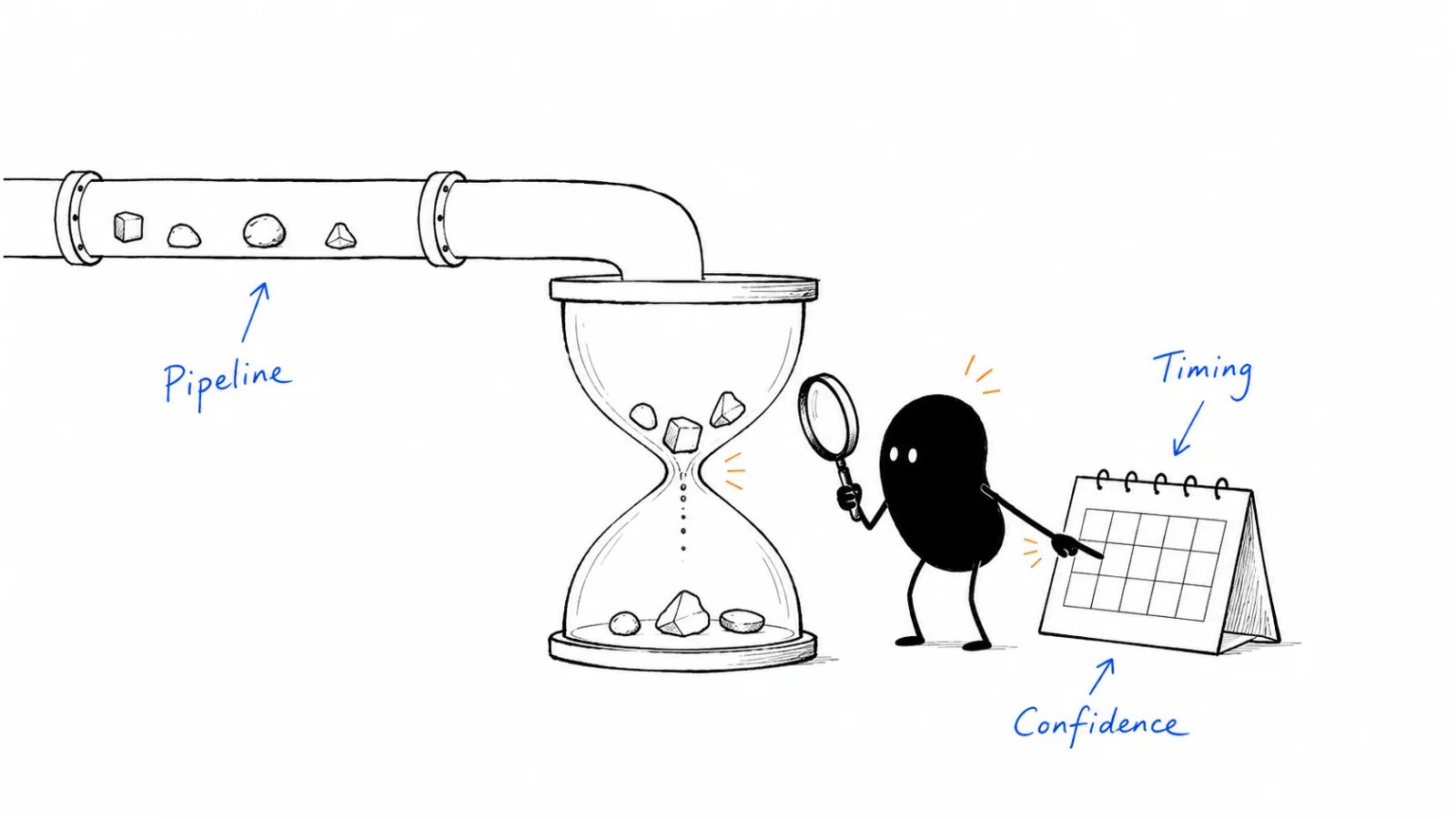 *Reading guide: check the pipeline → test timing and confidence → update the forecast.*
## Use this when
* The board number and the CRM number cannot be reconciled in one sitting.
* Managers “feel” the quarter and cannot say why a deal is in or out.
* Pipeline coverage is a screenshot, not a gap with a strategy.
* You are about to hire a second seller and the only forecast is a spreadsheet tab named FinalFinal.
## Do not use this when
* There is no [ICP](../01-strategy-and-buyers/icp.md) and no stages with entry/exit criteria. You will forecast noise.
* The founder still sells three logos. A CRO forecast stack is costume.
* You need to *create* pipeline. That is channel, outbound, or [account planning](../06-account-field-and-partner/account-planning.md)—not a call.
* Legal reporting (public company guidance) must set the process. Get qualified owners; this is not securities advice.
## A few useful terms
| Word | Meaning here |
| -------------- | --------------------------------------------------------------------------- |
| **Hygiene** | Stages, amounts, close dates, and next steps match reality |
| **Stage** | A state with **entry/exit criteria**, conversion math, and required actions |
| **Category** | A published bucket (for example commit / best case / pipeline / omit) |
| **Call** | The number a person will stand behind in this period |
| **Coverage** | Pipeline relative to the target (and the **gap** plus the plan to close it) |
| **Top-down** | High volume, high velocity: rates and cohorts more than deal archaeology |
| **Bottoms-up** | Long cycle: inspect the deals |
## Keep this in mind
**Always have a reason. Deliver bad news early. Ask for help. Document the process. Align with leadership and evolve it.** A forecast without a reason is a wish. Bad news on Friday of week 12 is a reputation event.
Data is a path to the answer. It is rarely the answer.
## How to do it
### Step 1: Understand how deals really progress
Inspect, in this order:
* **Buyers.** Process and messaging that match where they actually are.
* **Journey.** The problem, their familiarity, accelerators and decelerators on *this* deal.
* **Sales process.** If it is not consistent, you cannot measure it. Consistency is the foundation of repeatability.
* **Metrics.** Velocity versus the plan’s assumptions. Turn a qualitative journey into something you can compare.
* **Hygiene.** Does the pipeline reflect what you need to hit the number? Where is the bottleneck? RevOps is not the enemy.
* **The forecast itself.** Do not reinvent a private model every week. Protect your reputation.
Block time for hygiene or it will lose to “real selling.” Calendar tools are optional; the block is not.
### Step 2: Check the buyer experience and funnel records
Forecast quality is downstream of deal quality:
* **Discovery / demo:** account mapping before the call; maturity of the buyer; a real [account plan](../06-account-field-and-partner/account-planning.md) when the account is complex.
* **Consideration:** mutual action plans; async explanation; a standard evaluation path; value-add touches you can count.
* **Negotiation:** known redline minimums; business terms agreed with the business contact; legal as a partner, not a surprise.
* **Handoff:** async context (pain, solution, goals, dependencies) so [customer success](../08-lifecycle-and-customer-marketing/customer-success.md) does not start from zero.
* **Lost:** feedback, a cadence, a memory—so “lost” is data, not a sulk.
A methodology exists to help sellers understand needs, prioritize, repeat, and give the customer a better path. Bake it into the process. A poster in onboarding is not a methodology.
### Step 3: Use consistent pipeline definitions
Document conversion by stage. Compare people and periods. Define **opportunity health** with your manager and RevOps: a short score you can fill without a novel. Then look at where an AE can actually improve—not a pep talk.
### Step 4: Choose a method that fits your sales process
* **Top-down** when volume and velocity dominate.
* **Bottoms-up** when cycles are long (the class used \~90+ days as a rule of thumb for enterprise-shaped deals).
You can mix: bottoms-up on the named few, rates on the rest. What you cannot do is swap models mid-quarter without telling the people who call.
Rewind once a year: how was the **annual plan** built? A forecast that ignores the plan’s assumptions will always look “wrong.”
### Step 5: Design and review the forecast process
A better forecast process:
1. Clear sales process
2. Goals, metrics, and **shared words**
3. Roles and responsibilities
4. Deadlines
5. Train the team (not one-and-done)
6. Automate and simplify; single source of truth
7. Rigor and accountability
8. Review results over time and adjust
For each **stage**: number, name, entry/exit and conversion, actions and deliverables.
Keep **categories** and the **call** simple. Define, publish, train, integrate into the CRM, review qualitatively, hold the line.
Cadence (small team: collapse floors, do not skip the job):
1. Rep / manager 1:1
2. Leadership meeting
3. Manager forecast call
4. VP call if you have one
5. Head-of-revenue call
Enablement: explain why the process exists, train, reinforce, share outcomes. Redundant meetings are how people stop telling the truth.
### Step 6: Keep the review focused
Five lenses, then stop adding rituals:
* **Cadence** with clear expectations, the right people, no duplicate forums
* **Establish / enable / empower:** process, metrics, terms, R\&R, training, compliance
* **Technology:** one source of truth; less manual rekey; guardrails
* **Transparency:** marketing, sales, CS, implementation, finance—not a sales-only cave
* **Questions that matter:** pipeline acceleration, deal execution, risk, strategy, predictability, outcomes
### Step 7: Use coverage gaps to guide action
Do we have enough pipeline to hit the target?
* Coverage to target
* Out-quarter pipeline
* Created vs converted this period
* The **gap**
* The **strategy** to close the gap
Performance snapshot: forecast accuracy, variances, coverage, gap to close, attainment to date.
## Worked example (illustrative)
Four AEs. \~45-day cycle. Hybrid: bottoms-up on deals > \$40k, rates on the rest.
| Field | Fill |
| ------------ | -------------------------------------------------------------------------------------------- |
| Stages | 5 stages, each with entry/exit and a required next step dated \< 14 days |
| Categories | Commit / best case / pipeline / omit. Omit means “not this period,” not “delete.” |
| Call | Manager call = sum of commit they will defend in the 1:1, not CRM rollup of hope |
| Hygiene | Friday 45 minutes: close date, amount, next step, category. Stale > 14 days drops category. |
| Coverage | Target 3× on this motion; below 2.5× requires a named create plan, not a speech |
| Cadence | Weekly AE 1:1 · Monday leadership 25 min · no second “forecast standup” |
| Health score | Mutual plan exists? Economic buyer engaged? Next step owned? (yes/no, not a 40-factor model) |
## Copy: forecast design (fill)
* Motion and why top-down, bottoms-up, or hybrid:
* Stage list with entry/exit:
* Categories and what the **call** means:
* Hygiene rule (stale definition):
* Cadence (who, when, duration):
* Coverage target and gap-response:
* Opportunity health fields:
* Single source of truth:
* Who may change a category after the call:
## Before you start
* [ ] Stages have entry/exit, not only names.
* [ ] Categories and the call are published and trained.
* [ ] Hygiene has a clock; stale deals cannot sit in commit.
* [ ] The model matches cycle time and volume.
* [ ] Cadence has no duplicate forecast meeting.
* [ ] Coverage questions include a gap strategy.
* [ ] Bad news has a path that is earlier than the last week.
## Metrics
| Metric | Diagnostic use |
| ------------------------------------- | ------------------------------------------------------- |
| Forecast accuracy / variance | How predictions compare with the outcomes that followed |
| Coverage to target and gap | Whether the quarter is a math problem |
| Stage conversion vs plan | Process vs heroics |
| Hygiene (stale commit) | Trust in the CRM |
| Time from known slip to surfaced slip | Reputation and the golden rules |
Do not count forecast meetings held, or a decorated inspection tree, as success.
## Common mistakes
* Calling a number with no reason.
* Sitting on a slip until it is undeniable.
* Stages without exit criteria.
* Commit as a parking lot.
* Enterprise bottoms-up on a self-serve motion.
* Two sources of truth (spreadsheet vs CRM).
* Hygiene as a once-a-quarter cleanup.
* Treating pipeline coverage as a vanity multiple with no create plan.
## What to read next
Pay still sits in [sales compensation](https://b2-b-playbook.mintlify.app/playbooks/09-operations-pipeline-and-measurement/sales-compensation). Whether next year is even possible is [GTM planning](https://b2-b-playbook.mintlify.app/playbooks/09-operations-pipeline-and-measurement/gtm-planning). The record underneath the call is [CRM data model](https://b2-b-playbook.mintlify.app/playbooks/09-operations-pipeline-and-measurement/crm-data-model). How meetings split so the call is not also pipe-gen and coaching is [sales operating cadence](https://b2-b-playbook.mintlify.app/playbooks/09-operations-pipeline-and-measurement/sales-operating-cadence). Deal quality sits in [account planning](../06-account-field-and-partner/account-planning.md) and the [pitch](../02-product-marketing/sales-enablement.md). After close, hygiene continues in [customer success](../08-lifecycle-and-customer-marketing/customer-success.md). Creating pipeline is not a forecast meeting: [channel strategy](../04-channels-and-distribution/channel-strategy.md) and [outbound](../05-outbound-and-prospecting/).
## Sources and evidence boundary
This is an owner-maintained operating synthesis. It is not financial guidance, not a public-company forecasting control, and not a CRM implementation guide.
The chain (hygiene → forecast → number → reputation), the curiosity order (buyers, journey, process, metrics, hygiene, forecast), experience optimization across discovery through lost, making conversion quantitative, golden rules, top-down vs bottoms-up, stage/category/call design, operating cadence, rigor lenses, and coverage questions are distilled from an Enterprise GTM School class on building a forecast model (pipeline and forecasting; instructor-attributed deck, class labeled #10, September 2023 cohort). That deck is a **method prompt**, not a source to copy. Personal bio, bit.ly samples, and tool shout-outs in the slides are not imported as vendor requirements. The deck points at Atrium’s *Sales Manager’s Guide to Forecasting* and at Gong mutual-action-plan examples as further reading; this repository does not abridge those.
***
Copyright © 2026 Ivan Xu. All rights reserved. See the [copyright and reuse terms](https://github.com/weilun88313/B2B-Playbook/blob/main/LICENSE).
Canonical source: [github.com/weilun88313/B2B-Playbook](https://github.com/weilun88313/B2B-Playbook)
*Reading guide: check the pipeline → test timing and confidence → update the forecast.*
## Use this when
* The board number and the CRM number cannot be reconciled in one sitting.
* Managers “feel” the quarter and cannot say why a deal is in or out.
* Pipeline coverage is a screenshot, not a gap with a strategy.
* You are about to hire a second seller and the only forecast is a spreadsheet tab named FinalFinal.
## Do not use this when
* There is no [ICP](../01-strategy-and-buyers/icp.md) and no stages with entry/exit criteria. You will forecast noise.
* The founder still sells three logos. A CRO forecast stack is costume.
* You need to *create* pipeline. That is channel, outbound, or [account planning](../06-account-field-and-partner/account-planning.md)—not a call.
* Legal reporting (public company guidance) must set the process. Get qualified owners; this is not securities advice.
## A few useful terms
| Word | Meaning here |
| -------------- | --------------------------------------------------------------------------- |
| **Hygiene** | Stages, amounts, close dates, and next steps match reality |
| **Stage** | A state with **entry/exit criteria**, conversion math, and required actions |
| **Category** | A published bucket (for example commit / best case / pipeline / omit) |
| **Call** | The number a person will stand behind in this period |
| **Coverage** | Pipeline relative to the target (and the **gap** plus the plan to close it) |
| **Top-down** | High volume, high velocity: rates and cohorts more than deal archaeology |
| **Bottoms-up** | Long cycle: inspect the deals |
## Keep this in mind
**Always have a reason. Deliver bad news early. Ask for help. Document the process. Align with leadership and evolve it.** A forecast without a reason is a wish. Bad news on Friday of week 12 is a reputation event.
Data is a path to the answer. It is rarely the answer.
## How to do it
### Step 1: Understand how deals really progress
Inspect, in this order:
* **Buyers.** Process and messaging that match where they actually are.
* **Journey.** The problem, their familiarity, accelerators and decelerators on *this* deal.
* **Sales process.** If it is not consistent, you cannot measure it. Consistency is the foundation of repeatability.
* **Metrics.** Velocity versus the plan’s assumptions. Turn a qualitative journey into something you can compare.
* **Hygiene.** Does the pipeline reflect what you need to hit the number? Where is the bottleneck? RevOps is not the enemy.
* **The forecast itself.** Do not reinvent a private model every week. Protect your reputation.
Block time for hygiene or it will lose to “real selling.” Calendar tools are optional; the block is not.
### Step 2: Check the buyer experience and funnel records
Forecast quality is downstream of deal quality:
* **Discovery / demo:** account mapping before the call; maturity of the buyer; a real [account plan](../06-account-field-and-partner/account-planning.md) when the account is complex.
* **Consideration:** mutual action plans; async explanation; a standard evaluation path; value-add touches you can count.
* **Negotiation:** known redline minimums; business terms agreed with the business contact; legal as a partner, not a surprise.
* **Handoff:** async context (pain, solution, goals, dependencies) so [customer success](../08-lifecycle-and-customer-marketing/customer-success.md) does not start from zero.
* **Lost:** feedback, a cadence, a memory—so “lost” is data, not a sulk.
A methodology exists to help sellers understand needs, prioritize, repeat, and give the customer a better path. Bake it into the process. A poster in onboarding is not a methodology.
### Step 3: Use consistent pipeline definitions
Document conversion by stage. Compare people and periods. Define **opportunity health** with your manager and RevOps: a short score you can fill without a novel. Then look at where an AE can actually improve—not a pep talk.
### Step 4: Choose a method that fits your sales process
* **Top-down** when volume and velocity dominate.
* **Bottoms-up** when cycles are long (the class used \~90+ days as a rule of thumb for enterprise-shaped deals).
You can mix: bottoms-up on the named few, rates on the rest. What you cannot do is swap models mid-quarter without telling the people who call.
Rewind once a year: how was the **annual plan** built? A forecast that ignores the plan’s assumptions will always look “wrong.”
### Step 5: Design and review the forecast process
A better forecast process:
1. Clear sales process
2. Goals, metrics, and **shared words**
3. Roles and responsibilities
4. Deadlines
5. Train the team (not one-and-done)
6. Automate and simplify; single source of truth
7. Rigor and accountability
8. Review results over time and adjust
For each **stage**: number, name, entry/exit and conversion, actions and deliverables.
Keep **categories** and the **call** simple. Define, publish, train, integrate into the CRM, review qualitatively, hold the line.
Cadence (small team: collapse floors, do not skip the job):
1. Rep / manager 1:1
2. Leadership meeting
3. Manager forecast call
4. VP call if you have one
5. Head-of-revenue call
Enablement: explain why the process exists, train, reinforce, share outcomes. Redundant meetings are how people stop telling the truth.
### Step 6: Keep the review focused
Five lenses, then stop adding rituals:
* **Cadence** with clear expectations, the right people, no duplicate forums
* **Establish / enable / empower:** process, metrics, terms, R\&R, training, compliance
* **Technology:** one source of truth; less manual rekey; guardrails
* **Transparency:** marketing, sales, CS, implementation, finance—not a sales-only cave
* **Questions that matter:** pipeline acceleration, deal execution, risk, strategy, predictability, outcomes
### Step 7: Use coverage gaps to guide action
Do we have enough pipeline to hit the target?
* Coverage to target
* Out-quarter pipeline
* Created vs converted this period
* The **gap**
* The **strategy** to close the gap
Performance snapshot: forecast accuracy, variances, coverage, gap to close, attainment to date.
## Worked example (illustrative)
Four AEs. \~45-day cycle. Hybrid: bottoms-up on deals > \$40k, rates on the rest.
| Field | Fill |
| ------------ | -------------------------------------------------------------------------------------------- |
| Stages | 5 stages, each with entry/exit and a required next step dated \< 14 days |
| Categories | Commit / best case / pipeline / omit. Omit means “not this period,” not “delete.” |
| Call | Manager call = sum of commit they will defend in the 1:1, not CRM rollup of hope |
| Hygiene | Friday 45 minutes: close date, amount, next step, category. Stale > 14 days drops category. |
| Coverage | Target 3× on this motion; below 2.5× requires a named create plan, not a speech |
| Cadence | Weekly AE 1:1 · Monday leadership 25 min · no second “forecast standup” |
| Health score | Mutual plan exists? Economic buyer engaged? Next step owned? (yes/no, not a 40-factor model) |
## Copy: forecast design (fill)
* Motion and why top-down, bottoms-up, or hybrid:
* Stage list with entry/exit:
* Categories and what the **call** means:
* Hygiene rule (stale definition):
* Cadence (who, when, duration):
* Coverage target and gap-response:
* Opportunity health fields:
* Single source of truth:
* Who may change a category after the call:
## Before you start
* [ ] Stages have entry/exit, not only names.
* [ ] Categories and the call are published and trained.
* [ ] Hygiene has a clock; stale deals cannot sit in commit.
* [ ] The model matches cycle time and volume.
* [ ] Cadence has no duplicate forecast meeting.
* [ ] Coverage questions include a gap strategy.
* [ ] Bad news has a path that is earlier than the last week.
## Metrics
| Metric | Diagnostic use |
| ------------------------------------- | ------------------------------------------------------- |
| Forecast accuracy / variance | How predictions compare with the outcomes that followed |
| Coverage to target and gap | Whether the quarter is a math problem |
| Stage conversion vs plan | Process vs heroics |
| Hygiene (stale commit) | Trust in the CRM |
| Time from known slip to surfaced slip | Reputation and the golden rules |
Do not count forecast meetings held, or a decorated inspection tree, as success.
## Common mistakes
* Calling a number with no reason.
* Sitting on a slip until it is undeniable.
* Stages without exit criteria.
* Commit as a parking lot.
* Enterprise bottoms-up on a self-serve motion.
* Two sources of truth (spreadsheet vs CRM).
* Hygiene as a once-a-quarter cleanup.
* Treating pipeline coverage as a vanity multiple with no create plan.
## What to read next
Pay still sits in [sales compensation](https://b2-b-playbook.mintlify.app/playbooks/09-operations-pipeline-and-measurement/sales-compensation). Whether next year is even possible is [GTM planning](https://b2-b-playbook.mintlify.app/playbooks/09-operations-pipeline-and-measurement/gtm-planning). The record underneath the call is [CRM data model](https://b2-b-playbook.mintlify.app/playbooks/09-operations-pipeline-and-measurement/crm-data-model). How meetings split so the call is not also pipe-gen and coaching is [sales operating cadence](https://b2-b-playbook.mintlify.app/playbooks/09-operations-pipeline-and-measurement/sales-operating-cadence). Deal quality sits in [account planning](../06-account-field-and-partner/account-planning.md) and the [pitch](../02-product-marketing/sales-enablement.md). After close, hygiene continues in [customer success](../08-lifecycle-and-customer-marketing/customer-success.md). Creating pipeline is not a forecast meeting: [channel strategy](../04-channels-and-distribution/channel-strategy.md) and [outbound](../05-outbound-and-prospecting/).
## Sources and evidence boundary
This is an owner-maintained operating synthesis. It is not financial guidance, not a public-company forecasting control, and not a CRM implementation guide.
The chain (hygiene → forecast → number → reputation), the curiosity order (buyers, journey, process, metrics, hygiene, forecast), experience optimization across discovery through lost, making conversion quantitative, golden rules, top-down vs bottoms-up, stage/category/call design, operating cadence, rigor lenses, and coverage questions are distilled from an Enterprise GTM School class on building a forecast model (pipeline and forecasting; instructor-attributed deck, class labeled #10, September 2023 cohort). That deck is a **method prompt**, not a source to copy. Personal bio, bit.ly samples, and tool shout-outs in the slides are not imported as vendor requirements. The deck points at Atrium’s *Sales Manager’s Guide to Forecasting* and at Gong mutual-action-plan examples as further reading; this repository does not abridge those.
***
Copyright © 2026 Ivan Xu. All rights reserved. See the [copyright and reuse terms](https://github.com/weilun88313/B2B-Playbook/blob/main/LICENSE).
Canonical source: [github.com/weilun88313/B2B-Playbook](https://github.com/weilun88313/B2B-Playbook)