> ## Documentation Index
> Fetch the complete documentation index at: https://b2-b-playbook.mintlify.site/llms.txt
> Use this file to discover all available pages before exploring further.
# Company cadence
**Last reviewed:** 2026-08-30 · **Reading edit:** 2026-09-12
Product launches, marketing campaigns, and quarter-end sales work can compete for the same people. Put the important dates on one calendar and agree on when decisions will be made. Leave enough room for each team to do its part well.
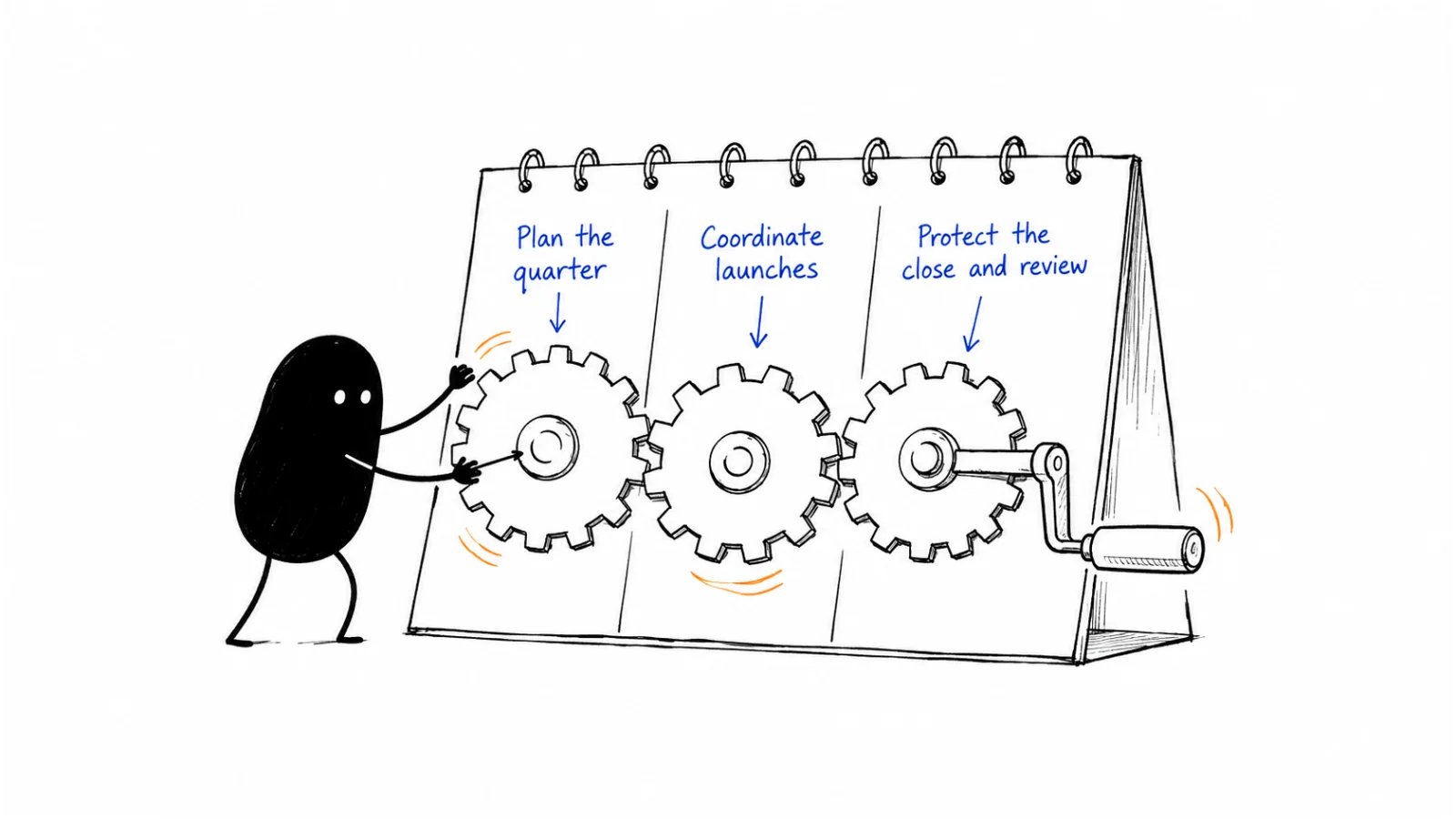 *Reading guide: plan the quarter → coordinate launches → protect the close and review.*
## Use this when
* You are roughly 50–500 people and the founder can no longer narrate every project in one room.
* Product slips a “quarter” that was never tied to a public date, and marketing dribbles news for 12 weeks.
* Sales changes quotas mid-quarter, or the board reads a mid-close snapshot as a quarter.
* Launch day and quarter-end try to occupy the same week.
## Do not use this when
* The founder still sells the first logos. A company calendar is costume. Stay in [first ten](../01-strategy-and-buyers/first-ten-customers.md).
* You need the weekly sales meetings. That is [sales operating cadence](https://b2-b-playbook.mintlify.app/playbooks/09-operations-pipeline-and-measurement/sales-operating-cadence).
* You need next year’s demand vs capacity math. That is [GTM planning](https://b2-b-playbook.mintlify.app/playbooks/09-operations-pipeline-and-measurement/gtm-planning).
* You need the budget and monthly headcount that follow that plan. That is [budget and planning](https://b2-b-playbook.mintlify.app/playbooks/09-operations-pipeline-and-measurement/budget-and-planning).
* You need MEDDIC fields. Write them on the opportunity. Do not smuggle a qualification brand into a launch week.
## A few useful terms
| Word | Meaning here |
| ---------------------------- | ------------------------------------------------------------------------------------------------- |
| **Sales–finance system** | Quota, close, books, board—snapped to the same fiscal quarter |
| **Product–marketing system** | What can ship in a quarter, and the **lightning strike** that makes it news |
| **Offset** | Close and launch are about half a quarter apart so nobody’s hair is on fire twice in one week |
| **Lightning strike** | One mid-quarter event (webinar, city room, release day) that concentrates news—not 52 press dribs |
## Keep this in mind
**Snap two calendars, then offset the peaks.** Sales and finance close together. Product and marketing launch together. Those two climaxes do not share a week. If you cannot point to the launch date that product is scoped to hit, marketing does not have a quarter. It has a content calendar.
## How to do it
### Step 1: Agree on planning periods and quota rules
December 31 is the default. Some sales-led companies end January 31 so the close is not Christmas week. Either is a choice. Changing quotas and territories after SKO is how you teach the team that the goalposts move.
Board meetings sit two to three weeks after the books close—while the quarter is still true.
### Step 2: Set a realistic product delivery schedule
The planning question is not “what would be amazing.” It is **what can ship inside this quarter** so marketing can put a date on it. Weekly or daily *code* can still ship. The **rock** (the thing you will demo in public) is quarterly. Sand that fills the jar first is how tentpoles never leave the building.
### Step 3: Coordinate marketing with launch dates
Four concentrated moments beat fifty-two announcements. A strike can be a webinar, a city room, or a user day. It does not have to be Dreamforce. The job is a date the CEO will stand on, so product cannot hide and sales has news in month two—not a surprise in week twelve.
If you already run [events](../06-account-field-and-partner/event-marketing.md) or [executive dinners](../06-account-field-and-partner/executive-dinners.md), one of them *is* the strike. Do not add a second circus.
### Step 4: Give each part of the quarter a clear purpose
| Month | Character | Sales–finance | Product–marketing |
| ---------- | ----------------- | ---------------------------------------------------------------- | ------------------------------------------------------------------------------ |
| 1 · Plan | SKO, books, board | New quotas and territories. Board while the last close is fresh. | Roadmap for the *next* strike. PMs show up at SKO so reps can sell the vision. |
| 2 · Launch | Lightning strike | Pipeline inspection. Use the news. | Ship, demo, debrief. QA is not optional because a date exists. |
| 3 · Close | Heads-down | Close the number. | Build the next rock. Minimal new launches. |
All-hands follow the milestones (close, board, pre-strike, post-strike). They do not invent a fifth ritual.
### Step 5: Publish the shared calendar
The [company-cadence card](../../templates/company-cadence.md) is the artifact. If launch and close are in the same week, you failed the offset. If marketing cannot name the rock, you failed step 2.
## Worked example (illustrative)
\~80 people. January 31 fiscal year. Two product squads. One AE team.
| Field | Fill |
| ------------ | ------------------------------------------------------- |
| Fiscal close | Jan / Apr / Jul / Oct |
| SKO + board | February, May, August, November (board \~week 3) |
| Strike | Week 6–7 webinar: one shipped rock + one customer story |
| Offset check | Strike is not in the close month |
| Refuse | A second “launch” the week quotas end |
## Before you start
* [ ] Fiscal year-end is written, and sales quarters match it.
* [ ] SKO, close, and board have dates; quotas do not move after SKO.
* [ ] One shippable rock is named for the next strike.
* [ ] The strike sits in month two, not on the close.
* [ ] Weekly sales meetings still follow [sales operating cadence](https://b2-b-playbook.mintlify.app/playbooks/09-operations-pipeline-and-measurement/sales-operating-cadence)—this page did not absorb them.
* [ ] We did not add a COO requisition to avoid writing the dates.
## Metrics
| Metric | Diagnostic use |
| -------------------------------------- | ------------------------------------------------------ |
| Rocks shipped vs promised this quarter | Whether the product calendar is real |
| Strike-to-close gap (weeks) | Whether the offset exists |
| Mid-quarter quota or territory edits | Whether the team can rely on the agreed sales calendar |
Do not count all-hands held, or a keynote that shipped nothing, as cadence.
## Common mistakes
* One calendar for the whole company that is actually just the forecast.
* Launch week on quarter-end.
* Marketing news every Friday because there is no rock.
* Annual-only quotas in a company that still learns every 90 days.
* Copying another company’s user conference as the only legal strike.
## What to read next
The weekly sales clock is [sales operating cadence](https://b2-b-playbook.mintlify.app/playbooks/09-operations-pipeline-and-measurement/sales-operating-cadence). Whether the year can close is [GTM planning](https://b2-b-playbook.mintlify.app/playbooks/09-operations-pipeline-and-measurement/gtm-planning). The money and monthly headcount that make that year honest are [budget and planning](https://b2-b-playbook.mintlify.app/playbooks/09-operations-pipeline-and-measurement/budget-and-planning). The launch as a market event (not the close-week date) is [product launch](../02-product-marketing/product-launch.md). Which assumption you will kill this quarter is [experimentation](https://b2-b-playbook.mintlify.app/playbooks/09-operations-pipeline-and-measurement/experimentation). What marketing is allowed to concentrate on is still [content strategy](../03-brand-story-and-content/content-strategy.md) and [channel strategy](../04-channels-and-distribution/channel-strategy.md). A night that is a table, not a keynote, is [executive dinners](../06-account-field-and-partner/executive-dinners.md).
## Sources and evidence boundary
This is an owner-maintained operating synthesis. It is not a COO job description and not a claim about any company’s exit.
The two-system picture (sales–finance vs product–marketing), quarterly rocks rather than endless sand, a mid-quarter lightning strike, offsetting close and launch, January 31 as an optional year-end, and the 50–500 employee window draw on David Sacks, “The Cadence: How to Operate a SaaS Startup” ([Craft Ventures / Medium, 2020-07-01](https://medium.com/craft-ventures/the-cadence-how-to-operate-a-saas-startup-436aa8099e8?ref=b2b-playbook)). That essay is a **method prompt**, not a source to copy. Yammer headcount, revenue, YamJam, and named founder-conference stories stay with that author. They are not this library’s operating proof.
***
Copyright © 2026 Ivan Xu. All rights reserved. See the [copyright and reuse terms](https://github.com/weilun88313/B2B-Playbook/blob/main/LICENSE).
Canonical source: [github.com/weilun88313/B2B-Playbook](https://github.com/weilun88313/B2B-Playbook)
*Reading guide: plan the quarter → coordinate launches → protect the close and review.*
## Use this when
* You are roughly 50–500 people and the founder can no longer narrate every project in one room.
* Product slips a “quarter” that was never tied to a public date, and marketing dribbles news for 12 weeks.
* Sales changes quotas mid-quarter, or the board reads a mid-close snapshot as a quarter.
* Launch day and quarter-end try to occupy the same week.
## Do not use this when
* The founder still sells the first logos. A company calendar is costume. Stay in [first ten](../01-strategy-and-buyers/first-ten-customers.md).
* You need the weekly sales meetings. That is [sales operating cadence](https://b2-b-playbook.mintlify.app/playbooks/09-operations-pipeline-and-measurement/sales-operating-cadence).
* You need next year’s demand vs capacity math. That is [GTM planning](https://b2-b-playbook.mintlify.app/playbooks/09-operations-pipeline-and-measurement/gtm-planning).
* You need the budget and monthly headcount that follow that plan. That is [budget and planning](https://b2-b-playbook.mintlify.app/playbooks/09-operations-pipeline-and-measurement/budget-and-planning).
* You need MEDDIC fields. Write them on the opportunity. Do not smuggle a qualification brand into a launch week.
## A few useful terms
| Word | Meaning here |
| ---------------------------- | ------------------------------------------------------------------------------------------------- |
| **Sales–finance system** | Quota, close, books, board—snapped to the same fiscal quarter |
| **Product–marketing system** | What can ship in a quarter, and the **lightning strike** that makes it news |
| **Offset** | Close and launch are about half a quarter apart so nobody’s hair is on fire twice in one week |
| **Lightning strike** | One mid-quarter event (webinar, city room, release day) that concentrates news—not 52 press dribs |
## Keep this in mind
**Snap two calendars, then offset the peaks.** Sales and finance close together. Product and marketing launch together. Those two climaxes do not share a week. If you cannot point to the launch date that product is scoped to hit, marketing does not have a quarter. It has a content calendar.
## How to do it
### Step 1: Agree on planning periods and quota rules
December 31 is the default. Some sales-led companies end January 31 so the close is not Christmas week. Either is a choice. Changing quotas and territories after SKO is how you teach the team that the goalposts move.
Board meetings sit two to three weeks after the books close—while the quarter is still true.
### Step 2: Set a realistic product delivery schedule
The planning question is not “what would be amazing.” It is **what can ship inside this quarter** so marketing can put a date on it. Weekly or daily *code* can still ship. The **rock** (the thing you will demo in public) is quarterly. Sand that fills the jar first is how tentpoles never leave the building.
### Step 3: Coordinate marketing with launch dates
Four concentrated moments beat fifty-two announcements. A strike can be a webinar, a city room, or a user day. It does not have to be Dreamforce. The job is a date the CEO will stand on, so product cannot hide and sales has news in month two—not a surprise in week twelve.
If you already run [events](../06-account-field-and-partner/event-marketing.md) or [executive dinners](../06-account-field-and-partner/executive-dinners.md), one of them *is* the strike. Do not add a second circus.
### Step 4: Give each part of the quarter a clear purpose
| Month | Character | Sales–finance | Product–marketing |
| ---------- | ----------------- | ---------------------------------------------------------------- | ------------------------------------------------------------------------------ |
| 1 · Plan | SKO, books, board | New quotas and territories. Board while the last close is fresh. | Roadmap for the *next* strike. PMs show up at SKO so reps can sell the vision. |
| 2 · Launch | Lightning strike | Pipeline inspection. Use the news. | Ship, demo, debrief. QA is not optional because a date exists. |
| 3 · Close | Heads-down | Close the number. | Build the next rock. Minimal new launches. |
All-hands follow the milestones (close, board, pre-strike, post-strike). They do not invent a fifth ritual.
### Step 5: Publish the shared calendar
The [company-cadence card](../../templates/company-cadence.md) is the artifact. If launch and close are in the same week, you failed the offset. If marketing cannot name the rock, you failed step 2.
## Worked example (illustrative)
\~80 people. January 31 fiscal year. Two product squads. One AE team.
| Field | Fill |
| ------------ | ------------------------------------------------------- |
| Fiscal close | Jan / Apr / Jul / Oct |
| SKO + board | February, May, August, November (board \~week 3) |
| Strike | Week 6–7 webinar: one shipped rock + one customer story |
| Offset check | Strike is not in the close month |
| Refuse | A second “launch” the week quotas end |
## Before you start
* [ ] Fiscal year-end is written, and sales quarters match it.
* [ ] SKO, close, and board have dates; quotas do not move after SKO.
* [ ] One shippable rock is named for the next strike.
* [ ] The strike sits in month two, not on the close.
* [ ] Weekly sales meetings still follow [sales operating cadence](https://b2-b-playbook.mintlify.app/playbooks/09-operations-pipeline-and-measurement/sales-operating-cadence)—this page did not absorb them.
* [ ] We did not add a COO requisition to avoid writing the dates.
## Metrics
| Metric | Diagnostic use |
| -------------------------------------- | ------------------------------------------------------ |
| Rocks shipped vs promised this quarter | Whether the product calendar is real |
| Strike-to-close gap (weeks) | Whether the offset exists |
| Mid-quarter quota or territory edits | Whether the team can rely on the agreed sales calendar |
Do not count all-hands held, or a keynote that shipped nothing, as cadence.
## Common mistakes
* One calendar for the whole company that is actually just the forecast.
* Launch week on quarter-end.
* Marketing news every Friday because there is no rock.
* Annual-only quotas in a company that still learns every 90 days.
* Copying another company’s user conference as the only legal strike.
## What to read next
The weekly sales clock is [sales operating cadence](https://b2-b-playbook.mintlify.app/playbooks/09-operations-pipeline-and-measurement/sales-operating-cadence). Whether the year can close is [GTM planning](https://b2-b-playbook.mintlify.app/playbooks/09-operations-pipeline-and-measurement/gtm-planning). The money and monthly headcount that make that year honest are [budget and planning](https://b2-b-playbook.mintlify.app/playbooks/09-operations-pipeline-and-measurement/budget-and-planning). The launch as a market event (not the close-week date) is [product launch](../02-product-marketing/product-launch.md). Which assumption you will kill this quarter is [experimentation](https://b2-b-playbook.mintlify.app/playbooks/09-operations-pipeline-and-measurement/experimentation). What marketing is allowed to concentrate on is still [content strategy](../03-brand-story-and-content/content-strategy.md) and [channel strategy](../04-channels-and-distribution/channel-strategy.md). A night that is a table, not a keynote, is [executive dinners](../06-account-field-and-partner/executive-dinners.md).
## Sources and evidence boundary
This is an owner-maintained operating synthesis. It is not a COO job description and not a claim about any company’s exit.
The two-system picture (sales–finance vs product–marketing), quarterly rocks rather than endless sand, a mid-quarter lightning strike, offsetting close and launch, January 31 as an optional year-end, and the 50–500 employee window draw on David Sacks, “The Cadence: How to Operate a SaaS Startup” ([Craft Ventures / Medium, 2020-07-01](https://medium.com/craft-ventures/the-cadence-how-to-operate-a-saas-startup-436aa8099e8?ref=b2b-playbook)). That essay is a **method prompt**, not a source to copy. Yammer headcount, revenue, YamJam, and named founder-conference stories stay with that author. They are not this library’s operating proof.
***
Copyright © 2026 Ivan Xu. All rights reserved. See the [copyright and reuse terms](https://github.com/weilun88313/B2B-Playbook/blob/main/LICENSE).
Canonical source: [github.com/weilun88313/B2B-Playbook](https://github.com/weilun88313/B2B-Playbook)