> ## Documentation Index
> Fetch the complete documentation index at: https://b2-b-playbook.mintlify.site/llms.txt
> Use this file to discover all available pages before exploring further.
# AI use-case selection
**Last reviewed:** 2026-08-30 · **Reading edit:** 2026-09-06
Start with a task that is slow, costly, or frequently done badly, rather than with a new AI product. Compare an AI approach with simpler alternatives, estimate the benefit and effort, and choose a small test your team can actually adopt.
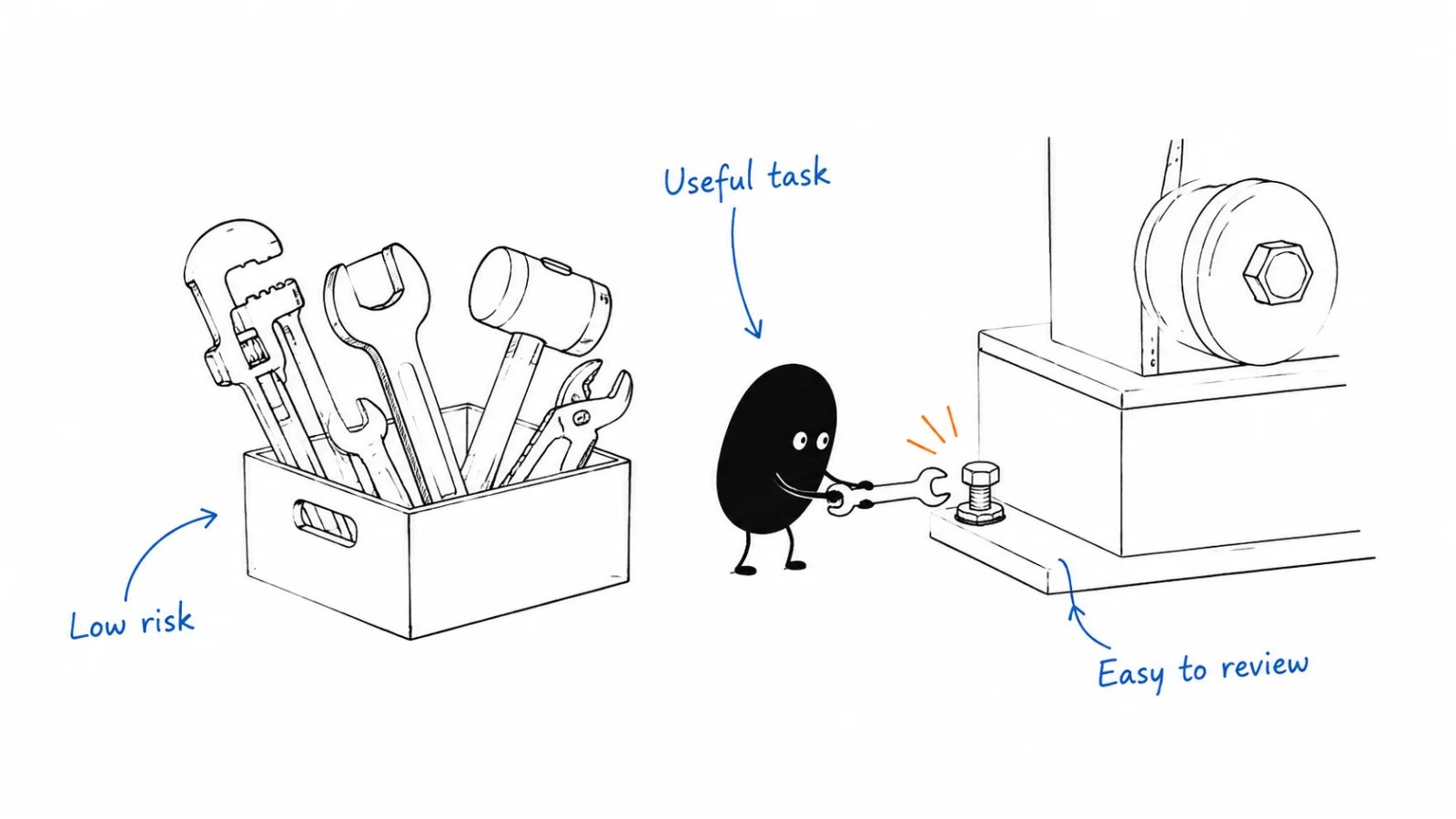 *Reading guide: name the work problem → compare possible fixes → choose a bounded test.*
## Use this when
* The calendar is a pile of AI pilots with no shared problem statement.
* Every function wants a different copilot, and none of them move the quarter’s number.
* You are about to buy from a community list of “GTM AI tools.”
* The team is tired of tool-of-the-month.
## Do not use this when
* There is no ICP and no number. Stay in [ICP](../01-strategy-and-buyers/icp.md) and [GTM planning](https://b2-b-playbook.mintlify.app/playbooks/09-operations-pipeline-and-measurement/gtm-planning).
* You already picked the problem and need stages, gates, and recovery. That is [AI workflow](https://b2-b-playbook.mintlify.app/playbooks/09-operations-pipeline-and-measurement/ai-workflow).
* You need a bake-off once the job is named. That is [MarTech governance](https://b2-b-playbook.mintlify.app/playbooks/09-operations-pipeline-and-measurement/martech-governance).
* You need a custom GPT’s instruction skeleton. That is [ai-teammate-brief.md](../../templates/ai-teammate-brief.md)—after the job exists.
## A few useful terms
| Word | Meaning here |
| ----------------- | ----------------------------------------------------------------------------------- |
| **Problem** | What is actually stopping the quarter—not a nice-to-have. |
| **Possibilities** | Every way to solve it, including *not* AI (hire, process, stop the work). |
| **Payoff** | If the bet works, the business impact as a number you will defend—not “efficiency.” |
| **Probability** | Honest chance it works *here*, given buyers, data, and skill. |
| **Perspiration** | Total load: your team **and** RevOps, enablement, product marketing, legal. |
| **Priority** | A conversation: expected value versus that load. Not a fake 7.3. |
## Keep this in mind
**Pick the problem first.** If you cannot name it in one sentence the CRO would recognize, you are shopping. A possibility that is only “try this model” is not a possibility. It is a catalog.
## How to do it
### Step 1: Name the business problems
Three at most. Pipeline missing, quality rotting, hiring gap, cycle slipping, onboarding stalling—**this quarter**. Then ask why until you have a cause you can act on, not a slogan. “We need AI” is not a cause. “Qualified people never reach the case-study stage because we only post the role” is.
### Step 2: Compare AI and non-AI options
For each problem: outreach, a human hire, a process change, a compensation change, a page, an agent, a stop-doing. If the only row is a vendor, you jumped.
### Step 3: Estimate benefit, confidence, and effort
**Payoff.** Is this a 5% lift you will not feel, or a change that would rewrite the plan? Demand a unit: pipeline, cycle days, hours returned *that you will reinvest*, win rate on a named slice. “Reps will be more productive” is not a payoff.
**Probability.** Proven in a company like yours, or a speculation you are taking because the upside is large enough. Write which.
**Perspiration.** Map every other team that must make this a top-three priority. A “one director, one month” project that also needs dashboards, training, and a narrative is a four-team project.
A useful comparison—not a law: *(payoff you believe × probability you believe) / perspiration*. If the high-payoff bets all have terrible probability given current load, **change the problem**. That is the framework working.
### Step 4: Check whether the team can adopt the change
The technology is usually less scarce than change. Principles that keep the frontline:
* Start with work that makes the job easier, not a keynote agent.
* Prefer tools that live where the team already works. A sixth surface is how you lose them.
* Size enablement to the change: a Slack note, a written standard plus meeting time, or formal training. Most companies under-staff the last two.
* One bet at a time with enough attention to finish. Random experiments train people to tune out.
When the bet is chosen, it becomes a row in the [experiment ledger](https://b2-b-playbook.mintlify.app/playbooks/09-operations-pipeline-and-measurement/experimentation): hypothesis, decision, kill date.
## Worked example (illustrative)
Sales-assist cybersecurity. Not Owner.com, not your vertical.
| Field | Fill |
| ------------- | ------------------------------------------------------------------------------------------------------------------------------------- |
| Problem | Pipeline quality: first meetings from content do not match the ICP; AEs burn the week. |
| Why | We do not brief the AE on stack and trigger; we book anyone who raises a hand. |
| Possibilities | (1) Human SDR writes a one-pager. (2) Pre-call brief workflow with a review gate. (3) Tighten the form. (4) Stop the content CTA. |
| Payoff | If briefs cut bad first meetings by a third, AE capacity returns to the ICP slice—enough to matter this quarter. Not “150% pipeline.” |
| Probability | Medium: we already have call notes; ICP file is stale. |
| Perspiration | Ops must land the brief in the CRM; AEs must open it; marketing must stop celebrating raw bookings. |
| Choice | (2) plus (3). Not a new chat SKU. |
## Copy: selection card (fill)
* Company problem (this quarter):
* Root cause we can act on:
* Possibilities (include at least one non-AI):
* Payoff in a number we will defend:
* Probability and why:
* Perspiration by team (not only the sponsor):
* Priority call (do / wait / pick another problem):
* Experiment row we will open if we do:
Working file: [ai-use-case-score.xlsx](../../templates/ai-use-case-score.xlsx).
## Before you start
* [ ] The problem is a company goal, not a vendor category.
* [ ] At least one possibility is not software.
* [ ] Payoff is a number, not “AI transformation.”
* [ ] Perspiration names other teams.
* [ ] Frontline can see how this makes the week easier.
* [ ] We are not running three AI bets with no owner.
* [ ] A community logo sheet did not pick the winner.
## Metrics
| Metric | Diagnostic use |
| ----------------------------------------- | --------------------------------------------------------------------------------------------------------------------------------------------- |
| Bets finished vs started | Attention vs fatigue |
| Problems killed because the math failed | Framework vs shopping |
| Frontline still using the thing at day 60 | Adoption vs launch |
| Experiment rows with a decision | Selection connected to [experimentation](https://b2-b-playbook.mintlify.app/playbooks/09-operations-pipeline-and-measurement/experimentation) |
Do not count tools trialed, or a CRO’s public “zero bad AI bets” story, as your selection system.
## Common mistakes
* Starting from a demo.
* Incremental busywork dressed as payoff.
* Ignoring other teams’ calendars.
* Adding a surface the team will not open.
* Switching tools before one bet embeds.
* Copying another company’s hiring-sprint tree as your problem.
* Pasting a Pavilion AI spreadsheet into the stack.
## What to read next
Where the motion sits on the ladder is [GTM AI maturity](https://b2-b-playbook.mintlify.app/playbooks/09-operations-pipeline-and-measurement/gtm-ai-maturity). How the chosen job is staged is [AI workflow](https://b2-b-playbook.mintlify.app/playbooks/09-operations-pipeline-and-measurement/ai-workflow). How you try to disprove it is [experimentation](https://b2-b-playbook.mintlify.app/playbooks/09-operations-pipeline-and-measurement/experimentation). Which SKU may do the job is [MarTech governance](https://b2-b-playbook.mintlify.app/playbooks/09-operations-pipeline-and-measurement/martech-governance). Instructions for a teammate come last: [ai-teammate-brief.md](../../templates/ai-teammate-brief.md).
## Sources and evidence boundary
This is an owner-maintained operating synthesis. It is not a decision-science textbook, not employment advice, and not an endorsement of any CRO’s win rate.
Problem-first selection, a full possibility set, payoff × probability versus organizational load, and adoption as the scarce skill are distilled from a public write-up of a use-case method ([Cannonball GTM, *The Five P’s Framework*](https://cannonballgtm.substack.com/p/the-five-ps-framework-how-to-pick?ref=b2b-playbook), discussing a talk by Kyle Norton). That essay is a **method prompt**, not a source to copy. Owner.com performance claims, “zero bad bets,” Opportunity Solution Tree examples, and enablement slogans in the piece are **not** this library’s facts. A circulated community list of AI products is not a substitute for Step 1. A survey in which more firms report using AI than attributing EBIT to it ([McKinsey, *The State of AI*](https://www.mckinsey.com/capabilities/quantumblack/our-insights/the-state-of-ai?ref=b2b-playbook)) is a reminder to pick a P\&L problem—not a reason to import their 2026 percentages as your business case.
***
Copyright © 2026 Ivan Xu. All rights reserved. See the [copyright and reuse terms](https://github.com/weilun88313/B2B-Playbook/blob/main/LICENSE).
Canonical source: [github.com/weilun88313/B2B-Playbook](https://github.com/weilun88313/B2B-Playbook)
*Reading guide: name the work problem → compare possible fixes → choose a bounded test.*
## Use this when
* The calendar is a pile of AI pilots with no shared problem statement.
* Every function wants a different copilot, and none of them move the quarter’s number.
* You are about to buy from a community list of “GTM AI tools.”
* The team is tired of tool-of-the-month.
## Do not use this when
* There is no ICP and no number. Stay in [ICP](../01-strategy-and-buyers/icp.md) and [GTM planning](https://b2-b-playbook.mintlify.app/playbooks/09-operations-pipeline-and-measurement/gtm-planning).
* You already picked the problem and need stages, gates, and recovery. That is [AI workflow](https://b2-b-playbook.mintlify.app/playbooks/09-operations-pipeline-and-measurement/ai-workflow).
* You need a bake-off once the job is named. That is [MarTech governance](https://b2-b-playbook.mintlify.app/playbooks/09-operations-pipeline-and-measurement/martech-governance).
* You need a custom GPT’s instruction skeleton. That is [ai-teammate-brief.md](../../templates/ai-teammate-brief.md)—after the job exists.
## A few useful terms
| Word | Meaning here |
| ----------------- | ----------------------------------------------------------------------------------- |
| **Problem** | What is actually stopping the quarter—not a nice-to-have. |
| **Possibilities** | Every way to solve it, including *not* AI (hire, process, stop the work). |
| **Payoff** | If the bet works, the business impact as a number you will defend—not “efficiency.” |
| **Probability** | Honest chance it works *here*, given buyers, data, and skill. |
| **Perspiration** | Total load: your team **and** RevOps, enablement, product marketing, legal. |
| **Priority** | A conversation: expected value versus that load. Not a fake 7.3. |
## Keep this in mind
**Pick the problem first.** If you cannot name it in one sentence the CRO would recognize, you are shopping. A possibility that is only “try this model” is not a possibility. It is a catalog.
## How to do it
### Step 1: Name the business problems
Three at most. Pipeline missing, quality rotting, hiring gap, cycle slipping, onboarding stalling—**this quarter**. Then ask why until you have a cause you can act on, not a slogan. “We need AI” is not a cause. “Qualified people never reach the case-study stage because we only post the role” is.
### Step 2: Compare AI and non-AI options
For each problem: outreach, a human hire, a process change, a compensation change, a page, an agent, a stop-doing. If the only row is a vendor, you jumped.
### Step 3: Estimate benefit, confidence, and effort
**Payoff.** Is this a 5% lift you will not feel, or a change that would rewrite the plan? Demand a unit: pipeline, cycle days, hours returned *that you will reinvest*, win rate on a named slice. “Reps will be more productive” is not a payoff.
**Probability.** Proven in a company like yours, or a speculation you are taking because the upside is large enough. Write which.
**Perspiration.** Map every other team that must make this a top-three priority. A “one director, one month” project that also needs dashboards, training, and a narrative is a four-team project.
A useful comparison—not a law: *(payoff you believe × probability you believe) / perspiration*. If the high-payoff bets all have terrible probability given current load, **change the problem**. That is the framework working.
### Step 4: Check whether the team can adopt the change
The technology is usually less scarce than change. Principles that keep the frontline:
* Start with work that makes the job easier, not a keynote agent.
* Prefer tools that live where the team already works. A sixth surface is how you lose them.
* Size enablement to the change: a Slack note, a written standard plus meeting time, or formal training. Most companies under-staff the last two.
* One bet at a time with enough attention to finish. Random experiments train people to tune out.
When the bet is chosen, it becomes a row in the [experiment ledger](https://b2-b-playbook.mintlify.app/playbooks/09-operations-pipeline-and-measurement/experimentation): hypothesis, decision, kill date.
## Worked example (illustrative)
Sales-assist cybersecurity. Not Owner.com, not your vertical.
| Field | Fill |
| ------------- | ------------------------------------------------------------------------------------------------------------------------------------- |
| Problem | Pipeline quality: first meetings from content do not match the ICP; AEs burn the week. |
| Why | We do not brief the AE on stack and trigger; we book anyone who raises a hand. |
| Possibilities | (1) Human SDR writes a one-pager. (2) Pre-call brief workflow with a review gate. (3) Tighten the form. (4) Stop the content CTA. |
| Payoff | If briefs cut bad first meetings by a third, AE capacity returns to the ICP slice—enough to matter this quarter. Not “150% pipeline.” |
| Probability | Medium: we already have call notes; ICP file is stale. |
| Perspiration | Ops must land the brief in the CRM; AEs must open it; marketing must stop celebrating raw bookings. |
| Choice | (2) plus (3). Not a new chat SKU. |
## Copy: selection card (fill)
* Company problem (this quarter):
* Root cause we can act on:
* Possibilities (include at least one non-AI):
* Payoff in a number we will defend:
* Probability and why:
* Perspiration by team (not only the sponsor):
* Priority call (do / wait / pick another problem):
* Experiment row we will open if we do:
Working file: [ai-use-case-score.xlsx](../../templates/ai-use-case-score.xlsx).
## Before you start
* [ ] The problem is a company goal, not a vendor category.
* [ ] At least one possibility is not software.
* [ ] Payoff is a number, not “AI transformation.”
* [ ] Perspiration names other teams.
* [ ] Frontline can see how this makes the week easier.
* [ ] We are not running three AI bets with no owner.
* [ ] A community logo sheet did not pick the winner.
## Metrics
| Metric | Diagnostic use |
| ----------------------------------------- | --------------------------------------------------------------------------------------------------------------------------------------------- |
| Bets finished vs started | Attention vs fatigue |
| Problems killed because the math failed | Framework vs shopping |
| Frontline still using the thing at day 60 | Adoption vs launch |
| Experiment rows with a decision | Selection connected to [experimentation](https://b2-b-playbook.mintlify.app/playbooks/09-operations-pipeline-and-measurement/experimentation) |
Do not count tools trialed, or a CRO’s public “zero bad AI bets” story, as your selection system.
## Common mistakes
* Starting from a demo.
* Incremental busywork dressed as payoff.
* Ignoring other teams’ calendars.
* Adding a surface the team will not open.
* Switching tools before one bet embeds.
* Copying another company’s hiring-sprint tree as your problem.
* Pasting a Pavilion AI spreadsheet into the stack.
## What to read next
Where the motion sits on the ladder is [GTM AI maturity](https://b2-b-playbook.mintlify.app/playbooks/09-operations-pipeline-and-measurement/gtm-ai-maturity). How the chosen job is staged is [AI workflow](https://b2-b-playbook.mintlify.app/playbooks/09-operations-pipeline-and-measurement/ai-workflow). How you try to disprove it is [experimentation](https://b2-b-playbook.mintlify.app/playbooks/09-operations-pipeline-and-measurement/experimentation). Which SKU may do the job is [MarTech governance](https://b2-b-playbook.mintlify.app/playbooks/09-operations-pipeline-and-measurement/martech-governance). Instructions for a teammate come last: [ai-teammate-brief.md](../../templates/ai-teammate-brief.md).
## Sources and evidence boundary
This is an owner-maintained operating synthesis. It is not a decision-science textbook, not employment advice, and not an endorsement of any CRO’s win rate.
Problem-first selection, a full possibility set, payoff × probability versus organizational load, and adoption as the scarce skill are distilled from a public write-up of a use-case method ([Cannonball GTM, *The Five P’s Framework*](https://cannonballgtm.substack.com/p/the-five-ps-framework-how-to-pick?ref=b2b-playbook), discussing a talk by Kyle Norton). That essay is a **method prompt**, not a source to copy. Owner.com performance claims, “zero bad bets,” Opportunity Solution Tree examples, and enablement slogans in the piece are **not** this library’s facts. A circulated community list of AI products is not a substitute for Step 1. A survey in which more firms report using AI than attributing EBIT to it ([McKinsey, *The State of AI*](https://www.mckinsey.com/capabilities/quantumblack/our-insights/the-state-of-ai?ref=b2b-playbook)) is a reminder to pick a P\&L problem—not a reason to import their 2026 percentages as your business case.
***
Copyright © 2026 Ivan Xu. All rights reserved. See the [copyright and reuse terms](https://github.com/weilun88313/B2B-Playbook/blob/main/LICENSE).
Canonical source: [github.com/weilun88313/B2B-Playbook](https://github.com/weilun88313/B2B-Playbook)