> ## Documentation Index
> Fetch the complete documentation index at: https://b2-b-playbook.mintlify.site/llms.txt
> Use this file to discover all available pages before exploring further.
# Expansion marketing
**Last reviewed:** 2026-08-30 · **Reading edit:** 2026-09-12
An existing customer may need another use case, more capacity, or a wider rollout. Start with evidence of value and a new need, then work with the account owner on a relevant offer. Do not treat the customer base as a list for every product announcement.
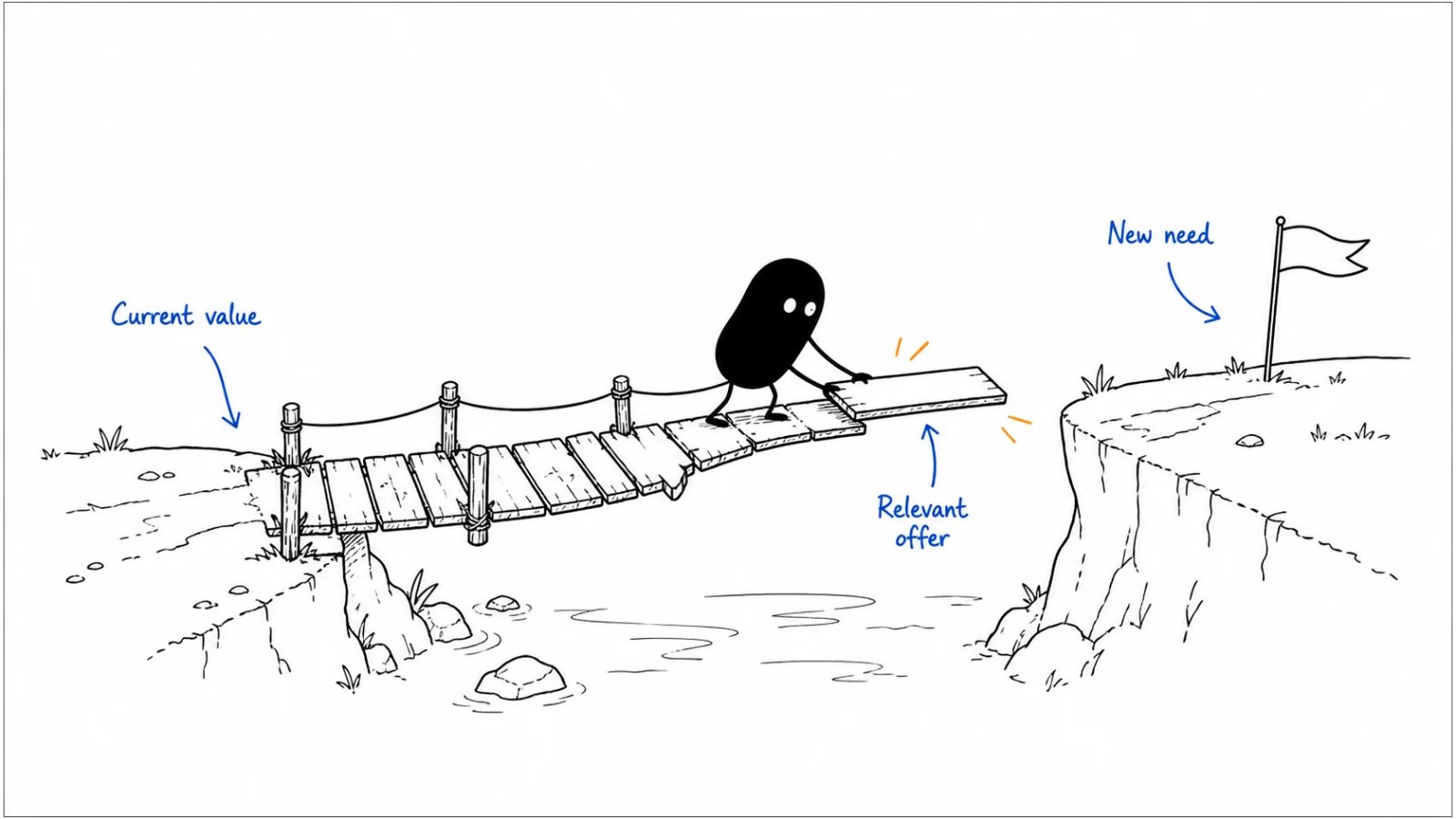 *Reading guide: value from today's use → evidence of another need → a relevant expansion offer.*
## Use this when
* New-logo quota is covering a leaking book and nobody will say so.
* CS and sales both “own expansion” and the customer hears two stories.
* Every QBR ends with a SKU, including accounts that never launched.
* Packaging created a second product and marketing wants a campaign to the whole base.
## Do not use this when
* There are no customers. Stay in [first ten](../01-strategy-and-buyers/first-ten-customers.md).
* You need who owns the book. That is [customer success](https://b2-b-playbook.mintlify.app/playbooks/08-lifecycle-and-customer-marketing/customer-success).
* You need the renewal clock. That is [renewal marketing](https://b2-b-playbook.mintlify.app/playbooks/08-lifecycle-and-customer-marketing/renewal-marketing).
* Gross churn is the fire. Fix onboarding and ICP before you sell more surface area.
## A few useful terms
| Word | Meaning here |
| -------------------- | ----------------------------------------------------------------------------------- |
| **Realization** | They got the first job they bought. No realization, no expansion ask |
| **Trigger** | Dated evidence a second job is now expensive (usage wall, new seat, new constraint) |
| **Commercial owner** | The role paid for the expansion—written, not “we’ll figure it out” |
| **Survivor growth** | Expansion that makes net look fine while gross still leaks |
## Keep this in mind
**Do not expand an account that has not realized the first purchase.** If launch is still open, or they cannot name the result, another SKU is how you create contraction. [CS workspace](https://b2-b-playbook.mintlify.app/playbooks/08-lifecycle-and-customer-marketing/cs-workspace) must show realization before marketing writes a campaign.
## How to do it
### Step 1: Agree on who owns the conversation
Write the sentence [customer success](https://b2-b-playbook.mintlify.app/playbooks/08-lifecycle-and-customer-marketing/customer-success) already demands: *renewals live with \_\_\_\_; expansion lives with \_\_\_\_; they are paid on \_\_\_\_.* If both are paid on the same dollar, say so. If they conflict, stop the campaign until [sales compensation](../09-operations-pipeline-and-measurement/sales-compensation.md) is honest.
### Step 2: Look for a customer need
Allowed triggers (need two that a stranger could check):
* They hit a usage or seat wall they already understood on the [pricing page](../07-website-and-conversion/pricing-page.md)
* A new seat or team asked for the same job
* A dated constraint (security, region, product line) the first SKU does not cover
* They asked
Not a trigger: “we launched a module,” “the AE is behind,” “they opened a newsletter.”
### Step 3: Offer the next useful use case
One additional job, one owner in their committee, one next step (scoped conversation or a [case study](../03-brand-story-and-content/case-study.md) from a similar expand). [Positioning](../02-product-marketing/positioning.md#step-8-position-the-way-you-sell) already says add-ons are for accounts that own the lead product—not a second standalone category story.
### Step 4: Review losses as well as expansion
If expansion is the only reason net looks healthy, say that in [GTM planning](../09-operations-pipeline-and-measurement/gtm-planning.md). Review upgrade revenue alongside departing customers so growth in healthy accounts does not hide problems elsewhere.
### Step 5: Keep the outreach relevant to each account
Do not email the whole customer list a new SKU. Segment on realization + trigger. A base-wide “what’s new” is [lifecycle](https://b2-b-playbook.mintlify.app/playbooks/08-lifecycle-and-customer-marketing) later—and even then it is education, not a close.
## Worked example (illustrative)
Ops queue product. Second SKU = audit log / enterprise admin.
| Field | Fill |
| --------------------- | ---------------------------------------------------------------------------------------------------------- |
| Commercial owner | AM, paid on expansion. CSM paid on retention. Written. |
| Trigger we will honor | Security questionnaire appeared, or a second queue asked for the same job |
| Trigger we refuse | “New module” email to everyone who launched |
| Proof | One [case study](../03-brand-story-and-content/case-study.md) of a team that added admin after realization |
| Will not expand | Accounts still in onboarding, or at-risk on the CS queue |
## Copy: expansion card (fill)
* Who is paid for expansion / who is paid for renewal:
* Realization rule (what must be true):
* Triggers we will honor (checkable):
* Triggers we refuse:
* Next job we are allowed to introduce this quarter (one):
* Segment (not the whole base):
* Gross vs net sentence we will not hide:
Working file: [expansion-marketing.md](../../templates/expansion-marketing.md).
## Before you start
* [ ] Commercial owner is written and does not secretly fight CS pay.
* [ ] Realization is visible in [CS workspace](https://b2-b-playbook.mintlify.app/playbooks/08-lifecycle-and-customer-marketing/cs-workspace).
* [ ] Triggers are dated and checkable.
* [ ] One next job, not a catalog.
* [ ] At-risk and unlaunched accounts are excluded.
* [ ] Gross is reported next to any expansion celebration.
## Metrics
| Metric | Diagnostic use |
| ------------------------------ | ------------------------------------------------------------------- |
| Expansion on realized accounts | Upgrades where first-value was already dated |
| Expansion on leaking accounts | Upgrades we should not have asked for |
| Gross vs net | Whether expansion is covering cancel + contraction |
| Ask quality | Expansion conversations the customer initiated or clearly triggered |
Do not treat “expansion pipeline from a product-launch email” as health.
## Common mistakes
* Expanding before launch.
* Two owners, two stories.
* Base-wide SKU blast.
* Using expansion to paper over gross churn.
* A second category story for an add-on.
## What to read next
The clock that must not be a surprise is [renewal marketing](https://b2-b-playbook.mintlify.app/playbooks/08-lifecycle-and-customer-marketing/renewal-marketing). The leak expansion must not hide is [revenue churn](https://b2-b-playbook.mintlify.app/playbooks/08-lifecycle-and-customer-marketing/revenue-churn). Who runs the book is [customer success](https://b2-b-playbook.mintlify.app/playbooks/08-lifecycle-and-customer-marketing/customer-success). How the second product is positioned is [position the way you sell](../02-product-marketing/positioning.md#step-8-position-the-way-you-sell). Named-account expansion still uses [account planning](../06-account-field-and-partner/account-planning.md).
## Sources and evidence boundary
This is an owner-maintained operating synthesis. Realization-before-ask and “do not let expansion hide gross” are this library’s judgments, already implied by [customer success](https://b2-b-playbook.mintlify.app/playbooks/08-lifecycle-and-customer-marketing/customer-success), [CS workspace](https://b2-b-playbook.mintlify.app/playbooks/08-lifecycle-and-customer-marketing/cs-workspace), and [revenue churn](https://b2-b-playbook.mintlify.app/playbooks/08-lifecycle-and-customer-marketing/revenue-churn) (Kellblog-shaped gross vs net). ITSMA/ABM “land and expand” slogans are not a method. This page is not a packaging or revenue-recognition opinion.
***
Copyright © 2026 Ivan Xu. All rights reserved. See the [copyright and reuse terms](https://github.com/weilun88313/B2B-Playbook/blob/main/LICENSE).
Canonical source: [github.com/weilun88313/B2B-Playbook](https://github.com/weilun88313/B2B-Playbook)
*Reading guide: value from today's use → evidence of another need → a relevant expansion offer.*
## Use this when
* New-logo quota is covering a leaking book and nobody will say so.
* CS and sales both “own expansion” and the customer hears two stories.
* Every QBR ends with a SKU, including accounts that never launched.
* Packaging created a second product and marketing wants a campaign to the whole base.
## Do not use this when
* There are no customers. Stay in [first ten](../01-strategy-and-buyers/first-ten-customers.md).
* You need who owns the book. That is [customer success](https://b2-b-playbook.mintlify.app/playbooks/08-lifecycle-and-customer-marketing/customer-success).
* You need the renewal clock. That is [renewal marketing](https://b2-b-playbook.mintlify.app/playbooks/08-lifecycle-and-customer-marketing/renewal-marketing).
* Gross churn is the fire. Fix onboarding and ICP before you sell more surface area.
## A few useful terms
| Word | Meaning here |
| -------------------- | ----------------------------------------------------------------------------------- |
| **Realization** | They got the first job they bought. No realization, no expansion ask |
| **Trigger** | Dated evidence a second job is now expensive (usage wall, new seat, new constraint) |
| **Commercial owner** | The role paid for the expansion—written, not “we’ll figure it out” |
| **Survivor growth** | Expansion that makes net look fine while gross still leaks |
## Keep this in mind
**Do not expand an account that has not realized the first purchase.** If launch is still open, or they cannot name the result, another SKU is how you create contraction. [CS workspace](https://b2-b-playbook.mintlify.app/playbooks/08-lifecycle-and-customer-marketing/cs-workspace) must show realization before marketing writes a campaign.
## How to do it
### Step 1: Agree on who owns the conversation
Write the sentence [customer success](https://b2-b-playbook.mintlify.app/playbooks/08-lifecycle-and-customer-marketing/customer-success) already demands: *renewals live with \_\_\_\_; expansion lives with \_\_\_\_; they are paid on \_\_\_\_.* If both are paid on the same dollar, say so. If they conflict, stop the campaign until [sales compensation](../09-operations-pipeline-and-measurement/sales-compensation.md) is honest.
### Step 2: Look for a customer need
Allowed triggers (need two that a stranger could check):
* They hit a usage or seat wall they already understood on the [pricing page](../07-website-and-conversion/pricing-page.md)
* A new seat or team asked for the same job
* A dated constraint (security, region, product line) the first SKU does not cover
* They asked
Not a trigger: “we launched a module,” “the AE is behind,” “they opened a newsletter.”
### Step 3: Offer the next useful use case
One additional job, one owner in their committee, one next step (scoped conversation or a [case study](../03-brand-story-and-content/case-study.md) from a similar expand). [Positioning](../02-product-marketing/positioning.md#step-8-position-the-way-you-sell) already says add-ons are for accounts that own the lead product—not a second standalone category story.
### Step 4: Review losses as well as expansion
If expansion is the only reason net looks healthy, say that in [GTM planning](../09-operations-pipeline-and-measurement/gtm-planning.md). Review upgrade revenue alongside departing customers so growth in healthy accounts does not hide problems elsewhere.
### Step 5: Keep the outreach relevant to each account
Do not email the whole customer list a new SKU. Segment on realization + trigger. A base-wide “what’s new” is [lifecycle](https://b2-b-playbook.mintlify.app/playbooks/08-lifecycle-and-customer-marketing) later—and even then it is education, not a close.
## Worked example (illustrative)
Ops queue product. Second SKU = audit log / enterprise admin.
| Field | Fill |
| --------------------- | ---------------------------------------------------------------------------------------------------------- |
| Commercial owner | AM, paid on expansion. CSM paid on retention. Written. |
| Trigger we will honor | Security questionnaire appeared, or a second queue asked for the same job |
| Trigger we refuse | “New module” email to everyone who launched |
| Proof | One [case study](../03-brand-story-and-content/case-study.md) of a team that added admin after realization |
| Will not expand | Accounts still in onboarding, or at-risk on the CS queue |
## Copy: expansion card (fill)
* Who is paid for expansion / who is paid for renewal:
* Realization rule (what must be true):
* Triggers we will honor (checkable):
* Triggers we refuse:
* Next job we are allowed to introduce this quarter (one):
* Segment (not the whole base):
* Gross vs net sentence we will not hide:
Working file: [expansion-marketing.md](../../templates/expansion-marketing.md).
## Before you start
* [ ] Commercial owner is written and does not secretly fight CS pay.
* [ ] Realization is visible in [CS workspace](https://b2-b-playbook.mintlify.app/playbooks/08-lifecycle-and-customer-marketing/cs-workspace).
* [ ] Triggers are dated and checkable.
* [ ] One next job, not a catalog.
* [ ] At-risk and unlaunched accounts are excluded.
* [ ] Gross is reported next to any expansion celebration.
## Metrics
| Metric | Diagnostic use |
| ------------------------------ | ------------------------------------------------------------------- |
| Expansion on realized accounts | Upgrades where first-value was already dated |
| Expansion on leaking accounts | Upgrades we should not have asked for |
| Gross vs net | Whether expansion is covering cancel + contraction |
| Ask quality | Expansion conversations the customer initiated or clearly triggered |
Do not treat “expansion pipeline from a product-launch email” as health.
## Common mistakes
* Expanding before launch.
* Two owners, two stories.
* Base-wide SKU blast.
* Using expansion to paper over gross churn.
* A second category story for an add-on.
## What to read next
The clock that must not be a surprise is [renewal marketing](https://b2-b-playbook.mintlify.app/playbooks/08-lifecycle-and-customer-marketing/renewal-marketing). The leak expansion must not hide is [revenue churn](https://b2-b-playbook.mintlify.app/playbooks/08-lifecycle-and-customer-marketing/revenue-churn). Who runs the book is [customer success](https://b2-b-playbook.mintlify.app/playbooks/08-lifecycle-and-customer-marketing/customer-success). How the second product is positioned is [position the way you sell](../02-product-marketing/positioning.md#step-8-position-the-way-you-sell). Named-account expansion still uses [account planning](../06-account-field-and-partner/account-planning.md).
## Sources and evidence boundary
This is an owner-maintained operating synthesis. Realization-before-ask and “do not let expansion hide gross” are this library’s judgments, already implied by [customer success](https://b2-b-playbook.mintlify.app/playbooks/08-lifecycle-and-customer-marketing/customer-success), [CS workspace](https://b2-b-playbook.mintlify.app/playbooks/08-lifecycle-and-customer-marketing/cs-workspace), and [revenue churn](https://b2-b-playbook.mintlify.app/playbooks/08-lifecycle-and-customer-marketing/revenue-churn) (Kellblog-shaped gross vs net). ITSMA/ABM “land and expand” slogans are not a method. This page is not a packaging or revenue-recognition opinion.
***
Copyright © 2026 Ivan Xu. All rights reserved. See the [copyright and reuse terms](https://github.com/weilun88313/B2B-Playbook/blob/main/LICENSE).
Canonical source: [github.com/weilun88313/B2B-Playbook](https://github.com/weilun88313/B2B-Playbook)