> ## Documentation Index
> Fetch the complete documentation index at: https://b2-b-playbook.mintlify.site/llms.txt
> Use this file to discover all available pages before exploring further.
# CS workspace
**Last reviewed:** 2026-08-30 · **Reading edit:** 2026-09-12
A customer success workspace should answer the questions your team asks every week. Where is each account in its journey? Who owns the next action? What value has the customer received, and what needs attention? Design fields and views around those questions.
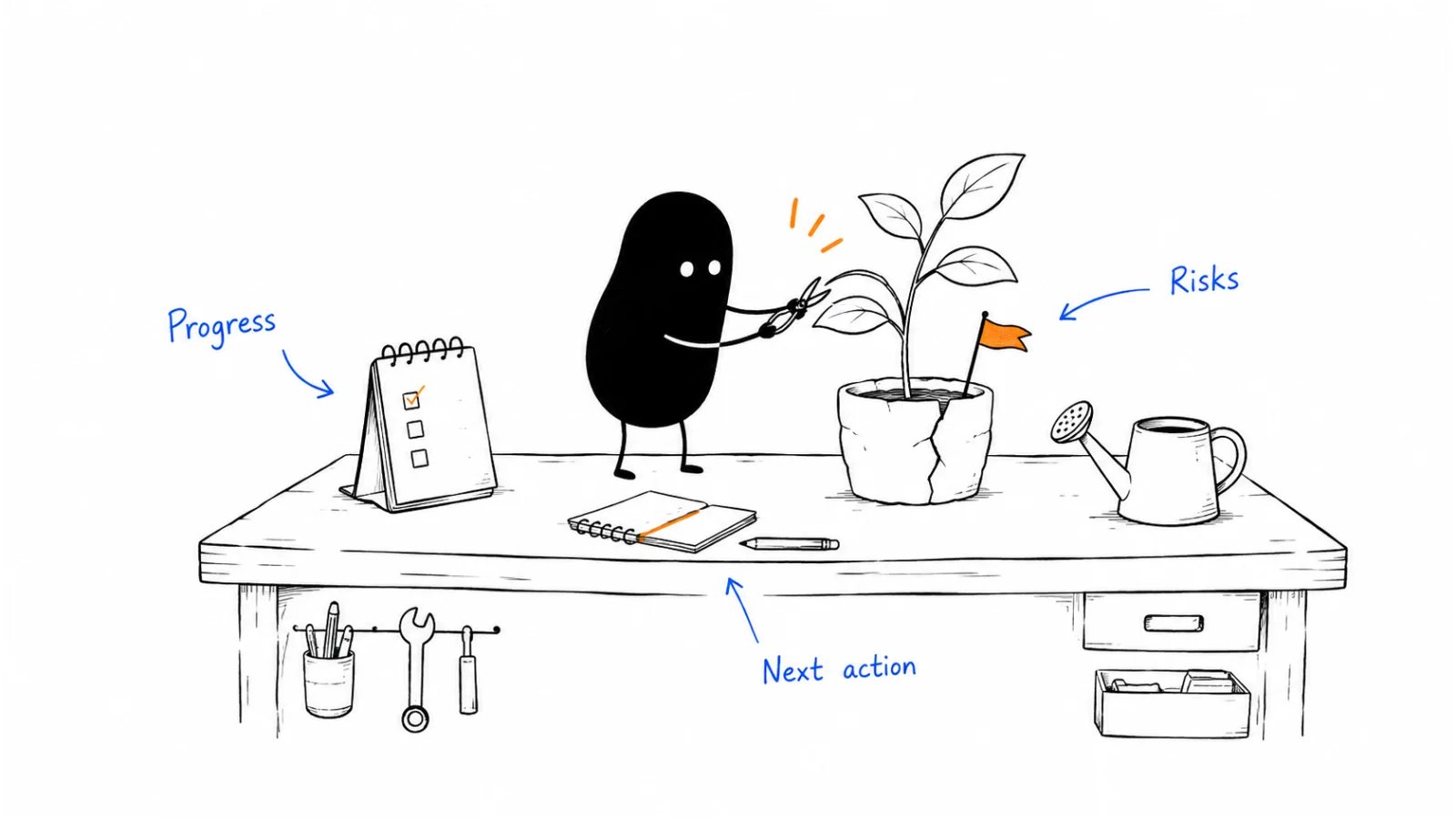 *Reading guide: customer progress · risks and renewal dates · owners and next actions.*
## Use this when
* CSMs live in a private spreadsheet because the CRM cannot show the book.
* Health is a formula nobody trusts, and the dashboard is a screenshot.
* You are “moving to Service Hub / Gainsight / ChurnZero” and the plan is to copy every field.
* Automation creates tasks the team ignores.
## Do not use this when
* There is no CS job sentence. Write [customer success](https://b2-b-playbook.mintlify.app/playbooks/08-lifecycle-and-customer-marketing/customer-success) first.
* You need the sales opportunity model. That is [CRM data model](../09-operations-pipeline-and-measurement/crm-data-model.md) and [forecasting](../09-operations-pipeline-and-measurement/forecasting.md).
* You need software names. Start in [TOOLS.md](../../TOOLS.md), then [MarTech governance](../09-operations-pipeline-and-measurement/martech-governance.md).
* Legal hold or privacy design is the request. Qualified owners; this is not that advice.
## A few useful terms
| Word | Meaning here |
| ---------------- | ----------------------------------------------------------------------------------------- |
| **Realization** | Are they getting the outcome they bought—not only logins? |
| **Relationship** | Do we have a dated cadence (QBR, check-in) that matches the tier? |
| **Renewal** | Where is the revenue, the date, the owner, the stage? |
| **Risk** | What leading signals (usage drop, champion leave, unpaid, dark) require a play this week? |
## Keep this in mind
**Every field, workflow, and saved view must serve one of the four questions—or it is killed.** “Nice to have for a future report” is how you recreate the last CS tool’s swamp. If you are migrating, move what you **operate**; leave ceremonial customs behind—same discipline as a CRM field map.
## How to do it
### Step 1: Define the questions the workspace must answer
Write, for your stack:
* **Realization:** which object holds outcomes, milestones, TTV (see [customer onboarding](https://b2-b-playbook.mintlify.app/playbooks/08-lifecycle-and-customer-marketing/customer-onboarding)). Usage may feed it; usage is not it.
* **Relationship:** last strategic touch, next QBR, tier, owner. Cadence is a date, not a vibe.
* **Renewal:** opportunity or equivalent, amount, date, stage language that matches [forecasting](../09-operations-pipeline-and-measurement/forecasting.md). Upsell: same object or a rule you can explain.
* **Risk:** the weekly at-risk list’s fields—why red, owner, next action. Champion-left, gone-dark, unpaid, expected vs surprise churn are **plays** on [customer success](https://b2-b-playbook.mintlify.app/playbooks/08-lifecycle-and-customer-marketing/customer-success), not mystery scores.
If two systems both claim “health,” pick a source of truth or you will argue in the QBR.
### Step 2: Keep fields that support those answers
Inventory like a field map: label, populated count, which of the four jobs, keep / kill / transform. CSMs track activity in the CRM they already work, not in a shadow tool, unless [MarTech governance](../09-operations-pipeline-and-measurement/martech-governance.md) said the overlay may write back.
Do not import another operator’s HubSpot property list. Their 25 years and client ARR are not your schema.
### Step 3: Automate work after the process is clear
Automate what the team already does by hand and **misses**: renewal created N days out, inactivity after a defined dark period, handoff task when opp closes. Leave judgment (save-path, commercial exception) manual. Workflows that create false-positive tasks train people to ignore the system.
### Step 4: Build views the team will use weekly
One queue for at-risk. One for renewals this quarter. One for onboarding still open. Filters that match [sales operating cadence](../09-operations-pipeline-and-measurement/sales-operating-cadence.md) thinking: one view, one question. Vanity NRR charts for Slack are not a workspace.
### Step 5: Connect systems where information needs to move
Another system’s data is not a reason to sync. If you cannot name the field on the four-question list, do not connect it. Consolidation beats a fourth “CS source of truth.”
### Step 6: Plan the migration and cutoff date
From Gainsight, ChurnZero, Salesforce CS clouds, or Sheets: sequence like [CRM data model](../09-operations-pipeline-and-measurement/crm-data-model.md)—objects you operate, populated fields, picklists that match forecast language. Leave the swamp. A “lift and shift” is how you pay for two swamps.
## Worked example (illustrative)
Forty logos. CRM is the system of record. Not a HubSpot blueprint.
| Job | Keep | Kill |
| ------------ | -------------------------------------------------------- | ------------------------------------- |
| Realization | Milestone “first value” date, TTV vs plan | Twelve unused “sentiment” customs |
| Relationship | Next QBR, last strategic touch, tier | Duplicate “check-in vibe” |
| Renewal | Renewal opp 120 days out, amount, stage = forecast names | A second ARR field CS updates by hand |
| Risk | At-risk reason, owner, next action; unpaid flag | Health 0–100 nobody can explain |
## Copy: workspace one-pager (fill)
* Realization fields / object:
* Relationship fields (cadence dates, tier, owner):
* Renewal object and stage language:
* Risk fields and the Monday view:
* Automations we will ship (and ones we refuse):
* Systems we will **not** sync:
* Migration: from-system, freeze date, what we leave behind:
Working file: [cs-workspace.xlsx](../../templates/cs-workspace.xlsx).
## Before you start
* [ ] Each kept field maps to realization, relationship, renewal, or risk.
* [ ] Renewal stages match the forecast page.
* [ ] One Monday view per question; no dashboard of everything.
* [ ] Automation has a miss-cost, not a “would be cool.”
* [ ] Migration has a kill list, not only a keep list.
* [ ] Health, if it exists, has a written formula and an owner.
* [ ] No HubSpot/Gainsight property dump as the model.
## Metrics
| Metric | Diagnostic use |
| --------------------------------------------- | ---------------------------------------------------------- |
| Fields mapped to one of four jobs vs live org | Swamp vs record |
| CSM time in CRM vs shadow sheet | Whether the workspace is real |
| Workflows opened vs completed | Noise |
| At-risk list age | Whether the risk list reflects current customer situations |
Do not count objects created, or resemblance to a paid HubSpot CS manual, as a workspace.
## Common mistakes
* Copying Service Hub defaults and calling it a playbook.
* Health score with no formula.
* Automating judgment.
* Syncing everything “in case.”
* Migrating unused Gainsight fields.
* Treating vendor ARR claims as evidence your schema will work.
* Building the workspace before [customer success](https://b2-b-playbook.mintlify.app/playbooks/08-lifecycle-and-customer-marketing/customer-success) names who owns renewals.
## What to read next
The jobs this record serves are [customer success](https://b2-b-playbook.mintlify.app/playbooks/08-lifecycle-and-customer-marketing/customer-success). Implementation clocks are [customer onboarding](https://b2-b-playbook.mintlify.app/playbooks/08-lifecycle-and-customer-marketing/customer-onboarding). Additional value on evidence is [expansion marketing](https://b2-b-playbook.mintlify.app/playbooks/08-lifecycle-and-customer-marketing/expansion-marketing). The clock before the commercial path is [renewal marketing](https://b2-b-playbook.mintlify.app/playbooks/08-lifecycle-and-customer-marketing/renewal-marketing). The commercial spine is [CRM data model](../09-operations-pipeline-and-measurement/crm-data-model.md). Tools still need [MarTech governance](../09-operations-pipeline-and-measurement/martech-governance.md). A new CS leader’s audit of this workspace is [CS-leadership ramp](https://b2-b-playbook.mintlify.app/playbooks/08-lifecycle-and-customer-marketing/cs-leadership-ramp).
## Sources and evidence boundary
This is an owner-maintained operating synthesis. It is not HubSpot documentation, not a Gainsight implementation, and not a licensed CS platform.
The four-job test (realization, relationship, renewal, risk) and the instruction that properties, workflows, and views must serve those jobs—or they do not belong—are distilled from a public operator landing page for a HubSpot CS workspace manual ([Infinite Renewals](https://info.infiniterenewals.com/customer-success-in-hubspot?ref=b2b-playbook)). That page is a **method prompt**, not a source to copy. The gated manual, HubSpot click-paths, \$1.8B client-ARR claim, and partner pitches are **not** this library’s schema or a requirement to buy a course. Object-model and migration *discipline* still follow this repository’s CRM field-map page.
***
Copyright © 2026 Ivan Xu. All rights reserved. See the [copyright and reuse terms](https://github.com/weilun88313/B2B-Playbook/blob/main/LICENSE).
Canonical source: [github.com/weilun88313/B2B-Playbook](https://github.com/weilun88313/B2B-Playbook)
*Reading guide: customer progress · risks and renewal dates · owners and next actions.*
## Use this when
* CSMs live in a private spreadsheet because the CRM cannot show the book.
* Health is a formula nobody trusts, and the dashboard is a screenshot.
* You are “moving to Service Hub / Gainsight / ChurnZero” and the plan is to copy every field.
* Automation creates tasks the team ignores.
## Do not use this when
* There is no CS job sentence. Write [customer success](https://b2-b-playbook.mintlify.app/playbooks/08-lifecycle-and-customer-marketing/customer-success) first.
* You need the sales opportunity model. That is [CRM data model](../09-operations-pipeline-and-measurement/crm-data-model.md) and [forecasting](../09-operations-pipeline-and-measurement/forecasting.md).
* You need software names. Start in [TOOLS.md](../../TOOLS.md), then [MarTech governance](../09-operations-pipeline-and-measurement/martech-governance.md).
* Legal hold or privacy design is the request. Qualified owners; this is not that advice.
## A few useful terms
| Word | Meaning here |
| ---------------- | ----------------------------------------------------------------------------------------- |
| **Realization** | Are they getting the outcome they bought—not only logins? |
| **Relationship** | Do we have a dated cadence (QBR, check-in) that matches the tier? |
| **Renewal** | Where is the revenue, the date, the owner, the stage? |
| **Risk** | What leading signals (usage drop, champion leave, unpaid, dark) require a play this week? |
## Keep this in mind
**Every field, workflow, and saved view must serve one of the four questions—or it is killed.** “Nice to have for a future report” is how you recreate the last CS tool’s swamp. If you are migrating, move what you **operate**; leave ceremonial customs behind—same discipline as a CRM field map.
## How to do it
### Step 1: Define the questions the workspace must answer
Write, for your stack:
* **Realization:** which object holds outcomes, milestones, TTV (see [customer onboarding](https://b2-b-playbook.mintlify.app/playbooks/08-lifecycle-and-customer-marketing/customer-onboarding)). Usage may feed it; usage is not it.
* **Relationship:** last strategic touch, next QBR, tier, owner. Cadence is a date, not a vibe.
* **Renewal:** opportunity or equivalent, amount, date, stage language that matches [forecasting](../09-operations-pipeline-and-measurement/forecasting.md). Upsell: same object or a rule you can explain.
* **Risk:** the weekly at-risk list’s fields—why red, owner, next action. Champion-left, gone-dark, unpaid, expected vs surprise churn are **plays** on [customer success](https://b2-b-playbook.mintlify.app/playbooks/08-lifecycle-and-customer-marketing/customer-success), not mystery scores.
If two systems both claim “health,” pick a source of truth or you will argue in the QBR.
### Step 2: Keep fields that support those answers
Inventory like a field map: label, populated count, which of the four jobs, keep / kill / transform. CSMs track activity in the CRM they already work, not in a shadow tool, unless [MarTech governance](../09-operations-pipeline-and-measurement/martech-governance.md) said the overlay may write back.
Do not import another operator’s HubSpot property list. Their 25 years and client ARR are not your schema.
### Step 3: Automate work after the process is clear
Automate what the team already does by hand and **misses**: renewal created N days out, inactivity after a defined dark period, handoff task when opp closes. Leave judgment (save-path, commercial exception) manual. Workflows that create false-positive tasks train people to ignore the system.
### Step 4: Build views the team will use weekly
One queue for at-risk. One for renewals this quarter. One for onboarding still open. Filters that match [sales operating cadence](../09-operations-pipeline-and-measurement/sales-operating-cadence.md) thinking: one view, one question. Vanity NRR charts for Slack are not a workspace.
### Step 5: Connect systems where information needs to move
Another system’s data is not a reason to sync. If you cannot name the field on the four-question list, do not connect it. Consolidation beats a fourth “CS source of truth.”
### Step 6: Plan the migration and cutoff date
From Gainsight, ChurnZero, Salesforce CS clouds, or Sheets: sequence like [CRM data model](../09-operations-pipeline-and-measurement/crm-data-model.md)—objects you operate, populated fields, picklists that match forecast language. Leave the swamp. A “lift and shift” is how you pay for two swamps.
## Worked example (illustrative)
Forty logos. CRM is the system of record. Not a HubSpot blueprint.
| Job | Keep | Kill |
| ------------ | -------------------------------------------------------- | ------------------------------------- |
| Realization | Milestone “first value” date, TTV vs plan | Twelve unused “sentiment” customs |
| Relationship | Next QBR, last strategic touch, tier | Duplicate “check-in vibe” |
| Renewal | Renewal opp 120 days out, amount, stage = forecast names | A second ARR field CS updates by hand |
| Risk | At-risk reason, owner, next action; unpaid flag | Health 0–100 nobody can explain |
## Copy: workspace one-pager (fill)
* Realization fields / object:
* Relationship fields (cadence dates, tier, owner):
* Renewal object and stage language:
* Risk fields and the Monday view:
* Automations we will ship (and ones we refuse):
* Systems we will **not** sync:
* Migration: from-system, freeze date, what we leave behind:
Working file: [cs-workspace.xlsx](../../templates/cs-workspace.xlsx).
## Before you start
* [ ] Each kept field maps to realization, relationship, renewal, or risk.
* [ ] Renewal stages match the forecast page.
* [ ] One Monday view per question; no dashboard of everything.
* [ ] Automation has a miss-cost, not a “would be cool.”
* [ ] Migration has a kill list, not only a keep list.
* [ ] Health, if it exists, has a written formula and an owner.
* [ ] No HubSpot/Gainsight property dump as the model.
## Metrics
| Metric | Diagnostic use |
| --------------------------------------------- | ---------------------------------------------------------- |
| Fields mapped to one of four jobs vs live org | Swamp vs record |
| CSM time in CRM vs shadow sheet | Whether the workspace is real |
| Workflows opened vs completed | Noise |
| At-risk list age | Whether the risk list reflects current customer situations |
Do not count objects created, or resemblance to a paid HubSpot CS manual, as a workspace.
## Common mistakes
* Copying Service Hub defaults and calling it a playbook.
* Health score with no formula.
* Automating judgment.
* Syncing everything “in case.”
* Migrating unused Gainsight fields.
* Treating vendor ARR claims as evidence your schema will work.
* Building the workspace before [customer success](https://b2-b-playbook.mintlify.app/playbooks/08-lifecycle-and-customer-marketing/customer-success) names who owns renewals.
## What to read next
The jobs this record serves are [customer success](https://b2-b-playbook.mintlify.app/playbooks/08-lifecycle-and-customer-marketing/customer-success). Implementation clocks are [customer onboarding](https://b2-b-playbook.mintlify.app/playbooks/08-lifecycle-and-customer-marketing/customer-onboarding). Additional value on evidence is [expansion marketing](https://b2-b-playbook.mintlify.app/playbooks/08-lifecycle-and-customer-marketing/expansion-marketing). The clock before the commercial path is [renewal marketing](https://b2-b-playbook.mintlify.app/playbooks/08-lifecycle-and-customer-marketing/renewal-marketing). The commercial spine is [CRM data model](../09-operations-pipeline-and-measurement/crm-data-model.md). Tools still need [MarTech governance](../09-operations-pipeline-and-measurement/martech-governance.md). A new CS leader’s audit of this workspace is [CS-leadership ramp](https://b2-b-playbook.mintlify.app/playbooks/08-lifecycle-and-customer-marketing/cs-leadership-ramp).
## Sources and evidence boundary
This is an owner-maintained operating synthesis. It is not HubSpot documentation, not a Gainsight implementation, and not a licensed CS platform.
The four-job test (realization, relationship, renewal, risk) and the instruction that properties, workflows, and views must serve those jobs—or they do not belong—are distilled from a public operator landing page for a HubSpot CS workspace manual ([Infinite Renewals](https://info.infiniterenewals.com/customer-success-in-hubspot?ref=b2b-playbook)). That page is a **method prompt**, not a source to copy. The gated manual, HubSpot click-paths, \$1.8B client-ARR claim, and partner pitches are **not** this library’s schema or a requirement to buy a course. Object-model and migration *discipline* still follow this repository’s CRM field-map page.
***
Copyright © 2026 Ivan Xu. All rights reserved. See the [copyright and reuse terms](https://github.com/weilun88313/B2B-Playbook/blob/main/LICENSE).
Canonical source: [github.com/weilun88313/B2B-Playbook](https://github.com/weilun88313/B2B-Playbook)