> ## Documentation Index
> Fetch the complete documentation index at: https://b2-b-playbook.mintlify.site/llms.txt
> Use this file to discover all available pages before exploring further.
# Trade shows
**Last reviewed:** 2026-08-30 · **Reading edit:** 2026-09-06
A trade show has many moving parts: the account list, pre-booked meetings, booth conversations, lead capture, and follow-up. Plan those together so the team knows whom to meet and what to record. A busy stand is useful only if the conversations go somewhere.
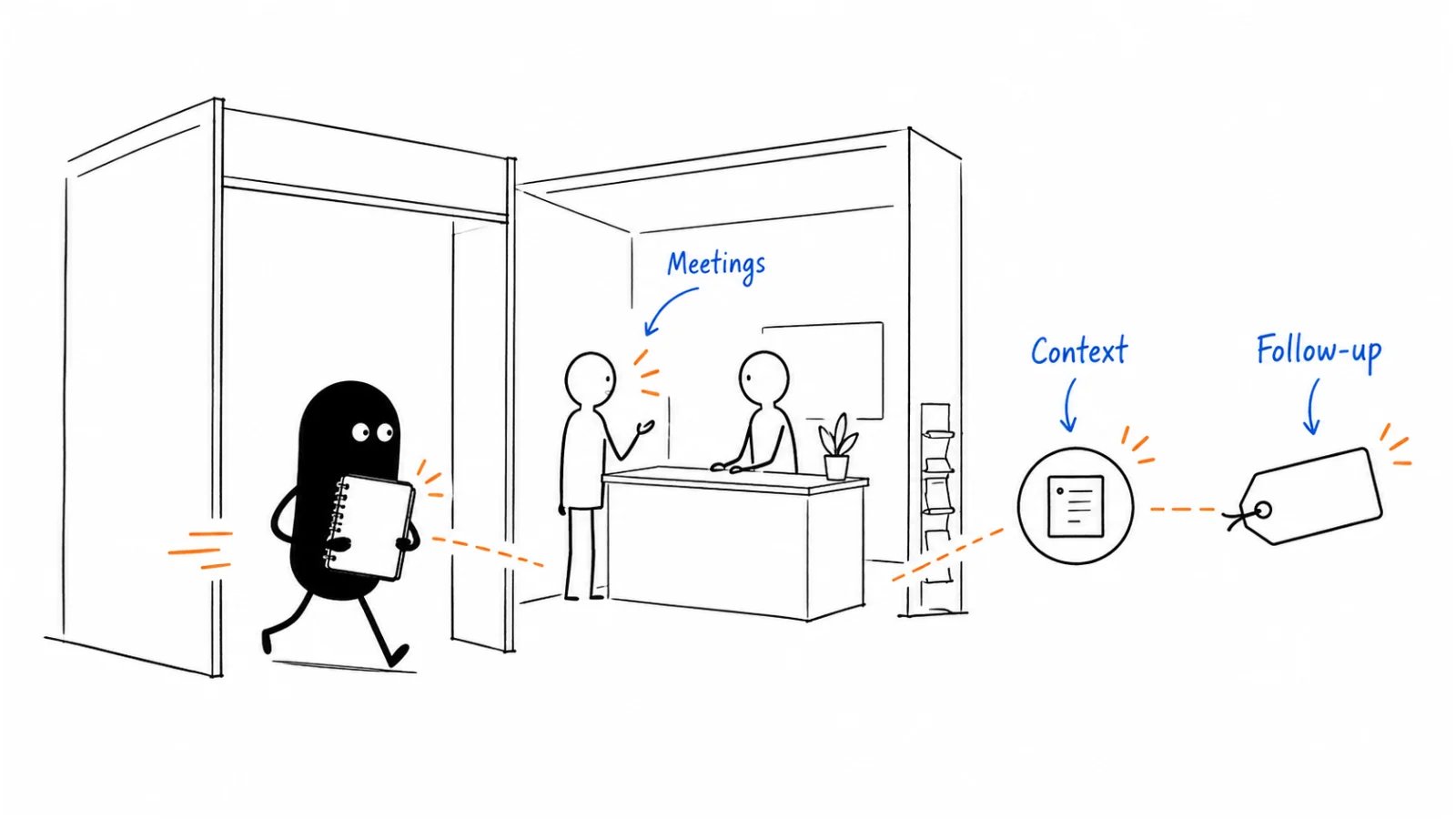 *Reading guide: before: book meetings → during: capture context → after: own the next step.*
## Use this when
* Relevant accounts and buying seats concentrate at a known event.
* The team can research and pre-book before travel.
* The event creates access or evidence that cheaper channels cannot.
## Do not use this when
* “Everyone in the industry goes” is the main reason.
* The budget is committed before account access is tested.
* Badge volume is the success metric.
Use the [event-marketing playbook](https://b2-b-playbook.mintlify.app/playbooks/06-account-field-and-partner/event-marketing) first to decide attend, sponsor, exhibit, or skip.
## 40 / 20 / 40 operating heuristic
* **40% before:** account mapping, meeting booking, briefs, partner coordination, and logistics.
* **20% on site:** protected meetings, relevant conversations, capture, and daily review.
* **40% after:** conversation-specific follow-up, next-action execution, opportunity validation, and program review.
This is an effort-allocation heuristic, not an ROI formula.
## Before the show
1. Review exhibitor, attendee, speaker, sponsor, and partner data where permitted.
2. Classify accounts by ICP tier and required buying seats.
3. Assign one-to-one research to T1 accounts and a shared hypothesis to T2 accounts.
4. Pre-book qualified meetings before increasing booth or sponsorship spend.
5. Prepare a conversation brief for every scheduled meeting.
6. Define capture fields, owners, follow-up timing, and system-of-record rules.
7. Train booth and field staff on qualification, routing, and stop conditions.
## On site
* Protect scheduled meetings from general booth traffic.
* **CRM context before they walk up:** tier, last touch, open opportunity, who owns the account. A cold scan with no context is a new research problem, not a lead.
* Confirm context before explaining the product.
* Ask a short **qualification set you wrote**—not the scanner vendor’s defaults. Minimum: job they came to finish, current alternative, timing, buying seat, missing seat.
* Record **interaction signals** that are not the badge: dwell, second pass, asked for a walk, named a next step, brought a second person. A two-second scan and a twenty-minute working conversation are not the same row.
* Assign an owner and date while the buyer is present.
* Route partners, customers, job seekers, vendors, and unqualified scans appropriately.
* Run a short daily review while evidence is fresh.
Capture tools still have to pass [MarTech governance](../09-operations-pipeline-and-measurement/martech-governance.md): offline, custom fields, CRM write-back, and whether booth staff will actually use the app. Names start in [TOOLS.md](../../TOOLS.md) (booth capture). This page is the test.
## After the show — rank, do not spray
* Send follow-up from the actual conversation, not a generic event template.
* **Priority is evidence, not scan time.** Rank: pre-booked meeting with a next step → qualified conversation with a dated action → interaction signal plus ICP → receipt-only scan (nurture or suppress).
* Complete agreed actions before adding another sales touch.
* Add only qualified evidence to pipeline reporting. Receipts do not become opportunities.
* Review decision quality, meeting quality, committee coverage, next-action completion, and cost.
* Record which account or operational assumption changed.
Working file: [show-capture.md](../../templates/show-capture.md).
## Copyable templates
### How a filled meeting brief reads
Same shape as [event marketing](https://b2-b-playbook.mintlify.app/playbooks/06-account-field-and-partner/event-marketing): T1 account, champion booked, trigger = questionnaire losses, next step = working session with the operator, not a badge scan.
### Meeting brief (copy)
* Account / tier:
* Person / buying seat:
* Trigger:
* Current alternative:
* Facts and assumptions:
* Unknowns:
* Intended next step:
* Owner / time / location:
### Conversation capture
* Business job:
* Trigger and timing:
* Current alternative:
* Confirmed buying seat:
* Missing seat:
* Objection or constraint:
* Interaction signals (dwell / second pass / walk asked / second person / other):
* CRM context we had before they walked up:
* Agreed next action:
* Seller owner and due date:
* Buyer owner and due date:
* Post-show rank (next-step / qualified / signal-only / receipt):
### Follow-up
**Subject:** \[trade show] — \[specific decision or trigger]
> At \[event], you said \[current process or trigger]. The agreed next step is \[bounded action] with \[required seat] by \[date]. I will \[seller action]; could you \[buyer action]?
## Before you start
* [ ] The event decision is evidence-backed.
* [ ] Target accounts are tiered.
* [ ] Required buying seats are mapped.
* [ ] Qualified meetings are pre-booked.
* [ ] Every meeting has a brief and owner.
* [ ] Staff understand qualification and routing.
* [ ] Qualification questions are ours, not the scanner defaults.
* [ ] CRM context will be visible on the floor.
* [ ] Capture fields, interaction signals, and follow-up rules are ready.
* [ ] Post-show rank (not scan order) is written.
* [ ] Badge-data use and consent follow applicable requirements.
* [ ] The team can downgrade or cancel the format when evidence weakens.
## Metrics
| Metric | Diagnostic use |
| ------------------------------ | ------------------------------------------------------- |
| Pre-booked qualified meetings | Tests access before the event |
| Qualified conversations | Counts buyer, problem, timing, or next-action evidence |
| Next-action completion | Agreed next actions completed / qualified conversations |
| Committee coverage | Required seats reached across target accounts |
| Event-sourced progression | Accounts reaching the next qualified decision |
| Cost per qualified next action | Total event cost / completed qualified next actions |
| Receipt-only share | Scans with no job or seat—must not enter pipeline |
## Common mistakes
* Buying a booth before testing account access.
* Treating every scan as a lead.
* Following up in scan order instead of evidence rank.
* Allowing unscheduled traffic to displace high-value meetings.
* Sending one generic follow-up to everyone.
* Claiming pipeline from meetings without qualified next actions.
## What to read next
The meetings you booked still need a story: [sales enablement](../02-product-marketing/sales-enablement.md). Whether a show should exist at all is [event marketing](https://b2-b-playbook.mintlify.app/playbooks/06-account-field-and-partner/event-marketing). A small night instead of a booth is [executive dinners](https://b2-b-playbook.mintlify.app/playbooks/06-account-field-and-partner/executive-dinners). Pre-show density that becomes a public cut is [creator partnership](../04-channels-and-distribution/creator-partnership.md). Partners who already own the aisle are [ecosystem](https://b2-b-playbook.mintlify.app/playbooks/06-account-field-and-partner/ecosystem). A dated change that is not a scan is [buying signals](../05-outbound-and-prospecting/buying-signals.md).
## Sources and evidence boundary
This is an owner-maintained operating synthesis. Event data rights, badge consent, labor rules, and outreach requirements vary; review them with qualified owners.
***
Copyright © 2026 Ivan Xu. All rights reserved. See the [copyright and reuse terms](https://github.com/weilun88313/B2B-Playbook/blob/main/LICENSE).
Canonical source: [github.com/weilun88313/B2B-Playbook](https://github.com/weilun88313/B2B-Playbook)
*Reading guide: before: book meetings → during: capture context → after: own the next step.*
## Use this when
* Relevant accounts and buying seats concentrate at a known event.
* The team can research and pre-book before travel.
* The event creates access or evidence that cheaper channels cannot.
## Do not use this when
* “Everyone in the industry goes” is the main reason.
* The budget is committed before account access is tested.
* Badge volume is the success metric.
Use the [event-marketing playbook](https://b2-b-playbook.mintlify.app/playbooks/06-account-field-and-partner/event-marketing) first to decide attend, sponsor, exhibit, or skip.
## 40 / 20 / 40 operating heuristic
* **40% before:** account mapping, meeting booking, briefs, partner coordination, and logistics.
* **20% on site:** protected meetings, relevant conversations, capture, and daily review.
* **40% after:** conversation-specific follow-up, next-action execution, opportunity validation, and program review.
This is an effort-allocation heuristic, not an ROI formula.
## Before the show
1. Review exhibitor, attendee, speaker, sponsor, and partner data where permitted.
2. Classify accounts by ICP tier and required buying seats.
3. Assign one-to-one research to T1 accounts and a shared hypothesis to T2 accounts.
4. Pre-book qualified meetings before increasing booth or sponsorship spend.
5. Prepare a conversation brief for every scheduled meeting.
6. Define capture fields, owners, follow-up timing, and system-of-record rules.
7. Train booth and field staff on qualification, routing, and stop conditions.
## On site
* Protect scheduled meetings from general booth traffic.
* **CRM context before they walk up:** tier, last touch, open opportunity, who owns the account. A cold scan with no context is a new research problem, not a lead.
* Confirm context before explaining the product.
* Ask a short **qualification set you wrote**—not the scanner vendor’s defaults. Minimum: job they came to finish, current alternative, timing, buying seat, missing seat.
* Record **interaction signals** that are not the badge: dwell, second pass, asked for a walk, named a next step, brought a second person. A two-second scan and a twenty-minute working conversation are not the same row.
* Assign an owner and date while the buyer is present.
* Route partners, customers, job seekers, vendors, and unqualified scans appropriately.
* Run a short daily review while evidence is fresh.
Capture tools still have to pass [MarTech governance](../09-operations-pipeline-and-measurement/martech-governance.md): offline, custom fields, CRM write-back, and whether booth staff will actually use the app. Names start in [TOOLS.md](../../TOOLS.md) (booth capture). This page is the test.
## After the show — rank, do not spray
* Send follow-up from the actual conversation, not a generic event template.
* **Priority is evidence, not scan time.** Rank: pre-booked meeting with a next step → qualified conversation with a dated action → interaction signal plus ICP → receipt-only scan (nurture or suppress).
* Complete agreed actions before adding another sales touch.
* Add only qualified evidence to pipeline reporting. Receipts do not become opportunities.
* Review decision quality, meeting quality, committee coverage, next-action completion, and cost.
* Record which account or operational assumption changed.
Working file: [show-capture.md](../../templates/show-capture.md).
## Copyable templates
### How a filled meeting brief reads
Same shape as [event marketing](https://b2-b-playbook.mintlify.app/playbooks/06-account-field-and-partner/event-marketing): T1 account, champion booked, trigger = questionnaire losses, next step = working session with the operator, not a badge scan.
### Meeting brief (copy)
* Account / tier:
* Person / buying seat:
* Trigger:
* Current alternative:
* Facts and assumptions:
* Unknowns:
* Intended next step:
* Owner / time / location:
### Conversation capture
* Business job:
* Trigger and timing:
* Current alternative:
* Confirmed buying seat:
* Missing seat:
* Objection or constraint:
* Interaction signals (dwell / second pass / walk asked / second person / other):
* CRM context we had before they walked up:
* Agreed next action:
* Seller owner and due date:
* Buyer owner and due date:
* Post-show rank (next-step / qualified / signal-only / receipt):
### Follow-up
**Subject:** \[trade show] — \[specific decision or trigger]
> At \[event], you said \[current process or trigger]. The agreed next step is \[bounded action] with \[required seat] by \[date]. I will \[seller action]; could you \[buyer action]?
## Before you start
* [ ] The event decision is evidence-backed.
* [ ] Target accounts are tiered.
* [ ] Required buying seats are mapped.
* [ ] Qualified meetings are pre-booked.
* [ ] Every meeting has a brief and owner.
* [ ] Staff understand qualification and routing.
* [ ] Qualification questions are ours, not the scanner defaults.
* [ ] CRM context will be visible on the floor.
* [ ] Capture fields, interaction signals, and follow-up rules are ready.
* [ ] Post-show rank (not scan order) is written.
* [ ] Badge-data use and consent follow applicable requirements.
* [ ] The team can downgrade or cancel the format when evidence weakens.
## Metrics
| Metric | Diagnostic use |
| ------------------------------ | ------------------------------------------------------- |
| Pre-booked qualified meetings | Tests access before the event |
| Qualified conversations | Counts buyer, problem, timing, or next-action evidence |
| Next-action completion | Agreed next actions completed / qualified conversations |
| Committee coverage | Required seats reached across target accounts |
| Event-sourced progression | Accounts reaching the next qualified decision |
| Cost per qualified next action | Total event cost / completed qualified next actions |
| Receipt-only share | Scans with no job or seat—must not enter pipeline |
## Common mistakes
* Buying a booth before testing account access.
* Treating every scan as a lead.
* Following up in scan order instead of evidence rank.
* Allowing unscheduled traffic to displace high-value meetings.
* Sending one generic follow-up to everyone.
* Claiming pipeline from meetings without qualified next actions.
## What to read next
The meetings you booked still need a story: [sales enablement](../02-product-marketing/sales-enablement.md). Whether a show should exist at all is [event marketing](https://b2-b-playbook.mintlify.app/playbooks/06-account-field-and-partner/event-marketing). A small night instead of a booth is [executive dinners](https://b2-b-playbook.mintlify.app/playbooks/06-account-field-and-partner/executive-dinners). Pre-show density that becomes a public cut is [creator partnership](../04-channels-and-distribution/creator-partnership.md). Partners who already own the aisle are [ecosystem](https://b2-b-playbook.mintlify.app/playbooks/06-account-field-and-partner/ecosystem). A dated change that is not a scan is [buying signals](../05-outbound-and-prospecting/buying-signals.md).
## Sources and evidence boundary
This is an owner-maintained operating synthesis. Event data rights, badge consent, labor rules, and outreach requirements vary; review them with qualified owners.
***
Copyright © 2026 Ivan Xu. All rights reserved. See the [copyright and reuse terms](https://github.com/weilun88313/B2B-Playbook/blob/main/LICENSE).
Canonical source: [github.com/weilun88313/B2B-Playbook](https://github.com/weilun88313/B2B-Playbook)