> ## Documentation Index
> Fetch the complete documentation index at: https://b2-b-playbook.mintlify.site/llms.txt
> Use this file to discover all available pages before exploring further.
# Event marketing
**Last reviewed:** 2026-08-29 · **Reading edit:** 2026-09-06
An event is worth considering when the people you need to meet will be there and you have a useful reason to meet them. Decide whether to host, attend, sponsor, or skip before choosing a format. Plan the follow-up before the event starts.
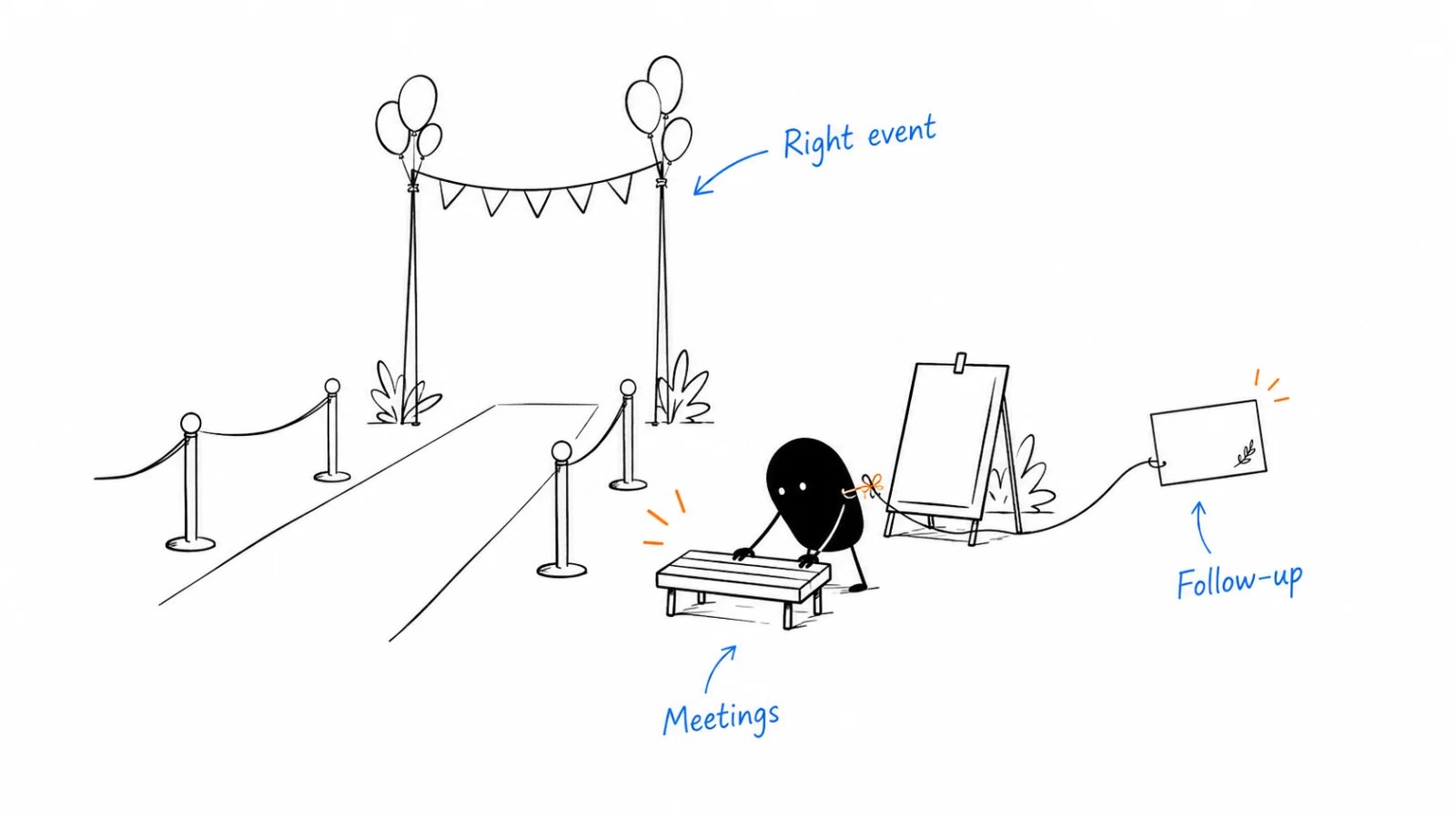 *Reading guide: choose the right event → arrange useful meetings → follow up on agreements.*
## Use this when
* The team is deciding whether to host, attend, sponsor, exhibit, partner, or skip.
* Money or staff time is committed and the event needs an execution system.
* Relevant accounts and buying-committee seats can be identified before the event.
## Do not use this when
* “Everyone in the industry goes” is the only reason to attend.
* Registration, badge, or attendee count is the success metric by itself.
* The ICP cannot identify likely accounts or buying seats.
## Go / attend / skip scorecard
Score each criterion from 0 to 2.
| Criterion | 0 | 1 | 2 | Event |
| --------------------- | ---------------------- | ---------------------- | -------------------------------------- | ----- |
| ICP concentration | Little evidence | Some relevant accounts | Dense, verifiable account presence | |
| Committee access | Wrong or unknown roles | Partial access | Required buying seats are visible | |
| Trigger density | Generic theme | Possible triggers | Dated, decision-relevant triggers | |
| Pre-booking potential | No paths | Limited paths | Several direct, partner, or warm paths | |
| Cost and capacity | Disproportionate | Manageable with limits | Strong fit with available capacity | |
Suggested starting thresholds. This is a planning aid, not a validated prediction of event ROI:
* **8–10:** attend or sponsor with an account plan.
* **5–7:** attend narrowly; avoid a large commitment until evidence improves.
* **0–4:** skip or use a cheaper remote/partner motion.
A high score does not justify a booth by itself. Separate the event decision from the format decision.
## How to do it
### Step 1: define the event decision
Write what the team must learn or produce: qualified meetings, access to missing seats, partner evidence, expansion conversations, or market insight. “Awareness” is too vague unless it has an observable definition.
### Step 2: build the account map
Review exhibitors, attendees, speakers, partners, sponsors, and prior participation where permitted. Classify accounts by ICP tier and map likely buying seats. Record the source and date.
### Step 3: pre-book the event
For T1 accounts, prepare one-to-one research and a decision-specific reason to meet. For T2 accounts, test one shared trigger hypothesis. Use partners and existing relationships to create credible access.
If qualified meetings cannot be booked before the event, revisit the attendance format and cost.
### Step 4: prepare conversation briefs
Each brief contains:
* account and person;
* buying-committee seat;
* trigger and current alternative;
* facts, assumptions, and unknowns;
* one useful question;
* intended next step;
* owner and meeting location.
### Step 5: operate the chosen format
Define roles, run of show, account or audience experience, capture rules, escalation, and follow-up before launch. For exhibitor and conference execution, use the [trade-show playbook](https://b2-b-playbook.mintlify.app/playbooks/06-account-field-and-partner/trade-shows).
### Step 6: follow up from the conversation
Follow-up should restate the buyer's words, the agreed next step, the owner, and the date. A generic “great meeting you” email wastes the event context.
### Step 7: run the five-line review
1. Was the attend/sponsor/skip decision correct?
2. What was booked before the event?
3. Which qualified conversations and next actions resulted?
4. Which committee or evidence gap repeated?
5. What must change for the next event?
## Copyable templates
### How a filled event brief reads
Illustrative example: a 400-person industry dinner, not a booth. Decision: **attend** because four T1 accounts already accepted a 20-minute slot. Score: access to named seats, not foot traffic. Skip if those meetings cannot be booked beforehand.
### Event brief
* Event and date:
* Decision: attend / sponsor / exhibit / skip
* Score and evidence:
* Target account count by tier:
* Required buying seats:
* Pre-booked meeting target:
* Qualified-conversation target:
* Budget and staff capacity:
* Stop or downgrade condition:
### How a filled meeting brief reads
| Field | Teaching fill |
| ----------------------- | --------------------------------------------------------------- |
| Account and person | T1 account; head of customer ops who booked |
| Buying seat | Champion; economic buyer still unknown |
| Trigger | Two lost deals citing questionnaire time |
| Current alternative | Spreadsheet + shared drive |
| Evidence | Their words on the booking note |
| Unknowns | Who in security can stop a vendor |
| Intended next step | 30-minute working session with the operator who builds the pack |
| Owner / time / location | AE name; 14:00, quiet table, not the noisy aisle |
### Meeting brief (copy)
* Account and person:
* Buying seat:
* Trigger:
* Current alternative:
* Evidence:
* Unknowns:
* Intended next step:
* Owner / time / location:
### Follow-up
**Subject:** \[event] — \[specific decision or trigger]
> At \[event], you said \[current process or trigger]. The useful next step is \[bounded action] with \[required seat] by \[date]. I will \[owner action]; could you \[buyer action]?
## Checklists
### Before
* [ ] The event score is evidence-backed.
* [ ] Attendance format matches the score and budget.
* [ ] Accounts are tiered and committee seats mapped.
* [ ] T1 research is complete.
* [ ] Meetings have owners, times, and intended next steps.
* [ ] Capture fields and follow-up owners are ready.
### On site
* [ ] Scheduled meetings remain protected.
* [ ] Every qualified conversation records trigger and alternative.
* [ ] Missing seats and objections are captured.
* [ ] Next actions have owners and dates.
* [ ] Consent and badge-data use follow applicable requirements.
### After
* [ ] Conversation-specific follow-up is sent promptly.
* [ ] Qualified next actions enter the system of record.
* [ ] Unqualified scans are not disguised as pipeline.
* [ ] The five-line review is complete.
* [ ] The next event decision uses the new evidence.
## Metrics
| Metric | Diagnostic use |
| ------------------------------ | ------------------------------------------------------------------------- |
| Pre-booked qualified meetings | Tests whether account access existed before the event |
| Qualified conversations | Counts conversations with buyer, problem, timing, or next-action evidence |
| Next-action completion | Agreed next actions completed / qualified conversations |
| Committee coverage | Target accounts with the required seats visible / target accounts engaged |
| Event-sourced progression | Accounts reaching the next qualified decision after the event |
| Cost per qualified next action | Total event cost / completed qualified next actions |
Badge scans, foot traffic, swag distributed, and raw meetings are activity—not pipeline outcomes.
## Common mistakes
* Choosing the format before defining the buyer outcome.
* Treating sponsorship inventory as a strategy.
* Using one objective and metric for every event type.
* Waiting until after the event to assign follow-up owners.
* Claiming pipeline from registrations or conversations without qualified progression.
## What to read next
If the format is a booth, the spend split and follow-up live in [trade shows](https://b2-b-playbook.mintlify.app/playbooks/06-account-field-and-partner/trade-shows). If the format is a small, role-locked night, that is [executive dinners](https://b2-b-playbook.mintlify.app/playbooks/06-account-field-and-partner/executive-dinners). If the buyer already learns from people you do not employ, that is [ecosystem](https://b2-b-playbook.mintlify.app/playbooks/06-account-field-and-partner/ecosystem) or a [peer room](../04-channels-and-distribution/community.md)—not a bigger sponsorship. A named account this event exists for should already have [account planning](https://b2-b-playbook.mintlify.app/playbooks/06-account-field-and-partner/account-planning).
## Sources and evidence boundary
This is an owner-maintained operating synthesis. The 40 / 20 / 40 allocation belongs in the specific [trade-show playbook](https://b2-b-playbook.mintlify.app/playbooks/06-account-field-and-partner/trade-shows), where it is presented as a heuristic rather than a benchmark or promise.
***
Copyright © 2026 Ivan Xu. All rights reserved. See the [copyright and reuse terms](https://github.com/weilun88313/B2B-Playbook/blob/main/LICENSE).
Canonical source: [github.com/weilun88313/B2B-Playbook](https://github.com/weilun88313/B2B-Playbook)
*Reading guide: choose the right event → arrange useful meetings → follow up on agreements.*
## Use this when
* The team is deciding whether to host, attend, sponsor, exhibit, partner, or skip.
* Money or staff time is committed and the event needs an execution system.
* Relevant accounts and buying-committee seats can be identified before the event.
## Do not use this when
* “Everyone in the industry goes” is the only reason to attend.
* Registration, badge, or attendee count is the success metric by itself.
* The ICP cannot identify likely accounts or buying seats.
## Go / attend / skip scorecard
Score each criterion from 0 to 2.
| Criterion | 0 | 1 | 2 | Event |
| --------------------- | ---------------------- | ---------------------- | -------------------------------------- | ----- |
| ICP concentration | Little evidence | Some relevant accounts | Dense, verifiable account presence | |
| Committee access | Wrong or unknown roles | Partial access | Required buying seats are visible | |
| Trigger density | Generic theme | Possible triggers | Dated, decision-relevant triggers | |
| Pre-booking potential | No paths | Limited paths | Several direct, partner, or warm paths | |
| Cost and capacity | Disproportionate | Manageable with limits | Strong fit with available capacity | |
Suggested starting thresholds. This is a planning aid, not a validated prediction of event ROI:
* **8–10:** attend or sponsor with an account plan.
* **5–7:** attend narrowly; avoid a large commitment until evidence improves.
* **0–4:** skip or use a cheaper remote/partner motion.
A high score does not justify a booth by itself. Separate the event decision from the format decision.
## How to do it
### Step 1: define the event decision
Write what the team must learn or produce: qualified meetings, access to missing seats, partner evidence, expansion conversations, or market insight. “Awareness” is too vague unless it has an observable definition.
### Step 2: build the account map
Review exhibitors, attendees, speakers, partners, sponsors, and prior participation where permitted. Classify accounts by ICP tier and map likely buying seats. Record the source and date.
### Step 3: pre-book the event
For T1 accounts, prepare one-to-one research and a decision-specific reason to meet. For T2 accounts, test one shared trigger hypothesis. Use partners and existing relationships to create credible access.
If qualified meetings cannot be booked before the event, revisit the attendance format and cost.
### Step 4: prepare conversation briefs
Each brief contains:
* account and person;
* buying-committee seat;
* trigger and current alternative;
* facts, assumptions, and unknowns;
* one useful question;
* intended next step;
* owner and meeting location.
### Step 5: operate the chosen format
Define roles, run of show, account or audience experience, capture rules, escalation, and follow-up before launch. For exhibitor and conference execution, use the [trade-show playbook](https://b2-b-playbook.mintlify.app/playbooks/06-account-field-and-partner/trade-shows).
### Step 6: follow up from the conversation
Follow-up should restate the buyer's words, the agreed next step, the owner, and the date. A generic “great meeting you” email wastes the event context.
### Step 7: run the five-line review
1. Was the attend/sponsor/skip decision correct?
2. What was booked before the event?
3. Which qualified conversations and next actions resulted?
4. Which committee or evidence gap repeated?
5. What must change for the next event?
## Copyable templates
### How a filled event brief reads
Illustrative example: a 400-person industry dinner, not a booth. Decision: **attend** because four T1 accounts already accepted a 20-minute slot. Score: access to named seats, not foot traffic. Skip if those meetings cannot be booked beforehand.
### Event brief
* Event and date:
* Decision: attend / sponsor / exhibit / skip
* Score and evidence:
* Target account count by tier:
* Required buying seats:
* Pre-booked meeting target:
* Qualified-conversation target:
* Budget and staff capacity:
* Stop or downgrade condition:
### How a filled meeting brief reads
| Field | Teaching fill |
| ----------------------- | --------------------------------------------------------------- |
| Account and person | T1 account; head of customer ops who booked |
| Buying seat | Champion; economic buyer still unknown |
| Trigger | Two lost deals citing questionnaire time |
| Current alternative | Spreadsheet + shared drive |
| Evidence | Their words on the booking note |
| Unknowns | Who in security can stop a vendor |
| Intended next step | 30-minute working session with the operator who builds the pack |
| Owner / time / location | AE name; 14:00, quiet table, not the noisy aisle |
### Meeting brief (copy)
* Account and person:
* Buying seat:
* Trigger:
* Current alternative:
* Evidence:
* Unknowns:
* Intended next step:
* Owner / time / location:
### Follow-up
**Subject:** \[event] — \[specific decision or trigger]
> At \[event], you said \[current process or trigger]. The useful next step is \[bounded action] with \[required seat] by \[date]. I will \[owner action]; could you \[buyer action]?
## Checklists
### Before
* [ ] The event score is evidence-backed.
* [ ] Attendance format matches the score and budget.
* [ ] Accounts are tiered and committee seats mapped.
* [ ] T1 research is complete.
* [ ] Meetings have owners, times, and intended next steps.
* [ ] Capture fields and follow-up owners are ready.
### On site
* [ ] Scheduled meetings remain protected.
* [ ] Every qualified conversation records trigger and alternative.
* [ ] Missing seats and objections are captured.
* [ ] Next actions have owners and dates.
* [ ] Consent and badge-data use follow applicable requirements.
### After
* [ ] Conversation-specific follow-up is sent promptly.
* [ ] Qualified next actions enter the system of record.
* [ ] Unqualified scans are not disguised as pipeline.
* [ ] The five-line review is complete.
* [ ] The next event decision uses the new evidence.
## Metrics
| Metric | Diagnostic use |
| ------------------------------ | ------------------------------------------------------------------------- |
| Pre-booked qualified meetings | Tests whether account access existed before the event |
| Qualified conversations | Counts conversations with buyer, problem, timing, or next-action evidence |
| Next-action completion | Agreed next actions completed / qualified conversations |
| Committee coverage | Target accounts with the required seats visible / target accounts engaged |
| Event-sourced progression | Accounts reaching the next qualified decision after the event |
| Cost per qualified next action | Total event cost / completed qualified next actions |
Badge scans, foot traffic, swag distributed, and raw meetings are activity—not pipeline outcomes.
## Common mistakes
* Choosing the format before defining the buyer outcome.
* Treating sponsorship inventory as a strategy.
* Using one objective and metric for every event type.
* Waiting until after the event to assign follow-up owners.
* Claiming pipeline from registrations or conversations without qualified progression.
## What to read next
If the format is a booth, the spend split and follow-up live in [trade shows](https://b2-b-playbook.mintlify.app/playbooks/06-account-field-and-partner/trade-shows). If the format is a small, role-locked night, that is [executive dinners](https://b2-b-playbook.mintlify.app/playbooks/06-account-field-and-partner/executive-dinners). If the buyer already learns from people you do not employ, that is [ecosystem](https://b2-b-playbook.mintlify.app/playbooks/06-account-field-and-partner/ecosystem) or a [peer room](../04-channels-and-distribution/community.md)—not a bigger sponsorship. A named account this event exists for should already have [account planning](https://b2-b-playbook.mintlify.app/playbooks/06-account-field-and-partner/account-planning).
## Sources and evidence boundary
This is an owner-maintained operating synthesis. The 40 / 20 / 40 allocation belongs in the specific [trade-show playbook](https://b2-b-playbook.mintlify.app/playbooks/06-account-field-and-partner/trade-shows), where it is presented as a heuristic rather than a benchmark or promise.
***
Copyright © 2026 Ivan Xu. All rights reserved. See the [copyright and reuse terms](https://github.com/weilun88313/B2B-Playbook/blob/main/LICENSE).
Canonical source: [github.com/weilun88313/B2B-Playbook](https://github.com/weilun88313/B2B-Playbook)