> ## Documentation Index
> Fetch the complete documentation index at: https://b2-b-playbook.mintlify.site/llms.txt
> Use this file to discover all available pages before exploring further.
# Cold email
**Last reviewed:** 2026-09-09 · **Reading edit:** 2026-09-09
The email starts with a compliment about a funding announcement. Then it mentions a hiring post, describes an “AI-powered platform,” and asks for thirty minutes on Tuesday.
The sender has researched the company. The recipient still has to work out what the product does and why this conversation belongs on their calendar.
A cold email asks someone who did not request your approach to spend attention on it. That is a reason to be clear about who you are, what you can help with, and why you think the work may be relevant. It is not a reason to manufacture familiarity or make the commercial purpose hard to recognize.
A useful first message can be simple. It names a recognizable task, gives enough context to explain the approach, and proposes a proportionate next step. It also leaves room for the recipient to say the premise is wrong, the timing is poor, or they do not want further contact.
The writing is only one part of the job. Account selection, data use, provider rules, sender identity, reply handling, and stopping correctly all affect whether the approach is appropriate.
This guide covers that whole path. It is an editorial operating guide, not permission to contact a particular person, a bulk-sending recipe, or a guarantee of inbox placement.
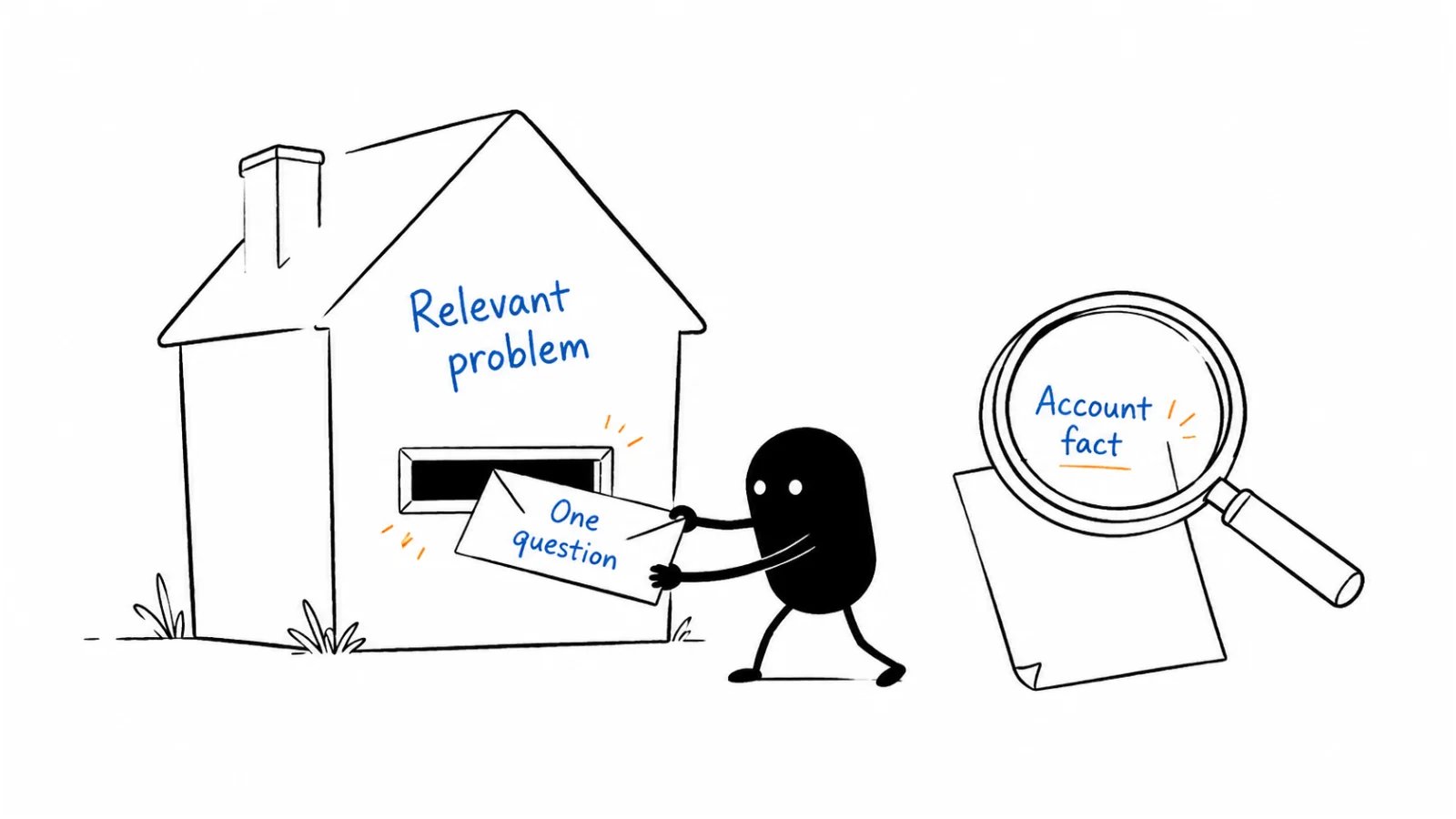 *Reading guide: choose a relevant account → check the contact route → explain the offer plainly → make an appropriate request → handle the reply → learn and stop when needed.*
If you already have a draft, start with [the first-message rewrite](#how-a-filled-first-message-reads). If you have replies but few useful conversations, read [reply classification](#step-5-classify-replies-by-evidence). The [worked example](#worked-example-illustrative) follows a small fictional batch without turning email activity into invented revenue.
## Use this when
You have a plausible business reason to approach a defined group, and email is an appropriate, reviewed route for doing so.
You want to translate account research into a message that someone can understand without reading your internal brief.
Your first emails are full of facts but unclear about the work, the offer, or the next step.
You need a small, inspectable test of an approach rather than a large sequence whose replies nobody has time to review.
You also need to improve what happens after a response: answer a real question, correct an assumption, coordinate a referral, pause, or stop.
A recent trigger is optional. A relevant approach can be based on the work an account does, provided you do not imply you know a current problem that has not been confirmed.
## Do not use this when
Someone already asked for information and you are about to put them into a cold sequence instead of answering. A demo request, product question, or support issue needs the response appropriate to that request.
Your contact source or intended use has not been reviewed. An address appearing in a database is not proof that you may use it for any purpose.
The recipient, account, or existing owner has given an instruction that rules out this approach. A new list or sender does not erase it.
Your plan depends on misleading subjects, invented referrals, concealed identity, fake reply activity, or rotating infrastructure to get around provider restrictions.
You cannot deliver what the message offers. Do not promise a personalized audit if nobody will produce it, or a result that the product cannot support.
If the larger uncertainty is whether the audience understands and values the offer, start with [message-market fit](https://b2-b-playbook.mintlify.app/playbooks/05-outbound-and-prospecting/message-market-fit). This guide helps you execute and review an email approach; it does not replace that learning.
## How to do it
Start with the decision the recipient should be able to make after reading.
They might decide that an example would be useful, that the question belongs with another team, or that there is no reason to continue. The first email does not have to perform discovery, demonstrate the product, and negotiate the purchase at once.
At the same time, do not hide the offer behind a seemingly innocent research question. A recipient should not have to reply before discovering that you sell something related to the question.
Keep the process small enough to inspect. You need to see which accounts were chosen, what each message claimed, what happened, and whether corrections reached the relevant systems.
### Step 1: define the smallest viable segment
Describe accounts by the work you could help with and the circumstances that make the offer plausible.
“VPs at software companies” does not tell you much about a workflow. “Teams that review customer security questionnaires with named technical owners” provides a clearer starting point for a questionnaire-review offer.
That description still needs verification. Some companies may have an effective existing process. Some may outsource the work. Some may require a deployment model you cannot offer.
Write down those differences before drafting. Otherwise, the email will tend to assume that everyone in the list has the same problem.
Choose a plausible role rather than automatically picking the most senior title available. The person who understands the task, the person who owns its outcome, and the person who approves expenditure may be different.
You can begin with one relevant role and learn about ownership. You do not need to contact every person who might participate in a future decision.
A focused segment is a working hypothesis, not a claim that all its members want the product. If you are still assembling that first account list, use [first ten customers](../01-strategy-and-buyers/first-ten-customers.md).
### Check the existing relationship before creating a first touch
Look for active customers, open opportunities, recent conversations, partners, support cases, and stop instructions.
A new rep seeing a company for the first time does not make the company new to your business. A cold introduction during an active evaluation can confuse the buyer and create duplicate work internally.
Where an owner exists, pass along relevant context and let the appropriate person decide the next step. Do not assume a marketing alert authorizes another seller to begin a separate conversation.
For a former customer or user, state the relationship accurately. Using a product in a previous role does not establish that the person chose it, liked it, or wants it again.
For a referral, preserve exactly what was said. “This topic sits with operations” is not the same as “Please contact Priya; I have told her to expect your email.”
Relationship checks should make the message more accurate, not supply a pretext for claiming warmth that is not there.
### Step 2: confirm the research brief
Keep only the research that helps determine relevance and avoid a false claim.
You need to understand the account, the likely work, the role, the source of your observation, and the uncertainty. You do not need a detailed biography or every item in the company's news archive.
A current job description may show that a team handles a task. It does not show that the team is failing at it. A new location may introduce coordination work, but it may also use an existing process without difficulty.
Write the fact and interpretation separately in your notes. For example: “The role description includes customer security reviews” is an observation. “The team may need a clearer owner for review requests” is a hypothesis.
If the hypothesis is important enough to mention, phrase it as something to check rather than something you know.
You do not need exactly two independent facts. One reliable, relevant observation may be sufficient for a bounded question; a complex account approach may need more. Additional facts should resolve uncertainty, not make the opening feel heavily researched.
Use [account research](https://b2-b-playbook.mintlify.app/playbooks/05-outbound-and-prospecting/account-research) for the brief and [buying signals](https://b2-b-playbook.mintlify.app/playbooks/05-outbound-and-prospecting/buying-signals) for timing. Do not make the recipient read the brief through your email.
### Confirm the address without confusing accuracy with permission
A technically valid address can still be the wrong route.
Check whether the person remains in the role, whether the account match is correct, and whether the address is appropriate for this business purpose. Avoid sending to a private address merely because it is easier to find.
An address-validation service may help identify obvious errors. Its result does not prove the person wants your email, that the address belongs to the intended individual, or that the message will reach the inbox.
Keep the source and permitted-use review available to the team responsible for the workflow. If the source cannot explain where information came from or how corrections are handled, that is a reason to pause before importing more records.
Do not infer a named visitor from company-level intent data and then write “I saw you on our pricing page.” A company signal combined with a contact database does not establish that the selected person visited.
If there is no appropriate contact route, choose another legitimate way to learn about the market. Do not solve the problem by guessing more addresses or bypassing a prior refusal.
### Review three different kinds of constraint
Legal obligations, your sending service's terms, and the receiving provider's rules are not the same thing.
A workflow can meet one set of conditions while failing another. Technical authentication does not grant consent, and a legal basis does not guarantee a provider will accept the mail.
The [compliance minimum](#compliance-minimum) below identifies some issues for qualified review. It is not a global legal checklist, and this page does not determine whether a specific campaign is lawful.
For the operational plan, name who is responsible for those reviews and what happens if the answer is uncertain. An unresolved question should not default to “send and see.”
Also distinguish a research session from an outbound approach. Inviting someone into transparent research can be appropriate in its own context; pretending to conduct independent research while concealing a sales purpose is not the approach taught here.
### Step 3: write a two-sentence first message
Two sentences can be a useful editing exercise, but they are not a mandatory format. A short paragraph may explain the offer more clearly than two overloaded sentences.
Aim to answer four questions: who is writing, why this work may be relevant, what help is being offered, and what the recipient is being asked to do.
Those answers can fit in a few short paragraphs. The sender identification, required disclosures, and opt-out information still need to be present; do not remove them to hit a word count.
A first message may mention a verified company change, but it does not have to begin with “I noticed.” Sometimes the work itself is the more useful opening.
For example, a fictional product team might write: “We help security teams keep questionnaire answers linked to their current owners.” That identifies the task and capability. The next sentence can explain why the team thinks it may be relevant to this recipient.
Do not wait until a second email to reveal what you sell if the first approach has a commercial purpose.
### Choose a subject that describes the conversation
A subject should help the reader understand what the email concerns.
“Questionnaire review ownership” is more informative than “Quick question.” That does not mean every subject needs to sound like a document title; it means the subject should not rely on hiding the topic.
Avoid false urgency, invented account alerts, and claims that a decision is overdue. Do not use “Re:” or “Fwd:” to make a first approach look like an existing conversation.
A subject about the person's actual work is generally easier to justify than one about a personal detail you found online. The latter may attract attention for the wrong reason.
The subject and body should agree. If the subject promises a specific finding, the email should contain that finding or accurately explain what is available. “Your security risk” is inappropriate if you have not identified a real issue and are merely selling software.
Try reading the subject without your internal context. Would a reasonable recipient mistake it for a message from their own team, a customer, or an existing supplier? If so, clarify it.
### Make the opening relevant rather than ornamental
A useful opening connects to work. An ornamental opening proves that you found something about the company and then moves to an unrelated pitch.
A funding announcement may be relevant to a financing service. It may be far less useful for a tool that manages questionnaire ownership. Do not force the connection simply because the announcement is recent.
Similarly, “Loved your post” should mean you actually read the post and have a relevant reason to mention it. Generic praise creates little context for the offer.
A direct opening can work without any praise: “Your security-operations role description includes coordinating customer reviews. Is answer ownership part of that team's remit?”
That question still needs a truthful explanation of your commercial interest. It should not masquerade as a neutral inquiry from another department.
Use only the amount of account detail needed to explain the approach. Long lists of observations can feel intrusive while making the email harder to understand.
### Explain the help in concrete terms
Name what the product or service actually does.
“Streamline compliance with intelligent automation” leaves many possibilities open. “Keep approved questionnaire answers attached to an owner and review date” describes a capability the recipient can evaluate.
Then connect the capability to an outcome without overpromising it. The intended benefit might be reducing repeated owner searches; the product cannot guarantee that every review finishes on time.
If your offer includes human work, say so. A service that prepares a review pack is different from software a customer must configure and maintain.
If a result depends on conditions, do not erase them in the first message. You can keep the introduction concise while avoiding a blanket promise.
The best evidence depends on the doubt. A small example may show the workflow. An authorized customer story may illustrate a result. Neither should be presented as proof that the same outcome will happen for everyone.
If you have no measured result, use an accurate capability description instead of borrowing a percentage from an unrelated case.
### Ask for a next step that fits the situation
The next step should help resolve a relevant uncertainty at a reasonable cost.
You might offer a short example, ask a focused ownership question, or suggest a brief working conversation. A calendar link can be convenient when a meeting makes sense; it is not inherently wrong, but it should not substitute for explaining why the meeting is useful.
Avoid stacking requests: read a report, watch a video, complete a form, forward the note, and book time. The recipient should not have to choose which of five actions you really want.
“Would an example help?” is appropriate only if you can provide an example that is actually useful. Do not turn a simple yes into a surprise qualification form.
A smaller request can increase replies without increasing product demand. Someone wanting a checklist may want only the checklist. Fulfill the request and keep the interpretation honest.
Do not ask a loaded question such as “How much time are you losing to your broken process?” when the problem has not been established. A neutral question gives the person an easy way to correct the premise.
### Keep the body readable
Use short paragraphs that each do one job. Write in ordinary professional language, with terms the audience actually uses.
A message does not need elaborate formatting to be readable. Plain text or restrained HTML can both work; neither is an inbox-placement guarantee.
Review the email on a phone. Check whether the purpose is visible without a long introduction and whether the signature overwhelms the message.
Use links only when they have a clear role. A relevant product example or identity link can be useful. A stack of tracking redirects, unrelated resources, and several calls to action can obscure what the reader should do.
Do not attach unexpected files simply to make the email feel substantial. If a document would help, explain it and provide it through an appropriate route. Never ask a stranger to open an executable or supply credentials as part of a “quick review.”
Keep accessibility in mind: the message should not depend on a large image containing all the text, tiny disclosures, or color alone to explain an action.
### Preserve a clear identity and a practical way to stop
Use a real, accurate sender identity and a reply route someone monitors.
If you are writing on behalf of a company, make that relationship clear. If an agency sends for a client, the workflow should not obscure who is making the offer.
The actual message must include the identity, address, disclosures, notices, and opt-out mechanisms required for its jurisdiction and provider context. The examples in this article are teaching drafts, not complete compliance-certified emails.
An opt-out should be understandable and operational. If you say a reply can stop further marketing, the relevant inbox and systems must recognize and honor it.
Do not make a person use your preferred wording when their meaning is clear. “Please stop,” “remove me,” and a clear equivalent should reach the appropriate suppression process.
Nor should stopping require them to explain their decision, take a sales call, or sign into a new account.
Good writing makes the offer easy to understand. A good process makes declining it easy too.
### Step 4: decide whether email is enough
A follow-up should have a reason beyond the fact that the previous email exists.
You might clarify an ambiguous capability, supply a relevant example already promised, or answer a question the recipient raised. If you have nothing useful to add, another message may not improve the situation.
The first email does not have to be perfect for a follow-up to be appropriate. But a sequence should not be designed around wearing down a person's refusal or making silence expensive.
Set a bounded follow-up approach before beginning, including who can pause it, what stops it, and when the account should leave the queue. The appropriate timing and number of messages depend on the relationship, context, applicable requirements, provider rules, and what you promised.
There is no universal schedule that works because it uses the third, seventh, and fourteenth days. Treat any schedule as an operational choice to review, not a discovered law of buyer behavior.
### Follow up with substance
Suppose the fictional first email asked about ownership of questionnaire answers. A later note might clarify a distinction:
> One detail that may help you judge relevance: the workspace keeps answer ownership and review dates visible; it does not approve security responses automatically. I can send the example if that is useful.
That adds information which could prevent a misunderstanding. It does not claim that the recipient read the first email or is interested.
A weaker follow-up says only “Bumping this to the top of your inbox.” It asks for attention without making the decision easier.
A useful follow-up can remain in the same genuine thread. Do not manufacture earlier messages or quote text as if the recipient had already participated.
If a person has replied, stop the generic sequence and handle the reply. Continuing scheduled reminders while a real conversation is underway makes the communication feel disconnected.
Treat an out-of-office response separately from interest. It may explain a temporary absence, but it does not authorize a new channel, a more intrusive route, or contacting a personal backup number.
### Coordinate channels instead of surrounding the person
Email may be sufficient if the topic can be understood and resolved in writing.
Another channel can be useful when it has a distinct, appropriate role: an agreed call, an introduction at an event, or a partner conversation that actually exists. Use [multichannel sequence](https://b2-b-playbook.mintlify.app/playbooks/05-outbound-and-prospecting/multichannel-sequence) for that planning.
Do not interpret “no email reply” as permission to message the same person everywhere. Channel choice has its own legal, platform, and relationship considerations.
Consistency is useful: the core offer should not change from channel to channel. Repetition is the problem when it adds pressure without context or new information.
Keep one owner able to see the whole contact history. Otherwise, two well-intentioned people can each run a “short” sequence that becomes excessive in combination.
An email stop instruction should be handled according to its actual scope. A broad request for no further marketing should not be routed around through a different channel or another teammate.
### Step 5: classify replies by evidence
Read the reply before assigning the next task.
A polite acknowledgment, a product question, an active need, a referral, a postponement, and an opt-out are different outcomes. A single positive/negative label often loses what matters most.
Preserve the actual requirement or correction. A seller should not have to ask again because an important sentence became a generic “interested” tag.
| Reply | What you know | Appropriate next action |
| ------------------------------------------ | --------------------------------------------------------- | ---------------------------------------------- |
| Confirms relevant work and asks a question | There is something specific to answer | Answer accurately, then agree the next step |
| Corrects the premise | Part of your account hypothesis was wrong | Correct the record and reassess or stop |
| Identifies another owner | Ownership information may be useful | Check the referral's scope and contact context |
| Says “not now” with a condition | Timing may be constrained | Pause and record any agreed revisit condition |
| Requests removal | Further marketing is unwanted within that request's scope | Stop and propagate suppression |
| Automated absence response | The mailbox generated a status message | Do not count it as human interest |
A reply can contain several elements. Someone may confirm a real need and identify a requirement you cannot meet. Keep the relevant details even when you choose one primary category for reporting.
Do not mark an account qualified solely because someone replied. Use the evidence required by your actual sales process.
### Answer the question before asking for more effort
If someone asks whether a capability works with their setup, answer what you can and state what needs checking.
Do not turn every reply into “Book a demo to find out.” A brief answer may save everyone a meeting, especially when there is a known mismatch.
If the question genuinely requires a conversation, explain why and propose a focused agenda. “We need to understand how approval authority changes by region” is more useful than “Let's explore synergies.”
A request for pricing deserves the available pricing information or a clear explanation of the variables needed to estimate it. Do not invent a quote or imply a price is fixed when it depends on scope.
If you promised an artifact, deliver it before adding unrelated requirements. If producing it requires more information than your first message suggested, acknowledge that and make the next step optional.
Clear reply handling is part of the offer. An excellent first email cannot compensate indefinitely for an evasive or inaccurate answer.
### Treat a correction as a correction
“Legal handles that, not security” may correct ownership. “We do not maintain a questionnaire library” may remove the entire use case.
Ask only what is proportionate to the situation. A recipient who has declined does not owe you a research interview or a referral.
Do not assume every objection is a misunderstanding that more persuasion will fix. Sometimes the current process is sufficient or the product is not suitable.
Record the correction where selection and automation can use it. Fixing one message while the same account reappears tomorrow is not enough.
Corrections have scope. A statement about one business unit may not apply to the entire company, but it also does not automatically justify approaching another unit.
When uncertain, preserve the original scope and avoid expanding the next action beyond what the conversation supports.
### Handle referrals without inventing endorsement
A named referral can make the next approach more relevant, but describe it precisely.
If someone says “Taylor manages that process,” you can record that ownership information. Do not rewrite it as “Taylor asked me to contact you” or “Your team is evaluating us.”
If the person offers to introduce you, let that introduction happen rather than immediately sending parallel messages. If they ask you to contact a named colleague, check the appropriate route and carry the actual context forward.
A referral does not transfer the first recipient's permission to every colleague or override another person's stop instruction.
Avoid turning the first reply into an org-chart collection exercise. You need enough context for a relevant next step, not private contact details for everyone involved.
### Make suppression survive the next import
A stop request must not disappear when records move between tools.
Decide which system is authoritative, how requests arrive, how quickly scheduled activity is paused, and how downstream services receive the instruction.
Check what happens when an agency uploads a list, a rep creates a duplicate contact, or a new enrichment record has a slightly different name. The relevant suppression should still be checked before another send.
Do not simply delete the record in a way that allows it to be reimported as new. The appropriate retention and suppression design needs the responsible privacy and operations owners.
Keep the process limited to what is needed to honor the instruction. Do not use an opt-out event to create a fresh marketing audience or another engagement score.
If the recipient asks for deletion or raises a privacy complaint, route that request through the relevant process instead of treating it only as a campaign status.
### Three short reply-handling examples
The following exchanges are invented. They are not customer transcripts or scripts proven to produce a result.
**Buyer:** “We already have approved answers. The problem is knowing when an owner has changed.”
**Seller:** “That is a narrower question than the one I started with. Our example shows ownership history; I need to check how reassignment works in your setup.”
**Buyer:** “We need the change to update an existing review queue.”
**Seller:** “I will confirm whether that queue can be updated before suggesting a meeting.”
The seller does not convert a relevant question into a capability promise before checking.
**Buyer:** “This is not my team's process. It is handled centrally.”
**Seller:** “Thanks for correcting that. I will remove the local-team assumption from this account note.”
**Buyer:** “We are not looking for another system.”
**Seller:** “Understood. I will stop this approach.”
The correction leads to a changed action, not a more forceful version of the same pitch.
**Buyer:** “Please remove me from your marketing.”
**Seller, internal note:** “Stop scheduled messages and apply the request through the relevant suppression process.”
**Operations, internal note:** “The contact is suppressed in the active sender and checked against the shared list; downstream synchronization is being verified.”
**Seller, internal note:** “Do not send a sales follow-up or restart the contact from another campaign.”
The last exchange illustrates internal handling. It is not a recommendation to send several acknowledgments to someone who asked for less email.
Not necessarily. You know they asked for information.
Send the relevant material you offered, with enough context to explain it. If one detail would materially change what you send, ask a concise clarifying question rather than adding a full qualification form.
Then record what actually happened. Requesting a product example differs from describing an active project, agreeing to an evaluation, or approving a purchase.
The next conversation may establish more. It may also show that the person was researching, helping someone else, or checking a capability that does not fit.
Do not mark the account as an opportunity simply to make the first campaign report look stronger. Use your normal opportunity criteria and preserve the difference between requested information and confirmed buying work.
### Step 6: review the segment, not only the copy
Look at the whole path from selection to response.
Wrong ownership, poor account fit, unclear value, unsupported claims, inconvenient timing, delivery problems, and a burdensome next step can all produce weak results.
Before rewriting, ask which explanation the evidence supports. If every response says the task belongs to another team, review the role selection. If people expect a capability you do not provide, revise the claim. If a link fails, fix the link.
When the inbox is quiet, the cause is still uncertain. A small batch with no replies is not proof of no demand, and it is not a reason to keep sending indefinitely.
Use [message-market fit](https://b2-b-playbook.mintlify.app/playbooks/05-outbound-and-prospecting/message-market-fit) to examine comprehension and relevance through a suitable learning method. Keep the observations separate from guesses about non-responders.
If you change the audience, offer, and request together, record that the next round is a different approach. You may learn something useful without being able to attribute the change to a specific sentence.
### Check sending readiness without treating it as a workaround
Have the responsible administrator verify the real sending configuration, authentication, reply route, unsubscribe handling, and the policies applying to the service and recipients.
For personal Gmail accounts, Google's guidance distinguishes all-sender requirements from bulk-sender requirements. It specifies SPF or DKIM for all senders and SPF, DKIM, and DMARC for bulk senders, with additional requirements including one-click unsubscribe for applicable marketing/subscribed messages. It also advises against purchased addresses and sending to people who did not sign up. Meeting authentication requirements therefore does not make unsolicited outreach provider-approved or guarantee delivery. [Google's sender guidelines](https://support.google.com/mail/answer/81126?hl=en\&ref=b2b-playbook).
Check the actual sending service and destination requirements rather than applying a Gmail summary to every provider. The approved decision may be to use another legitimate acquisition route, not to send the email.
Do not create lookalike domains, fictitious identities, or artificial engagement to evade rejection or disguise the sender. Splitting a campaign across mailboxes is not a remedy for an inappropriate audience or provider-policy conflict.
A test message to a mailbox you control can verify formatting and routing. It does not prove that every recipient will receive the same placement.
This article is not a DNS configuration guide. Incorrect authentication changes can affect legitimate company mail; use the appropriate administrator and provider documentation.
A delivery status usually describes part of the mail-handling process, not a person's attention. Read the sending provider's definition rather than assuming it means inbox placement or human reading.
Open and click measurements have their own limits. HubSpot documents suspected bot activity, privacy filters, and corporate screening effects in marketing-email analytics. Those measurements should not be treated as proof that an individual read and considered an offer. [HubSpot's bot-filtering documentation](https://knowledge.hubspot.com/marketing-email/understand-bot-filtering-in-marketing-email-analytics?ref=b2b-playbook).
Check genuine delivery errors through the appropriate operational tools, and keep them separate from business outcomes. A human reply provides different evidence from a pixel load; even the reply still needs interpretation.
Do not increase pressure because a tool shows repeated opens, or claim to know what someone read when the measurement cannot establish it.
## Pre-send checklist
Review the actual rendered email and the workflow behind it, not just the draft in a document.
* The account and role have a plausible connection to the work.
* Existing ownership, replies, and stop instructions have been checked.
* Sources and intended uses have the required review.
* Observations and assumptions are distinguishable.
* The sender, subject, and commercial purpose are accurate.
* Product claims and any numbers are supported.
* The next step is clear, proportionate, and deliverable.
* Required identity, disclosure, address, notice, and opt-out elements are present.
* Links, formatting, reply routing, and suppression have been tested.
* A responsible person can handle responses and pause the workflow.
Do not remove the final operational checks because the batch is small. A single incorrectly addressed message can still create a problem for the recipient.
## Compliance minimum
The following notes identify selected issues for qualified review. They are not a complete legal analysis, and the examples elsewhere on this page are not ready-to-send legal templates.
**United States.** The FTC explains that CAN-SPAM covers commercial email, including B2B messages, not only bulk campaigns. Its guidance calls for accurate sender information and subjects, clear advertising identification, a valid physical postal address, and an easy opt-out. It specifies honoring opt-outs within ten business days and keeping the mechanism available for at least thirty days after sending. Outsourcing does not remove responsibility. Review the actual message and any applicable additional obligations; these selected requirements are not a worldwide permission to cold email. [FTC CAN-SPAM guide](https://www.ftc.gov/business-guidance/resources/can-spam-act-compliance-guide-business?ref=b2b-playbook).
**United Kingdom.** ICO guidance distinguishes corporate subscribers from sole traders and certain partnerships. Corporate electronic marketing does not require consent under that PECR rule, but identity and an opt-out address matter, and UK GDPR still applies when personal data is processed. Individual subscribers generally require consent or a valid soft opt-in. Public business details are not unrestricted permission for marketing. Have a qualified owner assess the subscriber type, lawful basis, transparency, objections, and the proposed use. [ICO B2B marketing guidance](https://ico.org.uk/for-organisations/direct-marketing-and-privacy-and-electronic-communications/business-to-business-marketing/?ref=b2b-playbook).
**Other locations and providers.** Do not assume the US or UK explanation applies. Obtain the relevant review for the sender, recipient, data, service, and channel. Provider terms may be stricter than a legal minimum.
Operationally, stop scheduled marketing promptly when a clear stop request arrives. A legal deadline is not a recommended waiting period.
Keep a record of the qualified review, its scope, and when it needs revisiting. If the audience, data source, provider, or sending method changes materially, check whether the earlier review still applies.
## Copyable templates
These examples are fictional and have not been sent. They illustrate message structure, not proven response rates.
Use only claims you can support. Before any actual sending, add the accurate sender details and the disclosures, privacy information, postal address, and opt-out implementation required for the reviewed context. The bracketed footer prompts are not deployable substitutes for those requirements.
### How a filled first message reads
Consider this weak teaching draft:
**Subject:** Quick question about your growth
> Hi Morgan, congratulations on the expansion and the new hires. Your team must be overwhelmed with security questionnaires. Our revolutionary AI platform transforms compliance, saves 80% of your time, and helps you close deals faster. Are you free for thirty minutes tomorrow?
Almost every important claim needs attention.
The expansion and hiring may be real, but the conclusion about being overwhelmed is not established. The product description is vague. The percentage has no stated evidence. The meeting request arrives before the reader knows what would be discussed.
Here is a more grounded version, assuming the role description and fictional capability have been checked:
**Subject:** Ownership of questionnaire answers
> Hi Morgan,
>
> Your security-operations role description includes coordinating customer reviews. We build a workspace that keeps approved questionnaire answers linked to an owner and review date.
>
> Is maintaining those answers part of your team's work? If it is, I can send a short example of the ownership view.
>
> Alex, Example Company
>
> \[Accurate business identification and required disclosures]
>
> \[Applicable postal address and privacy information]
>
> \[Clear, working opt-out information]
This version does not prove the offer is compelling. It makes the offer and the ownership question understandable without inventing a current failure.
The role description could still refer to a different team or task. A correction would matter. If the address, intended use, or provider rules do not permit the approach, better wording does not resolve that problem.
### First message (copy)
Use this as an editing scaffold, not a mail-merge instruction to send wherever fields can be filled.
```text theme={null}
Subject: [The actual work or question]
Hi [name],
[One relevant, verified observation, if needed.]
We help [appropriate team] with [specific work] by
[accurate capability or service].
[One question or next step that fits this context.]
[Real sender and company]
[Required commercial identification / disclosures]
[Applicable postal address / privacy information]
[Clear opt-out method that is implemented and monitored]
```
If the observation adds no useful context, remove it. Do not replace it with personal trivia. The remaining message should still explain the actual offer and why the recipient's work might be relevant.
### A first message without a recent trigger
A relevant workflow can be a sufficient reason to investigate fit; you do not need a fresh announcement.
For the same fictional capability, an opening might say:
> We build a workspace for security teams that need to maintain approved questionnaire answers across several owners. It keeps the current answer, owner, and review date together.
>
> Does your team maintain that library internally, or is it handled elsewhere?
This is more honest than adding a generic funding reference. It still requires a plausible account and role, a permissible route, accurate identification, and the applicable footer and opt-out implementation.
It may also be too broad for your audience. Test whether people recognize the work instead of assuming a recent trigger would fix the problem.
### Close-the-loop message
A closing message is optional. Sometimes the appropriate action is simply to stop.
If a final note is justified under your approved approach, keep it factual and pressure-free:
> I will stop following up on the questionnaire-ownership idea here. If you choose to revisit it, the useful starting point would be the short ownership-view example.
Include the required identity and opt-out information as applicable. Do not send a closing note after an opt-out merely to create another touch.
Avoid “I assume this is not a priority,” “Have you given up?” or a joke about being ignored. Silence does not give you evidence about someone's priorities or an invitation to provoke a reply.
## Worked example: illustrative
Everything in this example is invented: the seller, account list, messages, dates, costs, and outcomes. It is a teaching exercise, not a reported company case or a Lensmor result.
A small software company offers a workspace that keeps questionnaire answers linked to an owner and review date. It does not automatically approve answers, provide legal advice, or guarantee that a customer's security review will pass.
The team wants to test a first approach to people whose responsibilities include maintaining those answers. It uses an already reviewed contact process and sends no real messages as part of this example.
### Begin with forty candidate accounts
The team examines forty candidate accounts, with one proposed recipient at each.
Before sending, it excludes five: two already have active conversations with account owners, one has a relevant stop instruction, and two do not appear to perform the work the product serves.
That leaves thirty-five accounts for the fictional pilot. The five exclusions are not failed emails or silent prospects. They never entered the sending group.
The team checks the remaining role assumptions and prepares a small, consistent first message. It does not invent a funding trigger for accounts with no relevant recent news.
The offer is a short ownership-view example, not a promise of automatic questionnaire completion. A person is assigned to deliver the example and answer replies.
### A delivery problem interrupts the plan
Two of the thirty-five first messages produce hard bounces in this invented record.
The team pauses the remaining scheduled activity to investigate rather than treating the bounces as people rejecting the offer. It finds stale role/address records, suppresses those routes, checks the source, and reviews the remaining contact records before continuing.
The example does not prescribe a safe bounce threshold. The response to a delivery problem depends on the error, provider policy, scale, and evidence. The useful principle is to inspect the problem rather than work around it with another sender.
Thirty-three accounts have a first message accepted according to the sending system's status. That does not establish inbox placement or human reading.
No new address is guessed for the two failed routes, and they do not receive follow-ups.
### Keep follow-up and account counts separate
After the delivery review, the team makes a bounded follow-up decision under its approved process. Twenty of the accounts without a human reply receive one additional message that clarifies the product's ownership function.
The pilot therefore contains thirty-five first-message attempts plus twenty follow-up attempts: fifty-five campaign-message attempts in total.
It still contains thirty-five contacted accounts, not fifty-five prospects. Human replies and the seller's answers in those conversations are recorded separately from these scheduled campaign sends.
At the review date, the thirty-three accounts with an accepted first message are classified as follows:
| Primary disposition | Accounts | What the team does |
| ------------------------------------- | -------- | --------------------------------------------------- |
| Relevant work plus a product question | 2 | Answer the specific questions |
| Named ownership referral | 1 | Review the referral's actual scope |
| Relevant work, no current timing | 1 | Pause; record any agreed revisit condition |
| Premise corrected | 1 | Correct the account and stop this approach |
| Opt-out | 1 | Apply suppression and verify propagation |
| Automated absence reply only | 1 | Do not count as human interest |
| No reply observed | 26 | Close the bounded sequence without inferring intent |
The categories sum to thirty-three. The two hard-bounce accounts bring the original sending group back to thirty-five.
The twenty followed-up accounts are not an additional disposition. They are a subset of the same original accounts, and some may have replied after the follow-up.
The six human replies are the first five rows: two plus one plus one plus one plus one. The automated response does not become a seventh human reply.
### Look inside the two relevant conversations
One recipient asks whether ownership changes can update an existing review queue. The seller checks the actual capability, explains the supported setup, and agrees to a focused review. At a later checkpoint, that conversation has taken place.
The other asks for the example, then explains that their process requires a deployment option the product does not support. The seller states the limit and stops this version of the approach.
Both originally asked relevant product questions. Only one progressed to a completed working conversation. Neither is reported as a purchase.
The referred account stays within the original pilot's reporting. If the team later contacts a different person, it records that separately and preserves the account identity rather than adding another independent account to the denominator.
The opt-out is not merely coded negative. It changes the operational state so the person is not included in the follow-up or a later import.
### Calculate what the pilot actually shows
The human reply rate against all contacted accounts is 6/35, about 17.1%.
If the team also reports replies against accounts with an accepted first message, it is 6/33, about 18.2%. Both figures need labels; the second denominator excludes the two bounce accounts and still does not establish that the remaining people saw the email.
The relevant-product-question rate against contacted accounts is 2/35, about 5.7%.
At the later checkpoint, the completed-working-conversation count is one. No opportunity or revenue count is inferred beyond the evidence the fictional record provides.
These are small-sample observations, not expected performance. A different audience, offer, sender, date, or follow-up process could produce a different result.
The report should also describe the stale-data issue, the role correction, and whether the opt-out propagated correctly. A reply percentage alone would hide those operational findings.
### Decide what to change next
The team has several specific tasks.
The data owner investigates how stale records entered the list and how the source communicates updates. The seller revises the selection check around questionnaire ownership. The product team records the unsupported deployment request without treating one request as a roadmap mandate.
The next message test should preserve an accurate description of the product and examine a defined uncertainty. It might test whether making the ownership mechanism clearer reduces automatic-approval assumptions.
The team does not conclude that all thirty-five accounts want the product or that the one completed conversation justifies a large increase in sending.
If the relevant work cannot be identified reliably, the next step may be more account research rather than more outreach. If provider or legal review no longer supports the process, the team stops that route.
### Put the cost in context
Assume the fictional pilot uses six hours of incremental preparation, review, and response handling. At an assumed internal cost of \$60 per hour, that is \$360.
Add an assumed \$90 allocation for the tools used during the period. The assigned pilot cost is \$450.
With one completed working conversation, the allocation is \$450 per completed conversation in this record. It is not acquisition cost or return on investment: no sale has been reported, other company costs are excluded, and later outcomes remain unknown.
The same work also identified bad data, avoided inappropriate contacts, and clarified a product gap. Those are useful findings, but the example does not assign invented financial savings to them.
The purpose of this cost view is to support a proportionate next decision, not make a small experiment look like a predictable revenue engine.
## Copyable sending brief
Use this to keep the draft attached to its audience, boundaries, and response process. It is an internal planning aid, not a substitute for the qualified review.
```text theme={null}
COLD EMAIL SENDING BRIEF
Audience and relevant work:
Who is not a fit:
Account / role selection rule:
Existing-owner and suppression checks:
Contact source and approved use:
Jurisdictions / provider review owner:
OFFER
Accurate capability or service:
Important limits:
Evidence we can show:
Next step promised:
Who will deliver it:
MESSAGE
Version / date:
Subject:
First-message draft:
Required identity and disclosures:
Opt-out implementation:
OPERATIONS
Reply owner:
Bounded follow-up plan:
Stop and pause conditions:
Delivery / link / routing checks:
How corrections reach the source:
REVIEW
Account and message denominators:
Outcome definitions:
Observation and later-review dates:
Costs included:
Next decision:
```
## Copyable reply-review note
Record what the person said separately from what you think it means. Do not store unnecessary private information in a shared campaign log.
```text theme={null}
REPLY REVIEW NOTE
Account / contact:
Message version:
Reply date:
Human / automated / delivery error:
OBSERVATION
Question or correction:
Relevant work confirmed:
Timing, if stated:
Requirement or constraint:
Referral wording and scope:
Stop or privacy instruction:
DECISION
Answer / clarify / route / pause / stop:
What we can truthfully promise:
What needs verification:
Responsible person:
Next step and due date:
SYSTEM UPDATES
Sequence paused or stopped:
Suppression applied where required:
Account or ownership correction:
Downstream synchronization checked:
Evidence retained appropriately:
OUTCOME
Requested information:
Agreed next step:
Completed conversation:
Opportunity criteria met, if any:
Later outcome still unknown:
```
## Metrics
Report account decisions and communication outcomes separately from activity.
**Contacted accounts** tells you how many distinct companies were approached under the defined scope. **Message attempts** includes first messages and follow-ups. **Accepted messages** uses a provider status whose meaning should be stated.
**Human replies** exclude automated absence responses and delivery notices. Count the primary disposition consistently, but keep secondary information about fit, requirements, and corrections.
**Relevant product questions** can indicate useful interest without establishing a project. **Agreed next steps**, **completed conversations**, and **qualified opportunities** should have separate definitions.
**Premise corrections** help you inspect selection and research. A correction is not automatically a reason to abandon the whole market, but it should change the account record where relevant.
**Stop handling** checks whether scheduled activity ended and the instruction reached the necessary systems. Counting an opt-out without applying it is not successful handling.
**Delivery problems** help identify operational issues. Review error types and source quality with the appropriate owner; do not interpret every failure as a copy problem.
**Costs** should match the decision. Cost per message, reply, meeting, and customer answer different questions. If no customer has been acquired, do not report a customer-acquisition figure.
### Choose a review window that does not erase later outcomes
A first-week snapshot and a later sales review can both be useful.
Label the dates and distinguish scheduled from completed events. A meeting booked on Friday is not a completed conversation in a report ending on Thursday.
Do not keep changing the review window until the result looks good. If a late response arrives, add it to the appropriate later view and preserve the earlier snapshot.
When comparing two approaches, account for differences in audience, sender, offer, follow-up, and response handling. If those changed together, report the combined change rather than claiming the subject line caused the result.
Keep sample size visible. One useful conversation can justify learning more without establishing a stable rate or a scalable channel.
### Learn from silence without assigning a story to it
No reply can mean many things: the email was not seen, the topic was irrelevant, the timing was poor, the person was unavailable, the offer was unclear, or the person simply chose not to respond.
Your record usually cannot identify which explanation applies to each silent account.
Look for evidence you can inspect: incorrect roles, unclear wording, broken destinations, missing identity, or an offer that relevant participants consistently misunderstand. Fix those issues before increasing activity.
Do not generate confident AI explanations for why individual people ignored the email. A model can propose hypotheses to investigate, not recover an unobserved buyer's intention.
Once the bounded approach ends, stop. A later material reason to revisit needs its own review and must respect existing instructions.
## Common mistakes
**Research becomes a list of compliments.** The opening mentions several company facts but never connects them to the work.
**A plausible problem becomes a declared fact.** “You must be overwhelmed” is not supported by a job advertisement.
**The offer is concealed until the reply.** A neutral-looking question becomes an unexpected sales pitch. Make the purpose clear from the start.
**Shortness removes necessary information.** Two sentences are not better if they hide the sender, capability, limits, or way to stop.
**A requested example becomes a qualification trap.** Deliver what you offered or explain honestly why you cannot.
**A referral becomes an invented endorsement.** Preserve what the person actually said and do not expand its scope.
**A real reply does not stop the sequence.** The recipient gets a reminder while waiting for an answer.
**Technical settings become a promise of delivery.** Authentication and a green status do not establish permission, inbox placement, or attention.
**A correction changes only the draft.** The same wrong account or role returns in the next import.
**A stop request is treated as a sentiment tag.** Apply the operational instruction rather than simply marking the reply negative.
**More messages are reported as more prospects.** Keep account and message denominators separate.
**A small pilot is presented as predictable revenue.** Report the observed next steps and leave later outcomes open.
## What to read next
For the account and role behind the message, use [account research](https://b2-b-playbook.mintlify.app/playbooks/05-outbound-and-prospecting/account-research). For timing, read [buying signals](https://b2-b-playbook.mintlify.app/playbooks/05-outbound-and-prospecting/buying-signals).
If buyers do not understand or value the offer, return to [message-market fit](https://b2-b-playbook.mintlify.app/playbooks/05-outbound-and-prospecting/message-market-fit). A channel-specific copy edit may not resolve that question.
For coordinated follow-up, continue with [multichannel sequence](https://b2-b-playbook.mintlify.app/playbooks/05-outbound-and-prospecting/multichannel-sequence). For a live conversation, use [cold call](https://b2-b-playbook.mintlify.app/playbooks/05-outbound-and-prospecting/cold-call). If a meeting is agreed, the [sales-enablement guide](../02-product-marketing/sales-enablement.md) helps connect it to a useful decision rather than an unrelated feature tour.
If you are still finding the first customers, use [first ten customers](../01-strategy-and-buyers/first-ten-customers.md). When someone else takes over the work, [SDR onboarding](https://b2-b-playbook.mintlify.app/playbooks/05-outbound-and-prospecting/sdr-onboarding) should include the real replies, corrections, and stop process—not only the best first email.
## Sources and evidence boundary
Sources checked on September 9, 2026:
* [FTC: CAN-SPAM compliance guide](https://www.ftc.gov/business-guidance/resources/can-spam-act-compliance-guide-business?ref=b2b-playbook) supports the selected US commercial-email requirements. It is not a complete cross-border legal review.
* [ICO: business-to-business marketing](https://ico.org.uk/for-organisations/direct-marketing-and-privacy-and-electronic-communications/business-to-business-marketing/?ref=b2b-playbook) supports the UK distinctions between subscriber types, electronic marketing and personal-data obligations.
* [Google: email sender guidelines](https://support.google.com/mail/answer/81126?hl=en\&ref=b2b-playbook) describes requirements and recommendations for personal Gmail recipients. It is not approval for a cold-email campaign or a guarantee of delivery.
* [HubSpot: bot filtering in marketing email analytics](https://knowledge.hubspot.com/marketing-email/understand-bot-filtering-in-marketing-email-analytics?ref=b2b-playbook) supports caution about interpreting email engagement measurements as human attention.
The writing process, examples, conversations, pilot counts, and cost allocation are editorial teaching material. No example was sent, no customer outcome is claimed, and no batch size, follow-up schedule, reply rate, or cost is presented as a universal benchmark.
Provider rules and legal requirements can change. Review the actual workflow with the responsible specialists before sending, especially when the audience, source, service, or channel changes.
***
Copyright © 2026 Ivan Xu. All rights reserved. See the [copyright and reuse terms](https://github.com/weilun88313/B2B-Playbook/blob/main/LICENSE).
Canonical source: [github.com/weilun88313/B2B-Playbook](https://github.com/weilun88313/B2B-Playbook)
*Reading guide: choose a relevant account → check the contact route → explain the offer plainly → make an appropriate request → handle the reply → learn and stop when needed.*
If you already have a draft, start with [the first-message rewrite](#how-a-filled-first-message-reads). If you have replies but few useful conversations, read [reply classification](#step-5-classify-replies-by-evidence). The [worked example](#worked-example-illustrative) follows a small fictional batch without turning email activity into invented revenue.
## Use this when
You have a plausible business reason to approach a defined group, and email is an appropriate, reviewed route for doing so.
You want to translate account research into a message that someone can understand without reading your internal brief.
Your first emails are full of facts but unclear about the work, the offer, or the next step.
You need a small, inspectable test of an approach rather than a large sequence whose replies nobody has time to review.
You also need to improve what happens after a response: answer a real question, correct an assumption, coordinate a referral, pause, or stop.
A recent trigger is optional. A relevant approach can be based on the work an account does, provided you do not imply you know a current problem that has not been confirmed.
## Do not use this when
Someone already asked for information and you are about to put them into a cold sequence instead of answering. A demo request, product question, or support issue needs the response appropriate to that request.
Your contact source or intended use has not been reviewed. An address appearing in a database is not proof that you may use it for any purpose.
The recipient, account, or existing owner has given an instruction that rules out this approach. A new list or sender does not erase it.
Your plan depends on misleading subjects, invented referrals, concealed identity, fake reply activity, or rotating infrastructure to get around provider restrictions.
You cannot deliver what the message offers. Do not promise a personalized audit if nobody will produce it, or a result that the product cannot support.
If the larger uncertainty is whether the audience understands and values the offer, start with [message-market fit](https://b2-b-playbook.mintlify.app/playbooks/05-outbound-and-prospecting/message-market-fit). This guide helps you execute and review an email approach; it does not replace that learning.
## How to do it
Start with the decision the recipient should be able to make after reading.
They might decide that an example would be useful, that the question belongs with another team, or that there is no reason to continue. The first email does not have to perform discovery, demonstrate the product, and negotiate the purchase at once.
At the same time, do not hide the offer behind a seemingly innocent research question. A recipient should not have to reply before discovering that you sell something related to the question.
Keep the process small enough to inspect. You need to see which accounts were chosen, what each message claimed, what happened, and whether corrections reached the relevant systems.
### Step 1: define the smallest viable segment
Describe accounts by the work you could help with and the circumstances that make the offer plausible.
“VPs at software companies” does not tell you much about a workflow. “Teams that review customer security questionnaires with named technical owners” provides a clearer starting point for a questionnaire-review offer.
That description still needs verification. Some companies may have an effective existing process. Some may outsource the work. Some may require a deployment model you cannot offer.
Write down those differences before drafting. Otherwise, the email will tend to assume that everyone in the list has the same problem.
Choose a plausible role rather than automatically picking the most senior title available. The person who understands the task, the person who owns its outcome, and the person who approves expenditure may be different.
You can begin with one relevant role and learn about ownership. You do not need to contact every person who might participate in a future decision.
A focused segment is a working hypothesis, not a claim that all its members want the product. If you are still assembling that first account list, use [first ten customers](../01-strategy-and-buyers/first-ten-customers.md).
### Check the existing relationship before creating a first touch
Look for active customers, open opportunities, recent conversations, partners, support cases, and stop instructions.
A new rep seeing a company for the first time does not make the company new to your business. A cold introduction during an active evaluation can confuse the buyer and create duplicate work internally.
Where an owner exists, pass along relevant context and let the appropriate person decide the next step. Do not assume a marketing alert authorizes another seller to begin a separate conversation.
For a former customer or user, state the relationship accurately. Using a product in a previous role does not establish that the person chose it, liked it, or wants it again.
For a referral, preserve exactly what was said. “This topic sits with operations” is not the same as “Please contact Priya; I have told her to expect your email.”
Relationship checks should make the message more accurate, not supply a pretext for claiming warmth that is not there.
### Step 2: confirm the research brief
Keep only the research that helps determine relevance and avoid a false claim.
You need to understand the account, the likely work, the role, the source of your observation, and the uncertainty. You do not need a detailed biography or every item in the company's news archive.
A current job description may show that a team handles a task. It does not show that the team is failing at it. A new location may introduce coordination work, but it may also use an existing process without difficulty.
Write the fact and interpretation separately in your notes. For example: “The role description includes customer security reviews” is an observation. “The team may need a clearer owner for review requests” is a hypothesis.
If the hypothesis is important enough to mention, phrase it as something to check rather than something you know.
You do not need exactly two independent facts. One reliable, relevant observation may be sufficient for a bounded question; a complex account approach may need more. Additional facts should resolve uncertainty, not make the opening feel heavily researched.
Use [account research](https://b2-b-playbook.mintlify.app/playbooks/05-outbound-and-prospecting/account-research) for the brief and [buying signals](https://b2-b-playbook.mintlify.app/playbooks/05-outbound-and-prospecting/buying-signals) for timing. Do not make the recipient read the brief through your email.
### Confirm the address without confusing accuracy with permission
A technically valid address can still be the wrong route.
Check whether the person remains in the role, whether the account match is correct, and whether the address is appropriate for this business purpose. Avoid sending to a private address merely because it is easier to find.
An address-validation service may help identify obvious errors. Its result does not prove the person wants your email, that the address belongs to the intended individual, or that the message will reach the inbox.
Keep the source and permitted-use review available to the team responsible for the workflow. If the source cannot explain where information came from or how corrections are handled, that is a reason to pause before importing more records.
Do not infer a named visitor from company-level intent data and then write “I saw you on our pricing page.” A company signal combined with a contact database does not establish that the selected person visited.
If there is no appropriate contact route, choose another legitimate way to learn about the market. Do not solve the problem by guessing more addresses or bypassing a prior refusal.
### Review three different kinds of constraint
Legal obligations, your sending service's terms, and the receiving provider's rules are not the same thing.
A workflow can meet one set of conditions while failing another. Technical authentication does not grant consent, and a legal basis does not guarantee a provider will accept the mail.
The [compliance minimum](#compliance-minimum) below identifies some issues for qualified review. It is not a global legal checklist, and this page does not determine whether a specific campaign is lawful.
For the operational plan, name who is responsible for those reviews and what happens if the answer is uncertain. An unresolved question should not default to “send and see.”
Also distinguish a research session from an outbound approach. Inviting someone into transparent research can be appropriate in its own context; pretending to conduct independent research while concealing a sales purpose is not the approach taught here.
### Step 3: write a two-sentence first message
Two sentences can be a useful editing exercise, but they are not a mandatory format. A short paragraph may explain the offer more clearly than two overloaded sentences.
Aim to answer four questions: who is writing, why this work may be relevant, what help is being offered, and what the recipient is being asked to do.
Those answers can fit in a few short paragraphs. The sender identification, required disclosures, and opt-out information still need to be present; do not remove them to hit a word count.
A first message may mention a verified company change, but it does not have to begin with “I noticed.” Sometimes the work itself is the more useful opening.
For example, a fictional product team might write: “We help security teams keep questionnaire answers linked to their current owners.” That identifies the task and capability. The next sentence can explain why the team thinks it may be relevant to this recipient.
Do not wait until a second email to reveal what you sell if the first approach has a commercial purpose.
### Choose a subject that describes the conversation
A subject should help the reader understand what the email concerns.
“Questionnaire review ownership” is more informative than “Quick question.” That does not mean every subject needs to sound like a document title; it means the subject should not rely on hiding the topic.
Avoid false urgency, invented account alerts, and claims that a decision is overdue. Do not use “Re:” or “Fwd:” to make a first approach look like an existing conversation.
A subject about the person's actual work is generally easier to justify than one about a personal detail you found online. The latter may attract attention for the wrong reason.
The subject and body should agree. If the subject promises a specific finding, the email should contain that finding or accurately explain what is available. “Your security risk” is inappropriate if you have not identified a real issue and are merely selling software.
Try reading the subject without your internal context. Would a reasonable recipient mistake it for a message from their own team, a customer, or an existing supplier? If so, clarify it.
### Make the opening relevant rather than ornamental
A useful opening connects to work. An ornamental opening proves that you found something about the company and then moves to an unrelated pitch.
A funding announcement may be relevant to a financing service. It may be far less useful for a tool that manages questionnaire ownership. Do not force the connection simply because the announcement is recent.
Similarly, “Loved your post” should mean you actually read the post and have a relevant reason to mention it. Generic praise creates little context for the offer.
A direct opening can work without any praise: “Your security-operations role description includes coordinating customer reviews. Is answer ownership part of that team's remit?”
That question still needs a truthful explanation of your commercial interest. It should not masquerade as a neutral inquiry from another department.
Use only the amount of account detail needed to explain the approach. Long lists of observations can feel intrusive while making the email harder to understand.
### Explain the help in concrete terms
Name what the product or service actually does.
“Streamline compliance with intelligent automation” leaves many possibilities open. “Keep approved questionnaire answers attached to an owner and review date” describes a capability the recipient can evaluate.
Then connect the capability to an outcome without overpromising it. The intended benefit might be reducing repeated owner searches; the product cannot guarantee that every review finishes on time.
If your offer includes human work, say so. A service that prepares a review pack is different from software a customer must configure and maintain.
If a result depends on conditions, do not erase them in the first message. You can keep the introduction concise while avoiding a blanket promise.
The best evidence depends on the doubt. A small example may show the workflow. An authorized customer story may illustrate a result. Neither should be presented as proof that the same outcome will happen for everyone.
If you have no measured result, use an accurate capability description instead of borrowing a percentage from an unrelated case.
### Ask for a next step that fits the situation
The next step should help resolve a relevant uncertainty at a reasonable cost.
You might offer a short example, ask a focused ownership question, or suggest a brief working conversation. A calendar link can be convenient when a meeting makes sense; it is not inherently wrong, but it should not substitute for explaining why the meeting is useful.
Avoid stacking requests: read a report, watch a video, complete a form, forward the note, and book time. The recipient should not have to choose which of five actions you really want.
“Would an example help?” is appropriate only if you can provide an example that is actually useful. Do not turn a simple yes into a surprise qualification form.
A smaller request can increase replies without increasing product demand. Someone wanting a checklist may want only the checklist. Fulfill the request and keep the interpretation honest.
Do not ask a loaded question such as “How much time are you losing to your broken process?” when the problem has not been established. A neutral question gives the person an easy way to correct the premise.
### Keep the body readable
Use short paragraphs that each do one job. Write in ordinary professional language, with terms the audience actually uses.
A message does not need elaborate formatting to be readable. Plain text or restrained HTML can both work; neither is an inbox-placement guarantee.
Review the email on a phone. Check whether the purpose is visible without a long introduction and whether the signature overwhelms the message.
Use links only when they have a clear role. A relevant product example or identity link can be useful. A stack of tracking redirects, unrelated resources, and several calls to action can obscure what the reader should do.
Do not attach unexpected files simply to make the email feel substantial. If a document would help, explain it and provide it through an appropriate route. Never ask a stranger to open an executable or supply credentials as part of a “quick review.”
Keep accessibility in mind: the message should not depend on a large image containing all the text, tiny disclosures, or color alone to explain an action.
### Preserve a clear identity and a practical way to stop
Use a real, accurate sender identity and a reply route someone monitors.
If you are writing on behalf of a company, make that relationship clear. If an agency sends for a client, the workflow should not obscure who is making the offer.
The actual message must include the identity, address, disclosures, notices, and opt-out mechanisms required for its jurisdiction and provider context. The examples in this article are teaching drafts, not complete compliance-certified emails.
An opt-out should be understandable and operational. If you say a reply can stop further marketing, the relevant inbox and systems must recognize and honor it.
Do not make a person use your preferred wording when their meaning is clear. “Please stop,” “remove me,” and a clear equivalent should reach the appropriate suppression process.
Nor should stopping require them to explain their decision, take a sales call, or sign into a new account.
Good writing makes the offer easy to understand. A good process makes declining it easy too.
### Step 4: decide whether email is enough
A follow-up should have a reason beyond the fact that the previous email exists.
You might clarify an ambiguous capability, supply a relevant example already promised, or answer a question the recipient raised. If you have nothing useful to add, another message may not improve the situation.
The first email does not have to be perfect for a follow-up to be appropriate. But a sequence should not be designed around wearing down a person's refusal or making silence expensive.
Set a bounded follow-up approach before beginning, including who can pause it, what stops it, and when the account should leave the queue. The appropriate timing and number of messages depend on the relationship, context, applicable requirements, provider rules, and what you promised.
There is no universal schedule that works because it uses the third, seventh, and fourteenth days. Treat any schedule as an operational choice to review, not a discovered law of buyer behavior.
### Follow up with substance
Suppose the fictional first email asked about ownership of questionnaire answers. A later note might clarify a distinction:
> One detail that may help you judge relevance: the workspace keeps answer ownership and review dates visible; it does not approve security responses automatically. I can send the example if that is useful.
That adds information which could prevent a misunderstanding. It does not claim that the recipient read the first email or is interested.
A weaker follow-up says only “Bumping this to the top of your inbox.” It asks for attention without making the decision easier.
A useful follow-up can remain in the same genuine thread. Do not manufacture earlier messages or quote text as if the recipient had already participated.
If a person has replied, stop the generic sequence and handle the reply. Continuing scheduled reminders while a real conversation is underway makes the communication feel disconnected.
Treat an out-of-office response separately from interest. It may explain a temporary absence, but it does not authorize a new channel, a more intrusive route, or contacting a personal backup number.
### Coordinate channels instead of surrounding the person
Email may be sufficient if the topic can be understood and resolved in writing.
Another channel can be useful when it has a distinct, appropriate role: an agreed call, an introduction at an event, or a partner conversation that actually exists. Use [multichannel sequence](https://b2-b-playbook.mintlify.app/playbooks/05-outbound-and-prospecting/multichannel-sequence) for that planning.
Do not interpret “no email reply” as permission to message the same person everywhere. Channel choice has its own legal, platform, and relationship considerations.
Consistency is useful: the core offer should not change from channel to channel. Repetition is the problem when it adds pressure without context or new information.
Keep one owner able to see the whole contact history. Otherwise, two well-intentioned people can each run a “short” sequence that becomes excessive in combination.
An email stop instruction should be handled according to its actual scope. A broad request for no further marketing should not be routed around through a different channel or another teammate.
### Step 5: classify replies by evidence
Read the reply before assigning the next task.
A polite acknowledgment, a product question, an active need, a referral, a postponement, and an opt-out are different outcomes. A single positive/negative label often loses what matters most.
Preserve the actual requirement or correction. A seller should not have to ask again because an important sentence became a generic “interested” tag.
| Reply | What you know | Appropriate next action |
| ------------------------------------------ | --------------------------------------------------------- | ---------------------------------------------- |
| Confirms relevant work and asks a question | There is something specific to answer | Answer accurately, then agree the next step |
| Corrects the premise | Part of your account hypothesis was wrong | Correct the record and reassess or stop |
| Identifies another owner | Ownership information may be useful | Check the referral's scope and contact context |
| Says “not now” with a condition | Timing may be constrained | Pause and record any agreed revisit condition |
| Requests removal | Further marketing is unwanted within that request's scope | Stop and propagate suppression |
| Automated absence response | The mailbox generated a status message | Do not count it as human interest |
A reply can contain several elements. Someone may confirm a real need and identify a requirement you cannot meet. Keep the relevant details even when you choose one primary category for reporting.
Do not mark an account qualified solely because someone replied. Use the evidence required by your actual sales process.
### Answer the question before asking for more effort
If someone asks whether a capability works with their setup, answer what you can and state what needs checking.
Do not turn every reply into “Book a demo to find out.” A brief answer may save everyone a meeting, especially when there is a known mismatch.
If the question genuinely requires a conversation, explain why and propose a focused agenda. “We need to understand how approval authority changes by region” is more useful than “Let's explore synergies.”
A request for pricing deserves the available pricing information or a clear explanation of the variables needed to estimate it. Do not invent a quote or imply a price is fixed when it depends on scope.
If you promised an artifact, deliver it before adding unrelated requirements. If producing it requires more information than your first message suggested, acknowledge that and make the next step optional.
Clear reply handling is part of the offer. An excellent first email cannot compensate indefinitely for an evasive or inaccurate answer.
### Treat a correction as a correction
“Legal handles that, not security” may correct ownership. “We do not maintain a questionnaire library” may remove the entire use case.
Ask only what is proportionate to the situation. A recipient who has declined does not owe you a research interview or a referral.
Do not assume every objection is a misunderstanding that more persuasion will fix. Sometimes the current process is sufficient or the product is not suitable.
Record the correction where selection and automation can use it. Fixing one message while the same account reappears tomorrow is not enough.
Corrections have scope. A statement about one business unit may not apply to the entire company, but it also does not automatically justify approaching another unit.
When uncertain, preserve the original scope and avoid expanding the next action beyond what the conversation supports.
### Handle referrals without inventing endorsement
A named referral can make the next approach more relevant, but describe it precisely.
If someone says “Taylor manages that process,” you can record that ownership information. Do not rewrite it as “Taylor asked me to contact you” or “Your team is evaluating us.”
If the person offers to introduce you, let that introduction happen rather than immediately sending parallel messages. If they ask you to contact a named colleague, check the appropriate route and carry the actual context forward.
A referral does not transfer the first recipient's permission to every colleague or override another person's stop instruction.
Avoid turning the first reply into an org-chart collection exercise. You need enough context for a relevant next step, not private contact details for everyone involved.
### Make suppression survive the next import
A stop request must not disappear when records move between tools.
Decide which system is authoritative, how requests arrive, how quickly scheduled activity is paused, and how downstream services receive the instruction.
Check what happens when an agency uploads a list, a rep creates a duplicate contact, or a new enrichment record has a slightly different name. The relevant suppression should still be checked before another send.
Do not simply delete the record in a way that allows it to be reimported as new. The appropriate retention and suppression design needs the responsible privacy and operations owners.
Keep the process limited to what is needed to honor the instruction. Do not use an opt-out event to create a fresh marketing audience or another engagement score.
If the recipient asks for deletion or raises a privacy complaint, route that request through the relevant process instead of treating it only as a campaign status.
### Three short reply-handling examples
The following exchanges are invented. They are not customer transcripts or scripts proven to produce a result.
**Buyer:** “We already have approved answers. The problem is knowing when an owner has changed.”
**Seller:** “That is a narrower question than the one I started with. Our example shows ownership history; I need to check how reassignment works in your setup.”
**Buyer:** “We need the change to update an existing review queue.”
**Seller:** “I will confirm whether that queue can be updated before suggesting a meeting.”
The seller does not convert a relevant question into a capability promise before checking.
**Buyer:** “This is not my team's process. It is handled centrally.”
**Seller:** “Thanks for correcting that. I will remove the local-team assumption from this account note.”
**Buyer:** “We are not looking for another system.”
**Seller:** “Understood. I will stop this approach.”
The correction leads to a changed action, not a more forceful version of the same pitch.
**Buyer:** “Please remove me from your marketing.”
**Seller, internal note:** “Stop scheduled messages and apply the request through the relevant suppression process.”
**Operations, internal note:** “The contact is suppressed in the active sender and checked against the shared list; downstream synchronization is being verified.”
**Seller, internal note:** “Do not send a sales follow-up or restart the contact from another campaign.”
The last exchange illustrates internal handling. It is not a recommendation to send several acknowledgments to someone who asked for less email.
Not necessarily. You know they asked for information.
Send the relevant material you offered, with enough context to explain it. If one detail would materially change what you send, ask a concise clarifying question rather than adding a full qualification form.
Then record what actually happened. Requesting a product example differs from describing an active project, agreeing to an evaluation, or approving a purchase.
The next conversation may establish more. It may also show that the person was researching, helping someone else, or checking a capability that does not fit.
Do not mark the account as an opportunity simply to make the first campaign report look stronger. Use your normal opportunity criteria and preserve the difference between requested information and confirmed buying work.
### Step 6: review the segment, not only the copy
Look at the whole path from selection to response.
Wrong ownership, poor account fit, unclear value, unsupported claims, inconvenient timing, delivery problems, and a burdensome next step can all produce weak results.
Before rewriting, ask which explanation the evidence supports. If every response says the task belongs to another team, review the role selection. If people expect a capability you do not provide, revise the claim. If a link fails, fix the link.
When the inbox is quiet, the cause is still uncertain. A small batch with no replies is not proof of no demand, and it is not a reason to keep sending indefinitely.
Use [message-market fit](https://b2-b-playbook.mintlify.app/playbooks/05-outbound-and-prospecting/message-market-fit) to examine comprehension and relevance through a suitable learning method. Keep the observations separate from guesses about non-responders.
If you change the audience, offer, and request together, record that the next round is a different approach. You may learn something useful without being able to attribute the change to a specific sentence.
### Check sending readiness without treating it as a workaround
Have the responsible administrator verify the real sending configuration, authentication, reply route, unsubscribe handling, and the policies applying to the service and recipients.
For personal Gmail accounts, Google's guidance distinguishes all-sender requirements from bulk-sender requirements. It specifies SPF or DKIM for all senders and SPF, DKIM, and DMARC for bulk senders, with additional requirements including one-click unsubscribe for applicable marketing/subscribed messages. It also advises against purchased addresses and sending to people who did not sign up. Meeting authentication requirements therefore does not make unsolicited outreach provider-approved or guarantee delivery. [Google's sender guidelines](https://support.google.com/mail/answer/81126?hl=en\&ref=b2b-playbook).
Check the actual sending service and destination requirements rather than applying a Gmail summary to every provider. The approved decision may be to use another legitimate acquisition route, not to send the email.
Do not create lookalike domains, fictitious identities, or artificial engagement to evade rejection or disguise the sender. Splitting a campaign across mailboxes is not a remedy for an inappropriate audience or provider-policy conflict.
A test message to a mailbox you control can verify formatting and routing. It does not prove that every recipient will receive the same placement.
This article is not a DNS configuration guide. Incorrect authentication changes can affect legitimate company mail; use the appropriate administrator and provider documentation.
A delivery status usually describes part of the mail-handling process, not a person's attention. Read the sending provider's definition rather than assuming it means inbox placement or human reading.
Open and click measurements have their own limits. HubSpot documents suspected bot activity, privacy filters, and corporate screening effects in marketing-email analytics. Those measurements should not be treated as proof that an individual read and considered an offer. [HubSpot's bot-filtering documentation](https://knowledge.hubspot.com/marketing-email/understand-bot-filtering-in-marketing-email-analytics?ref=b2b-playbook).
Check genuine delivery errors through the appropriate operational tools, and keep them separate from business outcomes. A human reply provides different evidence from a pixel load; even the reply still needs interpretation.
Do not increase pressure because a tool shows repeated opens, or claim to know what someone read when the measurement cannot establish it.
## Pre-send checklist
Review the actual rendered email and the workflow behind it, not just the draft in a document.
* The account and role have a plausible connection to the work.
* Existing ownership, replies, and stop instructions have been checked.
* Sources and intended uses have the required review.
* Observations and assumptions are distinguishable.
* The sender, subject, and commercial purpose are accurate.
* Product claims and any numbers are supported.
* The next step is clear, proportionate, and deliverable.
* Required identity, disclosure, address, notice, and opt-out elements are present.
* Links, formatting, reply routing, and suppression have been tested.
* A responsible person can handle responses and pause the workflow.
Do not remove the final operational checks because the batch is small. A single incorrectly addressed message can still create a problem for the recipient.
## Compliance minimum
The following notes identify selected issues for qualified review. They are not a complete legal analysis, and the examples elsewhere on this page are not ready-to-send legal templates.
**United States.** The FTC explains that CAN-SPAM covers commercial email, including B2B messages, not only bulk campaigns. Its guidance calls for accurate sender information and subjects, clear advertising identification, a valid physical postal address, and an easy opt-out. It specifies honoring opt-outs within ten business days and keeping the mechanism available for at least thirty days after sending. Outsourcing does not remove responsibility. Review the actual message and any applicable additional obligations; these selected requirements are not a worldwide permission to cold email. [FTC CAN-SPAM guide](https://www.ftc.gov/business-guidance/resources/can-spam-act-compliance-guide-business?ref=b2b-playbook).
**United Kingdom.** ICO guidance distinguishes corporate subscribers from sole traders and certain partnerships. Corporate electronic marketing does not require consent under that PECR rule, but identity and an opt-out address matter, and UK GDPR still applies when personal data is processed. Individual subscribers generally require consent or a valid soft opt-in. Public business details are not unrestricted permission for marketing. Have a qualified owner assess the subscriber type, lawful basis, transparency, objections, and the proposed use. [ICO B2B marketing guidance](https://ico.org.uk/for-organisations/direct-marketing-and-privacy-and-electronic-communications/business-to-business-marketing/?ref=b2b-playbook).
**Other locations and providers.** Do not assume the US or UK explanation applies. Obtain the relevant review for the sender, recipient, data, service, and channel. Provider terms may be stricter than a legal minimum.
Operationally, stop scheduled marketing promptly when a clear stop request arrives. A legal deadline is not a recommended waiting period.
Keep a record of the qualified review, its scope, and when it needs revisiting. If the audience, data source, provider, or sending method changes materially, check whether the earlier review still applies.
## Copyable templates
These examples are fictional and have not been sent. They illustrate message structure, not proven response rates.
Use only claims you can support. Before any actual sending, add the accurate sender details and the disclosures, privacy information, postal address, and opt-out implementation required for the reviewed context. The bracketed footer prompts are not deployable substitutes for those requirements.
### How a filled first message reads
Consider this weak teaching draft:
**Subject:** Quick question about your growth
> Hi Morgan, congratulations on the expansion and the new hires. Your team must be overwhelmed with security questionnaires. Our revolutionary AI platform transforms compliance, saves 80% of your time, and helps you close deals faster. Are you free for thirty minutes tomorrow?
Almost every important claim needs attention.
The expansion and hiring may be real, but the conclusion about being overwhelmed is not established. The product description is vague. The percentage has no stated evidence. The meeting request arrives before the reader knows what would be discussed.
Here is a more grounded version, assuming the role description and fictional capability have been checked:
**Subject:** Ownership of questionnaire answers
> Hi Morgan,
>
> Your security-operations role description includes coordinating customer reviews. We build a workspace that keeps approved questionnaire answers linked to an owner and review date.
>
> Is maintaining those answers part of your team's work? If it is, I can send a short example of the ownership view.
>
> Alex, Example Company
>
> \[Accurate business identification and required disclosures]
>
> \[Applicable postal address and privacy information]
>
> \[Clear, working opt-out information]
This version does not prove the offer is compelling. It makes the offer and the ownership question understandable without inventing a current failure.
The role description could still refer to a different team or task. A correction would matter. If the address, intended use, or provider rules do not permit the approach, better wording does not resolve that problem.
### First message (copy)
Use this as an editing scaffold, not a mail-merge instruction to send wherever fields can be filled.
```text theme={null}
Subject: [The actual work or question]
Hi [name],
[One relevant, verified observation, if needed.]
We help [appropriate team] with [specific work] by
[accurate capability or service].
[One question or next step that fits this context.]
[Real sender and company]
[Required commercial identification / disclosures]
[Applicable postal address / privacy information]
[Clear opt-out method that is implemented and monitored]
```
If the observation adds no useful context, remove it. Do not replace it with personal trivia. The remaining message should still explain the actual offer and why the recipient's work might be relevant.
### A first message without a recent trigger
A relevant workflow can be a sufficient reason to investigate fit; you do not need a fresh announcement.
For the same fictional capability, an opening might say:
> We build a workspace for security teams that need to maintain approved questionnaire answers across several owners. It keeps the current answer, owner, and review date together.
>
> Does your team maintain that library internally, or is it handled elsewhere?
This is more honest than adding a generic funding reference. It still requires a plausible account and role, a permissible route, accurate identification, and the applicable footer and opt-out implementation.
It may also be too broad for your audience. Test whether people recognize the work instead of assuming a recent trigger would fix the problem.
### Close-the-loop message
A closing message is optional. Sometimes the appropriate action is simply to stop.
If a final note is justified under your approved approach, keep it factual and pressure-free:
> I will stop following up on the questionnaire-ownership idea here. If you choose to revisit it, the useful starting point would be the short ownership-view example.
Include the required identity and opt-out information as applicable. Do not send a closing note after an opt-out merely to create another touch.
Avoid “I assume this is not a priority,” “Have you given up?” or a joke about being ignored. Silence does not give you evidence about someone's priorities or an invitation to provoke a reply.
## Worked example: illustrative
Everything in this example is invented: the seller, account list, messages, dates, costs, and outcomes. It is a teaching exercise, not a reported company case or a Lensmor result.
A small software company offers a workspace that keeps questionnaire answers linked to an owner and review date. It does not automatically approve answers, provide legal advice, or guarantee that a customer's security review will pass.
The team wants to test a first approach to people whose responsibilities include maintaining those answers. It uses an already reviewed contact process and sends no real messages as part of this example.
### Begin with forty candidate accounts
The team examines forty candidate accounts, with one proposed recipient at each.
Before sending, it excludes five: two already have active conversations with account owners, one has a relevant stop instruction, and two do not appear to perform the work the product serves.
That leaves thirty-five accounts for the fictional pilot. The five exclusions are not failed emails or silent prospects. They never entered the sending group.
The team checks the remaining role assumptions and prepares a small, consistent first message. It does not invent a funding trigger for accounts with no relevant recent news.
The offer is a short ownership-view example, not a promise of automatic questionnaire completion. A person is assigned to deliver the example and answer replies.
### A delivery problem interrupts the plan
Two of the thirty-five first messages produce hard bounces in this invented record.
The team pauses the remaining scheduled activity to investigate rather than treating the bounces as people rejecting the offer. It finds stale role/address records, suppresses those routes, checks the source, and reviews the remaining contact records before continuing.
The example does not prescribe a safe bounce threshold. The response to a delivery problem depends on the error, provider policy, scale, and evidence. The useful principle is to inspect the problem rather than work around it with another sender.
Thirty-three accounts have a first message accepted according to the sending system's status. That does not establish inbox placement or human reading.
No new address is guessed for the two failed routes, and they do not receive follow-ups.
### Keep follow-up and account counts separate
After the delivery review, the team makes a bounded follow-up decision under its approved process. Twenty of the accounts without a human reply receive one additional message that clarifies the product's ownership function.
The pilot therefore contains thirty-five first-message attempts plus twenty follow-up attempts: fifty-five campaign-message attempts in total.
It still contains thirty-five contacted accounts, not fifty-five prospects. Human replies and the seller's answers in those conversations are recorded separately from these scheduled campaign sends.
At the review date, the thirty-three accounts with an accepted first message are classified as follows:
| Primary disposition | Accounts | What the team does |
| ------------------------------------- | -------- | --------------------------------------------------- |
| Relevant work plus a product question | 2 | Answer the specific questions |
| Named ownership referral | 1 | Review the referral's actual scope |
| Relevant work, no current timing | 1 | Pause; record any agreed revisit condition |
| Premise corrected | 1 | Correct the account and stop this approach |
| Opt-out | 1 | Apply suppression and verify propagation |
| Automated absence reply only | 1 | Do not count as human interest |
| No reply observed | 26 | Close the bounded sequence without inferring intent |
The categories sum to thirty-three. The two hard-bounce accounts bring the original sending group back to thirty-five.
The twenty followed-up accounts are not an additional disposition. They are a subset of the same original accounts, and some may have replied after the follow-up.
The six human replies are the first five rows: two plus one plus one plus one plus one. The automated response does not become a seventh human reply.
### Look inside the two relevant conversations
One recipient asks whether ownership changes can update an existing review queue. The seller checks the actual capability, explains the supported setup, and agrees to a focused review. At a later checkpoint, that conversation has taken place.
The other asks for the example, then explains that their process requires a deployment option the product does not support. The seller states the limit and stops this version of the approach.
Both originally asked relevant product questions. Only one progressed to a completed working conversation. Neither is reported as a purchase.
The referred account stays within the original pilot's reporting. If the team later contacts a different person, it records that separately and preserves the account identity rather than adding another independent account to the denominator.
The opt-out is not merely coded negative. It changes the operational state so the person is not included in the follow-up or a later import.
### Calculate what the pilot actually shows
The human reply rate against all contacted accounts is 6/35, about 17.1%.
If the team also reports replies against accounts with an accepted first message, it is 6/33, about 18.2%. Both figures need labels; the second denominator excludes the two bounce accounts and still does not establish that the remaining people saw the email.
The relevant-product-question rate against contacted accounts is 2/35, about 5.7%.
At the later checkpoint, the completed-working-conversation count is one. No opportunity or revenue count is inferred beyond the evidence the fictional record provides.
These are small-sample observations, not expected performance. A different audience, offer, sender, date, or follow-up process could produce a different result.
The report should also describe the stale-data issue, the role correction, and whether the opt-out propagated correctly. A reply percentage alone would hide those operational findings.
### Decide what to change next
The team has several specific tasks.
The data owner investigates how stale records entered the list and how the source communicates updates. The seller revises the selection check around questionnaire ownership. The product team records the unsupported deployment request without treating one request as a roadmap mandate.
The next message test should preserve an accurate description of the product and examine a defined uncertainty. It might test whether making the ownership mechanism clearer reduces automatic-approval assumptions.
The team does not conclude that all thirty-five accounts want the product or that the one completed conversation justifies a large increase in sending.
If the relevant work cannot be identified reliably, the next step may be more account research rather than more outreach. If provider or legal review no longer supports the process, the team stops that route.
### Put the cost in context
Assume the fictional pilot uses six hours of incremental preparation, review, and response handling. At an assumed internal cost of \$60 per hour, that is \$360.
Add an assumed \$90 allocation for the tools used during the period. The assigned pilot cost is \$450.
With one completed working conversation, the allocation is \$450 per completed conversation in this record. It is not acquisition cost or return on investment: no sale has been reported, other company costs are excluded, and later outcomes remain unknown.
The same work also identified bad data, avoided inappropriate contacts, and clarified a product gap. Those are useful findings, but the example does not assign invented financial savings to them.
The purpose of this cost view is to support a proportionate next decision, not make a small experiment look like a predictable revenue engine.
## Copyable sending brief
Use this to keep the draft attached to its audience, boundaries, and response process. It is an internal planning aid, not a substitute for the qualified review.
```text theme={null}
COLD EMAIL SENDING BRIEF
Audience and relevant work:
Who is not a fit:
Account / role selection rule:
Existing-owner and suppression checks:
Contact source and approved use:
Jurisdictions / provider review owner:
OFFER
Accurate capability or service:
Important limits:
Evidence we can show:
Next step promised:
Who will deliver it:
MESSAGE
Version / date:
Subject:
First-message draft:
Required identity and disclosures:
Opt-out implementation:
OPERATIONS
Reply owner:
Bounded follow-up plan:
Stop and pause conditions:
Delivery / link / routing checks:
How corrections reach the source:
REVIEW
Account and message denominators:
Outcome definitions:
Observation and later-review dates:
Costs included:
Next decision:
```
## Copyable reply-review note
Record what the person said separately from what you think it means. Do not store unnecessary private information in a shared campaign log.
```text theme={null}
REPLY REVIEW NOTE
Account / contact:
Message version:
Reply date:
Human / automated / delivery error:
OBSERVATION
Question or correction:
Relevant work confirmed:
Timing, if stated:
Requirement or constraint:
Referral wording and scope:
Stop or privacy instruction:
DECISION
Answer / clarify / route / pause / stop:
What we can truthfully promise:
What needs verification:
Responsible person:
Next step and due date:
SYSTEM UPDATES
Sequence paused or stopped:
Suppression applied where required:
Account or ownership correction:
Downstream synchronization checked:
Evidence retained appropriately:
OUTCOME
Requested information:
Agreed next step:
Completed conversation:
Opportunity criteria met, if any:
Later outcome still unknown:
```
## Metrics
Report account decisions and communication outcomes separately from activity.
**Contacted accounts** tells you how many distinct companies were approached under the defined scope. **Message attempts** includes first messages and follow-ups. **Accepted messages** uses a provider status whose meaning should be stated.
**Human replies** exclude automated absence responses and delivery notices. Count the primary disposition consistently, but keep secondary information about fit, requirements, and corrections.
**Relevant product questions** can indicate useful interest without establishing a project. **Agreed next steps**, **completed conversations**, and **qualified opportunities** should have separate definitions.
**Premise corrections** help you inspect selection and research. A correction is not automatically a reason to abandon the whole market, but it should change the account record where relevant.
**Stop handling** checks whether scheduled activity ended and the instruction reached the necessary systems. Counting an opt-out without applying it is not successful handling.
**Delivery problems** help identify operational issues. Review error types and source quality with the appropriate owner; do not interpret every failure as a copy problem.
**Costs** should match the decision. Cost per message, reply, meeting, and customer answer different questions. If no customer has been acquired, do not report a customer-acquisition figure.
### Choose a review window that does not erase later outcomes
A first-week snapshot and a later sales review can both be useful.
Label the dates and distinguish scheduled from completed events. A meeting booked on Friday is not a completed conversation in a report ending on Thursday.
Do not keep changing the review window until the result looks good. If a late response arrives, add it to the appropriate later view and preserve the earlier snapshot.
When comparing two approaches, account for differences in audience, sender, offer, follow-up, and response handling. If those changed together, report the combined change rather than claiming the subject line caused the result.
Keep sample size visible. One useful conversation can justify learning more without establishing a stable rate or a scalable channel.
### Learn from silence without assigning a story to it
No reply can mean many things: the email was not seen, the topic was irrelevant, the timing was poor, the person was unavailable, the offer was unclear, or the person simply chose not to respond.
Your record usually cannot identify which explanation applies to each silent account.
Look for evidence you can inspect: incorrect roles, unclear wording, broken destinations, missing identity, or an offer that relevant participants consistently misunderstand. Fix those issues before increasing activity.
Do not generate confident AI explanations for why individual people ignored the email. A model can propose hypotheses to investigate, not recover an unobserved buyer's intention.
Once the bounded approach ends, stop. A later material reason to revisit needs its own review and must respect existing instructions.
## Common mistakes
**Research becomes a list of compliments.** The opening mentions several company facts but never connects them to the work.
**A plausible problem becomes a declared fact.** “You must be overwhelmed” is not supported by a job advertisement.
**The offer is concealed until the reply.** A neutral-looking question becomes an unexpected sales pitch. Make the purpose clear from the start.
**Shortness removes necessary information.** Two sentences are not better if they hide the sender, capability, limits, or way to stop.
**A requested example becomes a qualification trap.** Deliver what you offered or explain honestly why you cannot.
**A referral becomes an invented endorsement.** Preserve what the person actually said and do not expand its scope.
**A real reply does not stop the sequence.** The recipient gets a reminder while waiting for an answer.
**Technical settings become a promise of delivery.** Authentication and a green status do not establish permission, inbox placement, or attention.
**A correction changes only the draft.** The same wrong account or role returns in the next import.
**A stop request is treated as a sentiment tag.** Apply the operational instruction rather than simply marking the reply negative.
**More messages are reported as more prospects.** Keep account and message denominators separate.
**A small pilot is presented as predictable revenue.** Report the observed next steps and leave later outcomes open.
## What to read next
For the account and role behind the message, use [account research](https://b2-b-playbook.mintlify.app/playbooks/05-outbound-and-prospecting/account-research). For timing, read [buying signals](https://b2-b-playbook.mintlify.app/playbooks/05-outbound-and-prospecting/buying-signals).
If buyers do not understand or value the offer, return to [message-market fit](https://b2-b-playbook.mintlify.app/playbooks/05-outbound-and-prospecting/message-market-fit). A channel-specific copy edit may not resolve that question.
For coordinated follow-up, continue with [multichannel sequence](https://b2-b-playbook.mintlify.app/playbooks/05-outbound-and-prospecting/multichannel-sequence). For a live conversation, use [cold call](https://b2-b-playbook.mintlify.app/playbooks/05-outbound-and-prospecting/cold-call). If a meeting is agreed, the [sales-enablement guide](../02-product-marketing/sales-enablement.md) helps connect it to a useful decision rather than an unrelated feature tour.
If you are still finding the first customers, use [first ten customers](../01-strategy-and-buyers/first-ten-customers.md). When someone else takes over the work, [SDR onboarding](https://b2-b-playbook.mintlify.app/playbooks/05-outbound-and-prospecting/sdr-onboarding) should include the real replies, corrections, and stop process—not only the best first email.
## Sources and evidence boundary
Sources checked on September 9, 2026:
* [FTC: CAN-SPAM compliance guide](https://www.ftc.gov/business-guidance/resources/can-spam-act-compliance-guide-business?ref=b2b-playbook) supports the selected US commercial-email requirements. It is not a complete cross-border legal review.
* [ICO: business-to-business marketing](https://ico.org.uk/for-organisations/direct-marketing-and-privacy-and-electronic-communications/business-to-business-marketing/?ref=b2b-playbook) supports the UK distinctions between subscriber types, electronic marketing and personal-data obligations.
* [Google: email sender guidelines](https://support.google.com/mail/answer/81126?hl=en\&ref=b2b-playbook) describes requirements and recommendations for personal Gmail recipients. It is not approval for a cold-email campaign or a guarantee of delivery.
* [HubSpot: bot filtering in marketing email analytics](https://knowledge.hubspot.com/marketing-email/understand-bot-filtering-in-marketing-email-analytics?ref=b2b-playbook) supports caution about interpreting email engagement measurements as human attention.
The writing process, examples, conversations, pilot counts, and cost allocation are editorial teaching material. No example was sent, no customer outcome is claimed, and no batch size, follow-up schedule, reply rate, or cost is presented as a universal benchmark.
Provider rules and legal requirements can change. Review the actual workflow with the responsible specialists before sending, especially when the audience, source, service, or channel changes.
***
Copyright © 2026 Ivan Xu. All rights reserved. See the [copyright and reuse terms](https://github.com/weilun88313/B2B-Playbook/blob/main/LICENSE).
Canonical source: [github.com/weilun88313/B2B-Playbook](https://github.com/weilun88313/B2B-Playbook)