> ## Documentation Index
> Fetch the complete documentation index at: https://b2-b-playbook.mintlify.site/llms.txt
> Use this file to discover all available pages before exploring further.
# Creator partnership
**Last reviewed:** 2026-09-08 · **Reading edit:** 2026-09-08
The media kit looks convincing. The creator has an audience your team recognizes, the examples look polished, and there is a slot available next month.
Then the conversation gets awkward.
Are you buying a mention, a tutorial, a recommendation, or permission to run the creator's video as an ad? Does the price include production? Who answers the comments? What happens if the creator tries the product and does not like it?
Those are not details to settle after agreeing on a fee. They are the partnership.
A useful B2B creator relationship brings together a particular audience, a credible communicator, and a reason for that audience to pay attention. Sometimes the right format is a short sponsored newsletter placement. Sometimes it is a workshop, a product walkthrough, an interview, or a longer collaboration. None is automatically more honest or effective than the others.
This chapter takes you from choosing a partner to reviewing a first collaboration. It covers the work on both sides of the agreement: audience research, outreach, scope, compensation, creative development, permissions, publication, measurement, and renewal.
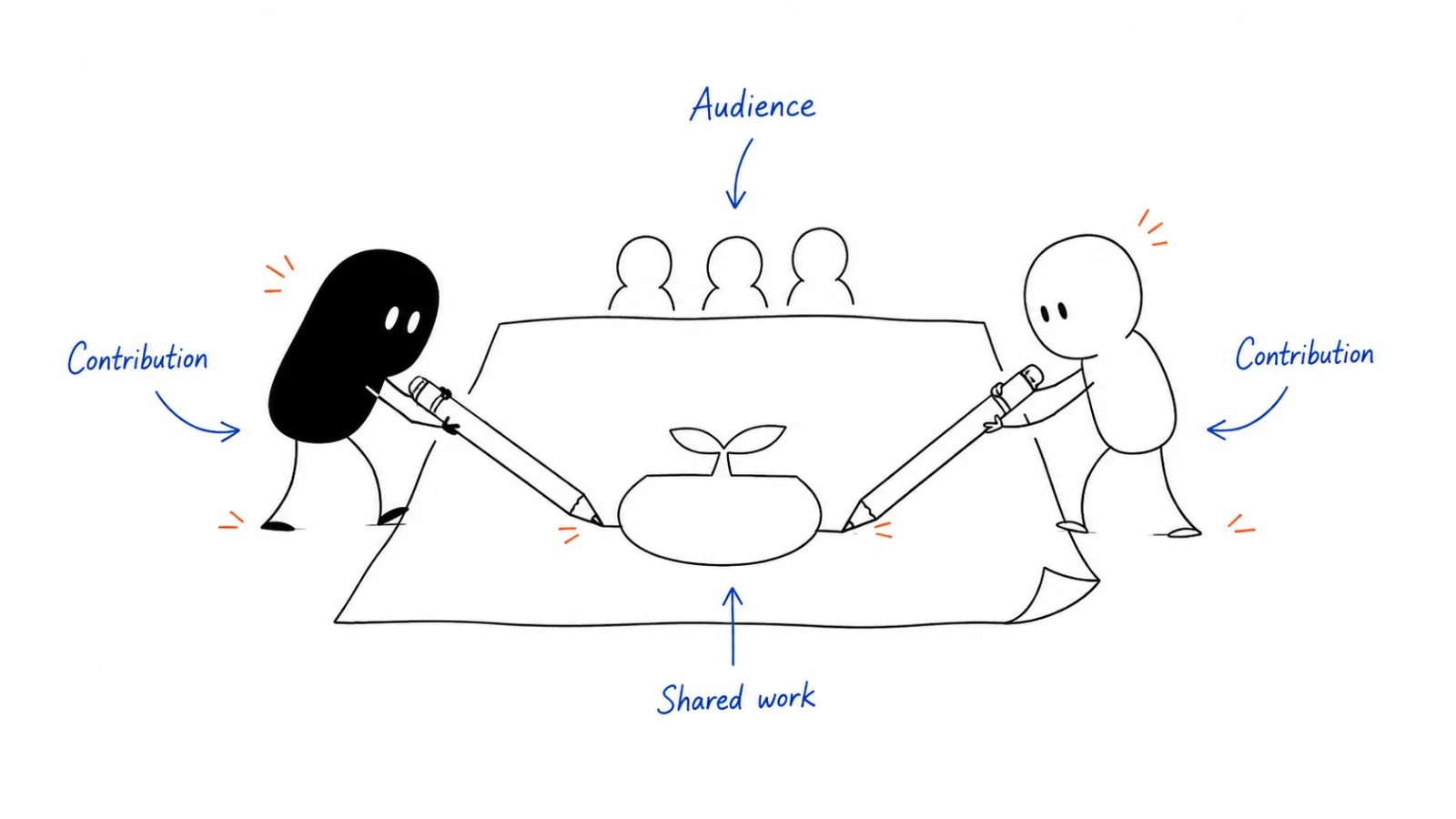 *Reading guide: choose the audience → agree on the work → build and review it → publish responsibly → decide what deserves another round.*
If a media kit is already in your inbox, start with [audience fit](#step-1-check-audience-fit). Before accepting a quote, read [scope and compensation](#separate-the-fee-from-the-rights). If a first campaign has finished, jump to [measurement](#metrics). The [worked example](#worked-example-illustrative) follows a fictional collaboration from the first email to the renewal decision.
## Use this when
Your buyers learn from people outside your company, and there is a plausible reason for one of those people to work with you.
They might follow a specialist newsletter, watch someone solve real problems on video, listen to an industry podcast, or trust a practitioner who teaches a difficult part of their job. The creator does not need to have a celebrity-sized following. They do need a relevant audience or a useful creative capability for the work you are proposing.
You can support the collaboration with a budget, access, expertise, production help, or something genuinely useful to the audience. The exchange should make sense to the creator, not merely to your acquisition spreadsheet.
A finished research report is not a prerequisite. You can commission content together, sponsor existing editorial work, or arrange a product evaluation before deciding whether publication makes sense. Be clear about which arrangement you mean.
You also need someone who can answer questions and make decisions. A creator should not have to coordinate six reviewers who disagree about what the product does.
## Do not use this when
You need guaranteed customers next week and cannot afford an inconclusive result. A creator can agree to deliver work or defined distribution. They usually cannot control whether a reader has budget, authority, or an active buying project.
You want praise disguised as independent opinion. That is not a creative brief worth improving.
You cannot provide a usable product experience, accurate supporting information, or a realistic description of what is still manual. You can sponsor a broader educational topic without a product demo, but you should not ask someone to demonstrate a capability that is not available.
You only need a freelancer to produce an asset for your own channels. That can be a perfectly good commission. Call it production, and evaluate the person's work rather than paying for an audience you will not use.
If you are negotiating legal terms, endorsement rules, intellectual property, or personal-data use, involve the appropriate qualified owner. The planning questions below help prepare that conversation; they are not a jurisdiction-specific contract or legal opinion.
## A few useful terms
A **creator** is a person or small publishing team with a recognizable way of explaining, entertaining, or teaching. In B2B this may be an operator, analyst, consultant, educator, newsletter writer, podcast host, or video producer. Their professional title alone does not establish their influence.
**Audience fit** means the people reached are relevant to your purpose. It includes their work, interests, context, geography, and familiarity with the problem—not just whether their job titles match a spreadsheet.
A **placement** buys an agreed appearance in content or distribution. A **co-created asset** involves shared development. A **commissioned asset** is made for the buyer's use. These can appear in the same package, but they should not be priced or evaluated as if they were identical.
An **endorsement** communicates the creator's own opinion or experience. A sponsor credit is not automatically a product recommendation.
**Usage rights** describe how the finished work, name, likeness, or other materials may be reused. The original publication and a paid ad using an excerpt are different uses.
An **affiliate arrangement** pays according to an agreed tracked outcome. It changes compensation and attribution requirements; it does not turn the relationship into an unbiased review.
**Attribution** assigns credit according to a rule or a person's report. **Incrementality** asks what happened because of the collaboration that would not otherwise have happened. A tracking link can help with the first without proving the second.
## Keep this in mind
Before discussing a package, complete three sentences:
The audience should get something worth its attention. The creator should get a fair exchange for the work and access being offered. The company should have a clear reason to fund or support it.
The audience benefit can be understanding your product. A tutorial does not become worthless because removing the product name would break it. The more useful question is whether the tutorial helps someone make a decision or complete a task without misleading them.
Likewise, paying for distribution is not a failure to create a deeper partnership. Sometimes a relevant, clearly identified ad is exactly the right purchase. Trouble starts when a placement is sold internally as trusted advocacy, or when a brief quietly demands much more work than the quoted slot includes.
## How to do it
### Step 1: Check audience fit
Start with the audience you want to help and the change you hope to support.
“Reach operations people” is broad. “Help customer-operations leads recognize why correction requests keep returning from engineering with missing context” gives you something to look for in a creator's work.
The relevant audience may include practitioners, managers, future buyers, implementers, and people who advise the buyer. Do not discard a technical educator simply because their followers are not all budget holders. Do ask whether their influence connects to the job your campaign is intended to do.
#### Find candidates through actual learning behavior
Ask customers and prospects what they read, listen to, or forward when working on this problem. Ask for examples of something they used, not only a list of famous people.
Look at relevant articles, public discussions, conference sessions, and recommendations from people already doing the work. A creator may have a modest main account and a much more relevant workshop audience.
An agency, marketplace, or search tool can help assemble candidates. Treat the results as leads for research, not a verified ranking. Check that the person still publishes in the relevant area and that the contact route really belongs to them.
Keep the initial list small enough to read the work. A handful of plausible candidates with notes is more useful than a hundred profiles whose only field is follower count. There is no mandatory shortlist size; the scope of the campaign and your research capacity determine it.
#### Read the work behind the media kit
Review recent material, a few typical older pieces, and examples of previous sponsorships where available. Look for recurring subjects, the level of explanation, the kinds of questions readers ask, and how the creator handles uncertainty.
A viral post about a career milestone may tell you little about the audience for a detailed workflow tutorial. A lower-reach explanation with thoughtful practitioner questions may be more relevant. Neither single post represents the entire publication.
Record what you actually observed: “Three recent tutorials cover operational handoffs; comments include implementation questions.” Do not rewrite that as “Their audience is 80% qualified buyers.”
Also notice how sponsorships fit into the work. Can you tell what is paid? Does every sponsor receive the same extravagant praise? Does the creator understand the product they are discussing? These observations help you decide whether their style is compatible with your standards.
#### Ask for useful evidence without demanding private lists
A media kit can supply audience size, distribution formats, geography, topic interests, recent performance, and pricing structure. Ask when the figures were measured and what the terms mean.
Subscriber count is not delivered emails. Delivered emails are not confirmed human readers. Followers are not the audience that will see a particular post.
For a significant purchase, ask for examples of comparable formats and a typical range rather than only the best campaign. If the publisher shares an audience survey, ask about its date, number of responses, and recruitment. Survey respondents may not represent everyone who receives the content.
Aggregate reporting, redacted screenshots, or a walkthrough of reporting may be sufficient. You do not need a list of subscriber emails or private customer names to assess a sponsorship.
Some valuable creators have limited demographic reporting. That does not automatically make them unsuitable. You can acknowledge the uncertainty, choose a smaller commitment, or decide the risk is too high. Inventing a precise overlap percentage is not a fourth option.
#### Separate fit, reach, and reliability
These answer different questions.
Fit asks whether the work is likely to reach relevant people. Reach asks how much distribution the format may receive. Reliability asks whether the creator can deliver the agreed work and communicate when something changes.
A large audience can be highly relevant. A small audience can be irrelevant. “Micro-creator” is not a substitute for research.
A simple candidate note can record the purpose, evidence of fit, format, uncertainty, indicative scope, and reason to talk. Avoid a weighted score that makes a weak assumption look scientific.
*The following conversation is invented.*
**Founder:** “This person has ten times as many followers. Should we start there?”
**Marketer:** “Maybe. Their popular posts are about career advice. Our proposed session is about operational handoffs.”
**Founder:** “The smaller creator teaches those handoffs every week.”
**Marketer:** “Then let us compare the actual formats and audiences before comparing the prices.”
#### Give reputation checks a defined purpose
For a material partnership, review relevant public conduct and past collaboration practices. Look for issues that could affect the project: fabricated expertise, repeated undisclosed promotions, harassment, stolen work, or persistent failures to deliver.
Do not turn this into speculation about private life or a demand that the creator agree with the company on everything. The purpose is a responsible business decision, with consistent criteria and room to clarify ambiguous information.
Confirm who represents the creator, who can approve the agreement, and who receives payment. Verify any later change of payment details through a known contact route. Do not rely on an urgent new email alone.
### Step 2: Choose a problem their readers care about
A pitch becomes easier to evaluate when it connects your contribution to the creator's editorial interests.
Instead of “We are launching an AI platform and would love exposure,” try “You have been covering the back-and-forth between operations and engineering. We can help show what a complete correction request looks like, including the parts our service still cannot handle.”
That is a proposal, not a script. The creator may know a more useful angle.
You do not need to find the exact topic in their archive. A related topic or a new audience question can justify a collaboration. You do need a credible explanation of why it belongs there.
#### Choose the format before comparing quotes
| Format | What you are mainly buying | What to clarify |
| -------------------------------------------- | ------------------------------------------------- | --------------------------------------------------------- |
| Newsletter or podcast placement | Defined space in an existing publication | Position, length, link, timing, labeling, reporting |
| Creator-led tutorial or demonstration | Explanation plus the creator's distribution | Access, testing, production, review, limitations |
| Joint workshop or interview | A live or recorded learning experience | Roles, registration, recording, questions, follow-up |
| Research or practical guide | Shared development of an asset | Method, sources, authorship, editing, hosting |
| Commissioned content for your channels | Production and agreed reuse | Deliverables, rights, versions, distribution not included |
| Ongoing ambassador or affiliate relationship | Repeated collaboration or outcome-based referrals | Cadence, compensation rules, conflicts, reporting, review |
The same creator may offer several of these. A newsletter slot and a bespoke workshop should not be compared only by cost per thousand subscribers.
Kit's [Newsletter Sponsorships instructions](https://help.kit.com/en/articles/11645396-how-to-run-kit-newsletter-sponsorships?ref=b2b-playbook), dated July 27, 2026, describe a structured placement model: advertiser-approved material, scheduled campaign windows, and offers publishers can accept or decline. That is an example of a legitimate sponsorship format, not evidence that placements will work for your business or that the platform's terms apply to a direct creator agreement.
#### Match the audience action to the experience
A tutorial might lead to a relevant sandbox or a detailed guide. A short sponsor message might link to a clear product page. An interview might be intended primarily to build understanding rather than collect immediate inquiries.
Choose a main next action so the content has a coherent ending. Secondary routes can still be useful: watch a demonstration, read documentation, or ask about a specific problem.
Do not send everyone to a generic homepage because it is convenient for the team. Also do not require a sales call to obtain something the content presented as freely available.
If you use a registration form, say who is collecting the information and what follow-up to expect. Registration for a workshop should not silently become permission for every partner to run unrelated outreach.
#### Send a proposal the creator can answer
Keep the first message specific enough to assess and short enough to read.
Name a relevant piece of their work, describe the audience problem, explain the possible collaboration, and state whether the proposal is paid. Share a budget range when you have one, or ask for scoped options when you do not.
Do not request a full unpaid concept deck from every candidate. A paid discovery or evaluation stage can make sense when substantial work is required before either side can commit to publication.
Use the creator's stated business contact route. If there is no reply, a considerate follow-up may be reasonable; repeated messages across their personal channels are not a relationship strategy.
An unsolicited product gift or access offer is not an accepted publishing commitment. If publication matters, agree on it.
#### Let the creator improve the idea
Ask what their audience is already tired of hearing, what would make the topic concrete, and what format normally works for this kind of explanation.
You may arrive wanting a founder interview and discover that a teardown of a fictional request is far more useful. You may arrive wanting a live session and discover that the creator's readers prefer a concise written walkthrough they can use at work.
The company owns the product facts. The creator brings knowledge of the audience and their own voice. A good brief allows both to influence the work.
### Step 3: Bring something useful to the collaboration
Your contribution does not have to be proprietary data.
It might be a knowledgeable person, a realistic demonstration environment, a clear explanation of a difficult workflow, access to a product, a well-supported research finding, or funding that lets the creator develop an otherwise impractical piece.
If you do provide data, explain its source, period, selection, permissions, and limitations. A collection of customer observations is not automatically a representative benchmark. A table that happens to be unique is not automatically useful.
Lensmor is owned by Ivan Xu, who maintains this repository. If Lensmor is involved in a future collaboration, that relationship should be clear. Nothing in the fictional example below is a Lensmor partnership, customer result, or claim about an actual event dataset.
#### Prepare a small evidence packet
Give the creator enough information to work accurately without burying them in sales material.
Include the current product or service scope, the relevant use case, access instructions, examples they may publish, and a contact for questions. Identify facts that are confirmed, claims that need verification, and features that are not yet available.
For a demonstration, label sample data and describe any manual preparation or assistance. If the product works only for one request type, do not hand over a title that promises to automate all operations.
If a customer story is involved, use the approved version and confirm the permitted scope. Permission to use a quote on your website does not necessarily answer whether it can appear in someone else's sponsored video. Resolve that before production.
Give the packet a date. A creator preparing a video over several weeks needs to know if the interface, pricing, or availability changes.
#### Make product access realistic and safe
Create an appropriate test account or environment. Use sample records rather than live customer data when possible. Keep credentials out of recordings and shared briefs.
Walk through setup if the product requires it, then allow time for the creator to work independently. An assisted onboarding session is useful; it should not be represented as the creator discovering every capability unaided.
Agree on what can be shown, what needs redaction, and how access ends. A product evaluation is not authorization to test production security, contact customers, or export private records.
If the creator cannot reproduce the proposed result, find out why. It may reveal a setup problem, a confusing workflow, or an unsupported claim. Treat that as useful information, not a failure of enthusiasm.
#### Build the brief around a real reader task
For a tutorial, name the starting situation, what the reader will see, and what they should understand afterward.
A workable outline might show an incomplete request, explain why the missing context matters, demonstrate one supported preparation path, and leave the reader with a checklist. It can mention the product naturally because the product is part of the task.
A vague outline—problem, solution, benefits, call to action—does not tell the creator what to make. Add the actual example, the difficult decision, and the limitation that affects whether the reader can use it.
Keep required facts separate from suggested language. “The service cannot write to production” is a factual boundary. “Unlock a new era of operational excellence” is optional copy, and probably not helpful copy.
#### Agree on review without taking over the voice
Define who reviews, what they review, and how many rounds are included. Consolidate feedback through one person.
Check factual accuracy, demonstrated capability, agreed scope, permissions, and the commercial relationship's presentation. Do not rewrite every sentence until the creator sounds like your website.
If you need a precisely controlled advertisement, commission that format openly. If you want the creator's evaluation, allow an evaluation—including conclusions you would not put in a sales deck.
*The following conversation is invented.*
**Creator:** “The demo needed your operator to prepare the input. I want to show that.”
**Founder:** “Could we leave that part out? The video is already long.”
**Creator:** “Then it would look like the software did work that your team did.”
**Founder:** “Keep it in. We can shorten the setup explanation instead.”
Start by separating the work they agreed to do from the opinion you hoped they would have.
If you commissioned an evaluation, a critical result may still be a completed evaluation. If publication was conditional on a separate agreement, use that decision point. Do not invent a new condition after receiving the work.
Ask which observations are factual, which reflect their preferences, and whether a problem can be reproduced. Correct a genuine misunderstanding with evidence. Do not make payment depend on removing an honest criticism that the agreed format allowed.
If a sponsored tutorial cannot be completed because a required capability is missing, discuss a narrower accurate topic, a reschedule, or the agreed cancellation path. The creator should not have to invent a successful demonstration.
The best prevention is an early testing stage and a clear distinction between paid production, optional publication, and a personal recommendation. A contract owner should handle disputes about obligations; this checklist does not settle them.
#### Use AI as an assistant, not a substitute for experience
AI can help organize research notes, generate outline alternatives, summarize approved materials, or flag inconsistent terminology. A human still needs to check the underlying facts and the finished work.
Do not generate a fictional first-person testimonial and put it in the creator's mouth. Do not make an AI avatar or cloned voice imply they said something they did not approve.
Discuss AI-generated or substantially altered media in the production plan, including consent, permitted uses, disclosure needs, and review. Uploading a creator's unpublished material or a customer's data to an outside service also needs appropriate permission.
A useful final check is simple: could the creator explain how they know each important claim? If the answer is “the draft sounded plausible,” it is not ready.
### Step 4: Agree on benefits and disclosure
Move from a promising conversation to a written scope both sides understand.
The agreement does not have to begin as a dense document. Start with the actual work: what will be created, where it will appear, who supplies what, which decisions require approval, and what happens if the plan changes. Have the appropriate owner turn that scope into suitable terms before making commitments.
#### Separate the fee from the rights
Ask for a breakdown that matches the proposed work. Useful categories include creative development, production, publication, revisions, additional versions, exclusivity, and reuse.
A fee of \$2,000 for a newsletter placement is not directly comparable with \$2,000 for producing a video you will distribute yourself. The number is the same; the purchase is different.
There is no universal fair price per follower. Relevant reach, specialist expertise, production effort, demand, format, timing, and the rights requested can all affect the quote. Ask for options if the scope exceeds your budget rather than arguing that the creator's audience should be cheaper.
For example, you might remove paid-ad reuse, reduce the number of cutdowns, or sponsor an existing format instead of requesting a custom production. Reducing scope is usually a clearer negotiation than asking for the same package at half the fee.
Do not assume organic reposting, paid distribution, translation, raw files, or use of the creator's name and face are included. Write down the intended channels, duration, geography, permitted edits, approval process, and what happens when the permission ends.
This is a negotiation checklist, not a statement of what rights either side automatically owns. Have a qualified reviewer confirm the terms for the actual arrangement.
#### Be precise about exclusivity and paid amplification
“Do not work with competitors” can cover far more than either side intended. Define the relevant category, named exclusions if needed, timeframe, and covered activities. Consider the creator's existing commitments and the cost of restricting future work.
Sponsorship exclusivity does not necessarily mean the creator must stop discussing competing products editorially. If that is part of the proposed arrangement, it needs an explicit conversation—and you should consider whether it undermines the credibility you wanted.
Running advertising through a creator-associated account or identity is a separate operational decision from reposting a clip on your company page. Agree on the content, budget controls, access, approval, reporting, and end date. Use authorized platform access where available, not password sharing.
Do not silently keep boosting an old asset after its permitted period or after its product claims have become inaccurate.
#### Define payment and changes before the deadline gets close
Agree on the fee, currency, payment schedule, invoice details, and treatment of taxes or platform fees. Explain any procurement requirements early. Do not reveal a long vendor-onboarding process after the creator has finished the work.
If there is a deposit or staged payment, connect it to clear milestones. Specify what happens when either party delays inputs, changes scope, cancels, or needs to reschedule.
For a placement, clarify what delivery means. It might be publication in a particular issue or a defined number of verified impressions under an agreed method. An estimated audience is not automatically a guarantee.
A **make-good** is a negotiated remedy for a delivery shortfall, such as a replacement placement. It is not an automatic refund because sales were disappointing. Put the applicable condition and remedy in the agreement rather than inventing them in the recap.
#### Keep affiliate compensation understandable
An affiliate arrangement needs more than a link and a percentage.
Define the eligible action, commission basis, attribution window, duplicate-credit rules, existing-customer treatment, refunds, exclusions, reporting, and payment timing. Specify how disputes are handled and what happens after the relationship ends.
A hybrid fee plus performance payment can share some uncertainty while still paying for production. It does not remove the need to define outcomes.
For a long sales cycle, paying only on closed revenue may shift a large amount of risk onto a creator who cannot control qualification, follow-up, or procurement. The creator may decline or ask for different terms. That is a commercial choice, not proof they lack confidence in their audience.
Keep commission reporting separate from claims about incremental growth. A tracking rule may properly award commission on a transaction without proving the transaction would not have happened otherwise.
#### Make the commercial relationship clear
The FTC's [endorsement guidance](https://www.ftc.gov/business-guidance/resources/ftcs-endorsement-guides-what-people-are-asking?ref=b2b-playbook) explains the U.S. principles: endorsements must be truthful, relevant unexpected connections should be clear, and advertisers have responsibilities for the claims and disclosures made on their behalf. It also emphasizes that context matters; the guidance is not a universal safe harbor.
The FTC's [Disclosures 101](https://www.ftc.gov/business-guidance/resources/disclosures-101-social-media-influencers?ref=b2b-playbook) covers connections beyond cash, including free access and employment. It recommends placing an understandable disclosure with the endorsement rather than relying on a profile or something hidden behind an expansion. Video and live formats need attention to how viewers actually encounter the message.
For YouTube, its current [branded-content instructions](https://support.google.com/youtube/answer/154235?hl=en\&ref=b2b-playbook) require notifying the platform through the paid-promotion setting for covered commercial content. The platform also says creators and partners remain responsible for applicable legal requirements. A platform label should not be treated as a substitute for that review.
Agree on the disclosure, who checks it, and how it survives excerpts or reposts. These are U.S. guidance and a platform example, not worldwide legal clearance. Have the responsible owner check the relevant jurisdiction, audience, and format.
#### Keep the working relationship manageable
Write one schedule with the dates for access, outline, draft, consolidated feedback, final approval, publication, and reporting. Include enough room for the actual production process.
Name a backup approver if the usual reviewer will be away. An unanswered approval request should not leave the creator guessing whether to publish.
Be explicit about which decisions belong to the creator. If the format permits editorial judgment, the company should not use an approval deadline to negotiate that judgment away.
*The following conversation is invented.*
**Founder:** “The package includes a video. Can we run it in ads for the rest of the year?”
**Creator:** “The quote covers production and publication on my channel, not paid reuse.”
**Founder:** “We only need one short excerpt for six weeks.”
**Creator:** “Let us price that use separately and agree on the edit before it runs.”
### Step 5: Plan one piece and its distribution
A limited first collaboration is often easier to learn from than a large roster. It is a starting option, not a rule that every business may publish only one creator piece per quarter.
A series can be appropriate when the topic needs repetition, the audience needs several steps, or a creator already has an established recurring format. Define what each installment contributes and where you can review progress before committing more resources.
#### Make the destination ready
Follow the proposed link yourself on a phone and on desktop. Check that the page continues the promise made in the content.
A visitor who has just watched an example should find the example, relevant product details, or the promised resource—not a page that asks them to start the explanation again.
Check access, form behavior, confirmation messages, scheduling availability, and who will respond. If the content describes a limited pilot, the destination should explain its scope and availability.
Use campaign parameters that your reporting system supports and test that redirects preserve them. Keep personal information out of URLs. A referral parameter can identify a source convention; it does not reveal every visitor's identity or guarantee attribution.
If affiliate tracking is part of the deal, test that separately from analytics. A working pageview does not prove commission credit is working.
#### Give publication a small checklist
Review the final version, not only an earlier script. Check the headline, thumbnail, captions, description, links, claims, and agreed relationship labeling.
Confirm the publication time and timezone, the correct version of the asset, and which person handles a problem on the day. A newsletter cannot always be corrected in subscribers' inboxes after it is sent; resolve important issues before release.
Prepare a short answer to predictable questions. The person answering comments should know what the product can do and when to bring in an expert.
Do not seed fake audience enthusiasm. Employees and colleagues can contribute genuinely, with their relationship clear where relevant; they should not pose as unrelated customers.
#### Respond without taking over the audience
Ask the creator how they want questions handled. Some prefer to answer themselves, some welcome a clearly identified company representative, and some want follow-up collected in one place.
Answer the question that was asked. Someone asking whether a feature exists has not necessarily requested a sales sequence.
If a person explicitly asks for help, agree on the next step with them. If they ask a question only the creator can answer, do not speak for the creator.
Do not request the full attendee or subscriber list simply because you helped fund the content. Plan any necessary data sharing and follow-up permissions before collection, using the responsible privacy owner.
#### Check what actually went live
Save the published link, date, agreed delivery evidence, and version of the materials. Review the live work for broken links, missing context, or changes introduced during publishing.
Where corrections are needed, coordinate them promptly. An incorrect capability claim in a widely shared excerpt may need attention even if the long video was accurate.
Keep a record of the correction without treating every edit as misconduct. Production mistakes happen. The important questions are whether the issue is addressed and whether the workflow needs to change.
First ask whether clicks were the main job of the format. A thoughtful interview may influence understanding without producing many immediate visits. That does not prove success, but it changes what to inspect.
Then check delivery and mechanics: did the correct piece publish, was the link visible and working, did the destination match, and are the reports using comparable definitions?
If those are sound, examine the audience, topic, offer, and next step. A relevant audience may enjoy the explanation without needing the product now. A strong tutorial may be paired with an unnecessarily demanding call to action.
Do not immediately demand a make-good unless an agreed delivery condition was missed. Do not buy several more identical placements solely to avoid admitting uncertainty.
Use the first result to propose a specific adjustment. If there is no plausible adjustment or the budget cannot support another uncertain round, stop politely, pay what is owed, and retain the lesson.
#### Review the partnership before building a program
Hold a brief retrospective with the creator. What questions came back? Where did the work become difficult? What did the audience misunderstand? What would the creator change if doing the topic again?
Compare this with the company's observations. The creator may see useful replies that never become website visits. The company may see inquiries whose first touch was elsewhere. Keep both, labeled by source.
Renew when there is a credible next purpose, acceptable economics, and a workable relationship—not simply because a slot is available.
If several collaborations are working, standardize the repetitive administration: briefs, access, claims, permissions, payment, and reporting. Preserve the creative differences that made each partnership useful. A program should not turn ten distinct voices into one campaign script.
## Worked example (illustrative)
This example is entirely fictional. It is not a Lensmor campaign, a real creator's rate card, or a growth benchmark.
The company helps operations teams prepare one supported type of correction request. Its service uses substantial human assistance. Customer engineers still approve and execute changes; the service cannot write to production.
The founder wants more suitable teams to understand that narrow offer. A previous general product post attracted people expecting an autonomous system, so the first job is accurate understanding—not the largest possible audience.
### The creator choice
The team considers a broad technology commentator and a specialist operations educator.
The commentator has more reach, but the proposed package is a short mention in a general AI roundup. The educator has a smaller newsletter and teaches operational handoffs. Their recent public work suggests a better fit for a detailed example, although audience job-title data is incomplete.
The team chooses a limited pilot with the educator. It records the incomplete composition data as a risk, not as proof that the audience is unqualified or perfectly matched.
The educator says readers would prefer to see a bad request improved rather than hear another founder interview. The team changes the format accordingly.
### The first message
The founder's note reads:
“I liked your recent explanation of why requests come back from engineering without a useful next step. We run a small assisted service for preparing one kind of correction request. We could work through a fictional before-and-after request with you, including what our operator does and what still needs an engineer. This would be a paid collaboration. Would a newsletter walkthrough fit your readers, and could you quote for one issue plus a short follow-up?”
This is an invented outreach example, not a message sent to anyone. The founder would replace the reference with a real piece before using it.
The note offers a concrete topic and acknowledges the service's limits. It does not ask the creator to declare the product the best in its category.
### The agreed pilot
They settle on a written walkthrough published in one newsletter issue, with a shorter follow-up in a later issue. The creator develops the narrative and illustrations from approved sample material. The company provides access, the fictional request, and a subject-matter reviewer.
The fictional scope includes:
* One outline and one consolidated factual-review round.
* A walkthrough showing the original request, the preparation process, and the engineer's remaining responsibilities.
* Two scheduled newsletter appearances with links to the same relevant guide.
* A reporting recap after the second appearance.
* Permission for the company to link to the article and share one approved excerpt organically for six weeks.
* No paid-ad reuse, raw-file delivery, exclusivity, or guaranteed sales.
A suitable agreement would document those terms and the relationship disclosure. This teaching scope is not a ready-to-sign contract.
The creator fee is \$1,200. An external accessibility and editing check costs \$200. The company expects ten internal hours, valued at an assumed \$50 per hour for planning.
That gives an initial planning cost of \$1,900: \$1,400 cash plus \$500 allocated internal time. These are invented figures, not recommended rates.
### The content changes during review
The first outline calls the service “an automated route from request to fix.” The company explains why that wording is wrong.
The revised walkthrough uses a fictional request missing the affected record, the intended correction, and the reason for it. It shows the operator collecting and organizing that context, then shows the engineer reviewing the prepared request.
The ending makes the boundary explicit: better preparation does not approve or execute the change.
The creator adds a useful question: “What happens when the request falls outside the supported type?” The company explains the manual assessment and possible decline. That answer stays in the article because it helps readers judge fit.
There is no customer performance claim. The sample demonstrates a workflow; it does not establish time savings or a typical outcome.
### The distribution and reporting plan
Each newsletter appearance has its own campaign label. Both link to a guide that explains the supported request, the human work, and the option to ask about a pilot.
The guide is readable without a form. An inquiry form is available for teams that want to discuss their own situation. The team tests the links and form before publication.
The creator reports delivery and clicks for each issue. The company reports attributable site sessions, inquiries, and inquiry quality. They agree that these are different systems, not a perfectly joined view of every reader.
### The observed results
At the fictional review date, both appearances have been delivered.
The first reports 4,000 delivered emails and 80 unique link clickers within that issue. The second reports 3,800 delivered emails and 57 unique link clickers within that issue.
The issue-level click-to-delivered rates are 2.0% and 1.5%. They are not click-to-open rates, confirmed human-reader rates, or industry benchmarks.
The reports do not deduplicate people across issues. Therefore, 80 plus 57 is 137 issue-level unique-click counts, not necessarily 137 different people.
The company's analytics records 110 campaign-tagged sessions. A session is not a person, and it need not equal the publisher's click count. Different definitions, repeated visits, automated traffic handling, redirects, and missing tracking can contribute to differences; this example does not identify which caused the gap.
Eight distinct inquiries are recorded. Five meet the team's written fit criteria, and three do not: two need unsupported request types and one is a service provider researching the category.
Of the five suitable inquiries, two already had an open evaluation with the company. Three are newly recorded suitable inquiries. The creator may have helped the existing evaluations, but the team does not relabel them as newly sourced opportunities.
One of those three new inquiries has paid for a pilot by the review date. The other two are still evaluating. The team has no evidence yet about renewals or longer-term revenue.
### The cost review
The company actually spends twelve internal hours, not the planned ten. At the same assumed \$50 hourly planning rate, allocated internal effort is \$600.
| Cost or observation | Calculation | Interpretation |
| ---------------------------------------- | ------------------------------------------------ | ------------------------------------------------------- |
| Cash campaign spending | 1,200 creator fee + 200 external check = \$1,400 | Excludes internal effort and pilot delivery |
| Planning cost including internal time | 1,400 + 600 = \$2,000 | An allocated-cost view, not just cash paid |
| Cost per recorded inquiry | 2,000 / 8 = \$250 | Includes unsuitable and pre-existing inquiries |
| Cost per suitable inquiry | 2,000 / 5 = \$400 | Still includes two existing evaluations |
| Cost per newly recorded suitable inquiry | 2,000 / 3 ≈ \$666.67 | Descriptive campaign ratio, not causal acquisition cost |
The paid pilot brings in \$900 and requires \$600 in direct delivery cost. Its contribution before campaign spending and other overhead is \$300.
Against \$1,400 cash campaign spending, that leaves a \$1,100 shortfall at this review point. Against the \$2,000 allocated-cost view, the shortfall is \$1,700. The company should not report that the campaign has paid for itself.
If every future pilot had the same \$300 contribution, five such pilots would exceed the cash campaign cost, and seven would exceed the allocated planning cost. That is a simple scenario, not a forecast: it assumes equal economics and does not prove those pilots would be incremental.
The existing one pilot counts toward those totals. It is not “five more” and “seven more.”
### The renewal decision
The team does not approve an open-ended retainer.
It learned that the creator could explain the assisted service accurately and bring some relevant inquiries. It also learned that production required more internal time than expected and that one paid pilot had not covered the campaign expense.
The next decision is whether another bounded collaboration has a better reason to exist. The creator suggests a follow-up about identifying requests that should not enter this workflow. The founder first improves the guide's fit explanation and waits for the two active new evaluations to progress.
They keep the relationship warm without reserving more inventory. That is a reasonable outcome for a useful but commercially unproven pilot.
A different company with a larger learning budget might fund the follow-up sooner. What matters is that the decision names the purpose, uncertainty, and spending limit instead of turning a promising conversation into proof of profitable scale.
## Copy: partnership card (fill)
Use this to prepare a discussion, then move the agreed commercial and legal terms into the appropriate agreement. It is not a substitute for one.
```text theme={null}
CREATOR PARTNERSHIP BRIEF
Creator / publication / business contact:
Audience and reader task:
Fit evidence, dates, and known gaps:
Main purpose and intended next action:
Format and exact deliverables:
Company inputs and access:
Creator's editorial decisions:
Confirmed facts / unsupported claims:
Sample data and publication permissions:
Fee, expenses, currency, and payment milestones:
Publication dates and timezone:
Review owner, deadline, and included rounds:
Changes, delays, cancellation, and delivery remedies:
Usage scope, duration, edits, and exclusions:
Exclusivity, if any:
Relationship disclosure and responsible reviewer:
Destination, links, and tracking test:
Questions and follow-up owner:
Reporting definitions and review date:
Budget limit and conditions for another round:
```
For an existing lightweight worksheet, use [creator-partnership.md](../../templates/creator-partnership.md). It is oriented toward one co-created asset. Its “unique cut” and “survive without our product name” prompts are useful tests for some educational collaborations, not universal requirements for every sponsorship or product tutorial. Adapt a private copy to the format you choose; do not discard completed work merely because the new brief is broader.
A separate recap helps prevent the reporting conversation from becoming an argument over one number.
```text theme={null}
PARTNERSHIP REVIEW
Published assets and dates:
Agreed delivery completed / exceptions:
Corrections and unresolved issues:
Audience questions and creator observations:
Publisher metrics, definitions, and time windows:
Company analytics, definitions, and time windows:
Cross-platform or cross-issue deduplication limits:
Distinct inquiries / suitable inquiries:
Existing evaluations versus newly recorded inquiries:
Paid customers to date / outcomes still pending:
What attribution does and does not establish:
Cash spending:
Internal effort and valuation assumption:
Other costs excluded:
Customer revenue and direct delivery cost:
Comparison with the original purpose and budget:
Continue / change scope / wait / stop:
Reason and remaining uncertainty:
Next owner and decision date:
Permissions, access, and materials to renew or end:
```
## Before you start
You should be able to explain why this creator, why this format, and why now. A recognizable name is not the explanation, but neither is a small audience automatically a good reason.
Check that both parties understand the work, compensation, rights, relationship presentation, review process, and reporting. Make sure the creator has what they need to produce an accurate piece and that someone can respond on your side.
Test the reader's next step. If the collaboration promises a guide, the guide should be available. If it invites a trial, the trial should reflect the demonstrated capability.
Finally, decide how much uncertainty you can afford. Do not commit a budget that requires every optimistic assumption to come true.
## Metrics
Start with the purpose of the collaboration. Then separate delivery, audience response, business observations, and economics.
| Layer | Useful observations | What they do not prove |
| ----------------- | --------------------------------------------------- | ------------------------------------------------------- |
| Delivery | Agreed assets published, timing, placement, reports | That the audience noticed or believed them |
| Audience response | Defined views, clicks, questions, saves, replies | Qualified demand or unique people across platforms |
| Understanding | Readers can describe the use case and limits | That everyone exposed learned the same thing |
| Business response | Distinct inquiries, fit, evaluations, paid pilots | Incremental revenue without further evidence |
| Economics | Cash, internal effort, delivery cost, contribution | Future retention or profitability from one short window |
### Use reach metrics without asking them to do everything
Views, opens, and downloads can help diagnose distribution. They are not meaningless simply because they are not revenue.
They do require definitions. Ask whether a count is total or unique, what period it covers, and how the reporting system handles automated activity where that information is available. An email open estimate should not be presented as a verified count of people reading the sponsored section.
Compare similar formats and definitions. Do not compare a video play, a newsletter delivery, and a site session as if they were identical impressions.
CPM or CPC can help compare purchases when the underlying units are sufficiently comparable. They cannot tell you whether a partnership improves buyer understanding or creates profitable customers.
### Keep the inquiry record clean
Use a consistent definition of an inquiry and a suitable inquiry. Deduplicate submissions you can legitimately identify as the same request. Record existing relationships rather than presenting every response as a new account.
Ask how people heard about you when useful, without requiring them to select the channel you want to credit. A person may name several influences or remember only the last one.
Record those answers alongside campaign tracking. Neither should erase the other.
Do not infer an individual's identity from a campaign link, anonymous site visit, or the creator's audience profile. Report uncertainty honestly.
### Choose a review window that fits the question
Delivery problems can be checked immediately. Initial audience response can be reviewed after an agreed reporting period. Sales outcomes may need longer.
There is no universal day-90 pass/fail test. A short-cycle self-serve tool and a large enterprise purchase need different expectations. Waiting longer also does not rescue a campaign automatically.
Define an early operational review and a later business review where useful. At each one, distinguish completed outcomes from work still in progress.
If scale justifies it, consider a properly designed comparison or holdout with an appropriate analyst. A before-and-after chart alone cannot isolate the creator's effect from other campaigns, seasonality, or existing demand.
### Compare the result with an alternative use of the budget
Ask what another round would displace: a different creator, better onboarding, your own content, a product improvement, or no spending yet.
Include internal effort. A small sponsorship fee can conceal weeks of review work. Conversely, a well-produced asset may have continuing value if you have permission to reuse it and its claims remain current.
Do not assign an arbitrary value to that asset merely to make a negative campaign look profitable. Record the actual permitted reuse and whether it is being used.
## Common mistakes
**Buying a person before choosing a purpose.** The team selects a famous name, then invents a campaign to justify the booking. Write the audience task first.
**Treating a placement as a personal recommendation.** A paid slot can work without implying the creator uses or endorses the product. Keep the format honest.
**Requiring proprietary data for every collaboration.** Expertise, access, production funding, or a useful demonstration can be enough. Data adds value only when it answers a relevant question and can be used responsibly.
**Sending a sales deck instead of usable inputs.** The creator needs accurate facts, a workable example, access, and decisions—not fifty slides of claims.
**Buying publication and assuming unlimited reuse.** Discuss paid ads, excerpts, translations, raw files, and the creator's identity separately.
**Changing the goal after results arrive.** Do not sell a campaign as demand generation, then declare it a success on reach alone without explaining that the original objective was not met.
**Making the creator responsible for your sales process.** Slow responses, unsupported requirements, and poor follow-up are not fixed by a larger audience.
**Scaling an administrative mess.** If one collaboration involved unclear payment, contradictory feedback, and last-minute access, fix the process before adding more people.
## What to read next
Use [Channel strategy](https://b2-b-playbook.mintlify.app/playbooks/04-channels-and-distribution/channel-strategy) to decide whether creator work deserves attention alongside other channels.
Read [Content strategy](../03-brand-story-and-content/content-strategy.md) when the brief needs a stronger topic or editorial purpose, and [Demo](../02-product-marketing/demo.md) when a creator will show the product.
Use [Community](https://b2-b-playbook.mintlify.app/playbooks/04-channels-and-distribution/community) for ongoing member relationships rather than publication-led distribution. [Ecosystem](../06-account-field-and-partner/ecosystem.md) covers broader company-to-company relationships.
For paid amplification, continue with [Paid media](https://b2-b-playbook.mintlify.app/playbooks/04-channels-and-distribution/paid-media). For an upcoming launch on that platform, read [Product Hunt](https://b2-b-playbook.mintlify.app/playbooks/04-channels-and-distribution/product-hunt); creator partnerships and launch voting are not the same activity.
[RESOURCES.md](../../RESOURCES.md) is a reading collection, not a vetted roster of available sponsorship partners.
## Sources and evidence boundary
This is an owner-maintained operating synthesis, not a creator rate survey, a universal contract, or legal advice. The selection method, briefs, fictional dialogues, and worked campaign are original teaching material. No actual outreach or paid collaboration was conducted for this chapter.
Primary materials checked September 8, 2026:
* [Kit: How to run Newsletter Sponsorships](https://help.kit.com/en/articles/11645396-how-to-run-kit-newsletter-sponsorships?ref=b2b-playbook), dated July 27, 2026. Used to illustrate a structured placement model, not to recommend a platform or claim campaign results.
* [FTC: Endorsement Guides questions and answers](https://www.ftc.gov/business-guidance/resources/ftcs-endorsement-guides-what-people-are-asking?ref=b2b-playbook). U.S. guidance on truthful endorsements, connections, and advertiser responsibilities; the page refers to the 2023 guide revision.
* [FTC: Disclosures 101](https://www.ftc.gov/business-guidance/resources/disclosures-101-social-media-influencers?ref=b2b-playbook). Practical disclosure guidance, not worldwide clearance for the sample workflow.
* [YouTube: branded-content restrictions and disclosure labels](https://support.google.com/youtube/answer/154235?hl=en\&ref=b2b-playbook). Current platform instructions; no creator account or platform setting was inspected or changed.
The publication examples establish that different commercial formats and responsibilities exist. They do not establish that any particular creator, format, price, or measurement window will work for your company.
***
Copyright © 2026 Ivan Xu. All rights reserved. See the [copyright and reuse terms](https://github.com/weilun88313/B2B-Playbook/blob/main/LICENSE).
Canonical source: [github.com/weilun88313/B2B-Playbook](https://github.com/weilun88313/B2B-Playbook)
*Reading guide: choose the audience → agree on the work → build and review it → publish responsibly → decide what deserves another round.*
If a media kit is already in your inbox, start with [audience fit](#step-1-check-audience-fit). Before accepting a quote, read [scope and compensation](#separate-the-fee-from-the-rights). If a first campaign has finished, jump to [measurement](#metrics). The [worked example](#worked-example-illustrative) follows a fictional collaboration from the first email to the renewal decision.
## Use this when
Your buyers learn from people outside your company, and there is a plausible reason for one of those people to work with you.
They might follow a specialist newsletter, watch someone solve real problems on video, listen to an industry podcast, or trust a practitioner who teaches a difficult part of their job. The creator does not need to have a celebrity-sized following. They do need a relevant audience or a useful creative capability for the work you are proposing.
You can support the collaboration with a budget, access, expertise, production help, or something genuinely useful to the audience. The exchange should make sense to the creator, not merely to your acquisition spreadsheet.
A finished research report is not a prerequisite. You can commission content together, sponsor existing editorial work, or arrange a product evaluation before deciding whether publication makes sense. Be clear about which arrangement you mean.
You also need someone who can answer questions and make decisions. A creator should not have to coordinate six reviewers who disagree about what the product does.
## Do not use this when
You need guaranteed customers next week and cannot afford an inconclusive result. A creator can agree to deliver work or defined distribution. They usually cannot control whether a reader has budget, authority, or an active buying project.
You want praise disguised as independent opinion. That is not a creative brief worth improving.
You cannot provide a usable product experience, accurate supporting information, or a realistic description of what is still manual. You can sponsor a broader educational topic without a product demo, but you should not ask someone to demonstrate a capability that is not available.
You only need a freelancer to produce an asset for your own channels. That can be a perfectly good commission. Call it production, and evaluate the person's work rather than paying for an audience you will not use.
If you are negotiating legal terms, endorsement rules, intellectual property, or personal-data use, involve the appropriate qualified owner. The planning questions below help prepare that conversation; they are not a jurisdiction-specific contract or legal opinion.
## A few useful terms
A **creator** is a person or small publishing team with a recognizable way of explaining, entertaining, or teaching. In B2B this may be an operator, analyst, consultant, educator, newsletter writer, podcast host, or video producer. Their professional title alone does not establish their influence.
**Audience fit** means the people reached are relevant to your purpose. It includes their work, interests, context, geography, and familiarity with the problem—not just whether their job titles match a spreadsheet.
A **placement** buys an agreed appearance in content or distribution. A **co-created asset** involves shared development. A **commissioned asset** is made for the buyer's use. These can appear in the same package, but they should not be priced or evaluated as if they were identical.
An **endorsement** communicates the creator's own opinion or experience. A sponsor credit is not automatically a product recommendation.
**Usage rights** describe how the finished work, name, likeness, or other materials may be reused. The original publication and a paid ad using an excerpt are different uses.
An **affiliate arrangement** pays according to an agreed tracked outcome. It changes compensation and attribution requirements; it does not turn the relationship into an unbiased review.
**Attribution** assigns credit according to a rule or a person's report. **Incrementality** asks what happened because of the collaboration that would not otherwise have happened. A tracking link can help with the first without proving the second.
## Keep this in mind
Before discussing a package, complete three sentences:
The audience should get something worth its attention. The creator should get a fair exchange for the work and access being offered. The company should have a clear reason to fund or support it.
The audience benefit can be understanding your product. A tutorial does not become worthless because removing the product name would break it. The more useful question is whether the tutorial helps someone make a decision or complete a task without misleading them.
Likewise, paying for distribution is not a failure to create a deeper partnership. Sometimes a relevant, clearly identified ad is exactly the right purchase. Trouble starts when a placement is sold internally as trusted advocacy, or when a brief quietly demands much more work than the quoted slot includes.
## How to do it
### Step 1: Check audience fit
Start with the audience you want to help and the change you hope to support.
“Reach operations people” is broad. “Help customer-operations leads recognize why correction requests keep returning from engineering with missing context” gives you something to look for in a creator's work.
The relevant audience may include practitioners, managers, future buyers, implementers, and people who advise the buyer. Do not discard a technical educator simply because their followers are not all budget holders. Do ask whether their influence connects to the job your campaign is intended to do.
#### Find candidates through actual learning behavior
Ask customers and prospects what they read, listen to, or forward when working on this problem. Ask for examples of something they used, not only a list of famous people.
Look at relevant articles, public discussions, conference sessions, and recommendations from people already doing the work. A creator may have a modest main account and a much more relevant workshop audience.
An agency, marketplace, or search tool can help assemble candidates. Treat the results as leads for research, not a verified ranking. Check that the person still publishes in the relevant area and that the contact route really belongs to them.
Keep the initial list small enough to read the work. A handful of plausible candidates with notes is more useful than a hundred profiles whose only field is follower count. There is no mandatory shortlist size; the scope of the campaign and your research capacity determine it.
#### Read the work behind the media kit
Review recent material, a few typical older pieces, and examples of previous sponsorships where available. Look for recurring subjects, the level of explanation, the kinds of questions readers ask, and how the creator handles uncertainty.
A viral post about a career milestone may tell you little about the audience for a detailed workflow tutorial. A lower-reach explanation with thoughtful practitioner questions may be more relevant. Neither single post represents the entire publication.
Record what you actually observed: “Three recent tutorials cover operational handoffs; comments include implementation questions.” Do not rewrite that as “Their audience is 80% qualified buyers.”
Also notice how sponsorships fit into the work. Can you tell what is paid? Does every sponsor receive the same extravagant praise? Does the creator understand the product they are discussing? These observations help you decide whether their style is compatible with your standards.
#### Ask for useful evidence without demanding private lists
A media kit can supply audience size, distribution formats, geography, topic interests, recent performance, and pricing structure. Ask when the figures were measured and what the terms mean.
Subscriber count is not delivered emails. Delivered emails are not confirmed human readers. Followers are not the audience that will see a particular post.
For a significant purchase, ask for examples of comparable formats and a typical range rather than only the best campaign. If the publisher shares an audience survey, ask about its date, number of responses, and recruitment. Survey respondents may not represent everyone who receives the content.
Aggregate reporting, redacted screenshots, or a walkthrough of reporting may be sufficient. You do not need a list of subscriber emails or private customer names to assess a sponsorship.
Some valuable creators have limited demographic reporting. That does not automatically make them unsuitable. You can acknowledge the uncertainty, choose a smaller commitment, or decide the risk is too high. Inventing a precise overlap percentage is not a fourth option.
#### Separate fit, reach, and reliability
These answer different questions.
Fit asks whether the work is likely to reach relevant people. Reach asks how much distribution the format may receive. Reliability asks whether the creator can deliver the agreed work and communicate when something changes.
A large audience can be highly relevant. A small audience can be irrelevant. “Micro-creator” is not a substitute for research.
A simple candidate note can record the purpose, evidence of fit, format, uncertainty, indicative scope, and reason to talk. Avoid a weighted score that makes a weak assumption look scientific.
*The following conversation is invented.*
**Founder:** “This person has ten times as many followers. Should we start there?”
**Marketer:** “Maybe. Their popular posts are about career advice. Our proposed session is about operational handoffs.”
**Founder:** “The smaller creator teaches those handoffs every week.”
**Marketer:** “Then let us compare the actual formats and audiences before comparing the prices.”
#### Give reputation checks a defined purpose
For a material partnership, review relevant public conduct and past collaboration practices. Look for issues that could affect the project: fabricated expertise, repeated undisclosed promotions, harassment, stolen work, or persistent failures to deliver.
Do not turn this into speculation about private life or a demand that the creator agree with the company on everything. The purpose is a responsible business decision, with consistent criteria and room to clarify ambiguous information.
Confirm who represents the creator, who can approve the agreement, and who receives payment. Verify any later change of payment details through a known contact route. Do not rely on an urgent new email alone.
### Step 2: Choose a problem their readers care about
A pitch becomes easier to evaluate when it connects your contribution to the creator's editorial interests.
Instead of “We are launching an AI platform and would love exposure,” try “You have been covering the back-and-forth between operations and engineering. We can help show what a complete correction request looks like, including the parts our service still cannot handle.”
That is a proposal, not a script. The creator may know a more useful angle.
You do not need to find the exact topic in their archive. A related topic or a new audience question can justify a collaboration. You do need a credible explanation of why it belongs there.
#### Choose the format before comparing quotes
| Format | What you are mainly buying | What to clarify |
| -------------------------------------------- | ------------------------------------------------- | --------------------------------------------------------- |
| Newsletter or podcast placement | Defined space in an existing publication | Position, length, link, timing, labeling, reporting |
| Creator-led tutorial or demonstration | Explanation plus the creator's distribution | Access, testing, production, review, limitations |
| Joint workshop or interview | A live or recorded learning experience | Roles, registration, recording, questions, follow-up |
| Research or practical guide | Shared development of an asset | Method, sources, authorship, editing, hosting |
| Commissioned content for your channels | Production and agreed reuse | Deliverables, rights, versions, distribution not included |
| Ongoing ambassador or affiliate relationship | Repeated collaboration or outcome-based referrals | Cadence, compensation rules, conflicts, reporting, review |
The same creator may offer several of these. A newsletter slot and a bespoke workshop should not be compared only by cost per thousand subscribers.
Kit's [Newsletter Sponsorships instructions](https://help.kit.com/en/articles/11645396-how-to-run-kit-newsletter-sponsorships?ref=b2b-playbook), dated July 27, 2026, describe a structured placement model: advertiser-approved material, scheduled campaign windows, and offers publishers can accept or decline. That is an example of a legitimate sponsorship format, not evidence that placements will work for your business or that the platform's terms apply to a direct creator agreement.
#### Match the audience action to the experience
A tutorial might lead to a relevant sandbox or a detailed guide. A short sponsor message might link to a clear product page. An interview might be intended primarily to build understanding rather than collect immediate inquiries.
Choose a main next action so the content has a coherent ending. Secondary routes can still be useful: watch a demonstration, read documentation, or ask about a specific problem.
Do not send everyone to a generic homepage because it is convenient for the team. Also do not require a sales call to obtain something the content presented as freely available.
If you use a registration form, say who is collecting the information and what follow-up to expect. Registration for a workshop should not silently become permission for every partner to run unrelated outreach.
#### Send a proposal the creator can answer
Keep the first message specific enough to assess and short enough to read.
Name a relevant piece of their work, describe the audience problem, explain the possible collaboration, and state whether the proposal is paid. Share a budget range when you have one, or ask for scoped options when you do not.
Do not request a full unpaid concept deck from every candidate. A paid discovery or evaluation stage can make sense when substantial work is required before either side can commit to publication.
Use the creator's stated business contact route. If there is no reply, a considerate follow-up may be reasonable; repeated messages across their personal channels are not a relationship strategy.
An unsolicited product gift or access offer is not an accepted publishing commitment. If publication matters, agree on it.
#### Let the creator improve the idea
Ask what their audience is already tired of hearing, what would make the topic concrete, and what format normally works for this kind of explanation.
You may arrive wanting a founder interview and discover that a teardown of a fictional request is far more useful. You may arrive wanting a live session and discover that the creator's readers prefer a concise written walkthrough they can use at work.
The company owns the product facts. The creator brings knowledge of the audience and their own voice. A good brief allows both to influence the work.
### Step 3: Bring something useful to the collaboration
Your contribution does not have to be proprietary data.
It might be a knowledgeable person, a realistic demonstration environment, a clear explanation of a difficult workflow, access to a product, a well-supported research finding, or funding that lets the creator develop an otherwise impractical piece.
If you do provide data, explain its source, period, selection, permissions, and limitations. A collection of customer observations is not automatically a representative benchmark. A table that happens to be unique is not automatically useful.
Lensmor is owned by Ivan Xu, who maintains this repository. If Lensmor is involved in a future collaboration, that relationship should be clear. Nothing in the fictional example below is a Lensmor partnership, customer result, or claim about an actual event dataset.
#### Prepare a small evidence packet
Give the creator enough information to work accurately without burying them in sales material.
Include the current product or service scope, the relevant use case, access instructions, examples they may publish, and a contact for questions. Identify facts that are confirmed, claims that need verification, and features that are not yet available.
For a demonstration, label sample data and describe any manual preparation or assistance. If the product works only for one request type, do not hand over a title that promises to automate all operations.
If a customer story is involved, use the approved version and confirm the permitted scope. Permission to use a quote on your website does not necessarily answer whether it can appear in someone else's sponsored video. Resolve that before production.
Give the packet a date. A creator preparing a video over several weeks needs to know if the interface, pricing, or availability changes.
#### Make product access realistic and safe
Create an appropriate test account or environment. Use sample records rather than live customer data when possible. Keep credentials out of recordings and shared briefs.
Walk through setup if the product requires it, then allow time for the creator to work independently. An assisted onboarding session is useful; it should not be represented as the creator discovering every capability unaided.
Agree on what can be shown, what needs redaction, and how access ends. A product evaluation is not authorization to test production security, contact customers, or export private records.
If the creator cannot reproduce the proposed result, find out why. It may reveal a setup problem, a confusing workflow, or an unsupported claim. Treat that as useful information, not a failure of enthusiasm.
#### Build the brief around a real reader task
For a tutorial, name the starting situation, what the reader will see, and what they should understand afterward.
A workable outline might show an incomplete request, explain why the missing context matters, demonstrate one supported preparation path, and leave the reader with a checklist. It can mention the product naturally because the product is part of the task.
A vague outline—problem, solution, benefits, call to action—does not tell the creator what to make. Add the actual example, the difficult decision, and the limitation that affects whether the reader can use it.
Keep required facts separate from suggested language. “The service cannot write to production” is a factual boundary. “Unlock a new era of operational excellence” is optional copy, and probably not helpful copy.
#### Agree on review without taking over the voice
Define who reviews, what they review, and how many rounds are included. Consolidate feedback through one person.
Check factual accuracy, demonstrated capability, agreed scope, permissions, and the commercial relationship's presentation. Do not rewrite every sentence until the creator sounds like your website.
If you need a precisely controlled advertisement, commission that format openly. If you want the creator's evaluation, allow an evaluation—including conclusions you would not put in a sales deck.
*The following conversation is invented.*
**Creator:** “The demo needed your operator to prepare the input. I want to show that.”
**Founder:** “Could we leave that part out? The video is already long.”
**Creator:** “Then it would look like the software did work that your team did.”
**Founder:** “Keep it in. We can shorten the setup explanation instead.”
Start by separating the work they agreed to do from the opinion you hoped they would have.
If you commissioned an evaluation, a critical result may still be a completed evaluation. If publication was conditional on a separate agreement, use that decision point. Do not invent a new condition after receiving the work.
Ask which observations are factual, which reflect their preferences, and whether a problem can be reproduced. Correct a genuine misunderstanding with evidence. Do not make payment depend on removing an honest criticism that the agreed format allowed.
If a sponsored tutorial cannot be completed because a required capability is missing, discuss a narrower accurate topic, a reschedule, or the agreed cancellation path. The creator should not have to invent a successful demonstration.
The best prevention is an early testing stage and a clear distinction between paid production, optional publication, and a personal recommendation. A contract owner should handle disputes about obligations; this checklist does not settle them.
#### Use AI as an assistant, not a substitute for experience
AI can help organize research notes, generate outline alternatives, summarize approved materials, or flag inconsistent terminology. A human still needs to check the underlying facts and the finished work.
Do not generate a fictional first-person testimonial and put it in the creator's mouth. Do not make an AI avatar or cloned voice imply they said something they did not approve.
Discuss AI-generated or substantially altered media in the production plan, including consent, permitted uses, disclosure needs, and review. Uploading a creator's unpublished material or a customer's data to an outside service also needs appropriate permission.
A useful final check is simple: could the creator explain how they know each important claim? If the answer is “the draft sounded plausible,” it is not ready.
### Step 4: Agree on benefits and disclosure
Move from a promising conversation to a written scope both sides understand.
The agreement does not have to begin as a dense document. Start with the actual work: what will be created, where it will appear, who supplies what, which decisions require approval, and what happens if the plan changes. Have the appropriate owner turn that scope into suitable terms before making commitments.
#### Separate the fee from the rights
Ask for a breakdown that matches the proposed work. Useful categories include creative development, production, publication, revisions, additional versions, exclusivity, and reuse.
A fee of \$2,000 for a newsletter placement is not directly comparable with \$2,000 for producing a video you will distribute yourself. The number is the same; the purchase is different.
There is no universal fair price per follower. Relevant reach, specialist expertise, production effort, demand, format, timing, and the rights requested can all affect the quote. Ask for options if the scope exceeds your budget rather than arguing that the creator's audience should be cheaper.
For example, you might remove paid-ad reuse, reduce the number of cutdowns, or sponsor an existing format instead of requesting a custom production. Reducing scope is usually a clearer negotiation than asking for the same package at half the fee.
Do not assume organic reposting, paid distribution, translation, raw files, or use of the creator's name and face are included. Write down the intended channels, duration, geography, permitted edits, approval process, and what happens when the permission ends.
This is a negotiation checklist, not a statement of what rights either side automatically owns. Have a qualified reviewer confirm the terms for the actual arrangement.
#### Be precise about exclusivity and paid amplification
“Do not work with competitors” can cover far more than either side intended. Define the relevant category, named exclusions if needed, timeframe, and covered activities. Consider the creator's existing commitments and the cost of restricting future work.
Sponsorship exclusivity does not necessarily mean the creator must stop discussing competing products editorially. If that is part of the proposed arrangement, it needs an explicit conversation—and you should consider whether it undermines the credibility you wanted.
Running advertising through a creator-associated account or identity is a separate operational decision from reposting a clip on your company page. Agree on the content, budget controls, access, approval, reporting, and end date. Use authorized platform access where available, not password sharing.
Do not silently keep boosting an old asset after its permitted period or after its product claims have become inaccurate.
#### Define payment and changes before the deadline gets close
Agree on the fee, currency, payment schedule, invoice details, and treatment of taxes or platform fees. Explain any procurement requirements early. Do not reveal a long vendor-onboarding process after the creator has finished the work.
If there is a deposit or staged payment, connect it to clear milestones. Specify what happens when either party delays inputs, changes scope, cancels, or needs to reschedule.
For a placement, clarify what delivery means. It might be publication in a particular issue or a defined number of verified impressions under an agreed method. An estimated audience is not automatically a guarantee.
A **make-good** is a negotiated remedy for a delivery shortfall, such as a replacement placement. It is not an automatic refund because sales were disappointing. Put the applicable condition and remedy in the agreement rather than inventing them in the recap.
#### Keep affiliate compensation understandable
An affiliate arrangement needs more than a link and a percentage.
Define the eligible action, commission basis, attribution window, duplicate-credit rules, existing-customer treatment, refunds, exclusions, reporting, and payment timing. Specify how disputes are handled and what happens after the relationship ends.
A hybrid fee plus performance payment can share some uncertainty while still paying for production. It does not remove the need to define outcomes.
For a long sales cycle, paying only on closed revenue may shift a large amount of risk onto a creator who cannot control qualification, follow-up, or procurement. The creator may decline or ask for different terms. That is a commercial choice, not proof they lack confidence in their audience.
Keep commission reporting separate from claims about incremental growth. A tracking rule may properly award commission on a transaction without proving the transaction would not have happened otherwise.
#### Make the commercial relationship clear
The FTC's [endorsement guidance](https://www.ftc.gov/business-guidance/resources/ftcs-endorsement-guides-what-people-are-asking?ref=b2b-playbook) explains the U.S. principles: endorsements must be truthful, relevant unexpected connections should be clear, and advertisers have responsibilities for the claims and disclosures made on their behalf. It also emphasizes that context matters; the guidance is not a universal safe harbor.
The FTC's [Disclosures 101](https://www.ftc.gov/business-guidance/resources/disclosures-101-social-media-influencers?ref=b2b-playbook) covers connections beyond cash, including free access and employment. It recommends placing an understandable disclosure with the endorsement rather than relying on a profile or something hidden behind an expansion. Video and live formats need attention to how viewers actually encounter the message.
For YouTube, its current [branded-content instructions](https://support.google.com/youtube/answer/154235?hl=en\&ref=b2b-playbook) require notifying the platform through the paid-promotion setting for covered commercial content. The platform also says creators and partners remain responsible for applicable legal requirements. A platform label should not be treated as a substitute for that review.
Agree on the disclosure, who checks it, and how it survives excerpts or reposts. These are U.S. guidance and a platform example, not worldwide legal clearance. Have the responsible owner check the relevant jurisdiction, audience, and format.
#### Keep the working relationship manageable
Write one schedule with the dates for access, outline, draft, consolidated feedback, final approval, publication, and reporting. Include enough room for the actual production process.
Name a backup approver if the usual reviewer will be away. An unanswered approval request should not leave the creator guessing whether to publish.
Be explicit about which decisions belong to the creator. If the format permits editorial judgment, the company should not use an approval deadline to negotiate that judgment away.
*The following conversation is invented.*
**Founder:** “The package includes a video. Can we run it in ads for the rest of the year?”
**Creator:** “The quote covers production and publication on my channel, not paid reuse.”
**Founder:** “We only need one short excerpt for six weeks.”
**Creator:** “Let us price that use separately and agree on the edit before it runs.”
### Step 5: Plan one piece and its distribution
A limited first collaboration is often easier to learn from than a large roster. It is a starting option, not a rule that every business may publish only one creator piece per quarter.
A series can be appropriate when the topic needs repetition, the audience needs several steps, or a creator already has an established recurring format. Define what each installment contributes and where you can review progress before committing more resources.
#### Make the destination ready
Follow the proposed link yourself on a phone and on desktop. Check that the page continues the promise made in the content.
A visitor who has just watched an example should find the example, relevant product details, or the promised resource—not a page that asks them to start the explanation again.
Check access, form behavior, confirmation messages, scheduling availability, and who will respond. If the content describes a limited pilot, the destination should explain its scope and availability.
Use campaign parameters that your reporting system supports and test that redirects preserve them. Keep personal information out of URLs. A referral parameter can identify a source convention; it does not reveal every visitor's identity or guarantee attribution.
If affiliate tracking is part of the deal, test that separately from analytics. A working pageview does not prove commission credit is working.
#### Give publication a small checklist
Review the final version, not only an earlier script. Check the headline, thumbnail, captions, description, links, claims, and agreed relationship labeling.
Confirm the publication time and timezone, the correct version of the asset, and which person handles a problem on the day. A newsletter cannot always be corrected in subscribers' inboxes after it is sent; resolve important issues before release.
Prepare a short answer to predictable questions. The person answering comments should know what the product can do and when to bring in an expert.
Do not seed fake audience enthusiasm. Employees and colleagues can contribute genuinely, with their relationship clear where relevant; they should not pose as unrelated customers.
#### Respond without taking over the audience
Ask the creator how they want questions handled. Some prefer to answer themselves, some welcome a clearly identified company representative, and some want follow-up collected in one place.
Answer the question that was asked. Someone asking whether a feature exists has not necessarily requested a sales sequence.
If a person explicitly asks for help, agree on the next step with them. If they ask a question only the creator can answer, do not speak for the creator.
Do not request the full attendee or subscriber list simply because you helped fund the content. Plan any necessary data sharing and follow-up permissions before collection, using the responsible privacy owner.
#### Check what actually went live
Save the published link, date, agreed delivery evidence, and version of the materials. Review the live work for broken links, missing context, or changes introduced during publishing.
Where corrections are needed, coordinate them promptly. An incorrect capability claim in a widely shared excerpt may need attention even if the long video was accurate.
Keep a record of the correction without treating every edit as misconduct. Production mistakes happen. The important questions are whether the issue is addressed and whether the workflow needs to change.
First ask whether clicks were the main job of the format. A thoughtful interview may influence understanding without producing many immediate visits. That does not prove success, but it changes what to inspect.
Then check delivery and mechanics: did the correct piece publish, was the link visible and working, did the destination match, and are the reports using comparable definitions?
If those are sound, examine the audience, topic, offer, and next step. A relevant audience may enjoy the explanation without needing the product now. A strong tutorial may be paired with an unnecessarily demanding call to action.
Do not immediately demand a make-good unless an agreed delivery condition was missed. Do not buy several more identical placements solely to avoid admitting uncertainty.
Use the first result to propose a specific adjustment. If there is no plausible adjustment or the budget cannot support another uncertain round, stop politely, pay what is owed, and retain the lesson.
#### Review the partnership before building a program
Hold a brief retrospective with the creator. What questions came back? Where did the work become difficult? What did the audience misunderstand? What would the creator change if doing the topic again?
Compare this with the company's observations. The creator may see useful replies that never become website visits. The company may see inquiries whose first touch was elsewhere. Keep both, labeled by source.
Renew when there is a credible next purpose, acceptable economics, and a workable relationship—not simply because a slot is available.
If several collaborations are working, standardize the repetitive administration: briefs, access, claims, permissions, payment, and reporting. Preserve the creative differences that made each partnership useful. A program should not turn ten distinct voices into one campaign script.
## Worked example (illustrative)
This example is entirely fictional. It is not a Lensmor campaign, a real creator's rate card, or a growth benchmark.
The company helps operations teams prepare one supported type of correction request. Its service uses substantial human assistance. Customer engineers still approve and execute changes; the service cannot write to production.
The founder wants more suitable teams to understand that narrow offer. A previous general product post attracted people expecting an autonomous system, so the first job is accurate understanding—not the largest possible audience.
### The creator choice
The team considers a broad technology commentator and a specialist operations educator.
The commentator has more reach, but the proposed package is a short mention in a general AI roundup. The educator has a smaller newsletter and teaches operational handoffs. Their recent public work suggests a better fit for a detailed example, although audience job-title data is incomplete.
The team chooses a limited pilot with the educator. It records the incomplete composition data as a risk, not as proof that the audience is unqualified or perfectly matched.
The educator says readers would prefer to see a bad request improved rather than hear another founder interview. The team changes the format accordingly.
### The first message
The founder's note reads:
“I liked your recent explanation of why requests come back from engineering without a useful next step. We run a small assisted service for preparing one kind of correction request. We could work through a fictional before-and-after request with you, including what our operator does and what still needs an engineer. This would be a paid collaboration. Would a newsletter walkthrough fit your readers, and could you quote for one issue plus a short follow-up?”
This is an invented outreach example, not a message sent to anyone. The founder would replace the reference with a real piece before using it.
The note offers a concrete topic and acknowledges the service's limits. It does not ask the creator to declare the product the best in its category.
### The agreed pilot
They settle on a written walkthrough published in one newsletter issue, with a shorter follow-up in a later issue. The creator develops the narrative and illustrations from approved sample material. The company provides access, the fictional request, and a subject-matter reviewer.
The fictional scope includes:
* One outline and one consolidated factual-review round.
* A walkthrough showing the original request, the preparation process, and the engineer's remaining responsibilities.
* Two scheduled newsletter appearances with links to the same relevant guide.
* A reporting recap after the second appearance.
* Permission for the company to link to the article and share one approved excerpt organically for six weeks.
* No paid-ad reuse, raw-file delivery, exclusivity, or guaranteed sales.
A suitable agreement would document those terms and the relationship disclosure. This teaching scope is not a ready-to-sign contract.
The creator fee is \$1,200. An external accessibility and editing check costs \$200. The company expects ten internal hours, valued at an assumed \$50 per hour for planning.
That gives an initial planning cost of \$1,900: \$1,400 cash plus \$500 allocated internal time. These are invented figures, not recommended rates.
### The content changes during review
The first outline calls the service “an automated route from request to fix.” The company explains why that wording is wrong.
The revised walkthrough uses a fictional request missing the affected record, the intended correction, and the reason for it. It shows the operator collecting and organizing that context, then shows the engineer reviewing the prepared request.
The ending makes the boundary explicit: better preparation does not approve or execute the change.
The creator adds a useful question: “What happens when the request falls outside the supported type?” The company explains the manual assessment and possible decline. That answer stays in the article because it helps readers judge fit.
There is no customer performance claim. The sample demonstrates a workflow; it does not establish time savings or a typical outcome.
### The distribution and reporting plan
Each newsletter appearance has its own campaign label. Both link to a guide that explains the supported request, the human work, and the option to ask about a pilot.
The guide is readable without a form. An inquiry form is available for teams that want to discuss their own situation. The team tests the links and form before publication.
The creator reports delivery and clicks for each issue. The company reports attributable site sessions, inquiries, and inquiry quality. They agree that these are different systems, not a perfectly joined view of every reader.
### The observed results
At the fictional review date, both appearances have been delivered.
The first reports 4,000 delivered emails and 80 unique link clickers within that issue. The second reports 3,800 delivered emails and 57 unique link clickers within that issue.
The issue-level click-to-delivered rates are 2.0% and 1.5%. They are not click-to-open rates, confirmed human-reader rates, or industry benchmarks.
The reports do not deduplicate people across issues. Therefore, 80 plus 57 is 137 issue-level unique-click counts, not necessarily 137 different people.
The company's analytics records 110 campaign-tagged sessions. A session is not a person, and it need not equal the publisher's click count. Different definitions, repeated visits, automated traffic handling, redirects, and missing tracking can contribute to differences; this example does not identify which caused the gap.
Eight distinct inquiries are recorded. Five meet the team's written fit criteria, and three do not: two need unsupported request types and one is a service provider researching the category.
Of the five suitable inquiries, two already had an open evaluation with the company. Three are newly recorded suitable inquiries. The creator may have helped the existing evaluations, but the team does not relabel them as newly sourced opportunities.
One of those three new inquiries has paid for a pilot by the review date. The other two are still evaluating. The team has no evidence yet about renewals or longer-term revenue.
### The cost review
The company actually spends twelve internal hours, not the planned ten. At the same assumed \$50 hourly planning rate, allocated internal effort is \$600.
| Cost or observation | Calculation | Interpretation |
| ---------------------------------------- | ------------------------------------------------ | ------------------------------------------------------- |
| Cash campaign spending | 1,200 creator fee + 200 external check = \$1,400 | Excludes internal effort and pilot delivery |
| Planning cost including internal time | 1,400 + 600 = \$2,000 | An allocated-cost view, not just cash paid |
| Cost per recorded inquiry | 2,000 / 8 = \$250 | Includes unsuitable and pre-existing inquiries |
| Cost per suitable inquiry | 2,000 / 5 = \$400 | Still includes two existing evaluations |
| Cost per newly recorded suitable inquiry | 2,000 / 3 ≈ \$666.67 | Descriptive campaign ratio, not causal acquisition cost |
The paid pilot brings in \$900 and requires \$600 in direct delivery cost. Its contribution before campaign spending and other overhead is \$300.
Against \$1,400 cash campaign spending, that leaves a \$1,100 shortfall at this review point. Against the \$2,000 allocated-cost view, the shortfall is \$1,700. The company should not report that the campaign has paid for itself.
If every future pilot had the same \$300 contribution, five such pilots would exceed the cash campaign cost, and seven would exceed the allocated planning cost. That is a simple scenario, not a forecast: it assumes equal economics and does not prove those pilots would be incremental.
The existing one pilot counts toward those totals. It is not “five more” and “seven more.”
### The renewal decision
The team does not approve an open-ended retainer.
It learned that the creator could explain the assisted service accurately and bring some relevant inquiries. It also learned that production required more internal time than expected and that one paid pilot had not covered the campaign expense.
The next decision is whether another bounded collaboration has a better reason to exist. The creator suggests a follow-up about identifying requests that should not enter this workflow. The founder first improves the guide's fit explanation and waits for the two active new evaluations to progress.
They keep the relationship warm without reserving more inventory. That is a reasonable outcome for a useful but commercially unproven pilot.
A different company with a larger learning budget might fund the follow-up sooner. What matters is that the decision names the purpose, uncertainty, and spending limit instead of turning a promising conversation into proof of profitable scale.
## Copy: partnership card (fill)
Use this to prepare a discussion, then move the agreed commercial and legal terms into the appropriate agreement. It is not a substitute for one.
```text theme={null}
CREATOR PARTNERSHIP BRIEF
Creator / publication / business contact:
Audience and reader task:
Fit evidence, dates, and known gaps:
Main purpose and intended next action:
Format and exact deliverables:
Company inputs and access:
Creator's editorial decisions:
Confirmed facts / unsupported claims:
Sample data and publication permissions:
Fee, expenses, currency, and payment milestones:
Publication dates and timezone:
Review owner, deadline, and included rounds:
Changes, delays, cancellation, and delivery remedies:
Usage scope, duration, edits, and exclusions:
Exclusivity, if any:
Relationship disclosure and responsible reviewer:
Destination, links, and tracking test:
Questions and follow-up owner:
Reporting definitions and review date:
Budget limit and conditions for another round:
```
For an existing lightweight worksheet, use [creator-partnership.md](../../templates/creator-partnership.md). It is oriented toward one co-created asset. Its “unique cut” and “survive without our product name” prompts are useful tests for some educational collaborations, not universal requirements for every sponsorship or product tutorial. Adapt a private copy to the format you choose; do not discard completed work merely because the new brief is broader.
A separate recap helps prevent the reporting conversation from becoming an argument over one number.
```text theme={null}
PARTNERSHIP REVIEW
Published assets and dates:
Agreed delivery completed / exceptions:
Corrections and unresolved issues:
Audience questions and creator observations:
Publisher metrics, definitions, and time windows:
Company analytics, definitions, and time windows:
Cross-platform or cross-issue deduplication limits:
Distinct inquiries / suitable inquiries:
Existing evaluations versus newly recorded inquiries:
Paid customers to date / outcomes still pending:
What attribution does and does not establish:
Cash spending:
Internal effort and valuation assumption:
Other costs excluded:
Customer revenue and direct delivery cost:
Comparison with the original purpose and budget:
Continue / change scope / wait / stop:
Reason and remaining uncertainty:
Next owner and decision date:
Permissions, access, and materials to renew or end:
```
## Before you start
You should be able to explain why this creator, why this format, and why now. A recognizable name is not the explanation, but neither is a small audience automatically a good reason.
Check that both parties understand the work, compensation, rights, relationship presentation, review process, and reporting. Make sure the creator has what they need to produce an accurate piece and that someone can respond on your side.
Test the reader's next step. If the collaboration promises a guide, the guide should be available. If it invites a trial, the trial should reflect the demonstrated capability.
Finally, decide how much uncertainty you can afford. Do not commit a budget that requires every optimistic assumption to come true.
## Metrics
Start with the purpose of the collaboration. Then separate delivery, audience response, business observations, and economics.
| Layer | Useful observations | What they do not prove |
| ----------------- | --------------------------------------------------- | ------------------------------------------------------- |
| Delivery | Agreed assets published, timing, placement, reports | That the audience noticed or believed them |
| Audience response | Defined views, clicks, questions, saves, replies | Qualified demand or unique people across platforms |
| Understanding | Readers can describe the use case and limits | That everyone exposed learned the same thing |
| Business response | Distinct inquiries, fit, evaluations, paid pilots | Incremental revenue without further evidence |
| Economics | Cash, internal effort, delivery cost, contribution | Future retention or profitability from one short window |
### Use reach metrics without asking them to do everything
Views, opens, and downloads can help diagnose distribution. They are not meaningless simply because they are not revenue.
They do require definitions. Ask whether a count is total or unique, what period it covers, and how the reporting system handles automated activity where that information is available. An email open estimate should not be presented as a verified count of people reading the sponsored section.
Compare similar formats and definitions. Do not compare a video play, a newsletter delivery, and a site session as if they were identical impressions.
CPM or CPC can help compare purchases when the underlying units are sufficiently comparable. They cannot tell you whether a partnership improves buyer understanding or creates profitable customers.
### Keep the inquiry record clean
Use a consistent definition of an inquiry and a suitable inquiry. Deduplicate submissions you can legitimately identify as the same request. Record existing relationships rather than presenting every response as a new account.
Ask how people heard about you when useful, without requiring them to select the channel you want to credit. A person may name several influences or remember only the last one.
Record those answers alongside campaign tracking. Neither should erase the other.
Do not infer an individual's identity from a campaign link, anonymous site visit, or the creator's audience profile. Report uncertainty honestly.
### Choose a review window that fits the question
Delivery problems can be checked immediately. Initial audience response can be reviewed after an agreed reporting period. Sales outcomes may need longer.
There is no universal day-90 pass/fail test. A short-cycle self-serve tool and a large enterprise purchase need different expectations. Waiting longer also does not rescue a campaign automatically.
Define an early operational review and a later business review where useful. At each one, distinguish completed outcomes from work still in progress.
If scale justifies it, consider a properly designed comparison or holdout with an appropriate analyst. A before-and-after chart alone cannot isolate the creator's effect from other campaigns, seasonality, or existing demand.
### Compare the result with an alternative use of the budget
Ask what another round would displace: a different creator, better onboarding, your own content, a product improvement, or no spending yet.
Include internal effort. A small sponsorship fee can conceal weeks of review work. Conversely, a well-produced asset may have continuing value if you have permission to reuse it and its claims remain current.
Do not assign an arbitrary value to that asset merely to make a negative campaign look profitable. Record the actual permitted reuse and whether it is being used.
## Common mistakes
**Buying a person before choosing a purpose.** The team selects a famous name, then invents a campaign to justify the booking. Write the audience task first.
**Treating a placement as a personal recommendation.** A paid slot can work without implying the creator uses or endorses the product. Keep the format honest.
**Requiring proprietary data for every collaboration.** Expertise, access, production funding, or a useful demonstration can be enough. Data adds value only when it answers a relevant question and can be used responsibly.
**Sending a sales deck instead of usable inputs.** The creator needs accurate facts, a workable example, access, and decisions—not fifty slides of claims.
**Buying publication and assuming unlimited reuse.** Discuss paid ads, excerpts, translations, raw files, and the creator's identity separately.
**Changing the goal after results arrive.** Do not sell a campaign as demand generation, then declare it a success on reach alone without explaining that the original objective was not met.
**Making the creator responsible for your sales process.** Slow responses, unsupported requirements, and poor follow-up are not fixed by a larger audience.
**Scaling an administrative mess.** If one collaboration involved unclear payment, contradictory feedback, and last-minute access, fix the process before adding more people.
## What to read next
Use [Channel strategy](https://b2-b-playbook.mintlify.app/playbooks/04-channels-and-distribution/channel-strategy) to decide whether creator work deserves attention alongside other channels.
Read [Content strategy](../03-brand-story-and-content/content-strategy.md) when the brief needs a stronger topic or editorial purpose, and [Demo](../02-product-marketing/demo.md) when a creator will show the product.
Use [Community](https://b2-b-playbook.mintlify.app/playbooks/04-channels-and-distribution/community) for ongoing member relationships rather than publication-led distribution. [Ecosystem](../06-account-field-and-partner/ecosystem.md) covers broader company-to-company relationships.
For paid amplification, continue with [Paid media](https://b2-b-playbook.mintlify.app/playbooks/04-channels-and-distribution/paid-media). For an upcoming launch on that platform, read [Product Hunt](https://b2-b-playbook.mintlify.app/playbooks/04-channels-and-distribution/product-hunt); creator partnerships and launch voting are not the same activity.
[RESOURCES.md](../../RESOURCES.md) is a reading collection, not a vetted roster of available sponsorship partners.
## Sources and evidence boundary
This is an owner-maintained operating synthesis, not a creator rate survey, a universal contract, or legal advice. The selection method, briefs, fictional dialogues, and worked campaign are original teaching material. No actual outreach or paid collaboration was conducted for this chapter.
Primary materials checked September 8, 2026:
* [Kit: How to run Newsletter Sponsorships](https://help.kit.com/en/articles/11645396-how-to-run-kit-newsletter-sponsorships?ref=b2b-playbook), dated July 27, 2026. Used to illustrate a structured placement model, not to recommend a platform or claim campaign results.
* [FTC: Endorsement Guides questions and answers](https://www.ftc.gov/business-guidance/resources/ftcs-endorsement-guides-what-people-are-asking?ref=b2b-playbook). U.S. guidance on truthful endorsements, connections, and advertiser responsibilities; the page refers to the 2023 guide revision.
* [FTC: Disclosures 101](https://www.ftc.gov/business-guidance/resources/disclosures-101-social-media-influencers?ref=b2b-playbook). Practical disclosure guidance, not worldwide clearance for the sample workflow.
* [YouTube: branded-content restrictions and disclosure labels](https://support.google.com/youtube/answer/154235?hl=en\&ref=b2b-playbook). Current platform instructions; no creator account or platform setting was inspected or changed.
The publication examples establish that different commercial formats and responsibilities exist. They do not establish that any particular creator, format, price, or measurement window will work for your company.
***
Copyright © 2026 Ivan Xu. All rights reserved. See the [copyright and reuse terms](https://github.com/weilun88313/B2B-Playbook/blob/main/LICENSE).
Canonical source: [github.com/weilun88313/B2B-Playbook](https://github.com/weilun88313/B2B-Playbook)