> ## Documentation Index
> Fetch the complete documentation index at: https://b2-b-playbook.mintlify.site/llms.txt
> Use this file to discover all available pages before exploring further.
# Channel strategy
**Last reviewed:** 2026-09-02 · **Reading edit:** 2026-09-12
You cannot give every channel the same attention, especially with a small team. Start by looking at how your best customers already find and buy from you. Put most of your effort there, then test one additional channel with a clear budget and review date.
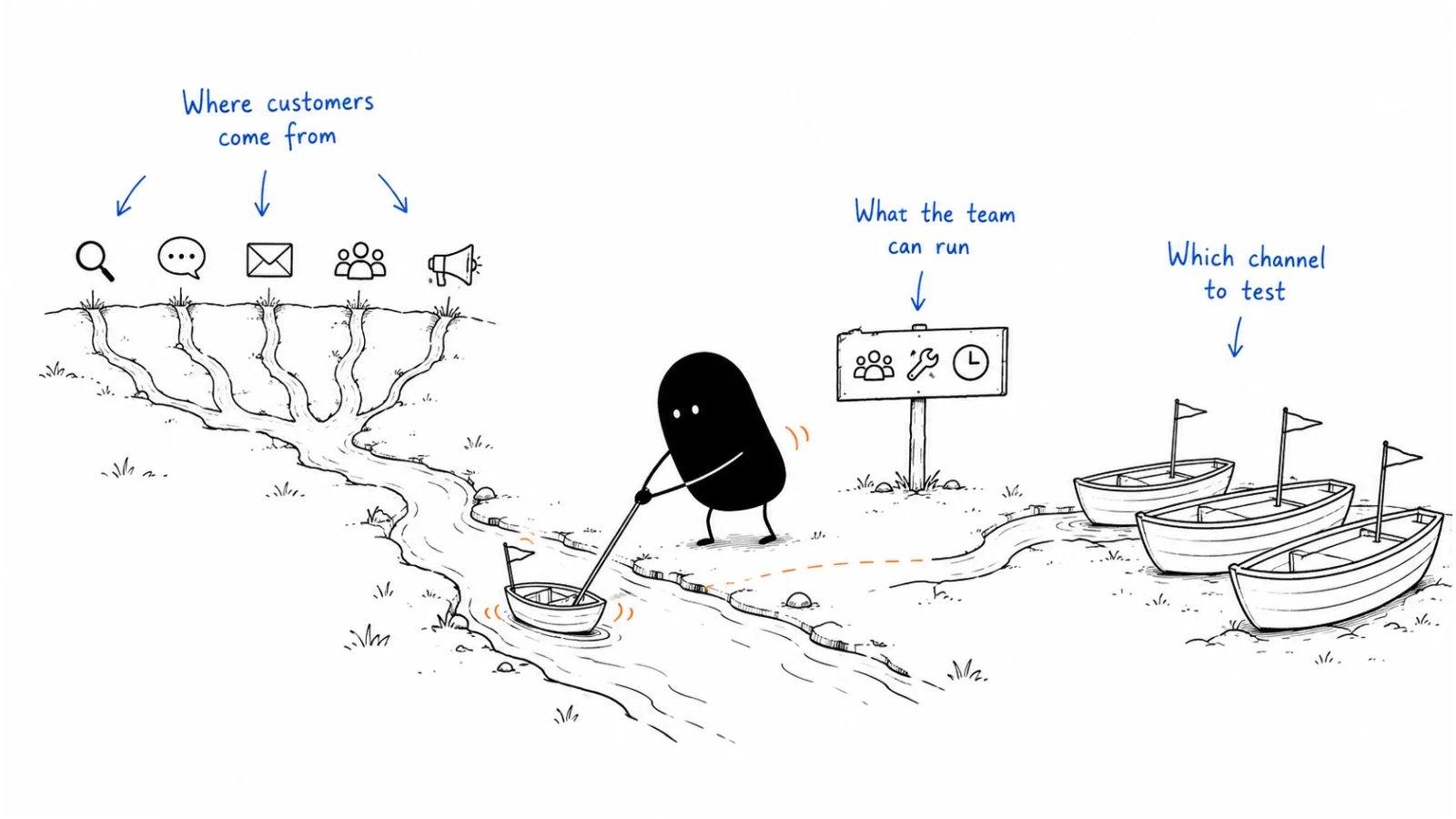 *Reading guide: where customers come from → what the team can run → which channel to test.*
## Use this when
* The team is adding channels because “that is what B2B does.”
* Founders want product-led growth as a way to avoid hiring sales.
* Content, ads, and partner logos are busy, but nobody can name the motion that actually creates customers.
* Leadership is arguing about time-to-\$1M without a first-customer date or a primary channel.
## Do not use this when
* The ICP and alternative are empty. Complete [ICP](../01-strategy-and-buyers/icp.md) and [positioning](../02-product-marketing/positioning.md) first.
* Nobody loves the product enough to keep using it. Climb the [PMF ladder](../01-strategy-and-buyers/product-market-fit.md) before scaling a motion.
* You do not yet have \~10 ICP-matching companies. Walk [first ten customers](../01-strategy-and-buyers/first-ten-customers.md) first—those tactics are handmade on purpose.
* There is no working product a buyer can try or buy. Channel mix will not create pull.
* The request is a seven-channel GTM deck for a board meeting.
## How to do it
### Step 1: Start with how customers already arrive
Pick **one** primary. Use what is already happening, not the motion that sounds modern.
| Primary motion | New customers arrive when | Sales role | Use it when |
| ------------------------ | --------------------------------------------------------------------------------------------------------------- | ----------------------------------------------------------------------------------- | ------------------------------------------------------------------ |
| **Self-serve inbound** | Someone hears about the product (or is invited) and completes signup and activation with no human in the funnel | Optional later (product-led sales). The first dollar usually comes from the product | A new user can reach value without handholding |
| **Sales-assist inbound** | Demand arrives (referral, site, word of mouth) and a seller walks the buyer through evaluation | Required to activate and close | Users cannot get to value alone; “Request a demo” is the real door |
| **Outbound sales** | The team creates the conversation | Required from the first serious account | The buyer will not raise a hand; seats and triggers are findable |
If organic inbound is absent, do not paper over it with ads.
Name the motion from the last ten to twenty wins, not from a slide titled “we are PLG.” A CRM default of “inbound” that was actually a founder intro is not evidence.
Named illustrations from that 2023 interview set (how *they* arrived, not a menu to copy):
* **Self-serve inbound** is a product fact: a new user can reach value without a human. **Figma** is the usual shorthand for “open it and work.” If your buyer cannot do that, you do not have this motion yet.
* **Sales-assist inbound:** demand shows up; a seller still walks evaluation. **Databricks** tried a more zero-touch console path and watched revenue flatten until sales was back in the motion.
* **Outbound:** the team creates the conversation because the buyer will not raise a hand. Do not borrow another company’s later mix until your last 20 wins name *your* primary.
### Step 2: Check whether self-service fits your product
Self-serve is a product and activation fact, not a values statement. If a new user cannot swipe a card and get value quickly, turning off sales to “be PLG” can stall revenue. The Databricks episode above is that failure mode. Enterprise deals that need a champion, security review, and a committee are sales-assist or outbound until proven otherwise.
Expect to build a sales team eventually. The question is when, not whether.
### Step 3: Identify the team's existing advantages
A secondary channel is how you **accelerate something that is already true**, not a menu item you add because a famous company used it. Write one to three advantages you actually have. Typical shapes: **product** (virality, a free plan that unlocks value, a wedge you will reuse), **ecosystem** (integrations, channel partners, a regulation or trend that creates urgency), **brand-story** (a founder who already has the room, a category you can own, an underserved community). If you cannot name one, do not invent a partner program or a category-creation campaign to look strategic.
Do not treat the list as a checklist. One real advantage beats nine borrowed ones.
### Step 4: Keep one main channel and test one more
After the primary motion is named, treat everything else as a **growth-engine menu**, not a department org chart. The six engines are inbound, outbound, product virality, events, ecosystem, and lifecycle. Lifecycle is owned by [lifecycle](../08-lifecycle-and-customer-marketing/); do not stand it up here as a seventh “channel.” Product virality is a product fact—if you do not have it, you do not have that engine.
Pick **one** secondary this quarter that accelerates a named advantage. Give it a **status** so the metric matches the job:
| Status | Meaning |
| --------------- | ------------------------------------------------------------ |
| **Up next** | Written, not started |
| **Testing** | Capped 90-day test; inefficient on purpose |
| **Scaling** | Worked in test; now the question is diminishing returns |
| **Core** | Already creating most of the growth from this engine |
| **Big bet** | Could change the trajectory; staffed like it |
| **Not working** | Tried; hypothesis written so we do not “never again” forever |
Treat the remaining tactics as a menu, not a checklist:
| Secondary | Engine | What it is | Open this playbook |
| ------------------------- | -------------------------- | --------------------------------------------------------------------- | ------------------------------------------------------------------------------------------------------------------------------------------------------------------------------- |
| Content / SEO | Inbound | Durable pages and search demand | [Content strategy](../03-brand-story-and-content/content-strategy.md); [SEO and AEO](https://b2-b-playbook.mintlify.app/playbooks/04-channels-and-distribution/seo-and-aeo) |
| LinkedIn organic | Inbound | Memory in a professional feed—people, not the logo | [LinkedIn organic](https://b2-b-playbook.mintlify.app/playbooks/04-channels-and-distribution/linkedin-organic) |
| Peer rooms | Ecosystem | A credible intro in a community the buyer already chose | [Peer community](https://b2-b-playbook.mintlify.app/playbooks/04-channels-and-distribution/community) |
| Creator / operator media | Ecosystem | Co-created artifact with overlap, not a rented mention | [Creator partnership](https://b2-b-playbook.mintlify.app/playbooks/04-channels-and-distribution/creator-partnership) |
| Small table | Events | Role-locked dinner or roundtable | [Executive dinners](../06-account-field-and-partner/executive-dinners.md) |
| Launch day | Inbound (one day) | Product Hunt as a one-day amplifier | [Product Hunt](https://b2-b-playbook.mintlify.app/playbooks/04-channels-and-distribution/product-hunt)—not a standing channel |
| Syndication | Inbound (rented) | Rented fills that survive audience, verification, and post-fill gates | [Content syndication](https://b2-b-playbook.mintlify.app/playbooks/04-channels-and-distribution/content-syndication) |
| Paid ads | Inbound capture / creation | Capture or test on Google, LinkedIn, and a few high-trust placements | [Paid media](https://b2-b-playbook.mintlify.app/playbooks/04-channels-and-distribution/paid-media)—one job, two scoreboards. Do not start here if the primary motion is unnamed |
| Partnerships | Ecosystem | Access through companies and people who already have trust | [Ecosystem](../06-account-field-and-partner/ecosystem.md) |
| Outbound (if not primary) | Outbound | Created conversations | [Outbound](../05-outbound-and-prospecting/) |
A useful rule: you are probably already living in one of the three primaries. Ask which **one** remaining engine is a real opportunity—then give it an owner, a status, a 90-day test, and a stop rule. Content that cannot scale beyond heroic founder posts is a turbo boost, not an engine.
### Step 5: Match the website to the buying process
* Self-serve: signup, activation, and a credit-card or equivalent path. The scan still starts on the [homepage](../07-website-and-conversion/homepage.md).
* Sales-assist: a decision-specific demo or conversation request, with the assisted process explained clearly to the visitor.
* Outbound: the site still has to pass the [homepage 10-second test](../02-product-marketing/positioning.md); it is not the acquisition engine.
### Step 6: Account for the time it takes to earn revenue
In one interview set of later-successful B2B companies, median time from founding to about \$1M ARR was roughly two years, and about **1.5 years after the first customer**. Some were faster; some delayed monetization on purpose (for example to become a default tool inside companies). Large ACV and small ACV did not produce a clean split in that sample.
Use the 1.5-year-after-first-customer line as a **worry trigger** if you want to compare yourself to that survivor set. It is not a promise, a fundraise requirement, or your OKR. Validate against your own first-customer date and ACV. Pricing timing is in [pricing and packaging](../02-product-marketing/pricing-and-packaging.md).
## Copyable templates
### How a filled motion one-pager reads
Illustrative example: last 20 wins were demos booked from inbound and referrals; nobody activated alone. Primary = **sales-assist inbound**. Advantage = founder already has the ops-lead room (brand-story), not a partner motion we wish we had. Secondary this quarter = one [content](../03-brand-story-and-content/content-strategy.md) comparison page (inbound engine, **testing**), not ads. Site door = request a scoped conversation. Stop rule for content: if sales has not pasted the URL into an evaluation thread in 90 days, pause publishing.
Copy:
### Motion one-pager
* Primary motion (exactly one): self-serve inbound / sales-assist inbound / outbound
* Evidence from the last 20 wins (how they actually arrived):
* Can a new user activate without a human? yes / no / unknown (test: \_\_\_\_)
* Marketing advantages we will accelerate (1–3):
* Secondary channel we will explore this quarter (exactly one or none):
* Engine it belongs to (inbound / outbound / virality / events / ecosystem):
* Status (up next / testing / scaling / core / big bet):
* Why not the other secondaries:
* Owner of the primary:
* Owner of the secondary test:
* Stop rule for the secondary:
* Site door that matches the primary:
### 90-day secondary-channel test
1. Hypothesis: \[channel] will create \[qualified conversations / self-serve starts] for \[ICP] because \[evidence].
2. Budget and hours we will not steal from the primary:
3. Leading indicator (week 4):
4. Business test (day 90):
5. Decision: keep as engine / keep as turbo / stop.
## Before you start
* [ ] Exactly one primary motion is written.
* [ ] The last 10–20 customers’ true source is listed (not the CRM default).
* [ ] Self-serve is claimed only if activation without a human has been watched, not hoped.
* [ ] Sales is not being removed to make a PLG story true.
* [ ] One to three marketing advantages are named; secondaries that do not accelerate one are deferred.
* [ ] At most one new secondary channel has an owner, a status, and a stop rule.
* [ ] Content, ads, and partners are not substituting for a missing primary.
* [ ] The website CTA matches the motion.
* [ ] Time-to-\$1M talk uses your first-customer date; borrowed medians are labeled survivor observations.
## Metrics
| Metric | Diagnostic use |
| ------------------------ | ------------------------------------------------------------------------------------- |
| Primary-motion share | New qualified customers (or ARR) from the named primary / all new qualified customers |
| Source truth | Wins whose first-touch story matches CRM / sampled wins |
| Activation without human | New users reaching the defined value event with no seller assist / self-serve starts |
| Secondary test yield | Qualified conversations from the one secondary / hours and cash spent |
| Sales presence | Whether a seller is in the path by design, not by accident |
Do not count channel count, campaign volume, or “we are now PLG” as outcomes. Do not import another company’s years-to-\$1M as your target.
## Common mistakes
* Running all six channels because a famous company used each of them at some point.
* Declaring PLG while every activation still needs a demo.
* Turning off sales because a cloud-console story sounded efficient.
* Treating word of mouth as a budget line instead of a fit diagnosis.
* Starting paid ads before the primary motion and offer are named.
* Picking a secondary before naming an advantage it would accelerate.
* Judging a **testing** channel on **core** efficiency.
* Launching partnerships as a time sink with no [win-win-win](../06-account-field-and-partner/ecosystem.md).
* Publishing a content calendar instead of a [decision-page map](../03-brand-story-and-content/content-strategy.md).
## What to read next
If market, product, channel, and model do not describe the same company, stop here and write [four fits](../01-strategy-and-buyers/four-fits.md). If you still need the first ten names, that work is [first ten customers](../01-strategy-and-buyers/first-ten-customers.md), not a channel mix. If the primary is outbound, start with [account research](../05-outbound-and-prospecting/account-research.md). If you are hiring people to run that motion, [SDR onboarding](../05-outbound-and-prospecting/sdr-onboarding.md) is the curriculum, not a sequence export. If it is sales-assist inbound, you need pages a champion can forward—[content strategy](../03-brand-story-and-content/content-strategy.md)—and a [pitch](../02-product-marketing/sales-enablement.md). How those pages (and citations) get found is [SEO and AEO](https://b2-b-playbook.mintlify.app/playbooks/04-channels-and-distribution/seo-and-aeo). If strangers already trust someone else, that is [ecosystem](../06-account-field-and-partner/ecosystem.md) or a [peer room](https://b2-b-playbook.mintlify.app/playbooks/04-channels-and-distribution/community), added as **one** secondary, not as a seventh channel. At high ACV, contribute in the room or [co-create](https://b2-b-playbook.mintlify.app/playbooks/04-channels-and-distribution/creator-partnership) before you buy [syndication](https://b2-b-playbook.mintlify.app/playbooks/04-channels-and-distribution/content-syndication) or ads. Product Hunt is a [one-day amplifier](https://b2-b-playbook.mintlify.app/playbooks/04-channels-and-distribution/product-hunt), not a motion. If the motion is a few named accounts, write [ABM strategy](../06-account-field-and-partner/abm-strategy.md) (capacity and tiers) and then [account planning](../06-account-field-and-partner/account-planning.md) before a campaign calendar. The first audience-plus-use-case the engine should serve is [wedge](../01-strategy-and-buyers/wedge.md). Pricing and packaging still decide whether the motion can collect money: [pricing](../02-product-marketing/pricing-and-packaging.md). If the primary needs quota-carrying sellers, they need a plan they can explain: [sales compensation](../09-operations-pipeline-and-measurement/sales-compensation.md). Whether the quarter’s number is real is [forecasting](../09-operations-pipeline-and-measurement/forecasting.md).
## Sources and evidence boundary
This is an owner-maintained operating synthesis. Channel mix is not a forecast.
The three-primary-motion frame, the six-channel menu, the “optimize the primary / add one” rule, the expectation that B2B firms eventually hire sales, the caution against forced product-led growth, and the \~2 year / \~1.5-year-after-first-customer pacing notes draw on Lenny Rachitsky’s interviews with later-successful B2B companies ([Lenny’s Newsletter, 2023-10-24](https://www.lennysnewsletter.com/p/scaling-your-b2b-growth-engine?ref=b2b-playbook)). That set is a survivor sample. Named companies in the source illustrate motions; they are not audited case studies here. Revenue expansion was out of scope in that piece.
Marketing advantages (name 1–3 real ones in product / ecosystem / brand-story before you pick a channel) draw on Emily Kramer ([MKT1, 2023-02-27](https://newsletter.mkt1.co/p/find-and-accelerate-your-marketing?ref=b2b-playbook)). The six-engine menu (inbound, outbound, product virality, events, ecosystem, lifecycle) and the test / scale / core / big-bet / not-working statuses draw on Kramer’s channel guidance ([MKT1, 2023-11-16](https://newsletter.mkt1.co/p/marketing-channels?ref=b2b-playbook)). Those essays are **method prompts**. The paid tactic charts, generator apps, and template packs behind the paywall are not reproduced here. Do not treat another company’s advantage list as yours.
***
Copyright © 2026 Ivan Xu. All rights reserved. See the [copyright and reuse terms](https://github.com/weilun88313/B2B-Playbook/blob/main/LICENSE).
Canonical source: [github.com/weilun88313/B2B-Playbook](https://github.com/weilun88313/B2B-Playbook)
*Reading guide: where customers come from → what the team can run → which channel to test.*
## Use this when
* The team is adding channels because “that is what B2B does.”
* Founders want product-led growth as a way to avoid hiring sales.
* Content, ads, and partner logos are busy, but nobody can name the motion that actually creates customers.
* Leadership is arguing about time-to-\$1M without a first-customer date or a primary channel.
## Do not use this when
* The ICP and alternative are empty. Complete [ICP](../01-strategy-and-buyers/icp.md) and [positioning](../02-product-marketing/positioning.md) first.
* Nobody loves the product enough to keep using it. Climb the [PMF ladder](../01-strategy-and-buyers/product-market-fit.md) before scaling a motion.
* You do not yet have \~10 ICP-matching companies. Walk [first ten customers](../01-strategy-and-buyers/first-ten-customers.md) first—those tactics are handmade on purpose.
* There is no working product a buyer can try or buy. Channel mix will not create pull.
* The request is a seven-channel GTM deck for a board meeting.
## How to do it
### Step 1: Start with how customers already arrive
Pick **one** primary. Use what is already happening, not the motion that sounds modern.
| Primary motion | New customers arrive when | Sales role | Use it when |
| ------------------------ | --------------------------------------------------------------------------------------------------------------- | ----------------------------------------------------------------------------------- | ------------------------------------------------------------------ |
| **Self-serve inbound** | Someone hears about the product (or is invited) and completes signup and activation with no human in the funnel | Optional later (product-led sales). The first dollar usually comes from the product | A new user can reach value without handholding |
| **Sales-assist inbound** | Demand arrives (referral, site, word of mouth) and a seller walks the buyer through evaluation | Required to activate and close | Users cannot get to value alone; “Request a demo” is the real door |
| **Outbound sales** | The team creates the conversation | Required from the first serious account | The buyer will not raise a hand; seats and triggers are findable |
If organic inbound is absent, do not paper over it with ads.
Name the motion from the last ten to twenty wins, not from a slide titled “we are PLG.” A CRM default of “inbound” that was actually a founder intro is not evidence.
Named illustrations from that 2023 interview set (how *they* arrived, not a menu to copy):
* **Self-serve inbound** is a product fact: a new user can reach value without a human. **Figma** is the usual shorthand for “open it and work.” If your buyer cannot do that, you do not have this motion yet.
* **Sales-assist inbound:** demand shows up; a seller still walks evaluation. **Databricks** tried a more zero-touch console path and watched revenue flatten until sales was back in the motion.
* **Outbound:** the team creates the conversation because the buyer will not raise a hand. Do not borrow another company’s later mix until your last 20 wins name *your* primary.
### Step 2: Check whether self-service fits your product
Self-serve is a product and activation fact, not a values statement. If a new user cannot swipe a card and get value quickly, turning off sales to “be PLG” can stall revenue. The Databricks episode above is that failure mode. Enterprise deals that need a champion, security review, and a committee are sales-assist or outbound until proven otherwise.
Expect to build a sales team eventually. The question is when, not whether.
### Step 3: Identify the team's existing advantages
A secondary channel is how you **accelerate something that is already true**, not a menu item you add because a famous company used it. Write one to three advantages you actually have. Typical shapes: **product** (virality, a free plan that unlocks value, a wedge you will reuse), **ecosystem** (integrations, channel partners, a regulation or trend that creates urgency), **brand-story** (a founder who already has the room, a category you can own, an underserved community). If you cannot name one, do not invent a partner program or a category-creation campaign to look strategic.
Do not treat the list as a checklist. One real advantage beats nine borrowed ones.
### Step 4: Keep one main channel and test one more
After the primary motion is named, treat everything else as a **growth-engine menu**, not a department org chart. The six engines are inbound, outbound, product virality, events, ecosystem, and lifecycle. Lifecycle is owned by [lifecycle](../08-lifecycle-and-customer-marketing/); do not stand it up here as a seventh “channel.” Product virality is a product fact—if you do not have it, you do not have that engine.
Pick **one** secondary this quarter that accelerates a named advantage. Give it a **status** so the metric matches the job:
| Status | Meaning |
| --------------- | ------------------------------------------------------------ |
| **Up next** | Written, not started |
| **Testing** | Capped 90-day test; inefficient on purpose |
| **Scaling** | Worked in test; now the question is diminishing returns |
| **Core** | Already creating most of the growth from this engine |
| **Big bet** | Could change the trajectory; staffed like it |
| **Not working** | Tried; hypothesis written so we do not “never again” forever |
Treat the remaining tactics as a menu, not a checklist:
| Secondary | Engine | What it is | Open this playbook |
| ------------------------- | -------------------------- | --------------------------------------------------------------------- | ------------------------------------------------------------------------------------------------------------------------------------------------------------------------------- |
| Content / SEO | Inbound | Durable pages and search demand | [Content strategy](../03-brand-story-and-content/content-strategy.md); [SEO and AEO](https://b2-b-playbook.mintlify.app/playbooks/04-channels-and-distribution/seo-and-aeo) |
| LinkedIn organic | Inbound | Memory in a professional feed—people, not the logo | [LinkedIn organic](https://b2-b-playbook.mintlify.app/playbooks/04-channels-and-distribution/linkedin-organic) |
| Peer rooms | Ecosystem | A credible intro in a community the buyer already chose | [Peer community](https://b2-b-playbook.mintlify.app/playbooks/04-channels-and-distribution/community) |
| Creator / operator media | Ecosystem | Co-created artifact with overlap, not a rented mention | [Creator partnership](https://b2-b-playbook.mintlify.app/playbooks/04-channels-and-distribution/creator-partnership) |
| Small table | Events | Role-locked dinner or roundtable | [Executive dinners](../06-account-field-and-partner/executive-dinners.md) |
| Launch day | Inbound (one day) | Product Hunt as a one-day amplifier | [Product Hunt](https://b2-b-playbook.mintlify.app/playbooks/04-channels-and-distribution/product-hunt)—not a standing channel |
| Syndication | Inbound (rented) | Rented fills that survive audience, verification, and post-fill gates | [Content syndication](https://b2-b-playbook.mintlify.app/playbooks/04-channels-and-distribution/content-syndication) |
| Paid ads | Inbound capture / creation | Capture or test on Google, LinkedIn, and a few high-trust placements | [Paid media](https://b2-b-playbook.mintlify.app/playbooks/04-channels-and-distribution/paid-media)—one job, two scoreboards. Do not start here if the primary motion is unnamed |
| Partnerships | Ecosystem | Access through companies and people who already have trust | [Ecosystem](../06-account-field-and-partner/ecosystem.md) |
| Outbound (if not primary) | Outbound | Created conversations | [Outbound](../05-outbound-and-prospecting/) |
A useful rule: you are probably already living in one of the three primaries. Ask which **one** remaining engine is a real opportunity—then give it an owner, a status, a 90-day test, and a stop rule. Content that cannot scale beyond heroic founder posts is a turbo boost, not an engine.
### Step 5: Match the website to the buying process
* Self-serve: signup, activation, and a credit-card or equivalent path. The scan still starts on the [homepage](../07-website-and-conversion/homepage.md).
* Sales-assist: a decision-specific demo or conversation request, with the assisted process explained clearly to the visitor.
* Outbound: the site still has to pass the [homepage 10-second test](../02-product-marketing/positioning.md); it is not the acquisition engine.
### Step 6: Account for the time it takes to earn revenue
In one interview set of later-successful B2B companies, median time from founding to about \$1M ARR was roughly two years, and about **1.5 years after the first customer**. Some were faster; some delayed monetization on purpose (for example to become a default tool inside companies). Large ACV and small ACV did not produce a clean split in that sample.
Use the 1.5-year-after-first-customer line as a **worry trigger** if you want to compare yourself to that survivor set. It is not a promise, a fundraise requirement, or your OKR. Validate against your own first-customer date and ACV. Pricing timing is in [pricing and packaging](../02-product-marketing/pricing-and-packaging.md).
## Copyable templates
### How a filled motion one-pager reads
Illustrative example: last 20 wins were demos booked from inbound and referrals; nobody activated alone. Primary = **sales-assist inbound**. Advantage = founder already has the ops-lead room (brand-story), not a partner motion we wish we had. Secondary this quarter = one [content](../03-brand-story-and-content/content-strategy.md) comparison page (inbound engine, **testing**), not ads. Site door = request a scoped conversation. Stop rule for content: if sales has not pasted the URL into an evaluation thread in 90 days, pause publishing.
Copy:
### Motion one-pager
* Primary motion (exactly one): self-serve inbound / sales-assist inbound / outbound
* Evidence from the last 20 wins (how they actually arrived):
* Can a new user activate without a human? yes / no / unknown (test: \_\_\_\_)
* Marketing advantages we will accelerate (1–3):
* Secondary channel we will explore this quarter (exactly one or none):
* Engine it belongs to (inbound / outbound / virality / events / ecosystem):
* Status (up next / testing / scaling / core / big bet):
* Why not the other secondaries:
* Owner of the primary:
* Owner of the secondary test:
* Stop rule for the secondary:
* Site door that matches the primary:
### 90-day secondary-channel test
1. Hypothesis: \[channel] will create \[qualified conversations / self-serve starts] for \[ICP] because \[evidence].
2. Budget and hours we will not steal from the primary:
3. Leading indicator (week 4):
4. Business test (day 90):
5. Decision: keep as engine / keep as turbo / stop.
## Before you start
* [ ] Exactly one primary motion is written.
* [ ] The last 10–20 customers’ true source is listed (not the CRM default).
* [ ] Self-serve is claimed only if activation without a human has been watched, not hoped.
* [ ] Sales is not being removed to make a PLG story true.
* [ ] One to three marketing advantages are named; secondaries that do not accelerate one are deferred.
* [ ] At most one new secondary channel has an owner, a status, and a stop rule.
* [ ] Content, ads, and partners are not substituting for a missing primary.
* [ ] The website CTA matches the motion.
* [ ] Time-to-\$1M talk uses your first-customer date; borrowed medians are labeled survivor observations.
## Metrics
| Metric | Diagnostic use |
| ------------------------ | ------------------------------------------------------------------------------------- |
| Primary-motion share | New qualified customers (or ARR) from the named primary / all new qualified customers |
| Source truth | Wins whose first-touch story matches CRM / sampled wins |
| Activation without human | New users reaching the defined value event with no seller assist / self-serve starts |
| Secondary test yield | Qualified conversations from the one secondary / hours and cash spent |
| Sales presence | Whether a seller is in the path by design, not by accident |
Do not count channel count, campaign volume, or “we are now PLG” as outcomes. Do not import another company’s years-to-\$1M as your target.
## Common mistakes
* Running all six channels because a famous company used each of them at some point.
* Declaring PLG while every activation still needs a demo.
* Turning off sales because a cloud-console story sounded efficient.
* Treating word of mouth as a budget line instead of a fit diagnosis.
* Starting paid ads before the primary motion and offer are named.
* Picking a secondary before naming an advantage it would accelerate.
* Judging a **testing** channel on **core** efficiency.
* Launching partnerships as a time sink with no [win-win-win](../06-account-field-and-partner/ecosystem.md).
* Publishing a content calendar instead of a [decision-page map](../03-brand-story-and-content/content-strategy.md).
## What to read next
If market, product, channel, and model do not describe the same company, stop here and write [four fits](../01-strategy-and-buyers/four-fits.md). If you still need the first ten names, that work is [first ten customers](../01-strategy-and-buyers/first-ten-customers.md), not a channel mix. If the primary is outbound, start with [account research](../05-outbound-and-prospecting/account-research.md). If you are hiring people to run that motion, [SDR onboarding](../05-outbound-and-prospecting/sdr-onboarding.md) is the curriculum, not a sequence export. If it is sales-assist inbound, you need pages a champion can forward—[content strategy](../03-brand-story-and-content/content-strategy.md)—and a [pitch](../02-product-marketing/sales-enablement.md). How those pages (and citations) get found is [SEO and AEO](https://b2-b-playbook.mintlify.app/playbooks/04-channels-and-distribution/seo-and-aeo). If strangers already trust someone else, that is [ecosystem](../06-account-field-and-partner/ecosystem.md) or a [peer room](https://b2-b-playbook.mintlify.app/playbooks/04-channels-and-distribution/community), added as **one** secondary, not as a seventh channel. At high ACV, contribute in the room or [co-create](https://b2-b-playbook.mintlify.app/playbooks/04-channels-and-distribution/creator-partnership) before you buy [syndication](https://b2-b-playbook.mintlify.app/playbooks/04-channels-and-distribution/content-syndication) or ads. Product Hunt is a [one-day amplifier](https://b2-b-playbook.mintlify.app/playbooks/04-channels-and-distribution/product-hunt), not a motion. If the motion is a few named accounts, write [ABM strategy](../06-account-field-and-partner/abm-strategy.md) (capacity and tiers) and then [account planning](../06-account-field-and-partner/account-planning.md) before a campaign calendar. The first audience-plus-use-case the engine should serve is [wedge](../01-strategy-and-buyers/wedge.md). Pricing and packaging still decide whether the motion can collect money: [pricing](../02-product-marketing/pricing-and-packaging.md). If the primary needs quota-carrying sellers, they need a plan they can explain: [sales compensation](../09-operations-pipeline-and-measurement/sales-compensation.md). Whether the quarter’s number is real is [forecasting](../09-operations-pipeline-and-measurement/forecasting.md).
## Sources and evidence boundary
This is an owner-maintained operating synthesis. Channel mix is not a forecast.
The three-primary-motion frame, the six-channel menu, the “optimize the primary / add one” rule, the expectation that B2B firms eventually hire sales, the caution against forced product-led growth, and the \~2 year / \~1.5-year-after-first-customer pacing notes draw on Lenny Rachitsky’s interviews with later-successful B2B companies ([Lenny’s Newsletter, 2023-10-24](https://www.lennysnewsletter.com/p/scaling-your-b2b-growth-engine?ref=b2b-playbook)). That set is a survivor sample. Named companies in the source illustrate motions; they are not audited case studies here. Revenue expansion was out of scope in that piece.
Marketing advantages (name 1–3 real ones in product / ecosystem / brand-story before you pick a channel) draw on Emily Kramer ([MKT1, 2023-02-27](https://newsletter.mkt1.co/p/find-and-accelerate-your-marketing?ref=b2b-playbook)). The six-engine menu (inbound, outbound, product virality, events, ecosystem, lifecycle) and the test / scale / core / big-bet / not-working statuses draw on Kramer’s channel guidance ([MKT1, 2023-11-16](https://newsletter.mkt1.co/p/marketing-channels?ref=b2b-playbook)). Those essays are **method prompts**. The paid tactic charts, generator apps, and template packs behind the paywall are not reproduced here. Do not treat another company’s advantage list as yours.
***
Copyright © 2026 Ivan Xu. All rights reserved. See the [copyright and reuse terms](https://github.com/weilun88313/B2B-Playbook/blob/main/LICENSE).
Canonical source: [github.com/weilun88313/B2B-Playbook](https://github.com/weilun88313/B2B-Playbook)